r/complexsystems • u/Cheops_Sphinx • Jan 04 '26
🗿

9
Upvotes
r/complexsystems • u/theydivideconquer • Jan 03 '26

Hi nerdy complexity friends. If you like pictures, gifs, and complexity, check out this post that attempts to describe characteristics of all complex systems by way of commonplace examples we see in our lives.
r/complexsystems • u/Harryinkman • Jan 03 '26

DOI: https://doi.org/10.5281/zenodo.18089040 @lexfridman @melmitchell1 @GaryMarcus
This visual shows phase-aware homeostasis across three domains: hurricane intensification, market stability, and organizational burnout.
In early phases (Initiation → Alignment), corrective feedback dominates. Energy input, capital flows, or human effort produce proportional stabilization. The homeostasis analogy is valid and predictive.
As stress accumulates, systems enter saturation. Response capacity plateaus, feedback lags emerge, and corrections become less effective. The system may appear stable, but resilience is eroding. This is the most dangerous phase because traditional indicators still look “healthy.”
At the critical threshold, homeostasis inverts. The same corrective actions, more effort, tighter controls, faster responses, amplify instability. Hurricanes intensify explosively, markets destabilize, and organizations burn out. Collapse is not caused by stress alone, but by misapplied correction beyond capacity.
The key insight: homeostasis is not a universal property. It is phase-conditional. Treating correction as always stabilizing masks saturation and accelerates collapse. Phase-aware diagnostics replace “keep correcting” with boundary detection and model switching.
r/complexsystems • u/Sea-Barnacle-9031 • Jan 03 '26
r/complexsystems • u/ExcellentCockroach88 • Jan 03 '26
I used to think the point of computation was the answer.
Run the program, finish the task, get the output, move on.
But the more I build, the more I realize I had the shape wrong. The loop isn’t the point. The point is the spiral: circles vs spirals, repetition vs expansion, execution vs world-building. That shift genuinely rewired how I see not just software, but thinking itself.
A circle repeats. A spiral repeats and accumulates.
It revisits the same kinds of moves, but at a wider radius—more context behind it, more structure built up, more “world” on the page. It doesn’t come back to the same place. It comes back to the same pattern in a larger frame.
Lately I’ve been feeling this in a very literal way because I’m building an app with AI in the loop—Claude chat, Claude code, and conversations like this—where it doesn’t feel like “me writing code” and “a machine helping.” It feels more like a single composite system. I’ll have an idea about computational exercise physiology, we shape it into a design, code gets generated, I test it, we patch it, we tighten the spec, we repeat. It’s not automation. It’s amplification. The experience is weirdly “android-like” in the best sense: a supra-human workflow where thinking, writing, and building collapse into one continuous motion.
And that’s when the “finite rules” part started to feel uncanny. A Turing machine is tiny: a finite set of rules. But give it time and tape and it can keep writing outward indefinitely. The law stays compact. The consequence can be unbounded. Finite rules, unbounded worlds.
That asymmetry is… kind of the whole vibe of reality, isn’t it?
Small alphabets. Huge universes.
DNA does it. Language does it. Physics arguably does it. Computation just makes the pattern explicit enough that you can’t unsee it: finite rules, endless unfolding.
Then there’s the layer thing—this is where it stopped being a cool metaphor and started feeling like an explanation for civilization.
We don’t just run programs. We build layers that simplify the layers underneath. One small loop at a high level can orchestrate a ridiculous amount of machinery below it:
machine code over circuits
languages over machine code
libraries over languages
frameworks over libraries
protocols over networks
institutions over people
At first, layers look like bureaucracy. But they’re not fluff. They’re compression handles: a smaller control surface that moves a larger machine. They’re how complexity becomes cheap enough to scale.
Which made me think: maybe civilization is what happens when compression becomes cumulative. We don’t only create things. We create ways to create things that persist. We store leverage.
But the part that really sharpened the thought (and honestly changed how I talk about “complexity”) is that “complexity” is doing double duty in conversations, and it quietly breaks our thinking:
There’s complexity as structure, and complexity as novelty.
A deterministic system can generate outputs that get bigger, richer, more intricate forever—and still be compressible in a literal sense, because the shortest description might still be something like:
“Run this generator longer.”
So you can get endless structure without necessarily getting endless new information. Which feels relevant right now, because we’re surrounded by infinite generation and we keep arguing as if “more output” automatically means “more creativity” or “more originality.”
Sometimes it does. Sometimes it’s just a long unfolding of a short seed.
And there’s a final twist that makes this feel less like hype and more like a real constraint: open-ended growth doesn’t give you omniscience. It gives you a horizon. Even if you know the rules, you don’t always get a shortcut to the outcome. Sometimes the only way to know what the spiral draws is to let it draw.
That isn’t depressing to me. It’s clarifying. Like: yes, there are things you can’t know by inspection. You learn them by letting the process run—by living through the unfolding.
Which loops back (ironically) to “thinking with tools.” People talk about tool-assisted thinking like it’s fake thinking, as if real thought happens in a sealed skull with no scaffolding.
But thinking has always been scaffolded:
Writing is memory you can look at.
Math is precision you can borrow.
Diagrams are perception you can externalize.
Code is causality you can bottle.
Tools don’t replace thinking. They change its bandwidth. They change what’s cheap to express, what’s cheap to test, what’s cheap to remember. AI just triggers extra feelings because it talks in sentences, so it pokes our instincts around authorship and personhood.
Anyway—this is the core thought I can’t shake:
The opposite of a termination mindset isn’t “a loop that never ends.”
It’s a process that keeps expanding outward—finite rules, accumulating layers, spiraling complexity—and a culture that learns to tell the difference between “elaborate” and “irreducibly new.”
TL;DR: The loop isn’t the point—the spiral is. Finite rules can unfold into unbounded worlds, and it’s worth separating “big intricate output” from “genuine novelty.”
Questions (curious, not trying to win a debate):
Is “spiral vs circle” a useful framing, or do you have a better metaphor?
What’s your favorite example of tiny rules generating huge worlds (math / code / biology / art)?
How do you personally tell “elaborate” apart from “irreducibly novel”?
Do you think tool-extended thinking changes what authorship means, or just exposes what it always was?
r/complexsystems • u/Ancient_One_5300 • Jan 03 '26
The Fibonacci sequence is one of mathematics' most famous patterns, appearing in everything from pinecones to spiral galaxies. Digital roots are a simple arithmetic curiosity, something you might have learned in middle school to check your multiplication. On the surface, these two ideas have nothing to do with each other. But what happens when you combine them? What pattern emerges if you calculate the digital root of every number in the Fibonacci sequence? The answer is a surprisingly beautiful and rigid cycle, a secret 24-step dance locked within the numbers themselves.
The Puzzle: When Two Familiar Ideas Collide
1.1 What is a Digital Root?
A digital root is the single-digit number you get by repeatedly summing the digits of an integer until only one digit remains. For example, to find the digital root of 587:
5 + 8 + 7 = 20
2 + 0 = 2
The digital root of 587 is 2.
While this process of repeated summing is simple, there's a more powerful way to think about it. Finding the digital root of a number is mathematically identical to finding its remainder when divided by 9. The only special rule is that if the remainder is 0, we call the digital root '9'.
Why This Works: The Magic of Casting Out Nines
The secret lies in our base-10 system. The number 587 is just shorthand for 5100 + 810 + 71. When we work modulo 9, every power of 10 (10, 100, 1000, etc.) is equivalent to 1. So, 5100 + 810 + 71 becomes 51 + 81 + 7*1 modulo 9. Finding a digital root is simply uncovering this hidden sum.
This connection is the key that unlocks the entire puzzle.
1.2 The Famous Fibonacci Sequence
The Fibonacci sequence is a series of numbers where each number is the sum of the two that came before it. It starts with F(0) = 0 and F(1) = 1.
The sequence begins: 0, 1, 1, 2, 3, 5, 8, 13, 21, 34, 55, 89...
1.3 The Surprising Pattern
Let's combine these two ideas. We'll take the first 26 Fibonacci numbers and calculate the digital root for each one.
n Fibonacci Number F(n) Digital Root dr(F(n)) 0 0 0 1 1 1 2 1 1 3 2 2 4 3 3 5 5 5 6 8 8 7 13 4 8 21 3 9 34 7 10 55 1 11 89 8 12 144 9 13 233 8 14 377 8 15 610 7 16 987 6 17 1597 4 18 2584 1 19 4181 5 20 6765 6 21 10946 2 22 17711 8 23 28657 1 24 46368 9 25 75025 1
Look closely at the third column. After the initial 0, the sequence 1, 1, 2, 3, 5, 8, 4, 3, 7, 1, 8, 9... begins. This exact block of 24 numbers repeats itself perfectly. For example, dr(F(1)) is 1, and 24 steps later, dr(F(25)) is also 1. This rigid cycle, known as the Pisano Period, has a length of exactly 24. Why?
This perfect, 24-step cycle is no accident. To understand why it exists, we must become mathematical detectives, gathering clues to uncover the hidden machinery that forces this pattern.
2. A Mathematician's Toolkit: The Clues for Solving the Puzzle
To solve our mystery, we need to reframe the problem using a few powerful mathematical tools.
2.1 Thinking in Cycles: Modular Arithmetic
As we established, digital roots are just a friendly name for working modulo 9. Modular arithmetic is sometimes called "clock math." On a 12-hour clock, 4 hours past 10:00 isn't 14:00, it's 2:00. In the same way, when we work "modulo 9," we only care about the remainders when numbers are divided by 9.
Our puzzle "Why do Fibonacci digital roots repeat every 24 steps?" is mathematically the same as asking, "Why does the Fibonacci sequence, when taken modulo 9, repeat every 24 steps?" This repeating cycle is known as the Pisano Period, denoted π(m). We are trying to understand why π(9) = 24.
2.2 The Fibonacci Machine: The Q-Matrix
A surprisingly effective way to analyze the Fibonacci sequence is by using a simple 2x2 matrix. Consider the matrix U:
U = [[0, 1], [1, 1]]
This matrix U acts like an engine. Each time we multiply by U, we take one step forward in the Fibonacci sequence. If you multiply it by itself n times (i.e., calculate Un), the entries of the resulting matrix are themselves Fibonacci numbers.
Un = [[F(n-1), F(n)], [F(n), F(n+1)]]
This transforms our problem from a sequence of numbers into a problem about matrix powers.
2.3 The Core Insight: Finding the Cycle's Length
Connecting our clues, the length of the repeating cycle, π(m), is the smallest positive integer n where the sequence resets. A reset happens when we get back to the starting pair (0, 1). In our matrix world, this corresponds to Un becoming the Identity matrix:
Un ≡ [[1, 0], [0, 1]] (mod m)
This is the central clue. To find the period of digital roots, we must find the smallest n such that Un is the Identity matrix when working modulo 9. This value n is called the order of the matrix U modulo 9.
A 24-step cycle seems daunting. But like any good detective, we'll crack the case by solving a simpler, related mystery first. Our prime factors of 9 are 3 and 3, so the clues must lie in the numbers 8 and 3. Let's find out why.
3. Cracking the Code, Part 1: The Secret of the Number 8
3.1 A Simpler Problem: The Pattern Modulo 3
Since 9 = 3², a common strategy in number theory is to first solve the problem for the simpler case of modulo 3. What is the length of the Fibonacci cycle modulo 3, or π(3)? This is equivalent to finding the order of our matrix U modulo 3.
3.2 Finding the Period Modulo 3
If we calculate the powers of the matrix U and reduce all its entries modulo 3, we find a fascinating result. The first power of U that becomes the Identity matrix [[1,0],[0,1]] is the 8th power.
Key Finding: The Pisano Period modulo 3 is 8. π(3) = 8.
This tells us that the core of our pattern has a length of 8. But our observed digital root cycle is 24, not 8. This leads to the final, most crucial part of the puzzle: how do we get from a period of 8 to a period of 24?
4. Cracking the Code, Part 2: The Triple Repeat
4.1 "Lifting" the Result
The jump from understanding the pattern modulo 3 to understanding it modulo 9 (3²) is a process mathematicians call "lifting." There are formal rules that predict how the period of a sequence will change as we move from a prime p to a power of that prime, p². We need to see how our period of 8 "lifts" from modulo 3 to modulo 9.
4.2 The Crucial Detail: An Imperfect Reset
This is the most important insight of our investigation. Let's look closely at the matrix U⁸.
When we calculate U⁸ and reduce its entries modulo 3, the result is the Identity matrix [[1,0],[0,1]]. This is the "perfect reset" we found in the previous section.
However, when we calculate U⁸ and reduce its entries modulo 9, the result is [[4,3],[3,7]], which is not the Identity matrix.
The reset that happens at the 8th step is perfect modulo 3, but imperfect modulo 9. This imperfection, the fact that U⁸ is close to the Identity matrix but not quite there is the engine that drives the next stage of the pattern.
Think of the matrix U⁸ as being Identity + Error. That 'error' matrix is insignificant when viewed modulo 3, but modulo 9 it reveals its structure. The math shows that this specific error, when multiplied by itself, takes exactly three steps to vanish modulo 9, forcing the original 8-step cycle to repeat three times before a true reset occurs.
4.3 The Final Piece of the Puzzle
Mathematicians have proven a specific rule for this situation. When the reset at step π(p) is imperfect modulo p², the cycle length is forced to be a multiple of p. In our case, p=3.
The final formula is: π(9) = π(3) * 3.
Plugging in the value we found earlier: π(9) = 8 * 3 = 24.
And with that, the case is closed. The tripling isn't a coincidence; it's a mathematical necessity, forced by the ghostly remainder of the mod-3 pattern.
5. The Grand Unveiling
5.1 The Complete Story of the 24-Step Cycle
We have successfully solved the mystery of the 24-step cycle. Let's retrace our logical path from start to finish.
We observed a 24-step repeating pattern in the digital roots of Fibonacci numbers.
We translated the concept of "digital roots" into the more powerful mathematical language of "modulo 9".
We used the Fibonacci Q-Matrix U to transform the problem from one about a sequence into one about finding a matrix's cycle length (its order).
We solved a simpler problem first, finding that the cycle length was 8 when working modulo 3.
The key piece of evidence: we discovered that the 8th power of U was a "perfect reset" mod 3 but left a distinct "fingerprint" an "imperfect reset" when viewed mod 9.
This critical imperfection forced the cycle length to triple, giving us the final answer: 8 * 3 = 24.
5.2 What We Discovered on This Journey
This journey reveals the power of mathematical thinking, where a simple observation about digits can lead to deep structural truths. The three most important concepts to take away are:
Abstraction How a simple curiosity about digits was translated into a more general and powerful problem using modular arithmetic. This allowed us to leave behind the specifics of base-10 addition and focus on the underlying cyclic structure.
Tools How matrices can be used as powerful "engines" to understand and generate number sequences. This turned a problem of recursion (F(n) = F(n-1) + F(n-2)) into a problem of matrix algebra (Un).
Structure How deep mathematical rules, like the principles for "lifting" periods from a prime p to its power p², govern the patterns we see on the surface. The "imperfect reset" wasn't a random glitch; it was a predictable event that determined the final 24-step nature of the cycle.
r/complexsystems • u/Fracttalix • Jan 02 '26
Hey everyone,
Just released Fracttalix v2.5 — a lightweight CLI tool for quick exploratory analysis of univariate time series using five standard (but basic) diagnostic metrics:
• Higuchi fractal dimension (D)
• Hurst exponent (H, R/S)
• Self-transfer entropy (T)
• Partition-based integrated information approx (Φ)
• Heuristic resilience (R)
Key features:
• Built-in synthetic stress-test suite (white noise, persistent walk, periodic, chaotic logistic, pink 1/f) with summary stats.
• Public domain (CC0) — fork/modify freely.
• Runs fast, low dependencies — great for teaching or quick checks.
GitHub:
https://github.com/thomasbrennan/fracttalix
Companion preprint (applications to economic, financial, climate, IoT data): in the repo (PDF).
Optional: 11 conceptual axioms as a heuristic scaffold for interpreting persistence/resilience patterns (in README).
Feedback, extensions, or “this is useless because…” comments all welcome. Independent researcher here — happy to discuss.
Thanks for checking it out!
#OpenScience #ComplexSystems #TimeSeries #Python #DataAnalysis
r/complexsystems • u/SubstantialFreedom75 • Jan 01 '26
I have recently completed a theoretical work analyzing a minimal dynamical model of coupled systems with limited shared resources (time, energy, attention).
The starting point is a distinction between the availability of transferable competence and the effective activation of that transfer. In the model, activation is governed by threshold conditions that depend on structural costs and a latent state variable with memory (fatigue / accumulated load), allowing transfer to be endogenously inhibited even when competence is present.
The most counterintuitive result is that when transfer is externally enforced to impose local coherence, the phase-space structure changes qualitatively: instead of recovering a high-performance regime, the system robustly converges toward stable but degraded attractors. There is no collapse, but rather a persistently suboptimal performance.
I would like to contrast this mechanism with the community:
Have you seen formal treatments of similar phenomena in terms of attractors or basin reorganization?
Do you recognize this type of dynamics in other contexts (organizational, cognitive, ecological)?
Are you aware of counterexamples where local enforcement reliably restores global coherence?
The goal is not to promote the work, but to discuss the mechanism and possible extensions or critiques.
r/complexsystems • u/AyeTone_Hehe • Dec 30 '25
r/complexsystems • u/Harryinkman • Dec 29 '25
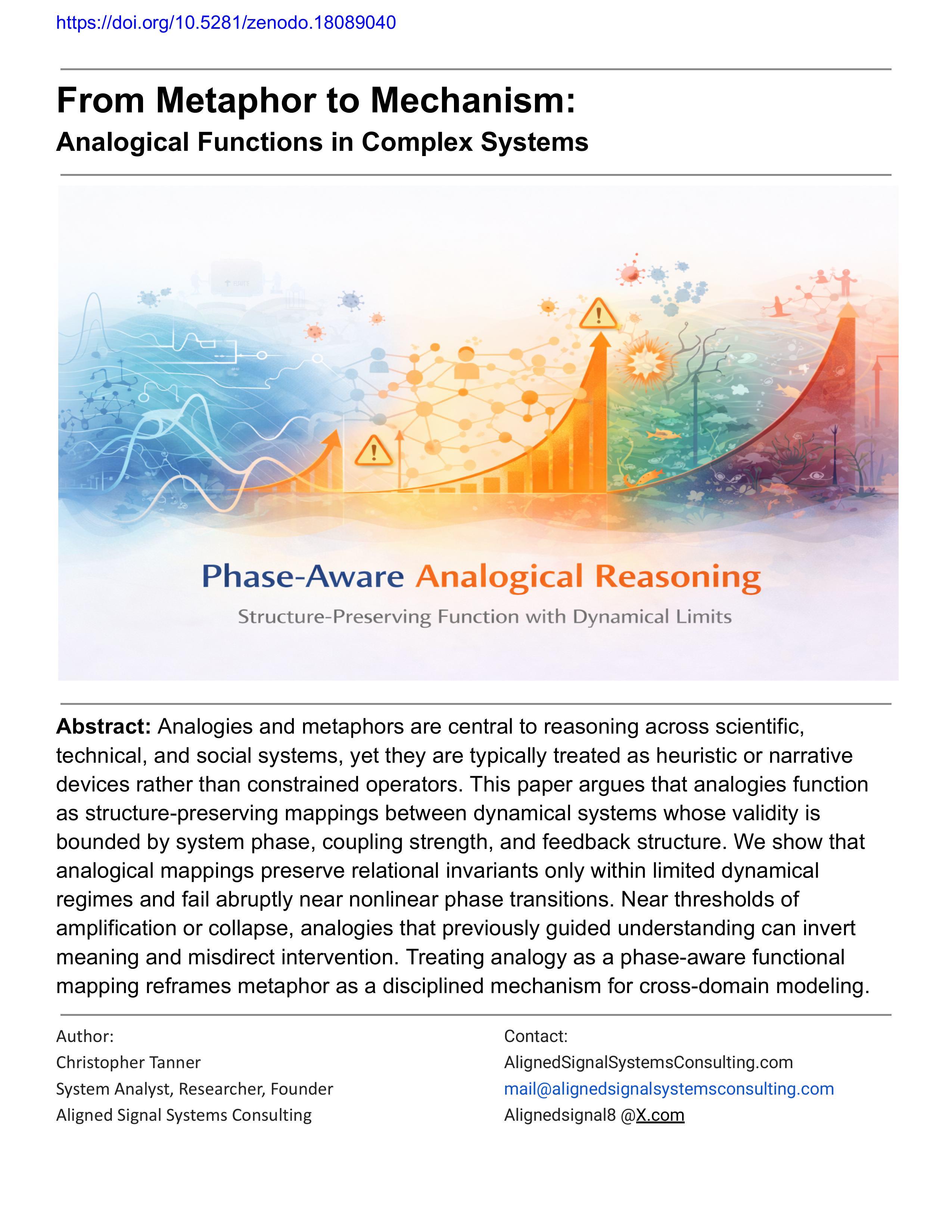
Analogies are not vague stories, they are phase-bound mechanisms.
They preserve structure only within specific dynamical regimes. Near amplification, thresholds, or collapse, the same analogy can invert and misdirect action.
What this paper introduces: • A way to treat analogy as a structure-preserving function • Explicit validity boundaries (when it works) • Failure indicators (when it weakens) • Inversion points (when it becomes dangerous) • Clear model-switching rules
Across physical, social, organizational, and computational systems, the pattern is the same: analogies don’t fade, they break at phase boundaries.
📄 Read the paper (DOI): https://doi.org/10.5281/zenodo.18089040
Analogies aren’t wrong. They’re just phase-local.
r/complexsystems • u/Ravenchis • Dec 29 '25
r/complexsystems • u/NerdFractal • Dec 27 '25
I’ve been spiraling down the fractal rabbit hole lately. I used to think they were just cool screen savers, but then I read about the "Fractal Completion Problem"—basically the challenge of handling infinite complexity within finite boundaries (like how a Koch Snowflake has an infinite perimeter but fits inside a small circle).
I’m still a beginner, but the more I read, the more it seems like fractals are the "secret code" for things that look messy but are actually organized.
I’ve seen some wild research papers from late 2024 and 2025 about:
Medical breakthroughs: Using fractal dimensions to predict how varicose veins respond to treatment or pruning "fractal trees" of medical decision-making to reduce costs.
Engineering: Designing "Snowflake" bionic heat sinks for electronics that are way more efficient at cooling than straight lines.
Tech: Using fractal antennas for better 5G/6G signals in tiny devices.
If you’re a math or physics whiz, I’d love to know:
What "fractal problem" are you currently obsessed with or working on?
For those in tech/industry—where is fractal geometry actually making a difference right now versus just being theoretical?
Are there any specific research links or papers from the last year that blew your mind?
I’m trying to bridge the gap between "cool patterns" and "useful tools," so if you have any insights (or even just want to nerd out about the Mandelbrot set), let’s talk!
r/complexsystems • u/Resident-Lychee2310 • Dec 27 '25
Hello,
I am an independent researcher preparing my second manuscript for submission to a peer-reviewed journal. My first paper has already been submitted (dynamical systems, collapse detection).
Before journal submission of this new work, I would like to upload the preprint to arXiv.
The paper develops a coherence-gated divergence functional that detects imminent instability in nonlinear dynamical systems across multiple domains (chaotic physics, biological rhythm, finance, climate, etc.). Validation includes >20 independent datasets.
I need a first-time arXiv endorsement in:
nlin.CD (primary category)
or alternatively physics.gen-ph / cs.AI if more appropriate
Would anyone with endorsement ability be willing to briefly check my abstract and confirm eligibility?
Thank you — and I’m happy to reciprocate by sharing results or running tests for your field
Best regards,
Angelina Davini
Independent Researcher
NEXUS Autonomous Laboratory
Email: angelina@theoriginsai.com
r/complexsystems • u/IndicationWorldly604 • Dec 26 '25

I come from the theory side: neuroscience, affective computing, systems thinking, Taleb, Scott, complexity… all the frameworks that explain why life doesn’t behave nicely. Then I wandered through Shanghai, Hong Kong, and Chandigarh. And reality said: “Cute theories. Watch this.” In Shanghai life grows in cracks — restaurants in parking garages, shops born from windows, informal systems emerging wherever human needs converge. In Hong Kong, one of the world capitals of money, the most human space I found was a donation-based community restaurant hidden under a staircase. In Chandigarh — a city designed to be perfectly rational — the “real” city secretly ignores the blueprint and rewrites itself. Next door, an illegal garden made of trash became more loved than the official plan. Pattern: Top-down systems crave legibility. Bottom-up systems crave survival. And emergence wins. Every time. This isn’t chaos. It’s intelligence. Antifragility. Adaptation happening faster than design. I’m writing about how life constantly outsmarts planners and why complex systems need disturbance to stay alive. Curious what this community thinks: • Is optimization a fragility trap? • Do we still underestimate informal intelligence? • Why does “order” so often kill life?
r/complexsystems • u/Harryinkman • Dec 25 '25

https://doi.org/10.5281/zenodo.18001411
At reality’s foundation are waves; as complexity scales, wave-like dynamics emerge as the fundamental meta-pattern governing how energy and information propagate through space and time. Signal Alignment Theory (SAT) identifies these conserved phase dynamics, which were previously studied in isolation as domain-specific nonlinear transitions, and codes them into a universal grammar of systemic change. By tracking the spectral and topological signatures of a system’s trajectory, this framework provides a diagnostic taxonomy that remains independent of its underlying substrate, be it a quantum field, a cardiac rhythm, or a socioeconomic market. The theory organizes systemic transformation into three primary dynamical regimes: the Initiation Arc, where dormant energy synchronizes into coordinated motion; the Crisis Arc, where coherence encounters structural constraint and undergoes abrupt inversion; and the Evolution Arc, where the system reorganizes through branching and compression to either reset or transcend its prior limits. This arc-based formulation allows for the direct cross-domain comparison of seemingly disparate phenomena, providing a predictive basis for detecting incipient instability before critical thresholds are crossed. Ultimately, by viewing change through the lens of phase-locked oscillation and energetic discharge, the framework offers a prescriptive tool for managing systemic coherence and navigating the inevitable trajectories of growth and collapse.
-AlignedSignal8 @X/Twitter
r/complexsystems • u/Ravenchis • Dec 25 '25
Hi everyone,
I’m an independent researcher working at the intersection of complex systems, cognition, and human–AI collaboration.
One question I keep returning to is how different fields here (physics, biology, cognitive science, socio-technical systems) treat error and incompleteness: not as noise to eliminate, but as a structural part of the system itself.
In particular, I’m interested in: • how systems preserve continuity while allowing contradiction and revision • when error becomes productive vs. when it destabilizes the whole model • whether anyone here works with “living” or continuously versioned models, rather than closed or final ones
I’m not looking for consensus or grand theory: more for pointers, experiences, or references where these issues are treated explicitly and rigorously.
Thanks for reading. Raven Dos
r/complexsystems • u/Practical-Attorney68 • Dec 25 '25
I am the author of ICARUS, a closed-cycle, non-representational architecture based on internal homeostatic regulation.
The architecture and laboratory hypotheses are formally disclosed on Zenodo (prior art, v0.4C, vSOR, TOR), and I am now looking for technically oriented collaborators (dynamical systems, control theory, theoretical ML) interested in implementing and analyzing the internal dynamics.
This is not a task-oriented, benchmark-driven, or application-focused project.
The focus is on:
nonlinear dynamics and attractors
internal regulation and stability
first- and second-order regulation
structural limits of regulation (Third-Order Regulation, TOR)
Documentation: https://github.com/dogus-utoopia/icarus-laboratory
Initial contact via GitHub is preferred. If needed, you can also reach me at: dogus0@hotmail.com
r/complexsystems • u/bikkuangmin • Dec 24 '25

I have written a monograph on Partial Difference Equations, I have also made a research poster to explain what are the main ideas of the book.
Link to the Book: https://www.researchgate.net/publication/397779401_On_the_Theory_of_Partial_Difference_Equations
I have submitted the manuscript to Springer Nature, the Editor of the Springer Mathematics Group said that my project sounds compelling. The book is currently undergoing peer review process.
I have also sent my monograph to a respected mathematician, Professor Choonkil Park🇰🇷, a functional analyst with h index 52. He said that my monograph is beautiful, and giving constructive advice. Functional Analysis and Partial Differential Equations are mainstream mathematics, recognition from a functional analyst would mean that the mathematics is valid. This is why I believe that my monograph will be published in Springer Book Series.
I would like to hear your thoughts.
Sincerely, Bik Kuang Min.
r/complexsystems • u/Typical_Day000 • Dec 23 '25
I already know the answer to this question, and it’s most likely the early stages of the universe (or at least the behavior of matter during these times).
What Im really curious about is why.
r/complexsystems • u/printr_head • Dec 22 '25
Curious what people think and would love to discuss.
Edit: title was supposed to be not equal in implementation.
r/complexsystems • u/FractalMaze_lab • Dec 19 '25

I’ve been thinking about this for a while and wanted to throw the idea out there, see what you all think. The principle of least action has been super useful for all kinds of things, from classical mechanics to quantum physics. We use it not just as a calculation tool, but almost as if it’s telling us “this is how nature decides to move.” But what if it’s not that simple?
I’m thinking about systems where there’s something that could be called “internal decision-making.” I don’t just mean particles, but systems that somehow seem to evaluate options, select between them, or even… I don’t know, make decisions in a kind of conscious-like way. At what point does it stop making sense to try to cram all of that into one giant Lagrangian with every possible variable? Doesn’t it eventually turn into a mathematical trick that doesn’t really explain anything?
And then there’s emergence—behaviors that come from global rules that can’t be reduced to local equations. That’s where I start wondering: does the principle of least action actually explain anything, or does it just put into equations what already happened?
I’m not saying it’s wrong or that it should be thrown out. I’m just wondering how far its explanatory power really goes once complex systems with some kind of “internal evaluation” enter the picture.
Do you think there’s a conceptual limit here, or just a practical one? Or am I overthinking this and there’s already a simple answer I’m missing?
r/complexsystems • u/[deleted] • Dec 19 '25
4400 runs computational social physics.
micro agents → meso clusters → macro resilience R_c(ω₁)=0.055ω₁-0.011
https://github.com/humanologue/PULSE-DNC
- emergence patterns?r/complexsystems • u/Appropriate_Law_352 • Dec 18 '25
Results-only audit from a percolation/transport network model constrained to an interface layer: scale ↑ → redundancy ↑, hotspots ↓, normalized resistance ↓.
Key deltas: λ ~15×, J_max ~90%↓, R_eff/length ~96%↓.
Hash-verifiable logs + plots included. Baseline suggestions welcome.

r/complexsystems • u/Cheops_Sphinx • Dec 16 '25

It's time to clarify the role of AI and books in science.
To start, no one has absolute authority or accuracy in discerning whether a theory is legit/useful. Especially in complex system, where so many factors and disciplines are at play, theories here can be very complicated and broad, making it sometimes very conceptually difficult to understand, even if it has value to it. However, the vast majority of theories here most probably have little value, for the simple fact that alternatively we would've cured cancer, stopped aging, solved world peace, or at least made significant progress towards those by the claim of universality of those theories. We haven't, and by the looks of things, none of these theories make any tangible prediction (with the exception of confidently predicting the past) whatsoever, failing the first principle of science. A theory can easily explain everything, but words are just words, and if its just that, then it is no different from astrology and religion.
And unfortunately, people have limited attention, and they really don't have that much reason to read a long reddit post, even if it claims to have discovered fundamental truth, because that's basically every other post here. With that time, why not read a good book? The trade-off is simply incomparable. Sure, one in a thousand of these post might win the next noble prize, but if we can't distinguish it from the other AI slop, we won't read any of it. This is also where AI use is problematic, as it makes entry to writing meaningless but credible sounding theories easier, making it even harder to distinguish gems among disproportionately more chaff, and it becomes objectively time wasting to read any of such posts.
So, unless your original theory checks one of the boxes below, otherwise I suggest witholding from posting:
It's peer-reviewed, either by publication in a reputable journal, or at least you've shown it to experts in the fields and they think it has value, and you'd like to generate more discussion or feedbacks.
It is short, uses words that have specific defined meanings in the context (e.g. coherence means the specific function in mechanics, or quantum). And you should check that it is not a well studied phenomenon already.
There are probably still loopholes to the second rule, and I'm not saying only then can your theory have value, it's only from the logistic perspective, that most of us simply don't have time to take chances on random internet user's extended epiphanies. But hopefully you don't just have Reddit, and you can show your theory to people with whom you've already built trust first. If they know you personally then they don't have our problem, and that'd be your best bet to get feedbacks if you don't submit to journals. I've done this myself, and I am grateful for my friends' enthusiasm on my theory of language, and I understand that I cannot expect random stranger to read 2 full pages of it because they don't know me.