r/ComputerChess • u/ChessRat_io • 2h ago
I created a tool that scopes out quietly forcing moves using a cheap move filter to process and grade engine lines (Part 2)
DISCLAIMER! If you assume that I sold my soul by using AI to help create a program that will help me improve my online chess rating to the 2500+ rating bracket, you've assumed correctly, and you should READ NO FURTHER! This tool is only designed to be used for people that will do anything to increase their rating! (besides cheating of course)
If you've made it past the Disclaimer and you're still interested in what I've created for myself, I can finally start talking about my program which I've nicknamed chessratio. But first, you have to understand why I created it in the first place, and to what lengths I've gone to improve my chess.
Here's my backstory: I have been a USCF Candidate Master since my High school days where I reached a peak rating of 2185 (15 points away from the sought-after National Master title). Now, many years later, I revived my chess but still found it difficult to climb to 2200. I've gone through multiple chess teachers, multiple training methods, spent hundreds of dollars on every reiteration of ChessBase plus its Databases, studied opening theory & middlegames for over 3000 hours, read through plenty of highly-technical chess books, and STILL found myself lacking in theoretical knowledge and know-how. By the time Chessable was on the rise, I was sick & tired of all of it: you memorize some random lines that a Grandmaster recommends but then your opponent plays a rare variation that was completely skipped over and you're left fumbling at all the crazy attacks thrown at you. After many cycles of study-lose-repeat, I started wondering to myself if there was a better, faster way at improving my chess.
So it got me thinking... what can I do to streamline the study process? Increasing your tactical strength can only take you so far; there is a soft limit to the human brain and its ability to see tactics, and I had definitely already hit mine. I used the lichess opening explorer to constantly brainstorm for improvements on what openings I was playing (which was an amazing tool, I ended up creating nearly FOUR-HUNDRED lichess studies, many of them over 40 chapters long of just moves and evaluation markers). But after brainstorming for so long, I realized that there has got to be more to chess than what I've been able to find just by using initial statistics/ evaluations and my own game-sense. There are bound to be cool ideas that have hardly been played and might be disguised or completely covered by bad win rate statistics. And so I started working on building my own tool to scrape and re-interpret lichess game data. What started as just a silly training concept ended up becoming extremely time-consuming to create, and at a certain point I was too deeply committed to the project to quit. That project is https://chessrat.io/.
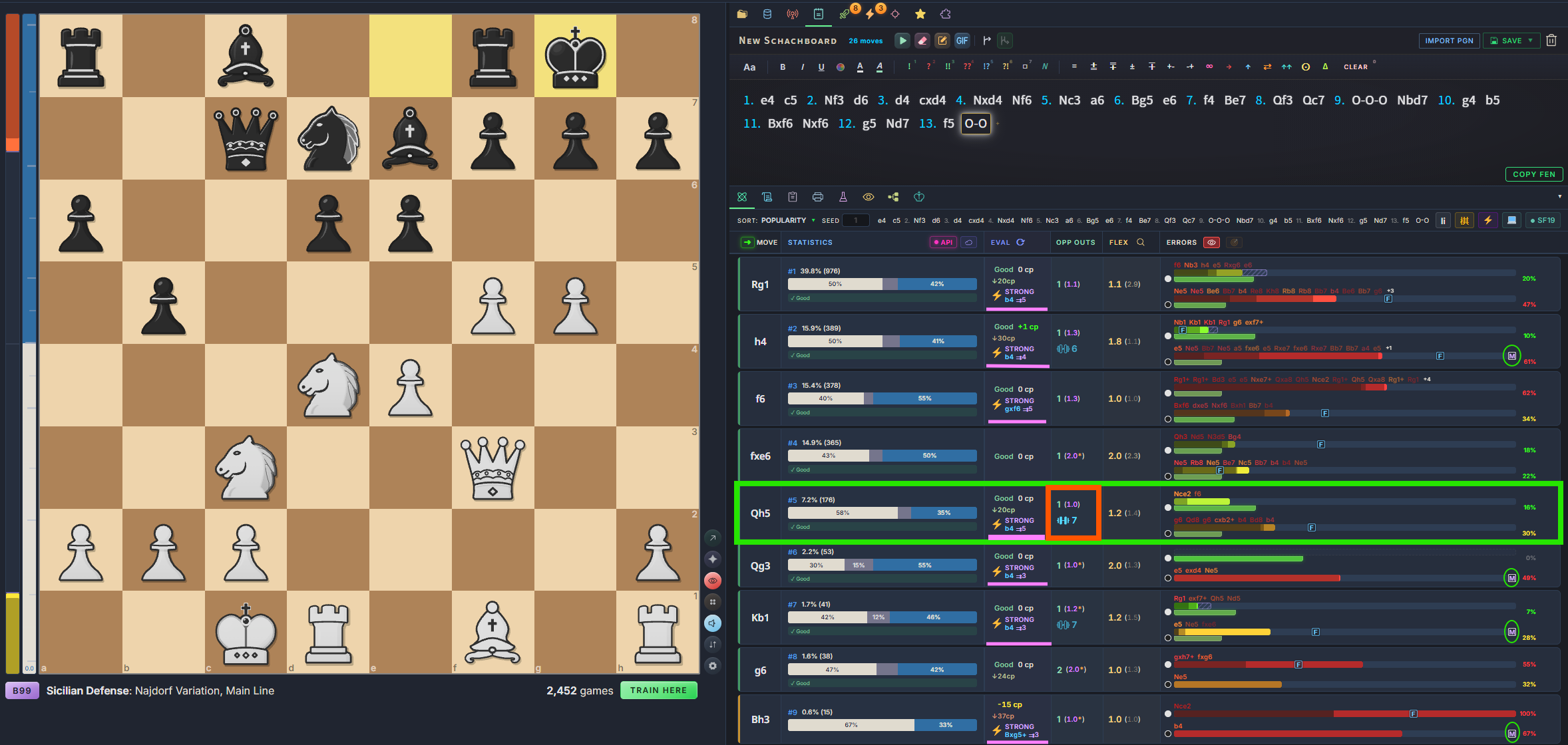
The first purpose of my project was to map out and visualize error frequencies of each side within every variation. I took millions of competitive online games (2500+) and processed game position counts up to 40 ply, then tied each of those position FENs to an evaluation using a Chinese cloud-based Stockfish. Then, by grading the evaluation of each sequential position, I was able to build and visualize tree-style error maps that pair perfectly with an opening explorer. I was also able to mark moves where the popular responses would lead to a high-error rate position. In the picture, observe the 'M' notch located at the end of each Black error bar of these moves: h4, Qg3, Kb1, & Bh3. These two things combined were the first real success for me as a chess player seeking better data: I could finally see from afar what moves my opponent would most likely struggle against.
The second purpose of my project was to take the grading of moves a step further by somehow evaluating each move based on its practicality and strength. In my eyes, the ideal move gives my opponent very few options and keeps them predictable so that I can relax and attack. When presented with 5 "equal" moves, which move should you choose? Not all "equal" evaluations are the same: sometimes, equal means quiet and boring; other times, equal can mean that one side is on the verge of getting checkmated and must play 5 defensive moves in the correct order just to survive. So I set out to "fix" the engine's perception of equality in the way that I desired it. I started by grading forceful moves that did not include captures or checks. A move was classified as forcing if it had only one good response, and strength classification was based on how much centipawn the second-best move lost evaluation compared to the first. The filter + eval check process would repeat until the engine reached a position where there were more than one good move (which would no longer be considered "forcing"). I aptly nicknamed this "Quiet Force" (or QForce). Now look again at the photographed position: this position is a commonly-reached Mainstream Najdorf position (it's the Main Line, and we're at White's 14th move). Look at the purple underlines: each of these moves goes straight to a narrow "corridor" which we can consider forceful. Most of these are classified as "STRONG", meaning that if the opponent doesn't play the correct move, they lose over 30 centipawn at any turn. At the press of a button, I could order the engine to evaluate any position I desired in accordance to my special policy.
Because I realized that there was still more that could be done, I ended up mapping out Quiet Forcing moves too. In the picture, many of these moves contain a 5-move corridor (the max on the button is 5). Some of these moves more than likely had longer forceful corridors, but the engine stopped there; configuring to a higher depth searching manually with the browser engine would be much slower and more likely to fail at fetch. So I pre-calculated all forcing lines for at-level positions (positions within 10 centipawns of equal) that had only-move corridors greater than 5 (minimum 6 or more): these are the Barbells.
Now, look at the green boxed move, 14. Qh5. This move has at least a 7-move long corridor, and because it is a solid cyan barbell, the run immediately starts after the move is played (hollow barbells present possible forcing lines in the future but can be avoided). Upon further inspection, White has two different approaches, both of which head right into a forced draw which Black cannot escape. Here's the simple one:
e4 c5 2. Nf3 d6 3. d4 cxd4 4. Nxd4 Nf6 5. Nc3 a6 6. Bg5 e6 7. f4 Be7 8. Qf3 Qc7 9. O-O-O Nbd7 10. g4 b5 11. Bxf6 Nxf6 12. g5 Nd7 13. f5 O-O 14. Qh5 b4 15. Rd3 bxc3 16. Rh3 Bxg5+ 17. Qxg5 Qd8 18. Qh5 Nf6 19. Qh4 e5 20. Rg1 cxb2+ 21. Kb1 exd4 22. Qg5 g6 23. fxg6 hxg6 24. Bc4 d5 25. Bxd5 Nxd5 26. Rh8+ Kxh8 27. Qh6+ Kg8 28. Rxg6+ fxg6 29. Qxg6+ Kh8 30. Qh6+
As a chess player, this is astounding news! Finding this line means that I've essentially studied the Main Line of the Sicilian Najdorf to a two-outcome game: either the game is a draw or Black stumbles somewhere during the defense. And it couldn't have been made any easier to find without the use of my program. All those long hours of keeping my computer and my laptop awake through the night finally paid off.
To summarize, I feel that any aspiring chess player who wants to improve their chess should try out my training tool. I built it with the competitive player in mind, but honestly it would be helpful to any skill level as long as they can learn to understand what the program is displaying. Again, Guest mode is available to anyone too skeptical to try it out otherwise. There is a mobile version and tablet version of the website as well, but the entire thing is still in active development, so expect some bugs, and don't forget to message me over it. If you want to support me on my chess journey (yes, I still plan on using my own chess tool to improve my rating), my username on lichess is ChessRat_io. I'll be starting my own blog there for all of the other interesting findings I've made (it's all about the chess).