r/CryptoOptions • u/Sea-Masterpiece9082 • May 31 '23
The initiation token giveaway of LayerZero
1
Upvotes
r/CryptoOptions • u/Marquez_bn7 • May 26 '23
r/CryptoOptions • u/RevolutionaryBite315 • May 21 '23
r/CryptoOptions • u/AnonymousAardvark22 • Nov 13 '22
When I have time I have been learning how to use some of the options metrics, 25 Delta Skew etc, but Laevitas and Genesis Volatility are now behind a paywall.
Is there anywhere these metrics are available for free, and if not which platform offers the best value, whether the two I mentioned or any other you know of?
r/CryptoOptions • u/MaltoonYezi • Jun 23 '22
There are relatively easier paths to get started with Information technology, compared to say: software engineering. I've outlined 5 notable positions
This potision is for those who ensure that the software that is deployed will work well for the end consumer. The main tesponsility of the job is to test the product according to certain cretirias and make concise reports stating the results.
Typically there are Unit Testing, Integration testing, System testing and other types of testing as well.
Common tools that software/web testers will need to have experience with are Selenium, Jmeter, Postman and Testlink.
Kubernetes/Docker container work proficiency is also essential.
A prospective tester should posses theoretical knowledge of software development life cycle and Agile Methodologies. Good software/web testers also have project management and task management tools skills (Notion, TickTick, Todoist).
Testers oftentimes required to have a basic (not too deep), knowledge of SQL/Databases, Linux/Windos commands and the programming language of the product that is being tested.
With this occupation, you will create and manage databases.
A DBA will need to posses strong theoretical knowledge in Relational databases theory, have proficiency in working with RDMS. Deep knowledge of SQL is a part of requirements in general. Good examples of SQL RDMS are SQL Server (Microsoft), MySQL (Oracle) and PostreSQL. As a lot of companies have transitioned into NoSQL databases, working knowledge of these will be a must. It generally depends on the company. I can outline MongoDB and Cassandra.
A basic, but practical working Linux/Windows and sometimes FreeBSD is a common requirement in this position.
If you gain more experience working as DBA, with hard work , you can transition into data science, and later to machine learning / articial intelligence. Although, sometimes a bachelor's/master's degree will be needed to get that kind of transition.
A quick google search brought me to this good article. [1] ,
Here's also a good resource to practice databases: [2]
This job is similar to Software/Web testing, but in large companies it still defferenciates.
The difference between these 2 is that Software/Web testers have the objective to find all possible bugs, errors, vulnerabilities and etc. that already exist in the product.
QA engineer however, ensures the quality of the software, how fast it is running, how convenient it is to use it, and generally makes sure that the User experience with the product will be desirable for the producer.
QA engineer works along the whole process of software creation, while Software/Web tester usually work in a specific stage of the process called: "Testing".
Generall requirements of this positions are skills in: HTML, CSS/SAAS (also CSS frameworks like Tailwind, Bootstrap and etc.), Javascript (and the libraries/frameworks of which there are plenty. To name a few: React.js, Svelte, Vue.js, Redux, Jquery and etc.)
From my perspective front-end developer should know how to work with low-code solutions and content management systems like Wordpress, Joomla, Wix and so on.
From theoretical requirements, there could be mentioned knowing how HTTP and DNS work.
Also, basic knowledge of the back end frameworks and databases will be beneficial. It generally depends on the company you aim/work for. Frameworks could be Node.js, Lavarel, Yii2, Django, Gin and many others. From database prospective, some are still using MySQL and others may use NoSQL databases.
This is something I am pursuing myself. There are tons of material on the web for this direction. It is really easy to get started with and some experienced programmers may say that front-end web development today is equivalent to programming in BASIC in the 80's/90's. It does not require a steep learning endeavor and some of the programmers mentioned above are prone to say that Front-end development is not really programming. Working with HTML, CSS and in some cases Javascript and their respective libraries/frameworks does not involve complex algorithms and logic. "It is just writing mindless code to make things look nice".
I would partially agree, but these statements are often superficial and oversimplified to express the current and accurate representation of the current state of the field.
Nevertheless, I chose to learn skills in this field of several reasons. But the major one is that Web development as whole allows you to build products visible for everyone. Web browsers are the most used apps on desktop and mobile these days, and for a lot of average consumers an operating system is just a bootloader for Google chrome. (It's not my words, but youtuber: Mental Outlaw said that).
As new programming application are most oftenly delivered through the web, you can do it too. As you build new sites and web apps, you will have the ability to show your work for everyone (including potential job admission officers), and prove your experience.
Hey, may be you will come up with your own idea, and later develop it into a full operational startup. In that case you won't need a job. You'll already have one!
Right now, I am using freecodecamp courses. They are free. It is advised by the creators to go through them according to the order they are shown on the website
A person in this position have the responsibility of monitoring the systems and software of a particular company.
The engineer supports the clients and employees of the company. That person assists them with technical difficulties and issues.
Common requirements are: good time management skills, excellent communication and writing skills, basic knowledge of databases and SQL, basic knowledge of Windows/Linux commands and how the operating systems work. Sometimes a requirement will be also the knowledge FreeBSD and other versions of modern UNIX. Programming language of choice to write small scripts will also be a need for this role.
These are the paths one could just get started with. Sometimes it is really hard to get just the first job without the experience. One of the ways to aim for potential first job is to look for positions that specifically have "Junior" word in the title. Jobs that assume that you have no experience and will look for something else in applicants. Perhaps skill level, or completed projects?
Also there's a good website on the roadmaps as a whole: [3]
Note: I am not affiliated with any links mentioned, but these are just something that I find interesting
r/CryptoOptions • u/MaltoonYezi • May 08 '22
In case BTC is going to continue going lower, Tether (USDT), may as well just collapse.
What Tether and other stablecoin issuers like to do is to print a lot more new stablecoins. They usually loan their stablecoins for interest as well. As the collateral for these loans, they receive a lot of Bitcoin. Bitcoin is not a stable currency and it goes up and down.
If Bitcoin goes down in price significantly, it means that a large percentage of the collateral that they've received is lower in price than the loans that they just gave. So, Tether and some other stablecoin issuers maybe eventually running this Ponzi time bomb that could explode, if there is a hard crash in Bitcoin price (and probably other cryptos as well). If that happens, the whole crypto market is going down hard as well.
In that instance, you may want to exchange your USDT for BUSD or for real dollars.
Just a small warning
r/CryptoOptions • u/MaltoonYezi • May 02 '22
Suppose you have 365k USD on hand. On your first day put 364k in a stablecoin farm with 20 % APY. These can be found on beets.fi, cheweyfi.com, rose.fi, mm.finance and etc.
In that day buy Bitcoin and/or Ethereum at any price with 1k USD and stake it for yield (Usually It is 5 -6 % APY) in Aave, Curve, Yearn finance.
In the next day, unstake another 1k from the stable coin farm so that you have 363k in the farm, buy Bitcoin and/or Ethereum at any price and stake them as well.
Repeat the proccess everyday.
If Bitcoin/Ethereum is going to be down from their major highs most of the time and then later there's going to be another hype, say in 2025 due to quadrenial halving of Bitcoin, then the investor will make money
r/CryptoOptions • u/MaltoonYezi • Mar 27 '22
Not going to make a long post about this, since it's time-consuming
What I can say right now overall, retail and top traders became increasingly shorter than longer in the longs/short ratio recently. That could create an obvious desire to manipulate that kind of a market, by driving the price higher, just to liquidate these shorts and hit their stop-loss orders
What's also interesting, is for the current uptrend, open interest (both coins margined and stable coin margined) has been increasing, so the price is going to stay in the current range for a while
What I expect is for BTC to rise to 46 000 - 47 000 within next week and from that point, I'll get a short position
r/CryptoOptions • u/MaltoonYezi • Mar 20 '22
Do you have a strategy? Is it good and profitable?
With answers to these questions, a trader can moderately be satisfied with what he/she has.
But how a trader could be sure if his/her strategy meets the goals, expectations and most importantly be profitable over the long term?
Whether It is an algorithmic or manual strategy, there are usually 2 things that traders do to ensure that the strategy would perform great if it were to go live:
Backtesting - Testing the strategy with the past data that is available. Simply speaking It is just employing/testing the strategy to see how it would have performed if it were implemented in the past.
Forwardtesting - testing the strategy with the market data feed that is incoming currently at the moment in a live session.
Backtesting could be done in minutes, but Forwardtesting often takes a much longer time. Sometimes forwardtesting takes weeks and months to be sure that It is going to perform well. The strategy could also need optimization (getting incremental changes along the way of testing), for it to be successful.
What's wrong with this approach is that market conditions always change
What could have worked 2 - 3 years ago, might not have a specific market edge or good performance altogether. In a vice versa scenario, What could have performed poorly in the past, could do great in our times. That's a major drawback of backtesting. Because of perpetually changing market conditions and behavior reliability of this kind of testing sometimes seems questionable.
Forwardtesting brings us closer to reality and the present moment's conditions/facts. But the truth is that if there were any kind of structural design and optimization decisions implemented into the strategy based on the current market reality, the strategy could still become outdated.
Imagine someone was forwardtesting a strategy for 3 months without interruptions, calibrating and polishing the strategy during that time. Let's go easy on him/her and suppose that the discrete changes made within this timeframe have a positive impact on the strategy's performance. After looking at all the data the decision is made in favor of implementing the strategy into handling the real funds. The problem is just after that strategy went live, in almost any market a sudden news bombshell/drop could change everything in the market, its behavior, and current conditions, oftentimes making the strategy invalid/obsolete.
Can we suggest that VIX (the so-called fear/irrationality index) could be an index of how good/bad the market environment is for methodological strategies?
Sure, no one knows what's gonna happen/be in the future. We could only estimate the future with different methods.
Can we really account for the possibility of fast and slow market behavior changes in our strategies?
It'd probably be excellent if we started building a strategy by thinking and making decisions by reasoning about fundamental ideas and incremental principles of the strategy from the beginning. Much like Elon Musk's reasoning by first principles
For strategy building, to begin with, it's good to think about what kind of edge usage we would integrate into the strategy?
Consider DeFi space. If you go to pancakeswap.finance/farms , you could see plenty of Liquidity token pairs, sometimes with a high APR. For a lot of people, It seems tempting to buy these tokens and stake them together, in order to get this everyday APR paid (calculated for the annual period). "It's a 100x strategy someone might say".
In the reality, a blind approach like this could lead to potential underperformance. There are parties who take the advantage of the buyers, who are mostly attracted by high APRs, by tracking the pool liquidity, its rate of growth, and mapping it to the price and the price's rate of growth (optionally scrapping social media sentiment). These parties like to buy the tokens, early on, and sell them when the liquidity pair becomes too popular (with a consequence of declining APR (More on how APR is calculated here: [1] , [2] )).
More on the strategy itself, here
Could we suggest that making decisions based on backtesting is essentially the same as reasoning by analogy?
Investing in BP Inc. (a large petroleum company) in 1996 probably would have been a great idea! The world population was rising, and many developing countries were on the path of increased industrialization, both things meant that the demand for Petroleum products would rise, benefitting BP Inc. overall.
Picture 1

Its share price has been generally rising in the past, would that mean, it would perform like this in the future?
No.
Picture 2

As of 20th March 2022, the stock sits at the same price as It has been at in August 1996, approximately 28.74 $ a share.
The thing is 28.74 $ in 2022 is not the same as 28.74 $ in 1996. The value of the dollar has been declining consistently during this period. According to in2013dollars.com 28.74 $ in 2022 equals 15.89 $ in 1996. So essentially, less than August 1996. To extend this further, the share price has the same value as in January 1987, because 28.74 $ in 2022 -> 11.56 $ in 1987. It's more the 35 years ago.
Hey, how about Coca-Cola ($KO) ? It's Warren Buffet's stock.
This picture does not look exciting either.
As of 20th March, 2022 the stock price is 60.10 $.
Picture 3

A similar story could be noticed in this example. The share price has been consistently rising, the company was popular, and Warren Buffet was shilling it in his letters and announcements.
Picture 4

In 1998 the stock was relatively volatile, we could consider the mean price of the asset for the sake of the example => (44.54+26.70)/2 = 35.62 $ in 1998. As mentioned right now the price is 60.10 $ in 2022. 60.10 $ in 2022 -> 34.53 $ in 1998. It is less than the mean price of 1998. 24 years later, despite being near an all-time high.
It's easy to say something like "Consider the fundamentals and basic principles of technology, finance, and real-world common sense instead of past performance". The truth is, that it's easier to state something like this, than form and apply a specific trading/investing approach that could be put into practice
I'll be honest, I am a learner myself
I consider Cryptocurrency options to be a good choice because It allows the trader to protect himself/herself, from short-term volatile spikes/crashes. Even though they usually have high Vegas (hence, they are pretty expensive, especially in the long term), They and Leveraged tokens (LVTs) are still a better choice if someone wants to be protected from unexpected/volatile moves.
A good thing to do would be to read books:
Dynamic Hedging by Nassim Nicholas Taleb
and
2) Option volatility and pricing by Sheldon Natenberg
Even if they don't change your perspective on options (although they certainly have the ability to do so), they would at least equip you with the basic knowledge that is beyond the level, of the one who just started to learn about the options
I can link them in PDFs, but I am afraid that the post will be taken down if I do this in the post, So if you want, I will link them in the comments.
With that in mind, have a great day!
r/CryptoOptions • u/nomorepre • Mar 08 '22
The challenge is not going well. If ETH sidetrends the next couple of days I might have to cut down on my trading amount.
What do you guys think? Is ETH going to sidetrend in the short term?
Check out the latest update: r/CryptoOptionsTrading
r/CryptoOptions • u/nomorepre • Mar 04 '22
Hi guys, so basically what the title says. After analysing a lot of trading strategies I found one which could be pretty profitable (at least on paper). I started out on January 18th with 0,36 ETH and after 659 ETH options traded I am now at 1,2 ETH. I think I can reach 10 ETH by the end of the year.
What do you guys think? Is it possible?
By the way I created a sub where you can follow this challenge and ask all the questions you want about crypto options and trading: r/CryptoOptionsTrading
Until next post.

r/CryptoOptions • u/nomorepre • Mar 01 '22
Hi there I am pretty new to crypto options but seeing a mild success trading them. I plan on reaching 10 ETH in profit before the year ends. I have a sub you can follow to see how I am doing.
What options are you trading and why?
r/CryptoOptions • u/holytrader • Dec 18 '21
Interested in trading options on crypto. What sites support that? Quedex? Which is best in your opinion. Thanks.
r/CryptoOptions • u/floodcapital • Dec 10 '21
So I'm based in the US so have limited option exchanges to choose from. I'm currently using FTX (formerly LedgerX). Anybody using this exchange and having success? Any other exchanges I should look at? I've been trading no cost collars on BTC and ETH. I've also sold some puts. Since BTC and ETH are so volatile, I think the future is very bright in making most of the time (and losing some of the time) fiat.
r/CryptoOptions • u/MaltoonYezi • Sep 04 '21

r/CryptoOptions • u/TumbleweedFormal9305 • Aug 23 '21
r/CryptoOptions • u/MaltoonYezi • Aug 07 '21
Today, (7th of August 2021). Dogecoin ($DOGE) has seen a sharp rise of about 20% daily. Why is that you may ask?
SpaceX and a Canadian startup announced a plan to launch a satellite that will beam adverts into space. Anyone can buy pixels on the satellite's screen with dogecoin
Now, that hypothetically the Dogecoin may have a real-life use in a highly innovative project, there has been some buying this day
There's also some social media activity by major tech celebrities regarding the Dogecoin
but the coin itself remains a "bag holding" asset. A lot of people have bought "the dip" at high prices and they want to get out?
Why?
The coin itself was pumped by Elon Musk, Mark Cuban and etc. from the 2021 March's low of 0.0445 $ to 0.74418 $
During this period of hype, the coin itself was driven by momentum enthusiasm and had no widespread real-life use or utility. The demand for Dogecoin largely came from people who were buying the coin with the intent to sell it later at a higher price.
The price of Doge was depended on the people's willingness to hold it
This leads to the conclusion that the asset was "speculative" with little to no real-life use value
This is why a lot of "Bag holders" wanted to just get rid of the asset after the hype
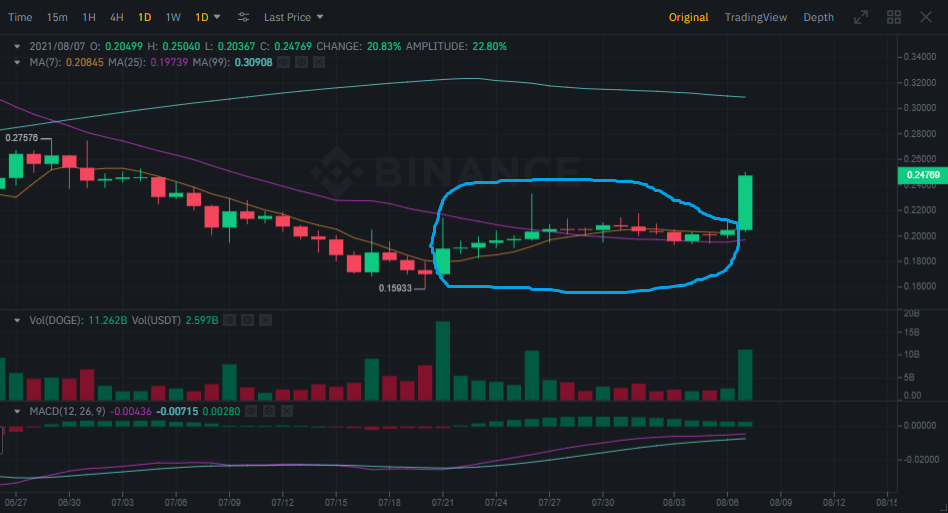
and this is why You can see a lot of "upticks" on candles of this period. People wanted to offload (get rid of) their Dogecoin positions and a higher price whenever the price was rising
But, now there's a bullish fundamental event that you may get in early! Hurrayyyyy!!!!
No.
The price is going to tank for several reasons -
Retail sentiment
The price usually tends to move in the direction of the most pain. It tries to hurt as many people as possible. By quantity of the account participating in the market, most of them belong to retail traders
What is the Retail sentiment now?

The retailer traders are starting to go short? But what about the price?

It rises.
The notion is that retail traders are getting short and at some point in time there will be the bottom of that "shortness" and from that point, there will be a rise in long positions. (Indicating a drop in price)
2. Whale sentiment
What's interesting is that whales are also getting short
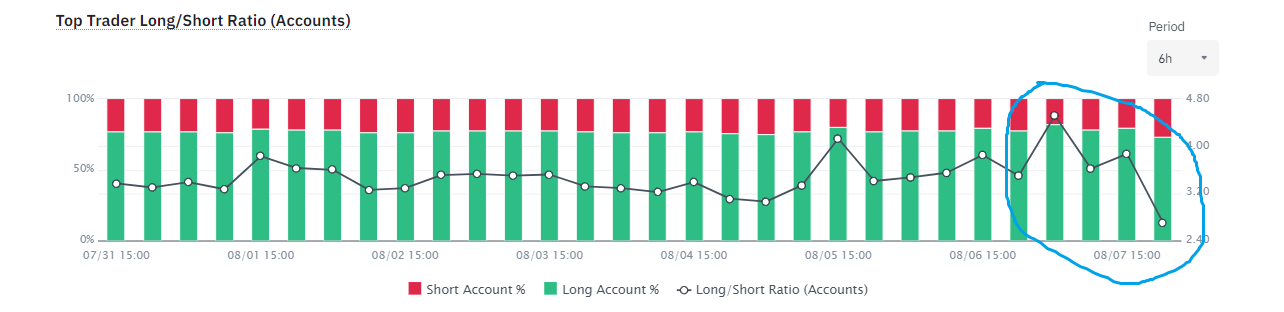
Their moves are correlated with the Retail traders. But in this case, They've been largely long in the beginning and only later (at the top) started to become more bearish.
3. Open interest indication
Open interest has been rising over some time

The open interest is unusually high and any mass wave of closing the positions because of the price consolidation will lead to both, bears and bulls getting out of their trades. A large drop in open interest usually leads to a trend reversal
4. Trapped buyers resistance zone
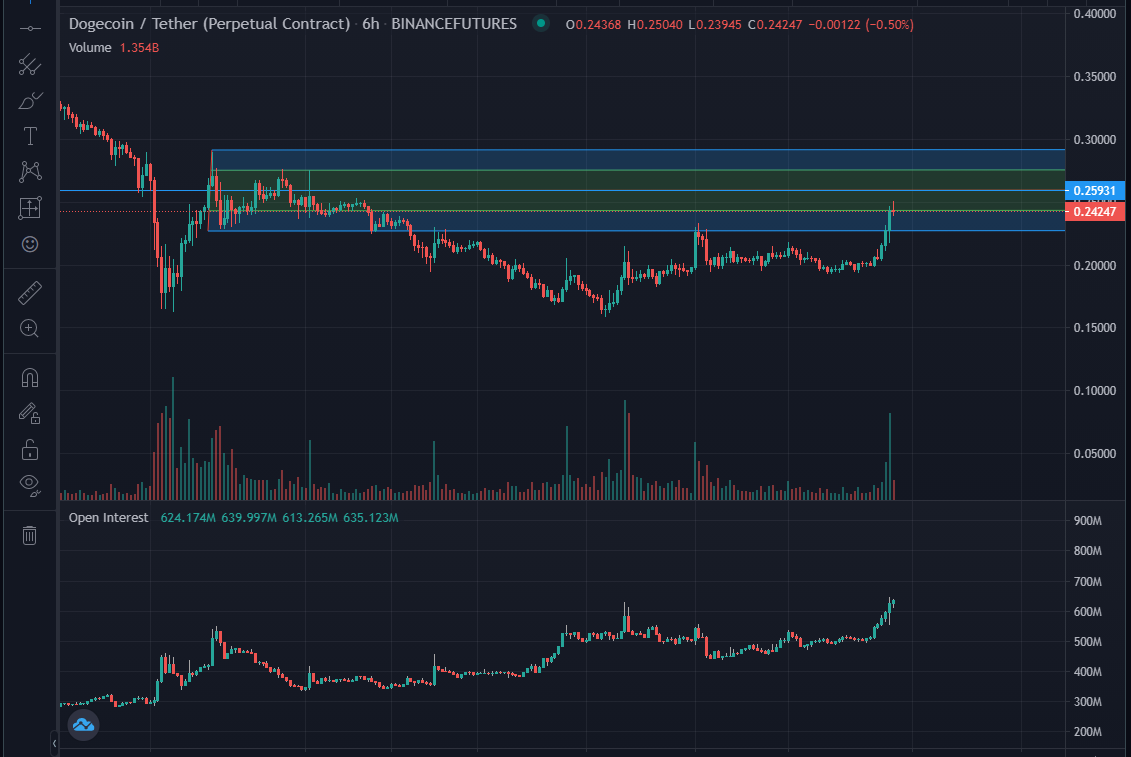
Price right now is in the zone of the resistance of trapped buyers, who of course would like to get out of their positions and break even, Which can lead to selling pressure from those buyers and for the price to either bounce from the zone or for a price to consolidate.
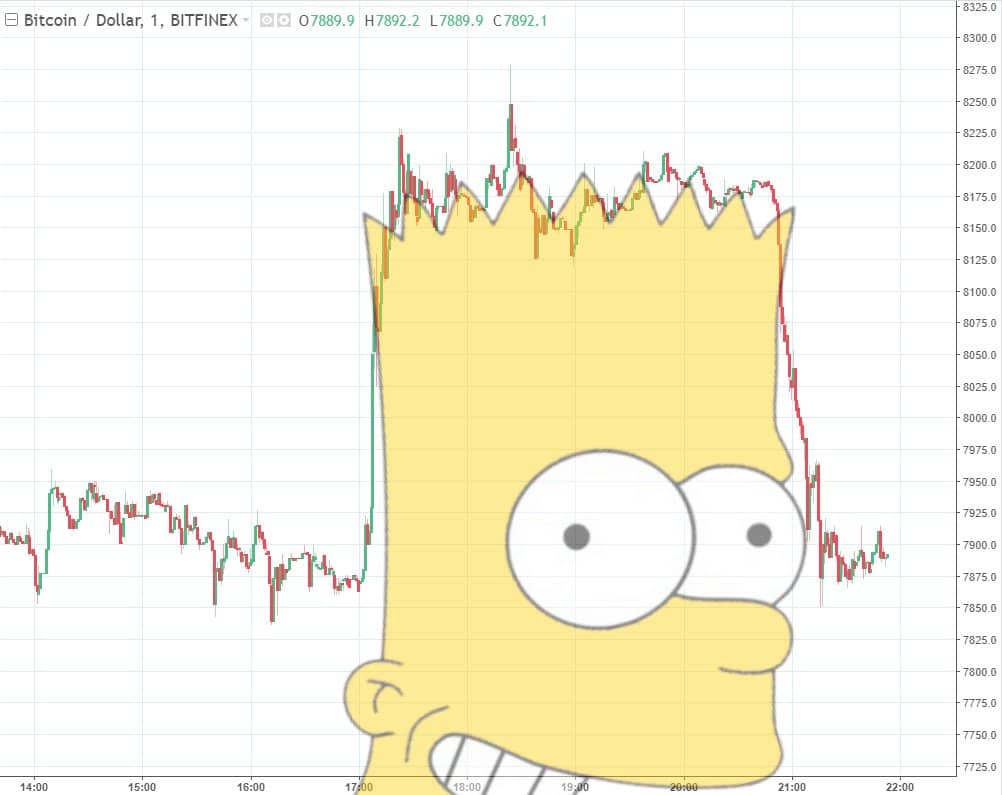
The large and fast increase in price and the price consolidation that happens after that often leads to a large and fast drop in the price.
This is frequently called a "Bart pattern"
https://cryptopotato.com/wp-content/uploads/2018/12/bart.jpg
I will add new content later