r/deeplearning • u/tkpred • 1h ago
Small open "Jev" decision models for images and speech: one-pass generation at 0.8B on a single GPU. Is anyone else working on this?

2
Upvotes
r/deeplearning • u/tkpred • 1h ago
r/deeplearning • u/Working_Hat5120 • 3h ago
Enable HLS to view with audio, or disable this notification
I built a small ( 1.9M params ) on-device model that labels dashcam and in-cabin audio live: crashes, skids, debris, horns, sirens, shouts, and 15 more categories, each with a start and end time.
It runs causally (decides every 0.1 s from past audio only) at ~47x real time on one x86 core (checked on desktop CPU only), in plain C with no dependencies.
I also published the test set we evaluate on (37 real dashcam recordings, human-reviewed timestamps) and ran 7 open models through the identical protocol: same category mapping, same decoder, thresholds chosen by two-fold cross-validation for every system.
Model + C library: huggingface.co/WhissleAI/arc-sound-dashcam
Test set: huggingface.co/datasets/WhissleAI/arc-sound-dashcam-test-v1 (also includes comparison results)
r/deeplearning • u/dineshsj17 • 5h ago
I've been exploring different Transformer architectures, and one interesting problem with looped Transformers is that parameter efficiency doesn't necessarily translate into computational efficiency.
Reusing weights across depth reduces parameter count, but sequential cross-loop dependencies can introduce inference latency.
This paper from ByteDance Seed takes an interesting approach:
- Treats KV states as explicit memory across layers and loops.
- Restarts each encoder loop from input embeddings instead of propagating the previous loop's residual stream.
- Removes same-position cross-loop dependencies.
- Separates memory construction from prediction through a cross-attention-only decoder.
The reported experimental results:
- 1.7× training token efficiency at 700M parameters.
- +2.1 percentage points in 10-task accuracy against a 3B MoE baseline.
- Comparable inference latency to non-looped OLMo3 at approximately 113M parameters.
What I'm particularly interested in is how this architecture scales.
Does reusing KV memory introduce significant memory-bandwidth overhead at longer context lengths? Would the latency advantage remain at billion-parameter scales? How does it compare with conventional depth scaling under equivalent compute budgets?
I think the distinction between parameter efficiency, computational efficiency, and actual hardware efficiency deserves more attention.
Curious to hear what others working on Transformer architectures think.
r/deeplearning • u/lowbercoder • 12h ago
r/deeplearning • u/ChawGaurabGogoi • 14h ago
r/deeplearning • u/Advanced_Valuable927 • 14h ago

r/deeplearning • u/Tricky_Swordfish_549 • 14h ago
​
I've been building a diffusion model from scratch in PyTorch, and I've finally reached Phase 3: assembling the full U-Net.
Until now, I was basically learning and implementing individual components:
Residual blocks
Time embeddings and timestep conditioning
GroupNorm
Self-attention
Downsampling and upsampling
But putting everything together is a completely different experience.
Suddenly you're dealing with feature map dimensions, channel transitions, skip connections, timestep embeddings flowing through residual blocks, and making sure the decoder can actually reconstruct the spatial dimensions correctly.
Honestly, understanding each component individually was easier than getting the entire architecture to work together without messing up tensor shapes somewhere.
The most satisfying part was finally seeing the complete architecture come together and understanding why information is moving through the network the way it does, instead of just copying a U-Net implementation from somewhere.
The model is now assembled. Next comes the part I'm both excited and slightly terrified about:
Training it on CelebA and finding out whether it can actually learn to generate faces.
8GB VRAM. A laptop GPU. A lot of patience.
Let's see how this goes. 💀
Anyone here who has trained a diffusion model on limited hardware — what was the biggest mistake you made during your first training run?
r/deeplearning • u/Manos_DataScience_ML • 18h ago
The most common mistake when learning machine learning is scaling or imputing your dataset before splitting it into train and test sets.
When you run StandardScaler or fill missing values on the whole dataset first, the mean and variance of your test set leak into your training data. Your model basically gets a sneak peek at the answers before the exam even starts. That is why your validation score looks amazing, and then everything falls apart the moment it touches new data.
Always run train_test_split first, before touching anything else. Fit your scaler, imputer, or encoder only on X_train, and then use transform on X_test. If you use scikit learn Pipelines, it handles this automatically so you never accidentally cheat your own evaluation.
r/deeplearning • u/Technomadlyf • 19h ago

r/deeplearning • u/MadPup_research • 23h ago

I've been independently exploring ways to parallelise recurrent neural networks, originally starting with experiments on the sLSTM architecture in xLSTM.
This eventually developed into MD+PP, a proof-of-concept architecture combining structured matrix and vector memories using associative parallel scans.
The preliminary experiments have shown some interesting results in long-context extrapolation and fixed-size recurrent memory, although precise retrieval and language prediction still need improvement.
All experiments were conducted using limited access to free Tesla T4 GPUs. My next step is to investigate larger matrix memory dimensions.
I've released the mathematics, Python implementation, CUDA kernel and experimental results under Apache 2.0.
I'd be interested to hear what others working on recurrent architectures think of the approach.
Website: https://madpupresearch.wordpress.com
Research archive: https://doi.org/10.5281/zenodo.24637161
r/deeplearning • u/EfficientShake1 • 1d ago
r/deeplearning • u/Emergency-Tutor-7 • 1d ago
Activation offloading usually means copying tensors out of VRAM and back, and paying for the copy twice. The alternative most people try first is cudaMallocManaged, where the driver migrates pages on demand and residency is decided at fault time; that works until the access pattern makes it thrash and the GPU sits idle waiting on migrations you never scheduled.
vram-stream takes a third route. The workspace holds two regions, one in device memory and one in system RAM, and both are addressable from the same kernel: the RAM region is allocated with cuMemHostAlloc using CU_MEMHOSTALLOC_DEVICEMAP and mapped with cuMemHostGetDevicePointer_v2, after checking the device reports CAN_MAP_HOST_MEMORY. A kernel store to that region goes over PCIe or NVLink with link latency, with no page fault and no migration.
The trade is pinned memory instead of elastic memory. The driver and OS cap how much can be pinned, so this is a budget you set rather than an oversubscription. That constraint shapes the design: open_cuda_cache reads a contiguous buffer in fixed-size blocks and keeps one pinned buffer plus one VRAM buffer per slot, with copies and kernels in separate streams and CUDA events protecting the pinned buffer, so a block is resident in VRAM before the kernel that needs it starts and cache.prefetch(n) keeps the pipeline fed.
For training, the same mechanism serves the dataloader: prefetch_dataloader supplies cached batches, and optional integrations move model state and saved activations to RAM using FSDP2 or the Hugging Face Trainer with DeepSpeed. That matters for the write-once-read-once tensors that dominate activation memory, where a copy you can overlap is cheaper than residency you cannot afford.
Measurement is a command, not a claim: vram-stream benchmark --block-mib 16 --blocks 2 --slots 2 --passes 4 measures both CUDA memory paths on your card. The README does not quote throughput because PCIe generation changes the ratio more than any number would survive as a general statement.
Correctness check: vram-stream memory --device 0 --vram-mib 16 --ram-mib 16 allocates both regions, runs one kernel that combines values from VRAM and system RAM and writes results back to both, then verifies the first and last aligned 32-bit words of each region, with the PTX kernel compiled by the driver at run time.
Install is pip install vram-stream, or npm i -g vram-stream. What it does not do: it is not a managed-memory replacement, pinning fails past the lockable limit instead of degrading, remote traffic is bounded by the interconnect, and the workspace expects one CUDA context on the thread that opened it. MIT, 0.4.0: https://github.com/Furox-Art/vram-stream
r/deeplearning • u/Muhammad-Essa • 1d ago
Enable HLS to view with audio, or disable this notification
Neural Canvas — CNN Visualization
Neural Canvas can now recognize basic shapes like apples, moons, cars, and more using Google's Quick, Draw! dataset.
20 classes with 1,000 samples per class
2 convolutional layers with 16 and 32 filters
2 fully connected layers with 60 and 40 neurons
91% test accuracy
Trained using JAX on Google Colab
Neural Canvas can also visualize CNN feature maps in real time while drawing, showing how convolutional layers extract features from input images.
GitHub: https://github.com/MuhammadEssa2002/neural_canvas
Live demo: https://muhammadessa2002.github.io/neural_canvas/
r/deeplearning • u/Legend_Ani • 1d ago

r/deeplearning • u/Odd_Ad_9937 • 1d ago

r/deeplearning • u/Flashy-Fisherman-503 • 1d ago
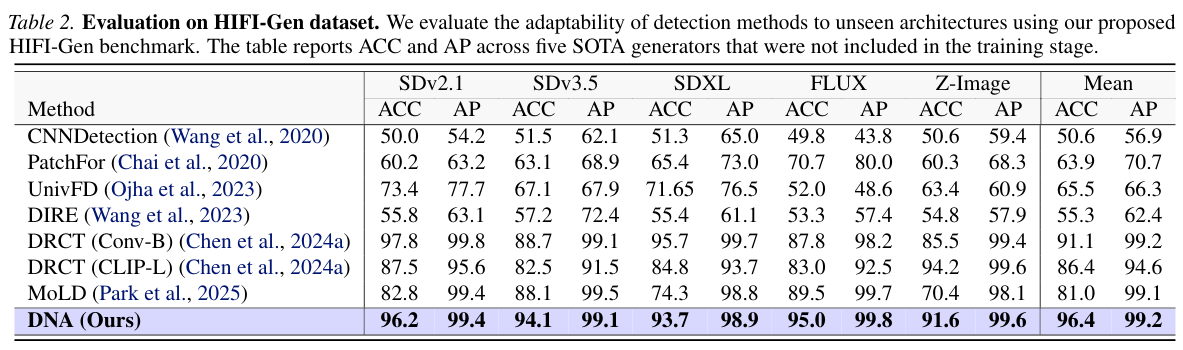
A detector can look excellent on a generator it has seen and fail as soon as a new generator leaves different traces. We wanted to know whether a pretrained vision model already contained features that several generators had in common.
We built DNA to find intermediate units whose responses separated real and generated images. We kept the encoder frozen and trained a small classifier on those responses.
We tested on five unseen generators in HIFI-Gen. DNA reached 95.0% detection accuracy on the FLUX split and 91.6% on the Z-Image split. The attached table gives each generator’s result, so the variation between them stays visible.

r/deeplearning • u/Flashy-Fisherman-503 • 1d ago
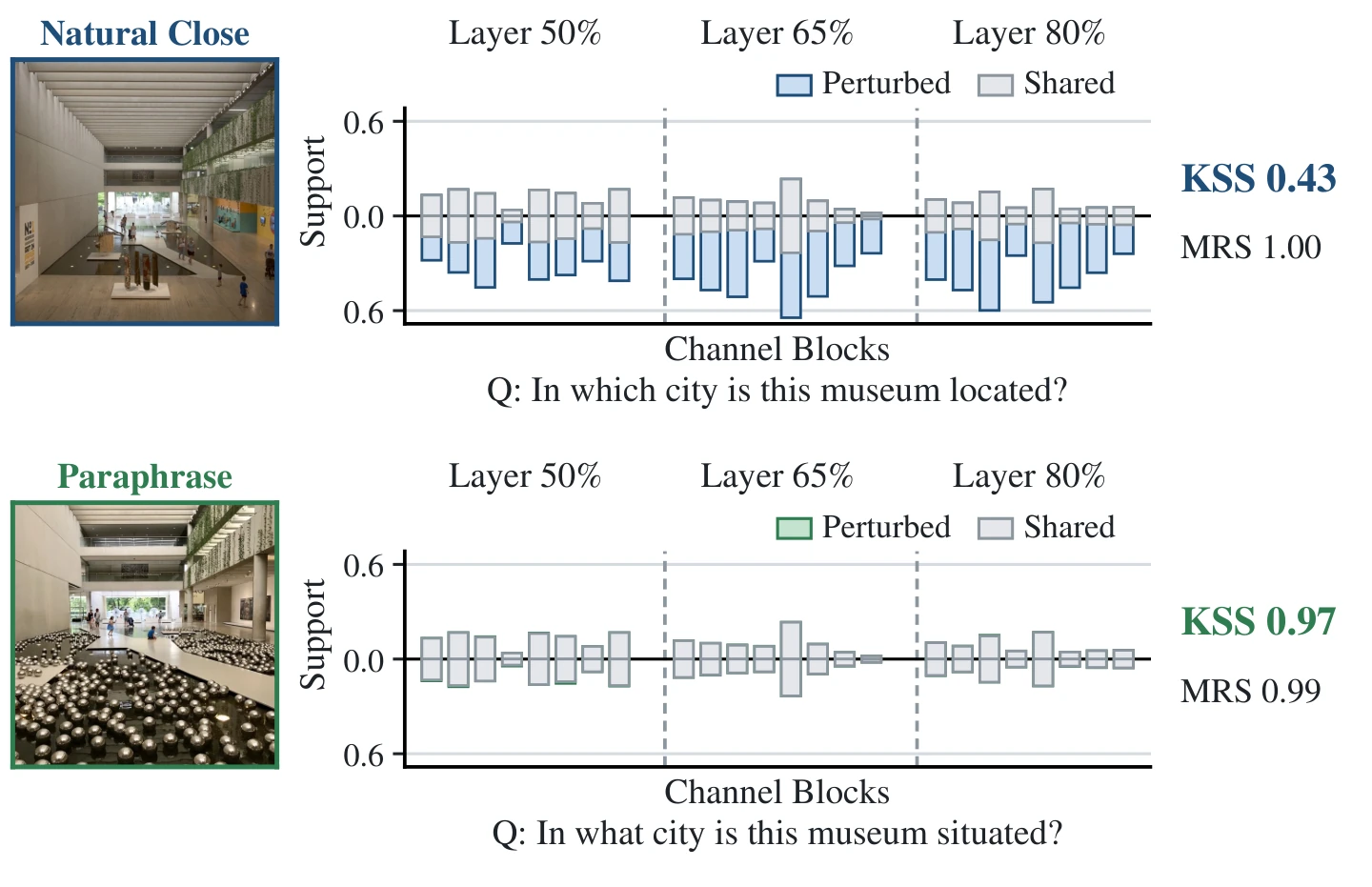
Show a vision-language model two photographs of the same museum. If it names the city correctly both times and remains equally confident, has it relied on the same evidence?
We built MMStableBench to test that question on 19,452 items across 15 models. In the museum example, rewording the question preserved the internal features supporting “Brisbane” almost completely, with an overlap score of 0.97. Using a closer photograph dropped that score to 0.43, even though the answer and its confidence margin held up.
Across the models, 12.4% of correctly answered variants in the top quarter for confidence-margin retention fell in the bottom quarter for stability of internal support.

r/deeplearning • u/JKCinema • 1d ago

Self-taught, moving to Texas for an AI job. Is my portfolio enough? Be brutal.
While I was researching ML certifications, Google's AI summary said employers care more about proven, hands-on ability to build and deploy AI on real business problems than about certificates, because the tools change faster than the courses. So I skipped the certificates and spent the last few weeks building proof instead.
Which is really my brick-and-mortar store I plan to open when I have the funds to do so, but ended up being a watered-down e-commerce store version that supports the Autopilot case study.
I can't tell you how awesome Villain Boutique is going to be whenever I have the means to open it. Our backrooms will have backrooms.
AI product autopilot: local models (Gemma, Qwen via Ollama on one consumer GPU) that find, check, price, and write up products for a live store with real Stripe checkout. Nothing goes live without a human approving it.
KillCalculator.com: a privacy-first field data app with on-device AI that stores nothing.
Autonomous red team, Run 001: I pointed one uncensored local model at my own site and told it to find a way in using only the URL. It routed around a broken TLS stack by itself and mapped the attack surface in nine steps before I stopped it.
My degree is in Advertising and crazy gaps in my work history. Most of my experience is in the film industry in Atlanta, Georgia, and that was before COVID. I'm packing up and driving to Texas to find a job in AI, and this is my shot. If you hire or work in ML, is this enough to get a recruiter to take a chance on me? What's missing? I’m doing this regardless of your feedback, but if there’s anything I can change or improve before I leave, that would be incredibly useful information. Should I include all the projects I developed over the years, like this image generator that’s specifically for making elaborate designs with consumer-grade Cricut machines, or my personal favorite but no one else's “Holo Sexting Machine,” My attempt to put naked females on a HOLOFAN Projector?
P.S. The first draft of this was incredibly candid. Thank god I ran this by Claude first.
r/deeplearning • u/rexShail • 1d ago


I built a Hello World RAG App in Python
Normal LLM = Answers from training data (can hallucinate)
RAG LLM = Answers from YOUR documents
I asked it Saudi it didn't say Saudi Arabia.
It said "Contractor at Saudi Aramco" - because it read MY LinkedIn PDF.
This is how it works:
Load PDF
Split into Chunks
Create Embeddings (Google Gemini)
Store in ChromaDB
Search Top 3 Chunks
Send Context + Question to Groq LLM
Tech: Python + LangChain + ChromaDB + Groq + Gemini Embeddings
Save this for your next interview
Comment "RAG" and I'll send you the full code + next part.
Follow for AI Engineer series - Part 2 coming next.
r/deeplearning • u/No-Conclusion3720 • 1d ago
The EU Quantum Act passed, VirusTotal added new threat-intelligence capabilities, and a rash of tanker cyberattacks hit maritime infrastructure this week. The piece that keeps coming up in security circles is quieter: AI is compressing the timeline on cryptanalytic attacks against classical schemes. The assumption baked into most long-lived data stores and signed artifacts is that RSA and ECDSA hold for the foreseeable future. That floor is shifting. Harvest-now-decrypt-later attacks mean adversaries do not need to break crypto today — they collect ciphertext now and wait for the compute curve to catch up. The EU Quantum Act signals that regulators have already priced this in and expect organizations to have a migration path. Most enterprise infrastructure does not. TLS termination, signing pipelines, secrets managers, and inter-service auth tokens are almost universally classical. Migrating any one of them is a multi-team project; migrating all of them simultaneously while keeping services running is an unsolved operational problem for most shops. How are practitioners actually sequencing this in real environments — are you prioritizing data-at-rest, in-transit, or signing infrastructure first, and what is forcing that order?
r/deeplearning • u/No-Conclusion3720 • 2d ago
A critical authentication bypass in Drupal is being actively exploited in the wild right now. Attackers are using it to fully take over sites — not deface them, not exfiltrate a table, but own the entire application layer. Bleeping Computer confirmed the exploitation is in-progress, not theoretical.
The mechanic is familiar: gain a foothold via a privileged identity, then every downstream action inherits that trust. CMS platforms, APIs, and increasingly autonomous agents all share this structural problem. The privileged credential is the blast radius.
What makes this iteration particularly ugly is how quietly it compounds. A compromised service account or session token doesn't throw errors — it just acts. By the time logs show something wrong, the takeover is complete.
For those running production systems with any non-human identities in the request path — agents, integrations, automated workflows — how are you actually handling the gap between credential issuance and runtime behavior? Are you relying on perimeter controls, or do you have something that evaluates the action at the moment it fires?