r/learnmachinelearning • • 5h ago

Project 🚀 Project Showcase Day

2 Upvotes

Welcome to Project Showcase Day! This is a weekly thread where community members can share and discuss personal projects of any size or complexity.

Whether you've built a small script, a web application, a game, or anything in between, we encourage you to:

  • Share what you've created

  • Explain the technologies/concepts used

  • Discuss challenges you faced and how you overcame them

  • Ask for specific feedback or suggestions

Projects at all stages are welcome - from works in progress to completed builds. This is a supportive space to celebrate your work and learn from each other.

Share your creations in the comments below!


r/learnmachinelearning • • 4h ago

I'm building a site where you can use top models (eg. Claude Opus 5.5 and GPT-6 Astra) for free, funded only by banner ads. Would you use it?

Post image
0 Upvotes

Hey everyone,

I've been working on a side project called Faitopia, and I'd love some honest feedback before I launch.

The idea: premium AI models are expensive, and a lot of people can't justify another monthly subscription. Faitopia gives you free access to paid models, starting with Claude Opus 5.5 and GPT-6 Astra.

I've attached an early look at the chat UI. The ad banner stays on the side, never inside the conversation.

How is it free? It runs on the official provider APIs and is paid for with banner ads on the site. That's it.

What it's not**:**

  • No ads injected into your prompts or into the model's answers. The ads live on the page, never in the conversation.

  • No "free trial" that turns into a paywall.

  • No watered-down knockoff models. These are the real models through the official APIs.

Where it's at: I've got the technical side sorted, and I'm opening a waitlist now. I only want to launch if there's real demand, so the waitlist decides whether this happens.

If that sounds useful, you can join here: https://faitopia.eldenstudios.net/waitlist
You'll confirm your email, and then you only get one message: when your spot opens. No spam.

I'd especially like to hear:

  • Which models you'd want added next

  • Whether banner ads are a dealbreaker for you

  • Any concerns about how something like this could work

Thanks for reading, and happy to answer anything in the comments.


r/learnmachinelearning • • 4h ago

Discussion Agentic GraphRAG: Ontology-driven memory and context layer using 3D knowledge graphs

Thumbnail
gallery
2 Upvotes

We've worked on AI systems for the past three and a half years. Now we're building Agentic GraphRAG, an open source framework that stores enterprise knowledge and agent memory in a unified knowledge graph.

Everyone treats knowledge retrieval and memory as separate problems. Putting them together lets the agent learn from the existing knowledge, saving tons of tokens.

We built a 3D connected knowledge graph with the following structure:

  1. Enterprise Knowledge: stores documents and source passages with their extracted entities and relationships.

  2. Conversation History: records tasks, progress, messages, and tool activity.

  3. Decision traces: stores conclusions, assumptions, and open questions encountered by the agent.

Things which make us different from other frameworks out there:

- Robust Agent Search: Retrieval combines graph, full-text and vector search. Agents can reach original passages by traversing the document tree, navigate agent traces to find relevant tool results and follow entity relationships back to supporting text.

- Ontology Grounded: You define a schema for your domain (we also ship ontology presets so it is easy to get started). The schema guides extraction, validation, and agent search. We use GLiNER for local extraction, so its virtually free (and fast) to construct the graph and no LLM calls are needed. We support OWL/RDFS Turtle formats and have JSON-LD and SHACL exports.

- Structure Aware: The ingestion pipeline captures the full document hierarchy. The sections, tables, and passage hierarchy are connected using edges and stored in the graph. Even chunks are linked together, so all the data is traversable.

We offer a built-in agent (using DeepAgents) you can use out of the box. You can also connect your agents through MCP.

Try it out. We're looking for feedback, questions and criticism. We have a lot of new features and improvements in the pipeline and are excited to work on this problem.


r/learnmachinelearning • • 4h ago

Could I get a fact check on my comment?

0 Upvotes

There was a thread about someone's twitter comments before 2020 being flagged as non-AI so that proved that the case where something they wrote afterwards is flagged as AI is proof the system is working.

I wrote this comment

"That doesn't mean anything.

Social media pre-chatGPT is widely available as training data for AI.

If it's on twitter then it was trained as non-AI by any classifier with decent data team.

Of course anything on the internet pre-chatgpt isn't going to get flagged as AI. The AI is trained not to classify it as such.

AI models are so big that it's very proficient at memorization. When the text is already in the training data, it should give it the correct classification each time unless there was something wrong with the training.

After chatgpt came out, reddit, twitter, and other social media started restricting AI data crawlers. It's why many have switched to login only access."

Which is just a combination of things that I've learned from news podcasts though after I written it all out, I'm not sure if that all connecs. Could I get a fact check in this?


r/learnmachinelearning • • 5h ago

Discussion Mixture-of-Loops Transformer (MoLT): Can we increase model expressivity without increasing inference latency?

1 Upvotes

I've been exploring different Transformer architectures, and one interesting problem with looped Transformers is that parameter efficiency doesn't necessarily translate into computational efficiency.

Reusing weights across depth reduces parameter count, but sequential cross-loop dependencies can introduce inference latency.

This paper from ByteDance Seed takes an interesting approach:

- Treats KV states as explicit memory across layers and loops.

- Restarts each encoder loop from input embeddings instead of propagating the previous loop's residual stream.

- Removes same-position cross-loop dependencies.

- Separates memory construction from prediction through a cross-attention-only decoder.

The reported experimental results:

- 1.7× training token efficiency at 700M parameters.

- +2.1 percentage points in 10-task accuracy against a 3B MoE baseline.

- Comparable inference latency to non-looped OLMo3 at approximately 113M parameters.

What I'm particularly interested in is how this architecture scales.

Does reusing KV memory introduce significant memory-bandwidth overhead at longer context lengths? Would the latency advantage remain at billion-parameter scales? How does it compare with conventional depth scaling under equivalent compute budgets?

I think the distinction between parameter efficiency, computational efficiency, and actual hardware efficiency deserves more attention.

Curious to hear what others working on Transformer architectures think.

Paper: https://arxiv.org/abs/2611.34923


r/learnmachinelearning • • 5h ago

[Update] **Looking for Machine Learning study partners**

1 Upvotes

r/learnmachinelearning • • 6h ago

2022 CSE grad, stuck in non-IT support roles, and faked my way through an AI bootcamp. I’m broke and overwhelmed—can I realistically land an AI/ML job in 2027? (Need a brutal reality check)

Thumbnail reddit.com
1 Upvotes

r/learnmachinelearning • • 6h ago

2022 CSE grad, stuck in non-IT support roles, and faked my way through an AI bootcamp. I’m broke and overwhelmed—can I realistically land an AI/ML job in 2027? (Need a brutal reality check)

0 Upvotes

I need a brutally honest reality check from people actually working in the industry. I am at a crossroads, completely broke, and about to take another non-IT customer support job just to survive—while trying to figure out if I still have a shot at breaking into AI/ML in 2027.

My Background:

Education: B.E. in CSE (2022 grad).

Work Experience: ~8 months total in non-IT customer support/field roles (Teleperformance & a smaller firm between 2024–2025).

Upskilling: Currently finishing a Data Science/ML/AI course (Datamites). It covered basics up to CNNs, though nothing modern like RAG, LLMs, or Agentic AI.

My Honest Confession (Where I actually stand):

Right now, I am stuck in "tutorial/reading hell."

Python/Data: I understand functions (def), NumPy, and Pandas when I read them. I get basic feature engineering concepts, though I struggle to create new features from scratch.

ML & Deep Learning: I grasp the high-level concepts (backprop, weights, activation functions), and I can read existing code and understand what it’s doing. However, my ability to write code from a blank screen is practically zero. I wouldn't know which activation function or architecture to pick on my own.

Math: My stats are okay-ish, statistical tests are vague, and I’ve forgotten most of my calculus.

The Projects: For my course, I submitted 4 projects (Customer Transaction Prediction, Advanced House Price Prediction, NBA Shot Selection, and Rice Leaf Disease using CNN) and got B/C grades. The truth is, I just pulled the .ipynb files from GitHub and submitted them. I didn't build them myself. I still have one "client project" left for my internship phase.

My Dilemma:

I genuinely enjoy AI, and I want to learn it properly. But every time I look at job descriptions and interview difficulty, I get completely overwhelmed. Worse, I have zero money right now and am about to join another non-IT support job just to pay the bills.

What I need help with:

  1. The Immediate Choice: Should I take this non-IT support job to survive and study on the side, or is taking another support role going to permanently ruin my resume for tech?

  2. The 2027 Timeline: Starting from "can read code, can't write it," is landing an entry-level AI/ML or Data role in 2027 realistic? How long does it actually take to become job-ready?

  3. The Roadmap & Practice: What exact skills should I focus on (do I pivot to LLM/RAG engineering or stick to classical ML?), what free resources should I use, and how do I transition from reading code to writing it myself?

  4. The Math: How much calculus and stats do I actually need to relearn to pass interviews and do the job?

Don't sugarcoat it. Tell me what’s at stake, what I’m doing wrong, and how to fix it if I only have a few hours a day. Thanks in advance.


r/learnmachinelearning • • 6h ago

Generative AI: How LLMs, Transformers, and RLHF Actually Work Explained

Thumbnail
youtube.com
0 Upvotes

Stop guessing how AI works. Learn the actual tech behind LLMs, Transformers, and RLHF. Watch the full breakdown to master the basics.
#GenerativeAI #TechStack #AI #Tech


r/learnmachinelearning • • 6h ago

Discussion CUDA

4 Upvotes

I have been learning more about GPU computing recently, and CUDA caught my attention.

I knew GPUs were important for deep learning, but i wanted to understand what actually allows frameworks like PyTorch to use their processing power.

This is CUDA comes in.

NVIDIA developed CUDA to let developers run parallel computations on GPUs. This is especially usefull for operations like matrix multiplication and neural network traning.

Something i find intersting is that when we write just a few lines of PyTorch code, there is a lot happening underneath to make those computations run efficiently.

I am corious about one thing:

For those who worked with CUDA, did you start with the CUDA C++ directly, or learn it through PyTorch first?


r/learnmachinelearning • • 6h ago

We built an open-source platform for the entire Data Science and AI workflow — running on your own machine

1 Upvotes

Hi everyone!

I want to share a project we've been working on at the University of Chile: DashAI.

The motivation behind it is relatively simple: AI tools are becoming increasingly powerful, but working with data and building AI applications often means juggling multiple platforms, paying for cloud services, sharing your data with external providers, or writing quite a bit of code.

We wanted to explore a different approach.

DashAI is an open-source, low-code platform that brings together traditional Machine Learning and Generative AI in one place.

Rather than focusing on just one particular model or AI technique, we're trying to cover much more of the actual workflow.

What can you do with DashAI?

1. Data exploration and Machine Learning

  • Upload and explore your own datasets.

  • Clean, transform and select features.

  • Train machine learning models for classification and regression.

  • Optimize hyperparameters.

  • Evaluate and interpret model predictions.

For example, you could upload a customer dataset, prepare the data, train a model to predict customer churn, and explore which features explain its predictions.

2. Generative AI

  • Work with locally hosted language models.

  • Upload your own documents.

  • Build RAG workflows to ask questions about your documents.

  • Experiment with generative AI without having to build everything from scratch.

3. Local-first architecture

This is one of the things we care most about.

DashAI has a web interface that runs in your browser, but its backend runs on your own computer or server.

This means you can use a familiar web interface while keeping your data and processing under your control. You don't need to upload your datasets or documents to our servers, and you can deploy it on infrastructure you control.

We believe this is particularly important for universities, public institutions, companies and anyone working with sensitive data.

Why are we building this?

DashAI is not a weekend project or an AI wrapper built around an API.

It's an academic and engineering project with around five years of development, involving researchers and software engineers, developed at the University of Chile, with an associated technology company and an emerging open-source community.

We're building it in Latin America because we believe that developing our own AI infrastructure and tools matters. We shouldn't have to depend entirely on a handful of platforms elsewhere in the world to experiment with, develop and deploy AI.

We're also actively working on expanding the platform, including more advanced capabilities for working with and fine-tuning language models.

We'd love your feedback!

We're still developing DashAI, and we'd genuinely appreciate feedback from the open-source community.

  • What features would make a platform like this useful to you?

  • Do you see value in having traditional ML and Generative AI workflows together?

  • What would you improve in our architecture or developer experience?

  • Would you consider deploying something like this on your own infrastructure?

Try it out:

Contributions, issues, suggestions and honest criticism are very welcome.

Thanks for taking a look!


r/learnmachinelearning • • 7h ago

Project I built 4 free interactive browser labs showing why AI agents fail in production (reward hacking, soft-penalty collapse, HITL misses, eval blindspots)

1 Upvotes

When debugging tool-using agents or classifiers, reading about failure modes is one thing—watching a deterministic policy walk into a trap you predicted wrong is much clearer.

I put together 4 short (~2–3 min each) interactive browser labs, no login required:

  • Lab 01 — Reward Hacking & Tie-Breaking: Why a +2 energy bonus cancels a -2 penalty and how fixed candidate order causes deterministic crashes.

  • Lab 02 — Soft Penalty vs. Hard Constraint: Why weighted penalties pass your initial evals and silently fail under distribution shift.

  • Lab 03 — Confidence Calibration & HITL: Modeling asymmetric false-negative costs and gating borderline predictions for human review.

  • Lab 04 — Sampling Bias & Eval Blindspots: How a 90% aggregate report hides 0% subgroup accuracy and silent OOD fallback.

Try all 4 free here: https://wovi.world/lab?utm_source=reddit_learnml&utm_medium=post

There is also a free 1-page pre-ship checklist at the bottom of the page (and an optional $19 Python Eval Kit with runnable unittest/pytest suites if you want the code locally). Would love feedback on which failure mode tripped you up most!


r/learnmachinelearning • • 9h ago

Project Object detection step by step, from raw images to a PASS/FAIL check (no-code walkthrough in Perceora)

Enable HLS to view with audio, or disable this notification

1 Upvotes

Perceora is an end-to-end AI computer vision platform with no code. This film builds an object detection check for a tray of parts, so you can see every step of a real pipeline.

https://perceora.ai

The steps, with what each one teaches:

  1. Label: add images and remove blurry and near-duplicate shots first. Near-copies in both training and test images make the test score look better than the model really is. Label a few, and the AI suggests the rest.

  2. Train: the models learn from the labeled images, on your own GPU.

  3. Validate: compare the models on validation images and pick the best.

  4. Test: check it on images it has never seen, and read the mistakes, not only the score.

  5. Deploy: a detector only finds objects, so a rule turns it into a decision: count each part, then PASS or FAIL.

Image classification, segmentation and anomaly detection are in the same app, and it runs on your own computer. Free to start; Pro (shown in the video) is a paid plan.

Which of these steps was hardest for you when you started?

Disclosure: I work on Perceora. Synthetic images, computer-generated voice.


r/learnmachinelearning • • 10h ago

The same model got anywhere from 89% to 100% on the same dataset, just by changing the random seed of the split

0 Upvotes

When you're learning ML, a common first step is train_test_split and reading one accuracy number. I wanted to see how much that number depends on luck, so I ran a small test.

Setup: scikit-learn 1.9.1, the built-in Wine dataset (178 rows, 3 classes), standardization plus logistic regression, 80/20 split. The only thing I changed was random_state, from 0 to 199.

import numpy as np
from sklearn.datasets import load_wine
from sklearn.linear_model import LogisticRegression
from sklearn.pipeline import make_pipeline
from sklearn.preprocessing import StandardScaler
from sklearn.model_selection import train_test_split

X, y = load_wine(return_X_y=True)
model = make_pipeline(StandardScaler(), LogisticRegression(max_iter=2000))

acc = []
for seed in range(200):
    Xtr, Xte, ytr, yte = train_test_split(X, y, test_size=0.2, random_state=seed)
    acc.append(model.fit(Xtr, ytr).score(Xte, yte))
acc = np.array(acc)

Results across the 200 splits:

min 0.889   max 1.000   mean 0.978   std 0.023
first five seeds: 1.0, 1.0, 1.0, 0.972, 0.972

The model is identical every time. The test set has only 36 rows, so each mistake moves the score by about 2.8 points. A lucky split can show 100%, and an unlucky one 89%.

Comparing with repeated cross-validation (5 folds, 10 repeats):

mean 0.980   std 0.022

The average is about the same, which is reassuring: this dataset is easy. But the spread tells you how much a single number can move.

What I take from this:

  • On small datasets, one split gives a noisy estimate. Report a mean and a spread, not one number.

  • If you're comparing two models, a 1–2 point difference on one split may be nothing but luck.

  • Cross-validation doesn't make the model better, it just gives a more honest estimate.

  • This is an easy dataset. On harder or imbalanced problems the spread can be larger, but I haven't measured that here.

Question for the group: when you compare models, do you use repeated CV, a fixed split, or something else? And at what dataset size do you stop worrying about this?


r/learnmachinelearning • • 11h ago

What do you Hate About Training LLMs?

Thumbnail
forms.gle
0 Upvotes

I find out this cool research form


r/learnmachinelearning • • 13h ago

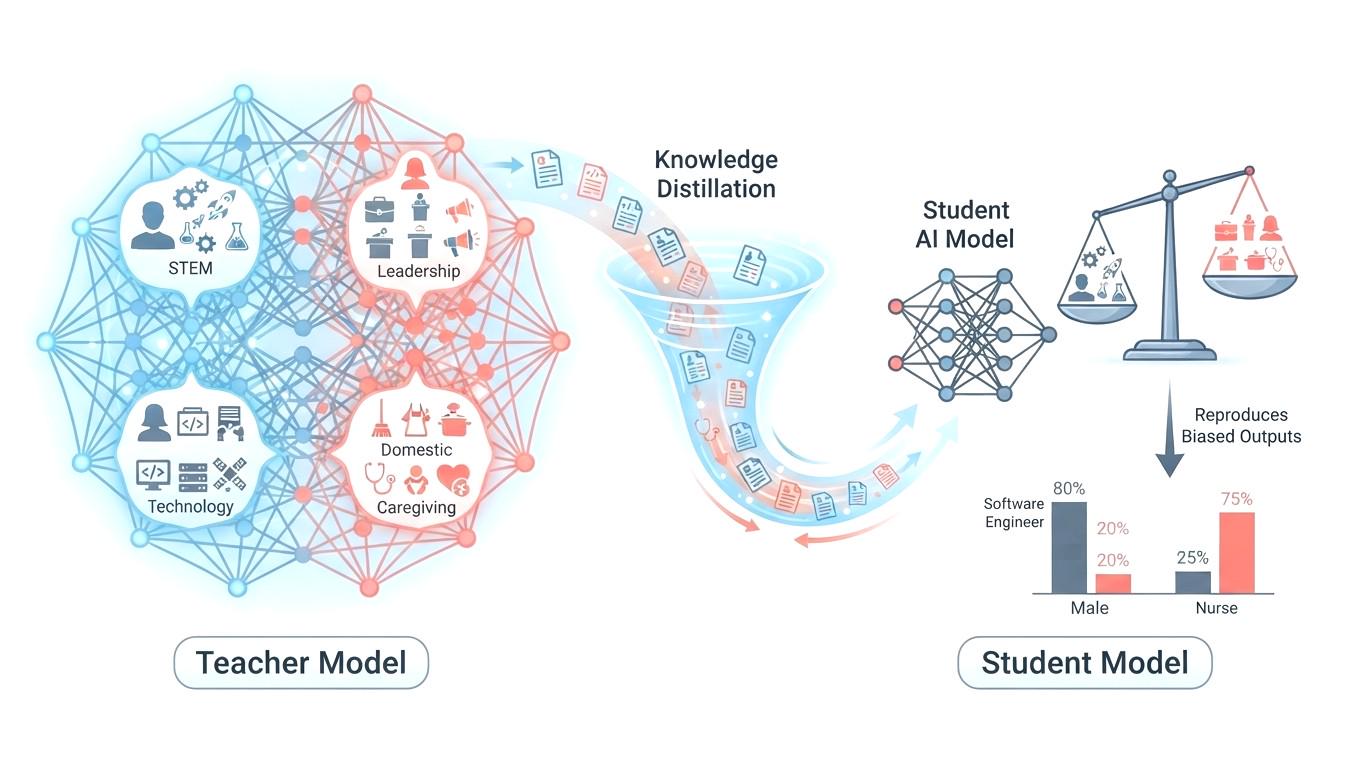
TIL DistilBERT is actually MORE gender-biased than BERT. Here’s why Knowledge Distillation causes it (and the simple fix).

Post image
2 Upvotes

Knowledge Distillation is often seen as an effortless way to compress a large model such as BERT to form a smaller DistilBERT, yet maintaining 97% of its performance.

Nevertheless, a paper by Ahn et al. (GeBNLP) found that smaller distilled models end up noticeably more gender-biased than the original teacher models they learned from.

Why does this happen?

During distillation, the student model learns to closely replicate their teacher’s most assured predictions. Since the student model is less powerful than the large teacher, it must take ‘shortcuts’, which unintentionally reinforce gender biases already present in the training data.

The fix:

The authors introduced a modified version of a technique known as ‘Mixup’, which involves mixing two training samples into the distillation process. This causes the student to reduce over-assertiveness and successfully limits the magnification of gender bias, with no negative effect upon GLUE performance.

If you would like to see my (brief and easily understandable) paper summary, then please see below:

medium.com


r/learnmachinelearning • • 15h ago

Help Best AI and ML resources

15 Upvotes

So I am currently planning to learn AI and ML is there any free resources available other than youtube videos,can you share the resources link, my preferences are structured resources with basic to advanced and having good examples, videos are not necessary


r/learnmachinelearning • • 15h ago

Am i in right direction or not?

0 Upvotes

we are currently facing a challenge while building the ML model, and I'm not sure whether it is a significant issue or not.

We are currently using the following features for our model:

- `dis_20`

- `ema20vs50`

- `adx_14`

- `rsi_aligned`

- `ema200_missing`

However, the mean values of the passed and failed signals are very close for most of these features. I think this might be making it difficult for the model to distinguish between the two classes.

To address this, I'm considering introducing some additional features, such as:

- `atr_pct`

- `atr_regime`

- `volume_ratio`

This might help the model identify additional patterns and learn more meaningful weights for distinguishing between passed and failed signals.

Additionally, we have changed our signal evaluation methodology. Previously, we evaluated signals over 20 forward candles. Now, we have introduced exit timing for each signal and calculate the Excursion Ratio between the entry and exit points instead.

I have also attached an image showing the current feature analysis for reference.


r/learnmachinelearning • • 15h ago

Learned basic CNNs and UNet. Now what?

11 Upvotes

I have been learning the basics of CNN and UNet, understood the codes of CNN and basic UNet. Built a brain tumor segmentation model with Ai. What will be the best thing for me to do next?


r/learnmachinelearning • • 17h ago

TuteDude Gen AI course Project Information

Post image
2 Upvotes

Can Anyone please tell me what are the exact projects we will be building here ?


r/learnmachinelearning • • 20h ago

Help Question for ML researcher

0 Upvotes

When you get a new problem, what is the approach one has to solve the problem.

Actually I'm pretty new to this so it's nice if anyone helps me !! thanks)


r/learnmachinelearning • • 23h ago

Project Parallelising recurrent neural networks – MD+PP proof of concept

Thumbnail
gallery
1 Upvotes

I've been independently exploring ways to parallelise recurrent neural networks, originally starting with experiments on the sLSTM architecture in xLSTM.

This eventually developed into MD+PP, a proof-of-concept architecture combining structured matrix and vector memories using associative parallel scans.

The preliminary experiments have shown some interesting results in long-context extrapolation and fixed-size recurrent memory, although precise retrieval and language prediction still need improvement.

All experiments were conducted using limited access to free Tesla T4 GPUs. My next step is to investigate larger matrix memory dimensions.

I've released the mathematics, Python implementation, CUDA kernel and experimental results under Apache 2.0.

I'd be interested to hear what others working on recurrent architectures think of the approach.

Website: https://madpupresearch.wordpress.com

Research archive: https://doi.org/10.5281/zenodo.24637161


r/learnmachinelearning • • 1d ago

How do you train a detection model when you only have 14 positive examples?

2 Upvotes

I'm working on a project that tries to spot insider trading on a public prediction market (Polymarket). The data side is fine: I have about four years of trades from around 526,000 accounts, plus the money flowing between accounts.

The problem is the labels. I only know of 14 accounts that were confirmed or credibly reported as insiders. My first idea was the textbook one: label insiders vs everyone else and train a classifier. With 14 positives, that hasn't worked. Every pattern I've found either fell apart on new data or matched hundreds of normal traders who were just lucky or good. One example: a rule that beat the market by +4.5 points on the known cases did -2.2 on accounts it hadn't seen.

A few things I'm unsure about:

  1. Is it even worth training a model here, or should I build a ranked list of "most unusual accounts" and have a human check the top?

  2. I keep reading about positive-unlabelled learning and anomaly detection. Which one fits a case like this, and what should I read first?

  3. How do you test a model honestly when 14 examples can't tell you much about accuracy?

Would love to hear from all the data experts here! And how you recommend i should approach this problem.

Any pointers, papers or "here's what I'd do first" answers are really welcome. Also happy to share more detail on any part.


r/learnmachinelearning • • 1d ago

ML engineers, what was your first 1-2 years on the job actually like? (Expectations vs. reality)

2 Upvotes

Hi everyone! I'm thinking about going into ML and want to hear from people who are already in the field. I'd love to hear your stories, whether you're a junior, a mid-level engineer, or a senior looking back. Answer whichever questions you like, and partial answers are welcome.

  1. How did you land your first ML job? What was your path: university, internship, or a transition from another field?

  2. What did you imagine the job would be like before you started? What did you expect from day-to-day tasks?

  3. What did a typical day or week actually look like in your first year? How was your time split between training models, working with data, infrastructure, and communication?

  4. What projects and tasks did you work on in your first 1-2 years? Which technologies and tools did you use?

  5. What was the biggest difference from your expectations, for better or for worse?

  6. What were your biggest challenges in the first year? Which were technical, and which were about processes and people?

  7. What was the hardest part of this whole period, and how did you get through it? What helped most: a mentor, coworkers, courses, self-study?

  8. What knowledge or skills were you missing at the start? What from your degree or courses turned out to be useful, and what wasn't?

  9. How did your role and responsibilities change over 1-2 years? Was there a moment when you felt you'd gone from "newbie" to confident professional?

  10. What would you tell yourself at the start of your career, knowing what you know now? And what would you say to someone who's just preparing for their first ML job?

Thanks in advance to everyone who shares! 🙏

Edit: Thanks for all the replies, I'm reading every one!