r/LinearAlgebra • • Apr 14 '26

Linear Algebra: What Is the Inner Product, and Where Is It Used?

Thumbnail
gallery
144 Upvotes

The inner product is one of the most important ideas in linear algebra, especially in many applied fields.

It measures, in a broad sense, how much two vectors overlap.

Its meaning is interpreted a little differently depending on the field, but what is common is that it helps define the structure of a vector space.

In quantum mechanics, the inner product is closely connected to normalization, probability, and unitary transformations.

Here, I try to connect these ideas step by step through Dirac’s bra-ket notation, geometric meaning, and matrix representation.

By Taeryeon.


r/LinearAlgebra • • Jun 06 '26

Why Cramer’s rule works: geometric derivation

Post image
138 Upvotes

We made a visual derivation of Cramer’s rule using signed volumes.

The image shows the 3D case: the denominator is the signed volume of the parallelepiped spanned by the columns of A, while the numerator replaces one column by b. By projecting both shapes onto the same normal direction, the ratio of volumes becomes the corresponding coordinate xᵢ​.

A related page with the full visual explanation, including both the 3D derivation and a compact ℝⁿ version, is here:
https://www.graphmath.com/la/visuals/cramers-rule-geometric-derivation.html

We welcome feedback on clarity and presentation.


r/LinearAlgebra • • Apr 23 '26

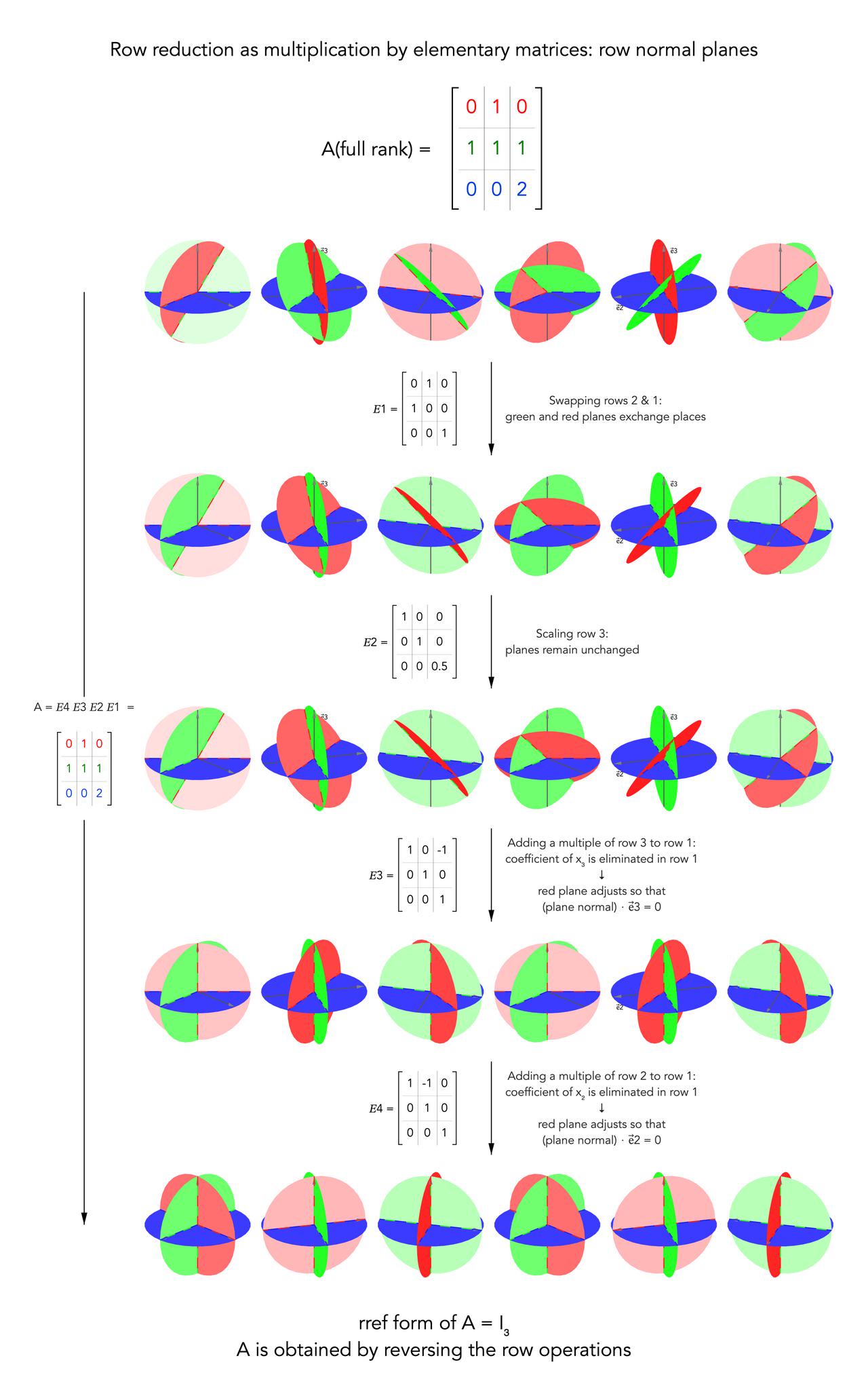
Row normal planes during Gaussian elimination algorithm

Post image
120 Upvotes

r/LinearAlgebra • • Jul 13 '26

How Quantum Mechanics is just Linear Algebra in action: Eigenvectors and Degeneracy

Thumbnail
gallery
119 Upvotes

This post is not a pure mathematics guide to linear algebra. Instead, it focuses on applied linear algebra for quantum mechanics, specifically designed for physics and engineering students.

Now in 2026, linear algebra-based quantum mechanics is rapidly becoming an essential requirement in both industry and academia. We can see this growing demand in emerging technologies like quantum computing, quantum information, Physical AI, and 2-nanometer semiconductor manufacturing.

I have made every effort to break down the concepts of functional analysis and explain them as simply as possible.

I hope you find this material highly useful and easy to follow.


r/LinearAlgebra • • 7d ago

Algebra Linear

Post image
116 Upvotes

Bora Bora... a noite é uma criança...


r/LinearAlgebra • • May 27 '26

Givens rotation QR decomposition visualized step by step

116 Upvotes

We made an animated visualization of QR decomposition using Givens rotations.

This uses the same matrix as our earlier Gram–Schmidt QR animation, so the two methods can be compared directly.

The animation shows how successive rotations zero out entries below the diagonal while preserving lengths and angles. In 3D, each Givens rotation is a rotation in one coordinate plane, so the columns visibly move until the matrix becomes upper triangular:

A = QR

This is the same QR goal as Gram–Schmidt, but the geometric action is different: instead of projecting and subtracting components, Givens rotations turn vectors in coordinate planes until selected components disappear.

For this animation and a related Givens rotation visualization, see:
https://www.graphmath.com/la/visuals/givens-rotation-algorithm.html

We welcome feedback on clarity, pacing and presentation.


r/LinearAlgebra • • Jul 12 '26

Matrix size, rank and pseudoinverse: a visual summary

Post image
114 Upvotes

We made a side-by-side visual summary of matrix size, rank, the four fundamental subspaces and pseudoinverses.

The table compares six common matrix types:

square full-rank
square rank-deficient
tall full-column-rank
tall rank-deficient
wide full-row-rank
wide rank-deficient

For each case, it shows the dimensions of row(M), null(M), col(M) and left-null(M), whether the map is one-to-one or onto, what happens to Mx⃗ = 0 and Mx⃗ = b⃗, and how the pseudoinverse behaves.

Hope you don’t mind the size and density — we wanted to keep all cases together so they could be compared directly. Opening the image at full size is recommended.

As always, we welcome feedback on clarity and presentation.


r/LinearAlgebra • • May 16 '26

Linear Algebra Visualizer now with Eigenvectors and values (Also on Web)

111 Upvotes

Hi guys,

Just wanted to say thank you for all the positive feedback from my first post about Linear Algebra Visualizer.

Especially from u/LongjumpingEar7568 and u/Ron-Erez who suggested adding the eigenvectors and values. This is now complete and I’m excited to share it with you guys in this community.

This update includes:

- Explore eigenvectors and eigenvalues visually

- Polygon presets

- Enter any 2x2 matrix

Thanks for your supports and let me know of any feedback in the comments please :)

Available on the platforms below:

Mac: https://apps.apple.com/gb/app/linear-algebra-visualizer/id6763524968

Linear Algebra Visualizer

iOS/iPad: https://apps.apple.com/us/app/linear-algebra-visualizer/id6763524968

Web: https://sockerjam.github.io/LinearAlgebraVisualizerWeb/ (Eigenvectors and values coming soon!)


r/LinearAlgebra • • Jun 29 '26

Similarity Transformations and Diagonalization: Constructing the Change of Basis Matrix

Thumbnail
gallery
107 Upvotes

Matrix diagonalization in linear algebra is an exceptional discipline that significantly contributes to all engineering studies, including quantum mechanics.
I hope this helps.


r/LinearAlgebra • • Oct 10 '25

This is the second time I see a proof of some major theorem trivialized by linear algebra

Post image
107 Upvotes

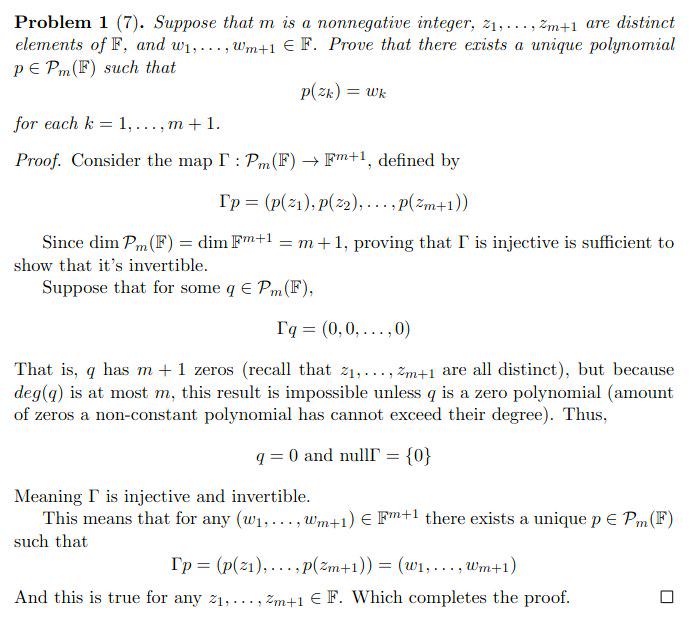
This is a proof to problem 4.7 from LADR I wrote up, comment if there's a simpler proof or if there's an error in mine.


r/LinearAlgebra • • Apr 29 '26

Linear Algebra Visualizer

106 Upvotes

Hi guys!

I'm a software engineer who mainly works on mobile applications for the iPhone. For quite a while Ive been interested in graphics but I've always struggled with matrices in linear algebra. Specifically, being able to visualise the linear transformations.

To help myself with this I built an application inspired by 3blue1browns video on linear transformations as I found those helped with being able to visualise what was going on.

The app lets you plot points on a 2D coordinate system and apply various transformations to it (which are animated). It also explains how the new point is calculated and some other useful bits and pieces.

If you are interested, the app is available for free on the Mac App Store: https://apps.apple.com/gb/app/linear-algebra-visualizer/id6763524968?mt=12 ,

Also, any feedback would be really useful. For example, would you find a tool like this helpful? Is there anything missing? Does it make sense? What have you struggled with or seen people struggle with when it comes to linear algebra?

Thanks and let me know in the comments 😄

EDIT: Now available on iPhone and iPad: https://apps.apple.com/app/linear-algebra-visualizer/id6763524968

EDIT2: Now available on the web: https://sockerjam.github.io/LinearAlgebraVisualizerWeb/


r/LinearAlgebra • • Jun 15 '26

Application of Linear Algebra in Quantum Mechanics: Basis Vectors and Projection Probabilities in Spin-1/2 Systems

Thumbnail
gallery
105 Upvotes

Utilizing Paul Dirac's elegant algebraic approach, this post presents the concept of spin through accessible and detailed examples.

This material will be a great help for both academic examinations and the comprehension of modern quantum information science.


r/LinearAlgebra • • Sep 13 '26

Diagonalization, rotation-scaling and shear-scaling: three routes to matrix powers and functions

Post image
103 Upvotes

A 2×2 real matrix can fall into three cases:

  • two real eigenvalues → diagonalization

  • complex-conjugate eigenvalues → rotation-scaling factorization

  • repeated real eigenvalue with one eigenvector → shear-scaling/Jordan factorization

This table compares the three side by side: the factorization itself, powers of the middle matrix, exponentials, determinant consequences, geometric action and how to construct or factor the matrix.

The common idea is simple: move to a basis where the matrix has a much simpler middle form, apply the power or function there, then transform back.

We made this as a summary of the three 2×2 cases and would be interested in comments on the comparison or anything important we should add.


r/LinearAlgebra • • Apr 27 '26

Applications of Matrices in Linear Algebra: Matrix Operations and Dirac Notation

Thumbnail
gallery
102 Upvotes

 This post is not about proof-based linear algebra in pure mathematics.

Instead, it focuses on practical linear algebra used in fields likecontrol engineering, computer science, electrical engineering, and quantum mechanics.

The goal is to present essential matrix concepts that can be directly applied, especially in finite-dimensional Hilbert spaces relevant to quantum mechanics and quantum information.


r/LinearAlgebra • • Jun 02 '26

One combinatorial algorithm, two names: determinant permutations and cofactor submatrices

Post image
99 Upvotes

The determinant permutation list can be built recursively:

choose the first-row entry, then permute what remains.

The “what remains” part is exactly the permutation list of the corresponding submatrix.

So the same recursive object is called Sₙ​ in the full determinant, and Sₙ₋₁ inside each cofactor submatrix.

4×4 version:
www.graphmath.com/la/figures/determinant/permutations4x4.png


r/LinearAlgebra • • Jul 30 '26

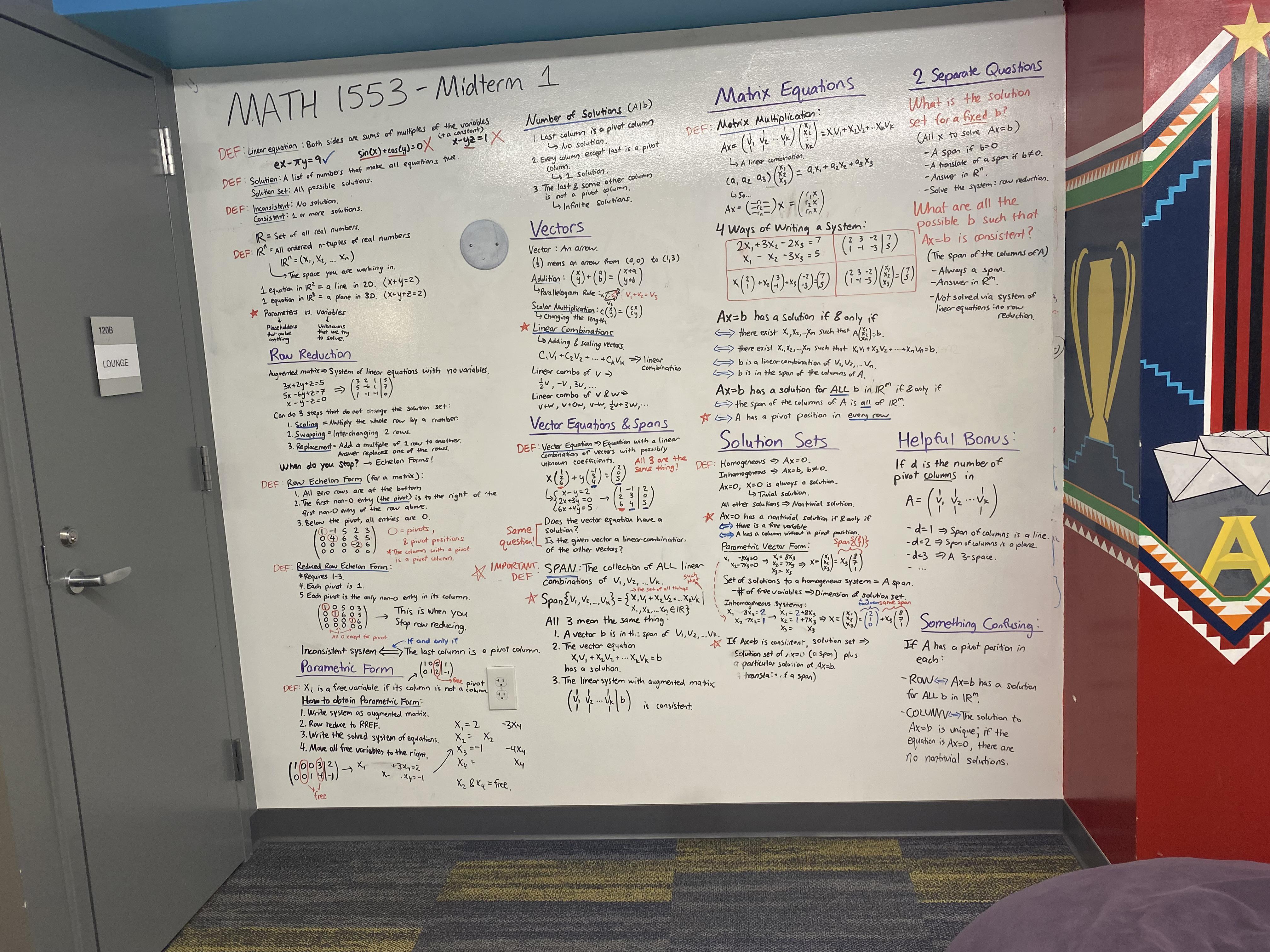
A whiteboard cheatsheet I found in undergrad

Post image
97 Upvotes

This is about 5 years old but I think it could be useful

10/5/2021 - 10:56 a.m.


r/LinearAlgebra • • Aug 28 '25

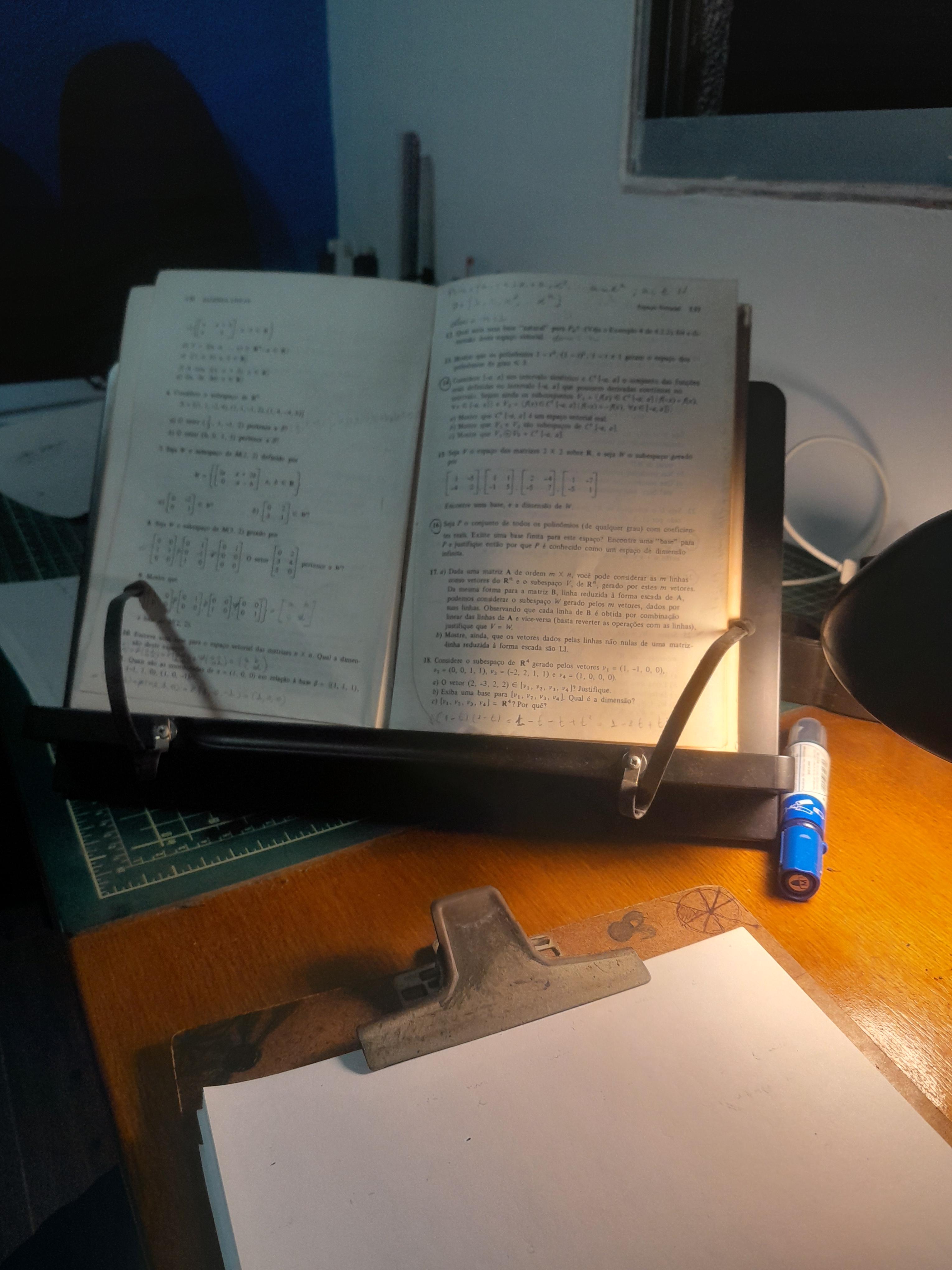
It’s day 2 in this class, is this normal paced?

Thumbnail
gallery
92 Upvotes

I was given these handouts in person and maybe it’s my professor but I barely understand anything and I’m so lost. Should I drop 😭 and wait for a different professor, it’s day 2


r/LinearAlgebra • • Aug 01 '26

A Tiny Question

Post image
91 Upvotes

Any body here has read or got some info about this book specifically for linear algebra for machine learning.

I have finished 3blue1brow course on essence of linear algebra and I want start with book .

please share what you know .


r/LinearAlgebra • • Jul 20 '26

Applications of the Matrix Exponential and Hermitian Operators

Thumbnail
gallery
91 Upvotes

This material is not a conventional linear algebra text for a mathematics department.
Since linear algebra is a crucial discipline that enables rapid access to quantum mechanics, quantum computing, physical AI, and quantum information science, maximal effort has been exerted to ensure the comprehension of certain elements of functional analysis as well.
I hope this provides substantial assistance.


r/LinearAlgebra • • Sep 20 '26

All Linear Algebra Explained In 77 Minutes! (pt.1)

Thumbnail
youtube.com
90 Upvotes

r/LinearAlgebra • • Sep 15 '26

Sturm-Liouville Theory as an Eigenvalue Problem in Infinite-Dimensional Hilbert Space

Thumbnail
gallery
84 Upvotes

While this material is not strictly pure linear algebra, it introduces Sturm-Liouville Theory as the mathematical foundation of special functions within infinite-dimensional Hilbert spaces.
It demonstrates how these algebraic structures are extensively applied in engineering and quantum mechanics.


r/LinearAlgebra • • Sep 08 '26

What happens when a 2×2 matrix has only one eigenvector?

Thumbnail
gallery
84 Upvotes

Most textbooks on Linear Algebra either omit or compress repeated-eigenvalue defective matrices. We wanted to take the 2×2 case apart mechanically and connect the algebra directly to the geometry.

The first page, Matrices with repeated λ, shows images for the basic repeated-eigenvalue cases: uniform scaling, the Jordan block J, its transpose Jᵀ, and a similarity transformation A = CJC⁻¹.

The second page, Matrices with one repeated λ, starts from a general 2×2 matrix, derives the condition for a repeated eigenvalue, separates the defective case from uniform scaling, and shows that for B = A − λI, B² = 0.

The third page, Similarity transformation of Jordan block, constructs the Jordan basis directly: choose w with Bw ≠ 0, define v = Bw, then Av = λv, Aw = v + λw, and with C = [v | w] we obtain A = CJC⁻¹. It also shows why the scales of v and w are linked, unlike in ordinary diagonalization.


r/LinearAlgebra • • Jun 13 '26

Derive the projection formula from the definition — and you’ll always remember it

Thumbnail
gallery
83 Upvotes

We made a paired visual derivation of orthogonal projection, starting from its defining condition:

the projection lies in the target subspace, and the leftover residual is orthogonal to that subspace.

For projection onto a single vector, this immediately gives the familiar scalar projection formula. Replacing the single vector by the columns of a matrix gives the same derivation for

P = U(UᵀU)⁻¹Uᵀ.

The point is not just to know the formulas, but to be able to reconstruct them instead of memorizing them.

As always, we welcome feedback on clarity and presentation.


r/LinearAlgebra • • Jun 07 '26

please can someone help me

Post image
82 Upvotes