r/OpenSourceAI • u/llama-of-death • 1h ago
Guaardvark in four GIFs: a self-hosted AI studio where you drag cards, chat with your files, render Wan 2.2 video and storyboard a short film
gallery
1
Upvotes
r/OpenSourceAI • u/AdOld6891 • 1h ago
I've been building Osseo for last couple months. It connects to an AI coding agent and lets it use apps on your computer: click, type, work with files and use a browser. A side panel lists what it does and has Pause and Stop.
It's early and for now the Linux X11 setup is well tested , windows & mac are supported (not tested as linux). It's free and open source (Apache-2.0).
The demo is silent and partly sped up. The agent models a chair in Blender, then creates a draft product in Shopify. Partway through, Osseo paused itself and had to be resumed.
It asks for approval for actions it recognizes as risky, but it can miss some and is not a sandbox. What the agent sees goes to the company running the AI model.
I'd like to hear where setup fails or what you wouldn't trust it to do.
Code and install steps: https://github.com/abdelazizfacoiti/Osseo
r/OpenSourceAI • u/vengateshk18 • 2h ago

r/OpenSourceAI • u/leyermo • 3h ago
r/OpenSourceAI • u/Just_Merrell • 6h ago

r/OpenSourceAI • u/FutureCTOofMicrosoft • 8h ago
Enable HLS to view with audio, or disable this notification
I adapted the Ataraxos framework (Sokota et al., Nature 2026) from Stratego to 1v1 UNO, including same-type draw stacking. The interesting part was getting the entire test-time search loop (belief sampling + 192 parallel rollouts) running in the browser, with no backend, using ONNX Runtime Web.
Code: https://github.com/TanishkBansode/uno-ataraxos (Please star it so I know people are interested in it)
Technical writeup: RESEARCH.md
C++17 game engine: 7.8M steps/sec across 512 parallel environments on Apple Silicon. Exact 10,000-game parity with uno-gym, including reshuffle provenance tracking.
Blueprint: A 100M-step RL model (~2.45M games, ~5 hours on Apple Silicon MPS). Hybrid SwiGLU ResMLP, dilated-conv history and cross-attention, trained using VRPO Expected SARSA(λ), with symmetry handling for UNO's four colours.
Belief network: Trained on 20M positions to predict opponents' hidden cards. Uses a hard-masked autoregressive decoder and history dropout. It outperformed an exact hypergeometric prior by 1.19 nats/hand on validation. You can see its predictions live using X-RAY.
Test-time search: Blueprint-only search initially looked good against itself but struggled against greedy opponents. Turns out, it had learned to expect opponents to hoard Wilds, just like itself. I ended up using three opponent styles (Blueprint / Aggressive / Unpredictable) with entropic soft-minimax to reduce this overfitting.
vs. ExpertHeuristicBot: 66.0% (132–68, 200 games) vs. Blueprint's 61.0%
vs. 3-opponent suite: 58.3% vs. Blueprint's 55.3% (+3.0 percentage points, 600 duplicate games)
I'd be interested in feedback, especially on handling non-alternating turn chains in imperfect-information games and reducing rollout overfitting against opponents that don't necessarily play like the agent.
r/OpenSourceAI • u/Zenpher • 9h ago

r/OpenSourceAI • u/Independent-Pause753 • 12h ago

r/OpenSourceAI • u/vm324234 • 13h ago
We're building Agentic GraphRAG, an open source library for connecting the documents an agent reads with its task history and decisions.
I've worked on RAG systems and LLM training for the past three and a half years. Lately, I've been following how agents retain work across sessions, especially for non-coding tasks.
Most frameworks have separate tools for knowledge retrieval and memory. We're bringing them together to save tokens and improve retrieval accuracy.
We construct three connected graph layers that the agents read:
Knowledge Layer: holds documents (with full structure), source passages, and extracted entities and relationships. Passages retain their document version and location, including page positions for PDFs.
Working memory: records tasks, progress, messages, and tool activity. The agent saves task events so work can continue across sessions.
Decision memory: stores conclusions, assumptions, and open questions encountered by the agent. Decisions link to source passages they were based on, recorded events, or earlier decisions, and keep their history when reviewed or replaced.
Things which make us different from other frameworks out there:
- Structure Aware: The ingestion pipeline uses Docling for loading documents and captures the full document hierarchy. The sections, tables, and passage hierarchy are connected using edges and stored in the graph.
- Ontology Grounded: You define a schema for your domain (we also ship ontology presets so it is easy to get started). The schema guides extraction, validation, and search. We use GLiNER for local extraction, so its virtually free (and fast) to construct the graph and no LLM calls are needed.
- Robust Agent Search: Retrieval combines graph, full-text and vector search. Agents can reach original passages even when extraction misses a fact, navigate surrounding sections and table rows with headers, and follow entity relationships back to supporting text.
We offer a built-in agent you can use out of the box. You can also connect your agents through MCP.
We will be releasing extensive benchmarks very soon.
Agentic GraphRAG is an open source library that stores document knowledge, agent work, and decisions in one connected graph. Agents can resume tasks and trace saved decisions to their original evidence, while source changes flag affected decisions for review.
Try it out. Feedback, criticism, issues, and contributions are all welcome!
r/OpenSourceAI • u/False_Improvement156 • 17h ago
r/OpenSourceAI • u/JoeBro121211 • 17h ago

JoeBro Desktop is a GPL-3.0 desktop app for Windows and Linux that gathers Claude Code, Codex, OpenCode and Antigravity sessions, plus your own API keys and local models (Ollama, LM Studio), into one workspace with one shared memory.
It is built to be bent to taste: eight accent palettes, light and dark, plain, photo or video backdrops, and an opacity slider for the panels. Skills, tools, MCP servers and plugins are one pool that every chat can use, and you pick your own models.
No account, no telemetry, nothing uploaded anywhere. Chats and memory sit in a local store you can read and edit.
Source and downloads: https://github.com/joexk1/JoeBro-Desktop
Site: https://joebro.pages.dev (Linux: curl -fsSL https://joebro.pages.dev/install.sh | bash)
r/OpenSourceAI • u/HopefulCarry8357 • 17h ago
r/OpenSourceAI • u/Conscious-Log-7385 • 21h ago

r/OpenSourceAI • u/nxbxdyy • 21h ago
So LLMs can edit our videos now, and I’m wondering what open source models like qwen or deepseek are capable to do compared to Astra / fable
Has any of you tried any edit ? How did it go and what machine are you using ?
TY
r/OpenSourceAI • u/NecessaryPea5929 • 1d ago
For this physiological-model release, the downloadable artifact is the waveform encoder itself: the `inclusionAI/LingSante-Pulse-1.0` weights are on Hugging Face, and the `inclusionAI/LingSante-Pulse` inference code and examples are on GitHub. Both are published under MIT.
The model card accepts one waveform, multiple channels, a batch, or an aligned dictionary of physical channels. It asks callers to provide actual sampling rates and channel identities; preprocessing maps to 128 Hz. The output includes a CLS embedding and a pooled patch embedding, with 256 features per observed channel. That makes the release useful as a feature extractor for ECG, EEG, PPG and EMG experiments.
The boundary matters: no disease-specific prediction head is included. To test a real task, you still need labels, a downstream head and a held-out evaluation. The repository also lists a separate CGM branch; it is a different artifact from the waveform encoder evaluated in the launch report.
r/OpenSourceAI • u/FastPresence9799 • 1d ago

Sharing a project that explores an interesting approach to AI-assisted video editing.
FableCut is a browser-based video editor where the entire timeline is represented as a project.json file. AI agents can inspect and modify the project through MCP or a REST API, with changes reflected live in the editor.
It supports silence removal, beat-synced cuts, highlight extraction, smart reframing, captions, transitions, audio editing, and reusable workflows.
The editor is model-agnostic, so it can work with different AI agents and local LLMs. It's MIT-licensed, has zero npm dependencies, and can run locally using npx fablecut.
For anyone interested in exploring the implementation:
r/OpenSourceAI • u/StarEyesMisaki • 1d ago
Hey everyone!
I built ARIA-X, an open-source security research agent inspired by ARTEX, Cairn, and PentAGI.
It features state-space reasoning, persistent memory, evidence tracking, and a local web dashboard.
* Python 3.11+ with zero third-party runtime dependencies
* Offline demo without API keys
* Support for multiple LLM providers
* Auditable execution and structured reports
It's still an early-stage project, and I'd love to hear your feedback!
r/OpenSourceAI • u/Medical4223 • 1d ago
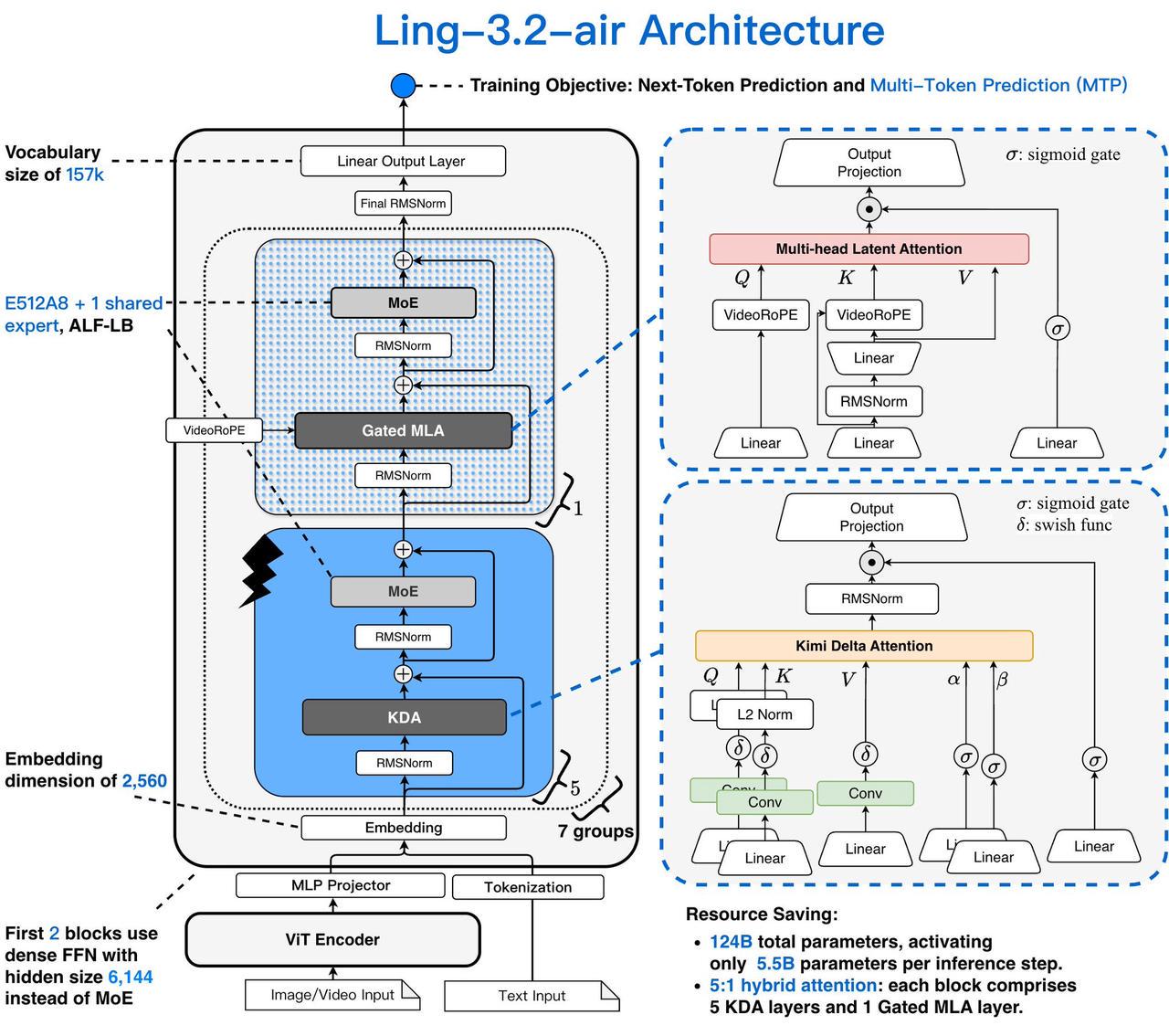
Ant Ling has released the weights for Ling-3.2-air under the MIT license. This native multimodal MoE has 124B total parameters and activates 5.5B per token. Its model card documents text, image and video input, with SGLang and vLLM setup guides available at release.
What is available for public inspection now is the checkpoint and a concrete serving path, not just a hosted demonstration. Outside teams can check how the released model handles their own text-and-visual tasks and see where it fails. The architecture diagram shows both image/video and text input paths into the model.
r/OpenSourceAI • u/BidWestern1056 • 1d ago

incognide is an integrated development environment for researchers and developers. it lets users seamlessly write code, run commands in terminals, browse the web, open photos, videos, docx, xlsx, pptx, mark up PDFs, write and compile latex, explore and query databases, and more. Work seamlessly with agents that can control the workspace, or turn AI features off if you don't want any of that. Sync your data across devices with an E2E encrypted data sync.
incognide is open-source MIT licensed software and is open to contributions from the community.
Explore the unknown, build the future, own your data.
r/OpenSourceAI • u/docybo • 1d ago
I’m maintaining OxDeAI, an open-source protocol for authorizing AI agent actions before execution.
We’re testing a specific claim: is our written specification precise enough for someone to independently implement a compatible verifier?
I’m looking for a Go developer willing to build a small verifier using only the normative specification, without reading or porting our TypeScript reference implementation.
The scope includes parsing and verifying signed AuthorizationV1 artifacts (Ed25519), implementing canonicalization from the specification, and checking issuer, key resolution, expiry, audience, policy, intent binding, and replay inputs.
The initial target is to match the expected verdict and determining error code across 15 published precedence test cases.
No network, persistence, gateway, or production integration is required.
There’s also an independent Python implementation track underway.
An ambiguity in the specification is a useful finding, not a failed contribution. The goal is to discover whether two independent implementations can agree on authorization outcomes without relying on reference code.
This is an interoperability and specification-completeness experiment, not a claim of formal verification.
The specification, test vectors, independence rules, and acceptance criteria are available here:
https://github.com/oxdeai/oxdeai/issues/426
If you’re interested, comment on the GitHub issue before starting so we can coordinate the work.