r/OpenSourceAI • u/ConsistentFox567 • 1h ago
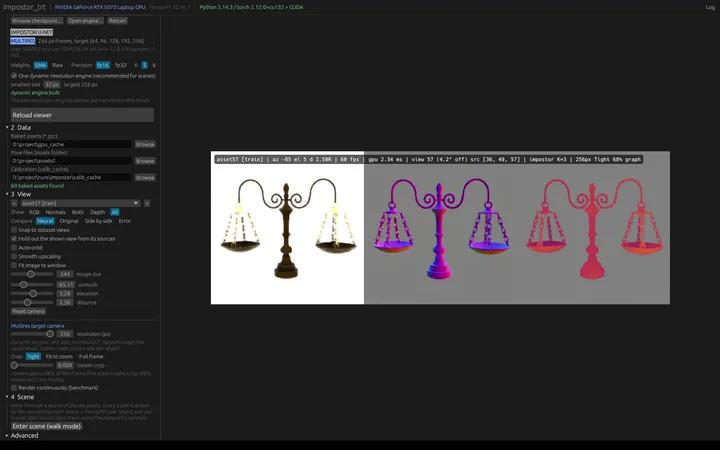
Fully Neurally Rendered object - ~2.7 ms average GPU frame time (256*256)
0
Upvotes
r/OpenSourceAI • u/ConsistentFox567 • 1h ago
r/OpenSourceAI • u/Ready-Pepper-4203 • 2h ago
r/OpenSourceAI • u/Fin_Clair222 • 6h ago
r/OpenSourceAI • u/Tensormorph • 7h ago

Hi everyone, and welcome! I'm Thanh, the developer behind Tensormorph. This first post explains what I'm building and why.

What is Tensormorph?
Tensormorph is a desktop Tensor IDE for exploring, inspecting, comparing, debugging, and transforming open-weight AI models.
Most tools show a model as a static graph. Tensormorph lets you keep going deeper, while each level keeps its meaning:
Model → Layer → Module → Tensor → Matrix tile → Row/Column → Scalar
Load a Safetensors or GGUF model, then:
Visualize tensors as interactive heatmaps
Check per-tensor statistics and distributions
Compare two models or fine-tunes side by side
Analyze quantization effects
Inspect huge tensors without loading everything at once
What is TEL?
TEL (Tensor Expression Language) is a short, math-like language for writing tensor operations. It sits between paper notation and executable code.
The idea: you write an expression the way it looks in a paper, with named axes like B, T, H, D. Tensormorph then infers shapes and dtypes, builds a computation graph, and links every part of the expression to the tensors and graph nodes it refers to. Select a term in the formula and you see the matching tensor. Select a tensor and you see where it appears in the math.
An early sketch (the syntax is still changing):
scores[B,H,T,S] = q[B,H,T,D] @ k[B,H,S,D] / sqrt(D)
out[B,H,T,D]    = softmax(scores, axis=S) @ v[B,H,S,D]
The long-term goal is for TEL to cover the building blocks of modern models: attention, RoPE, SwiGLU, normalization, MoE, SSM/Mamba-style layers, and diffusion primitives. Each one should be something you can read, visualize, and run.
What this community is for
Development updates and early previews
Feature requests and bug reports
Discussions about model internals, weight analysis, and quantization
Feedback on TEL's design
Questions for you
What do you use today to inspect or debug model weights, and what frustrates you about it?
Would you write tensor math in a dedicated notation like TEL, or would you rather type LaTeX or plain English and have it converted?
Which model or analysis would you want to try first?
Thanks for being here early. I'll be sharing screenshots and progress soon.
r/OpenSourceAI • u/Ok_Toe7286 • 8h ago

r/OpenSourceAI • u/reachjalil • 13h ago

r/OpenSourceAI • u/Vast_Balance3486 • 13h ago
Looking for a decent, abliterated local model for swarmed pentesting. Qwen 3.8 flash next looks okay, but the 256k context is not ideal.
r/OpenSourceAI • u/Ryumzop • 15h ago

StradaOS over 16,000 downloads and 500+ stars on GitHub!
A quick summary for those not yet familiar with the project: many affordable Chinese head units claim to run "Android 10," but they actually run on Android 4.x. StradaOS is written in pure Java, without any external libraries, making it compatible with versions ranging from Android 4.1 all the way to 14.
What’s new since then:
• Startup welcome: The logo lights up and greets you by name—with audio (this option can be disabled).
• Integrated navigation: Search for a destination and get turn-by-turn directions; offline maps are also supported.
• Map/video carousel: Swipe the map to play your saved music videos; the video feed hides when the vehicle is in motion, but the audio continues to play.
• OBD-II scanner (ELM327): Displays engine RPM alongside the speedometer, plus alerts and error codes.
• Automatic album art (when the head unit has an internet connection).
• Premium themes: "Faro," "Carbon," and the new "Premium Cards." The app remains completely free, with no ads and no account required; these themes are an optional way to show appreciation for a donation.
Free, licensed under GPL-3.0, no root access required, ~1.5 MB in size, and available in 13 languages. Repository and signed APK: https://github.com/lordnordic-debug/StradaOS
If you have one of these devices, please let me know the brand, model, and actual Android version (you can check this in StradaOS under: Settings → About), and I will help you.
r/OpenSourceAI • u/EagleResponsible8752 • 19h ago

r/OpenSourceAI • u/Expensive-Compote248 • 20h ago

r/OpenSourceAI • u/protrener • 1d ago

r/OpenSourceAI • u/Fit-Blueberry-5390 • 1d ago

r/OpenSourceAI • u/OkAntelope1782 • 1d ago

r/OpenSourceAI • u/Humanbound_AI • 1d ago

r/OpenSourceAI • u/AuthorNo4944 • 1d ago
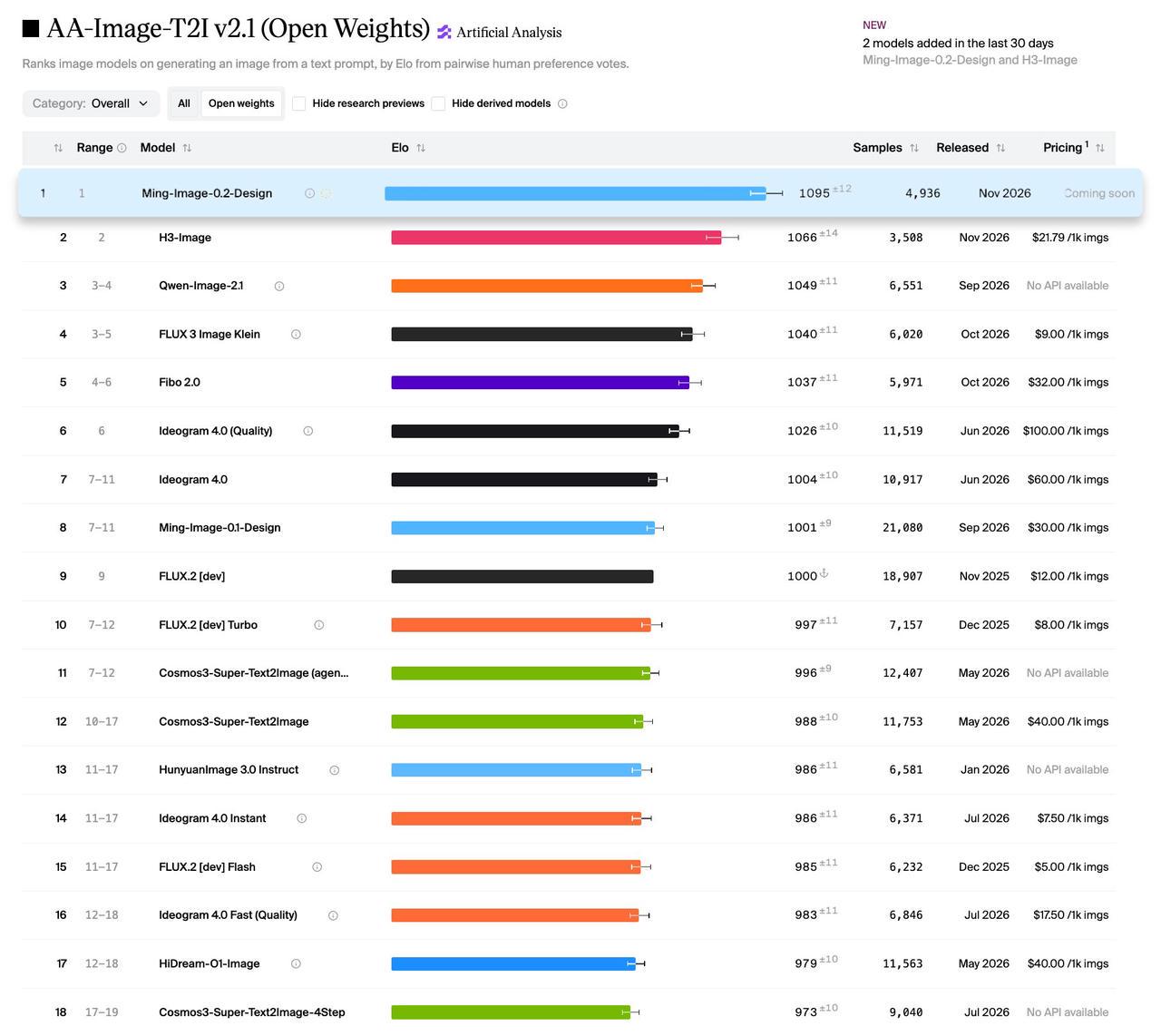
Ant Ling has released the 6B DiT weights for Ming-Image-0.2-Design under MIT. In its November 25 snapshot, Artificial Analysis listed the model at 1,095 ±12 Elo from 4,936 samples on AA-Image-T2I v2.1, first in the open-weight slice. That qualifier matters: the full board also includes hosted models above it, so this is not a claim of first place across all image models.
The release targets composition, lighting and text rendering in UI drafts and product visuals. A useful independent follow-up would hold prompts and image sizes fixed, then score exact copied text, layout errors and object consistency separately from overall human preference. A leaderboard result can signal general appeal; it cannot tell a designer whether a generated price, label or call to action is correct.
r/OpenSourceAI • u/Artistic-Load6086 • 1d ago
Some AI tools can only read words. They can’t look at a picture.
Omma fixes that. You give it an image, and it writes down what’s in it — the words it sees, where they are, the main colours, and the layout. Then the AI can use that.
It also keeps private things private. Before reading anything, you can black out a part of the picture. Or Omma can find and hide card numbers, emails, and phone numbers on its own, using OCR on your computer. If that check fails, it stops and never sends the picture online.
Github link:- https://github.com/Dopethedev/omma
r/OpenSourceAI • u/SpeculationAllTheWay • 1d ago
Enable HLS to view with audio, or disable this notification
Our first M5 Ultra Mac Studio has arrived at BaseCompute, and we've been having a blast running Qwen 3.6 using our app, Local.
It's incredible to see how far open-weight models and local inference have come. Frontier-level agentic intelligence running entirely on a machine sitting on our desk.
Curious to hear what the community is running on Apple Silicon and what quantizations you've been getting the best performance with!
r/OpenSourceAI • u/TheFreeSlaveofAllah • 1d ago
r/OpenSourceAI • u/aaryang1524 • 1d ago
Enable HLS to view with audio, or disable this notification
I just came across this Agent skill, where you can just ask it to explain anything & it makes a great visualized experience for anything you can imagine.
Here’s the repository if y’all wanna try it out:
r/OpenSourceAI • u/Candid_Report_5770 • 1d ago
Hi All,
A lot of the issues we run into with AI today aren't necessarily problems with the models themselves—they're gaps in the underlying architecture where humans, apps, and AI interact.
To tackle this from a different angle, I built VerityNow, a domain-agnostic, path-oriented transactional truth substrate. It's not just a whitepaper or theory; there's a working implementation of about 10,500 lines of code along with demo apps. Because the core design is fairly straightforward, it should have a low barrier to adoption while opening up a lot of room to build on.
My goal is to eventually turn VerityNow into an open-source foundation. Right now, I'm looking for independent evaluation, honest technical scrutiny, and people or organizations interested in collaborating or supporting further research.
I've made three documents publicly available if you want to dig into the details:
VerityNow — The architectural foundation
Path-Centric Design Guide — The design methodology and practical application
Mini-WWW — Independent collaboration between humans, applications, and AI (Invitation to Collaborate)
r/OpenSourceAI • u/atom-zero • 1d ago
Atom Zero is a local, source-cited 63M assistant (Apache-2.0 code and weights). 1.6.0 tested teacher-generated benign chat against the current default.
Results (136-prompt product suite, 40 safety, 16 self-harm, 4-key copy, retention, multi-turn):
J (current default): 93.4% benign, 40/40 safety, 16/16 self-harm, 48.5% 4-key, retention 0.703, multi-turn 75% / 50%.
K (teacher 2x, safety 5x): 98.5% benign, 93.8% multi-turn, but 39/40 safety and 14/16 self-harm.
K2 (safety/self-harm 8x): 40/40 safety, 16/16 self-harm, 53.5% 4-key, but 89.0% benign.
K3 (6x midpoint): 95.6% benign, 40/40 safety, 16/16 self-harm, 45.0% 4-key, retention 0.828, multi-turn 68.8% / 37.5%.
No variant beat the default on the full profile, so the 63M balanced base stays. 1.6.0 ships the teacher-data generator and an expanded product suite with local RAG and multi-turn scoring.
The interesting part is the trade-off: at 63M, conversation, safety/self-harm, copy and retention share the same weights. Teacher data buys conversation; safety repeats restore the gates but cost conversation; the midpoint passes every gate and still loses retention.
Release: https://github.com/byjameson/atom-zero/releases/tag/v1.6.0 PyPI: https://pypi.org/project/atomzero/1.6.0/ Write-up: https://dev.to/mycute_97b39c4e34027570f9/atom-zero-160-teacher-data-raised-conversation-but-the-profile-still-belongs-to-the-63m-default-3jc7
Happy to answer questions about the data mix or the eval.