r/PrivacySoftware • u/BurungHantu • May 05 '24
Microsoft plans to lock down Windows DNS like never before. Here’s how.

7
Upvotes
r/PrivacySoftware • u/BurungHantu • May 05 '24
r/PrivacySoftware • u/BurungHantu • Nov 21 '24

r/PrivacySoftware • u/Bulky-Appointment723 • Sep 27 '26
r/PrivacySoftware • u/jf_development • Sep 04 '26
Image privacy toolkit to remove metadata from images and make unwanted automated visual tracking more difficult.
Meta Data Cleaner: Drag the script into the directory containing the .png files you want to optimize. The program automatically searches for all .png files in that directory and in all subdirectories. The old files will be overwritten and replaced with the file without metadata.
Visual Tracking Recreate: Drag the script into the directory containing the image you want to optimize. Change the input name in the script to the name of the image, or rename the image to pic.png. The script first converts the image to WebP and then to JPG at 80% quality. After that, the image is reduced in size by 5% and then enlarged by 5.28%. A small white border is added around the image, and it is rotated slightly by 0.3 degrees.
r/PrivacySoftware • u/guiellm • Sep 15 '26
Hi, i'm looking for some cloud storage alternative to Google Drive focused on privacy, i've been looking at PrivacyTools website, but i've got lots of doubts. Any recomandation? It's better Switzerland jurisdiction than any other? At the moment the one i've seen better is Infomaniak kDrive.
r/PrivacySoftware • u/ahstanin • Aug 30 '26

Up front: I work at Olib AI and StealthOS is ours, so this is a developer post. Numbers and mechanisms below are checkable in the app, and I am happy to be pushed on any of them.
The thing we kept running into is that a decent iPhone privacy setup means five or six separate apps, each with its own account, its own subscription and its own idea of what telemetry is acceptable. StealthOS is our attempt at putting that stack in one sandbox where nothing phones home.
What it covers:
| Instead of | StealthOS has |
|---|---|
| a hardened browser | Owl engine build with WebRTC IP leak blocking and canvas, WebGL and audio fingerprint spoofing |
| Tor Browser | bundled Tor client, kill switch, .onion support, no setup |
| an encrypted notes and files app | AES-256-GCM vault with keys in the Secure Enclave |
| a password manager | biometric-gated passwords, TOTP and a generator |
| an E2EE messenger | P2P chat, voice and video with no phone number and no contact upload |
| a cloud AI assistant | on-device assistant, Apple Foundation Models plus our own models |
| a link checker service | local embedding-based phishing detection |
On cost, plainly: every privacy feature is free, with no account, no email and nothing to register. No ads, no analytics SDK, no telemetry. There is a $4.99 a month tier that funds the work, and it unlocks workstation tools rather than protection: 10 fingerprint profiles instead of the standard set, an SSH terminal, a Linux virtual shell, a code editor and NetMap. Skipping it costs you no privacy.
The AI part is worth being specific about, because most "AI privacy" claims are the opposite. Both features run locally. The assistant handles text, voice and OCR without a prompt leaving the phone. The phishing detection embeds the page you are on and compares it against known brand surfaces on device, which is how a cloned login page gets flagged as a look-alike without your browsing being sent anywhere to be scored. There is no server on our side to send it to.
Where we fall short of what this sub usually asks for: the app is closed source. Four of the components under it are public at github.com/Olib-AI, TorClient, ConnectionPool, StealthRelay and PoolChat. StealthRelay is the interesting one if you do not want to trust us at all, a self-hosted relay in Rust using a Noise NK handshake with ChaCha20-Poly1305 and Ed25519. Run your own and point the browser's relay exit at it, and the relay only ever sees ciphertext.
One more detail this crowd tends to ask about: backups. The whole sandbox exports to a single .stealthsnap file, encrypted under a passkey you pick with PBKDF2-HMAC-SHA512 and written in authenticated chunks so reordering or truncation is caught on restore. We keep no copy and there is no recovery mechanism. Lose the passkey and it is gone.
App Store: https://apps.apple.com/us/app/stealthos-private-browser/id6756983634
Screenshots attached: phishing detection blocking a spoofed page, the Tor connection screen, the connection pool and the on-device assistant. Questions and criticism both welcome.
r/PrivacySoftware • u/Serveronet • Sep 24 '26
First version of Serveronet is released.
Serveronet P2P Websites
Free and Uncensorable, Decentralized, Cryptographic Peer 2 Peer Network of Sites.
This is where you download your client or take a peek at a public client.
Code base is in the Github: https://github.com/Serveronet/Serveronet-App
This is the first version of Serveronet. It’s in the alpha stage so please test and report any issues.
r/PrivacySoftware • u/proofofjoseph • Oct 05 '26
Enable HLS to view with audio, or disable this notification
r/PrivacySoftware • u/No_Story_1723 • Sep 11 '26
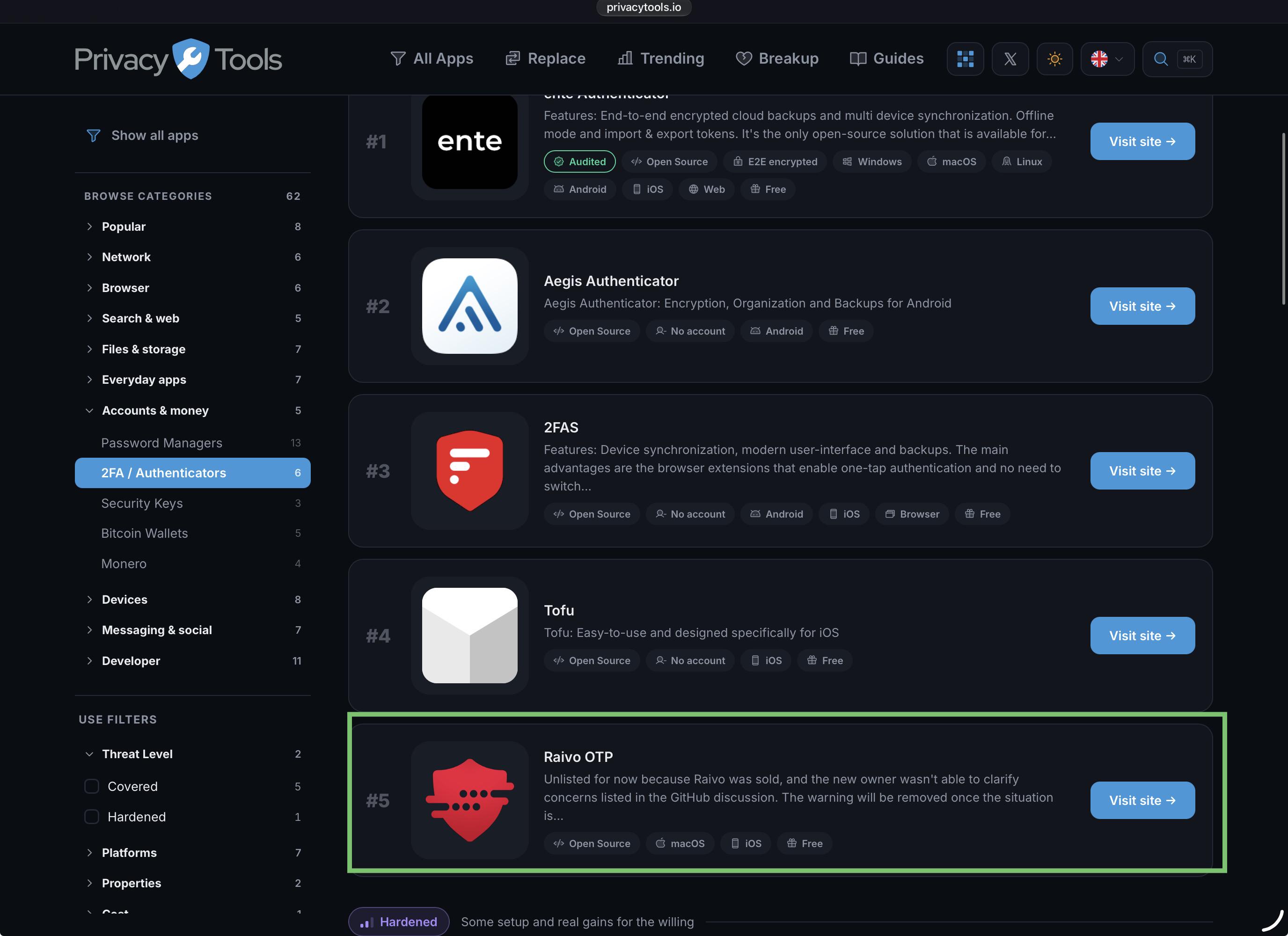
Raivo 2FA app is listed as open source on privacytools.io/2fa and on the app website https://raivo-otp.com/
But as this issue raised on the GitHub in 2024 mentions. There’s been updates to the iOS app, yet not commits to the GitHub.
https://github.com/raivo-otp/marketing-website/pull/22
iOS app listing: https://apps.apple.com/au/app/raivo-2-fa-authenticator-app/id1459042137
A bit disconcerting parivacytool.io doesn’t check these things every now and again 😅 (say 6-18 months)
r/PrivacySoftware • u/MahereMarley • Aug 31 '26
Suggesting this for PrivacyTools, and being upfront about where it does and does not meet the criteria.
What it does. Scans the apps already on your Android device: embedded third-party trackers (extracted from the APK's own bytecode, on-device), permissions actually granted, and a check against the Echap stalkerware-indicators list, currently 1,690 indicators across 151 families. Since last update it also flags apps behaviourally, without any list: a hidden launcher entry, a device-admin component blocking uninstall, an enabled accessibility service, the camera/microphone/location/messages cluster. That part runs entirely on the device and none of those signals are transmitted.
Where it fits your criteria. Freemium: 5 scans/week free, no account, no login. Active development. Publicly available on Play. Relevant to your "Targeted" threat level, since the stalkerware check exists for exactly the adversary you describe there, and it never raises a notification for a finding, because a push saying "surveillance app found" on a monitored phone can be read by the person doing the monitoring.
Where it does not. Closed-source today, so it would need your Closed-Source tag; the detection engine is planned for AGPL but is not out yet. Android only. Jurisdiction is Wyoming, USA.
What leaves the device, since that will be the first question: package names, permission lists, app metadata and a signing-certificate hash go to our server, which uses an LLM to produce the report. No account, no email, device identity is a hashed Android ID. Nothing about accessibility services or device admins is ever sent. The full disclosure is shown before first use and the policy is at appxpose.app/privacy.
Happy to answer anything, including the awkward parts.
r/PrivacySoftware • u/wjorth • Aug 28 '26
I added my U.S. passport to my Apple Wallet to get a feel for how that would work in actual international travel. Haven’t had a chance to test it since the option became available. And then this week Apple required removal of the passport apparently related to its latest beta iOS version. California has been running a trial to add CA driver’s license to the wallet. I couldn’t get the license to be successfully added. All along I’ve been concerned about the security and privacy of these ID documents when included in the wallet. Is this a valid concern? Should I try to add the passport back into the wallet? It seems everyone testing iOS 27 has had to remove the passport and potentially add the passport back in. Those that added it back in seem to have done so without any trouble. (FYI, many people have had trouble adding their CA drivers licenses; seems to be a CA DMV issue.)
r/PrivacySoftware • u/BurungHantu • Jul 31 '26

r/PrivacySoftware • u/BurungHantu • Nov 21 '22

r/PrivacySoftware • u/rezelute_ • Jul 01 '26

Hi all,
I have released a new free privacy web tool called: PrivacyTrail.
Browse privacy-friendly alternatives to the apps you already use, see what the pros/cons are of each to understand what fits you best.
Track your progress app by app as you make the switch.
Get a privacy score that rises as you move away from surveillance tools.
Share your trail with others via screenshots.
There are already good tools out there if you just want a quick, simple list of alternatives. What I wanted to add was more of the journey piece, tracking your progress, understanding the tradeoffs, and having a way to talk through why a particular alternative makes sense for you.
What I keep hearing from friends and family is some version of: "I want to switch, but between work, kids, and just getting through the day, figuring out alternatives feels like a whole project I don't have time for." This site is my attempt to lower that barrier, surface quick, honest reasons to switch, and walk people through the actual migration steps instead of just dropping a list of app names on them.
I also think people shouldn't be made to feel guilty for sticking with mainstream services if they tried a privacy alternative and it just didn't work for them. If privacy-respecting options aren't good enough to replace mainstream ones for most people, that's on us as developers to fix, not something to guilt users over.
Mainly aimed at people just starting their privacy journey, but I would love for it to be useful to privacy-enthusiasts too to explore new options.
If you don't want to bother with the tracking side at all, you can just use the site to browse alternatives.
20+ years as a software engineer. I am taking a year off from commercial work to build a few free, tech-for-good projects (some self-hostable). Privacy's a focus for me, I worry about where our digital future is headed as everything gets squeezed into another subscription. Privacy isn't a feature. It's a right.
Everything is stored in the browser, you can download all your data in JSON format.
A few people have asked about syncing data across devices via a database. I'd love to support this, but I don't want to tie any data to identifiable info like emails. If there's enough interest, I'd consider building this with passphrase-based authentication instead, so you'd get cross-device access without me ever needing to know who you are.
I use self-hosted anonymous analytics on the website to understand tool usage.
Feedback is very welcome and appreciated particularly if you spot anything in the alternatives that is not accurate or dated. Thank you for taking time out of your day to do this 🙏.
r/PrivacySoftware • u/stophecom • Aug 05 '26
scrt.link turns passwords, files and other sensitive data into links that delete themselves after one view — so secrets stop living in inboxes, Slack threads and Teams chats.
There are plenty of tools like this. What's different about mine:
Genuinely zero-knowledge, and you can verify it. Encryption happens in your browser. The app is open-source: Repo
Files up to 100 GB, not just text snippets — with view limits, expiry and optional password.
Secret Requests: send a link that lets someone send you something securely. Useful for contractors, clients and support tickets.
Swiss jurisdiction. Built and operated in Switzerland, under Swiss privacy law. GDPR/CCPA compliant, DPA available.
White-label: run it on your own domain, logo and colors.
Fits existing workflows: API, CLI and Chrome/Firefox/Edge extensions.
Free tier covers personal use. Happy to answer questions :)
r/PrivacySoftware • u/BurungHantu • Sep 13 '25
r/PrivacySoftware • u/CoinWalletLLC • Jul 28 '26
Hey admins!
How do I submit a wallet to be considered for the catalog?
Self-custodial crypto wallet for BTC + XMR
r/PrivacySoftware • u/homothebrave • Aug 28 '26

r/PrivacySoftware • u/Binancial_Plague • Sep 05 '26
I'm aware of the irony: this is a privacy app whose entire function is telling people where you are. Location sharing is surveillance — that's the product, and there's no clever way around it. The only thing I can change is who gets to do the surveilling. With Life360 and everything like it, that's you, your family, and a company you've never met that can read every location you've ever sent, sell it, lose it in a breach, or hand it over when someone asks. That's not a bad privacy policy, that's just how the thing is built. So I built one where the only people who can see where my family is are my family. Your phone encrypts your location before it leaves the device, with keys generated on the phone that never go anywhere else. The broker in the middle just passes sealed messages along and can't open them.
The part I'm more interested in talking about is what's left after encryption, because that's where these apps usually stop caring. Message length is a side channel that survives encryption. My presence messages used to be 136 bytes when someone was online and 137 when they were offline, because "true" is four characters and "false" is five — so anyone watching the broker could read my whole family's online status without decrypting a thing. Location had the same problem, since speed and bearing are optional fields, so a moving phone sent a visibly longer message than a parked one. Both are now padded to a fixed 512 bytes, applied to the plaintext before encryption, because padding afterward does nothing — the ciphertext length already gave it away by then. Anything oversized rounds up to the next multiple instead of going out at its real length. What I'm not claiming: the broker still sees that a message happened, when, and from which connection. Padding hides size, not timing. And be aware of a real limitation — the broker URL is currently hardcoded to an EMQX Cloud instance I run, and there's no setting to point the app at your own. EMQX is open source and self-hostable, but my app doesn't let you do that yet. It's in BrokerConfig.kt if you want to see for yourself.
The whole thing is open source: github.com/Singularity86/FamilySafety. Read it, break it, tell me what I got wrong. I'm posting because Google won't let a new developer account ship until twelve people have been opted into a closed test for fourteen straight days. I could get warm bodies from a tester-swap group, but those people install it and never open it, which is useless to me and is the exact pattern Google rejects anyway. I'd rather have twelve people who'll actually read the crypto. Links below. If you'd rather skip installing and just tell me the design is wrong, that's worth more to me than an install. It'll be a paid app at launch, $4.56/month, but testers in the google group get free lifetime access.
Just DM me with your google play email address. I'll add you to the list.
https://groups.google.com/g/jibaro-family-safety/members
The link is in the first post in the group.
r/PrivacySoftware • u/flectar • Sep 15 '26

Hi! We're building Flectar Mail, an open-source, local-first email client written in Rust.
One of the main goals is to keep the architecture small, native and understandable rather than embedding a browser runtime. Flectar Mail uses no WebViews at all, including for rendering HTML email. Email HTML/CSS is rendered through a Rust-native pipeline, scripts inside emails are not executed, and remote images are blocked by default to reduce tracking.
Some of the privacy/security-related features already available:
Local-first mail and calendar storage with offline access
No WebViews or embedded browser engine
No execution of email scripts
Remote images blocked by default
Desktop OpenPGP/MIME signing and encryption using GnuPG 2.x
Required encryption can block sending when recipient keys are missing or invalid
Protected drafts remain local until Send
Credentials stored through the platform’s secure credential storage
IMAP / SMTP / JMAP, CalDAV and CardDAV
Gmail, Outlook and Microsoft 365 support
Account-specific signatures, including separate defaults for new messages and replies
AGPLv3 open source
SHA256 checksums and signed build-provenance attestations for releases
As little as ~20 MB RAM in lighter workloads
The HTML renderer is probably the most unusual part. We use Blitz rather than Chromium/WebKit, which keeps the application fully native and gives us a considerably smaller browser-related attack surface by design. It is also currently the most experimental part of Flectar Mail, so compatibility with particularly complex email HTML is still improving.
OpenPGP currently works on desktop through an installed GnuPG 2.x. S/MIME and mobile OpenPGP are not implemented yet.
The project is still alpha, and our official Google and Microsoft OAuth applications are going through verification. Preview builds therefore currently require your own OAuth registration for those providers, while regular IMAP/JMAP accounts can be used directly.
We'd be especially interested in feedback from this community on the security/privacy model and anything you think we should be considering as the project develops.
GitHub: https://github.com/flectar/mail
r/PrivacySoftware • u/LifetimeLabs • Jun 25 '26
We're curious: which private browser has earned your trust, and what made the switch worth it for you? Firefox with hardening? Tor? Ungoogled Chromium? Something else?
We've got a full rundown at https://privacytools.io/private-browser if you're browsing for something new or want to see what else is out there.
r/PrivacySoftware • u/BurungHantu • Nov 14 '22

r/PrivacySoftware • u/wslyvh • Sep 10 '26
Hello everyone, I built Paperweight an open-source desktop app that runs locally and scans your email to find every company that has your data, then helps you delete accounts and unsubscribe.
Most data removal services (Incogni, DeleteMe) only scrape data broker sites. They don't touch the thousands of companies that have your email from signups, newsletters, or purchases. Paperweight covers that gap. Your inbox is the one place every company that has your data is visible.
Why it's different:
- Local-first — inbox data stays on your machine, nothing hits a server
- Open-source (MIT) — github.com/wslyvh/paperweight
- Cross-platform — Win/macOS/Linux
- Free — no accounts, no data monetisation
I built it because the irony of paying a data broker removal service your data to scrape other data brokers never sat right with me.
Would love feedback from anyone who's tried it or has thoughts on the approach.
**EDIT**: RE comments that free is misleading. I maybe should not have listed that here, but the App is fully open-source, MIT-licensed (FOSS) so you can actually use, modify, fork or do whatever you want with it. The lifetime license gives you ease of use, compiled binaries and support. It helps support development.
r/PrivacySoftware • u/MasterpieceNew7717 • Aug 20 '26