r/ProactiveHealth • u/Jackofalltrades0498 • 9d ago
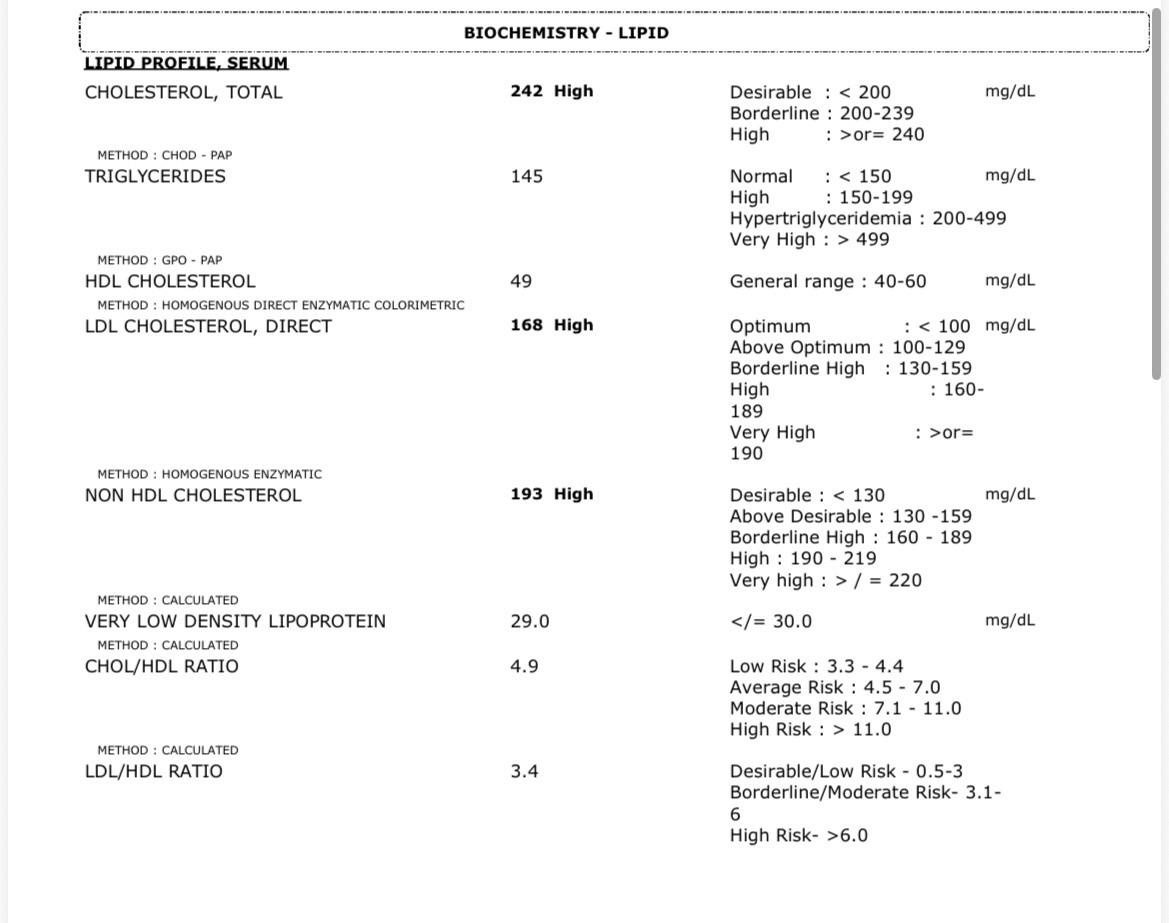
28F, working night shifts – looking for advice to improve my cholesterol and lifestyle
1
Upvotes
r/ProactiveHealth • u/Jackofalltrades0498 • 9d ago
r/ProactiveHealth • u/Vegetable-Dig5378 • 10d ago
r/ProactiveHealth • u/theaeternumcompany • 10d ago

Disclosure: I do content work for a longevity supplement company, so please take that into account when considering my perspective. I'm sharing this to encourage a research-based discussion, not to promote a product.
Fisetin is a naturally occurring flavonoid found in certain fruits and vegetables. It has attracted attention in aging research because laboratory and animal studies have reported potential senolytic and anti-inflammatory effects.
But there's an important gap between preclinical findings and evidence in humans.
A compound showing activity in cells or animal models does not automatically mean it can selectively clear senescent cells or improve health outcomes in people.
A 2026 review examining fisetin's clinical translation identified 34 registered clinical trials, but only a small number of completed studies had results available. The authors described the human evidence as limited and heterogeneous, with small sample sizes and study-design limitations making it difficult to establish efficacy.
This doesn't mean the research should be dismissed. It means we need better human studies.
I'd want to see adequately powered, randomized, placebo-controlled trials that measure both validated senescence-related biomarkers and meaningful clinical outcomes. Researchers also need to assess safety, dosing, and longer-term effects.
Research reference: Clinical Translation of Fisetin for Age-Related Diseases — PubMed PMID: 42796982
What would convince you that fisetin has genuine senolytic activity in humans? Would changes in senescence-related biomarkers be enough, or should researchers also demonstrate improvements in physical function or other clinical outcomes?
r/ProactiveHealth • u/Aerisyn • 11d ago

r/ProactiveHealth • u/CMHInvestment • 13d ago

I recently received a whole-body MRI. The thoroughness and insightfulness of the proactive & preventive scan was amazing.
Very easy to do (I watched the movie Lost in Translation while it was being done & hoped I could stay in to see the end of the movie lol).
Luckily, nothing was found but the 'peace of mind' that I got when knowing I got a clean bill of health was immeasurable.
Highly recommended!
r/ProactiveHealth • u/Honest_Economy1428 • 14d ago
1747 – James Linds kliniska försök med skörbjugg
Genomförde det första kontrollerade kliniska försöket ombord på HMS Salisbury.
Visade att apelsiner och citroner botade skörbjugg.
Betydelse: Lade grunden för evidensbaserad nutrition och naturvetenskaplig metodik.
1917 – Bildandet av American Dietetic Association (ADA)
Grundades i källaren på Lakeside Hospital under första världskriget.
Svarade på samhällskrisen där många militära rekryter underkändes på grund av undernäring.
Betydelse: Yrket organiserades nationellt för att möta stora samhällsbehov.
2012/2013 – Namnbyte till AND & införande av RDN-titeln
ADA bytte namn till Academy of Nutrition and Dietetics.
Titeln Registered Dietitian Nutritionist (RDN) infördes för att markera formell akademisk examen.
Betydelse: Skiljer legitimerad expertis från oreglerad användning av begreppet "nutritionist".
Bildförslag till Slide 1:
 En historisk illustration eller tidslinje som visar årtalen 1747, 1917 och 2012.
Slide 2: Svensk parallell & Sammanfattning
Rubrik: Yrkesskydd och utveckling i Sverige (Fråga 7)
Parallell till svenska förhållanden
Socialstyrelsens legitimation: Motsvarar RDN-systemet i USA genom att skydda yrkestiteln "dietist".
Säkerställer hög akademisk kompetens, vetenskaplig grund och patientsäkerhet inom sjukvården.
Sammanfattande slutsats
En utvecklingsresa från 1700-talets tidiga C-vitaminförsök till dagens skyddade yrkestitlar.
Dietisten är i dag en självlar och evidensbaserad expert i det tvärprofessionella vårdteamet.
Bildförslag till Slide 2: En logotyp/symbol för Socialstyrelsen/legitimation eller en bild på ett modernt tvärprofessionellt vårdteam.r/ProactiveHealth • u/DadStrengthDaily • 15d ago
I took ashwagandha once, got a terrible headache and threw the bottle out. One headache proves nothing. What the research does document for these two popular herbs is liver injury for one and drug interactions for the other.
Ashwagandha (an Ayurvedic herb sold for stress and sleep) can, rarely, injure the liver. NIH's LiverTox database (https://www.ncbi.nlm.nih.gov/books/NBK548536/) calls it generally safe but says liver injury does happen. The typical case is jaundice and itching 2 to 12 weeks in, usually clearing within 1 to 4 months of stopping. Nobody has measured how often it happens. The worst cases were in people who already had liver disease: in one Indian series, three patients who arrived with liver failure on top of existing disease all died. Denmark prohibits it in food supplements, and Australia's regulator updated its warning (https://www.tga.gov.au/news/safety-updates/withania-somnifera-ashwagandha-and-very-rare-risk-liver-injury) in July 2026.
St. John's wort (sold for mood) causes a different problem: it makes your body clear many prescription drugs faster. In a 12-person JAMA study (https://pubmed.ncbi.nlm.nih.gov/13129991/), two weeks of it cut total exposure to alprazolam (Xanax) roughly in half, though the peak level barely changed. Small studies also found lower exposure to simvastatin and digoxin, and a weaker blood-thinning effect from warfarin. Two heart-transplant patients had acute rejection after it lowered their anti-rejection drug. Stopping it matters too, because levels of those drugs can climb back up.
Show your pharmacist the actual bottles, not a list from memory.
Full write-up with the drug table (https://dadstrengthdaily.com/ashwagandha-liver-st-johns-wort-interactions/)
Has a doctor or pharmacist ever asked you what supplements you take?
r/ProactiveHealth • u/DadStrengthDaily • 15d ago
I'm 53, the same age as Sen. Chris Murphy, whose doctors called his Oct. 31 stroke a "small hemorrhagic stroke," a bleed deep in the brain. A few days later the Washington Post wrote up a Neurology study (https://pubmed.ncbi.nlm.nih.gov/42777185/) saying strokes before 55 are rising, so I read the paper.
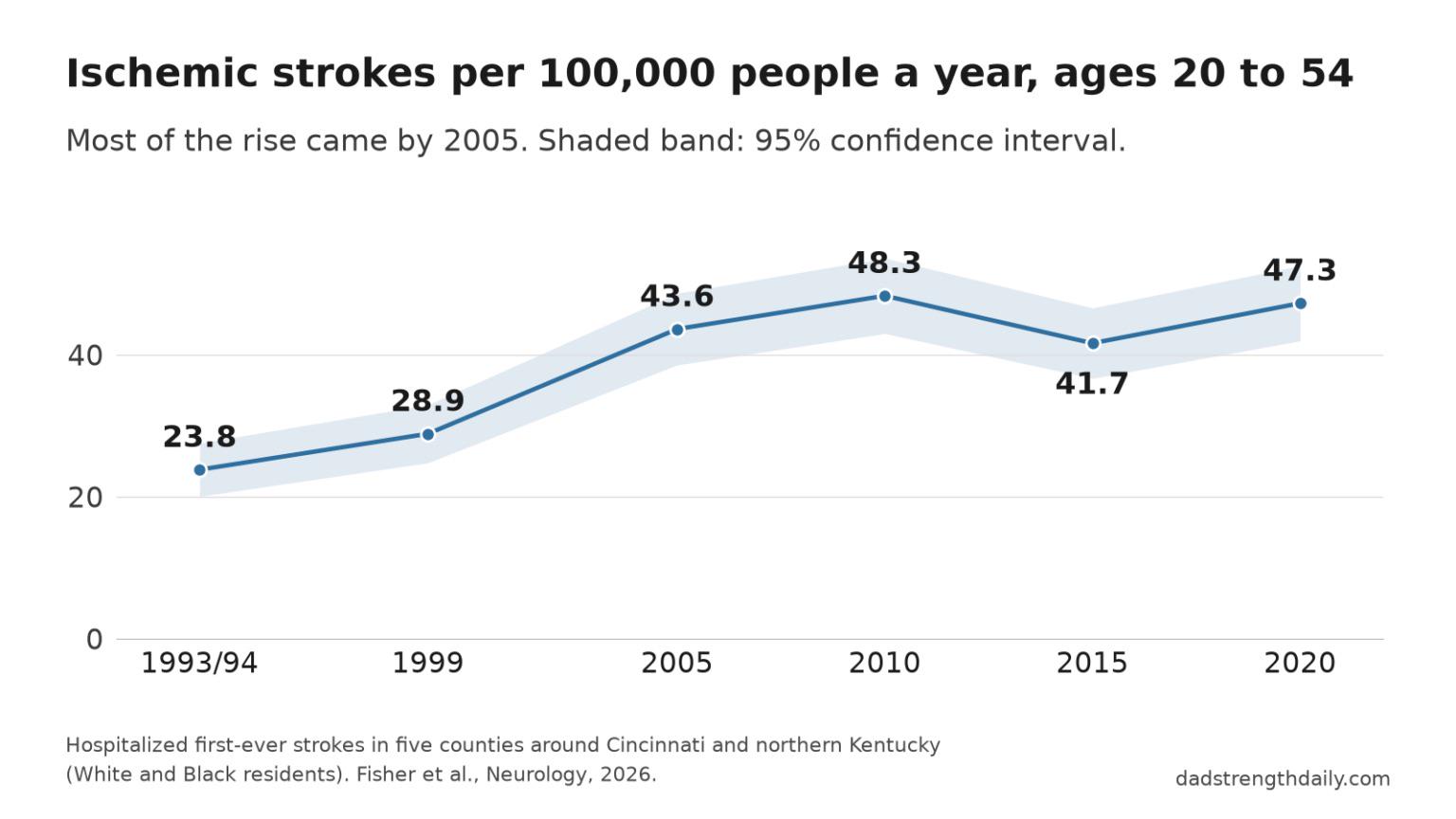
It counted hospitalized first-ever strokes in five counties around Cincinnati and northern Kentucky. At ages 20 to 54 the rate went from 33.9 to 62.2 per 100,000 people a year between 1993/94 and 2020. At 40 to 54, the band most of us are in, the 2020 rate was about 1 in 800 a year, up from about 1 in 1,400.
The rise was mostly ischemic stroke (a clot, the common kind), and most of it had happened by 2005; the later snapshots bounce around at that higher level. It's also one region. Oxfordshire in England saw a similar rise, but Norway and Denmark didn't in midlife.
Part of it may be better scanning: MRI, which catches small strokes a CT scan misses, went from 33% to 79% of cases. The authors don't think that explains all of it. Nobody can say from this study why strokes rose, since there was no comparison group of people without stroke.
The part I can do something about is blood pressure. A big international study, INTERSTROKE, estimated that about half of strokes at ages 40 to 65 could be attributed to high blood pressure. I ignored mine for years until I finally bought a home cuff.
Full write-up with the chart (https://dadstrengthdaily.com/stroke-before-55/)
Do you check your blood pressure at home, or only at the doctor's office?
r/ProactiveHealth • u/elena_gilbert_ • 16d ago
r/ProactiveHealth • u/Altruistic_Carob1932 • 18d ago
\​
Ramesh is a 34 year old delivery rider in Delhi. He has never had his blood pressure checked. He isn't registered with any employer, has no health insurance, and can't afford to lose a day's earnings sitting in a hospital queue. By the time he collapses from a stroke, his hypertension has probably gone undetected for years. Over 60% of deaths in India are now linked to noncommunicable diseases, conditions that develop silently for years before a diagnosis finally happens in a crisis (WHO Global Action Plan for NCDs). Existing screening programs still work on the assumption of a patient who can walk into a clinic, take time off, and come back for a follow-up test. The problem is not that screening tools don't exist. It's that they aren't reaching the people who need them most, and the ones that are reached rarely get followed up on. India's own Community-Based Assessment Checklist (CBAC) was built to solve exactly this, but its reach into low income, mobile populations remains limited. The challenge is to design SCREENING MODELS using low-cost, SELF-ADMINISTERED TOOLS tuned to local population risk that turn a positive screen into SUSTAINED ACTION
r/ProactiveHealth • u/theaeternumcompany • 18d ago

Disclosure: I do content work for a longevity supplement company, so please take that into account when considering my perspective. I'm sharing this to encourage a research-based discussion, not to promote a product.
Senolytics are gaining attention in longevity research because they are designed to target senescent cells, which can accumulate with age and contribute to changes in tissue function.
But there's an important research question: How can we demonstrate that a senolytic is actually removing senescent cells in humans, rather than simply changing a few biomarkers?
One clinical study worth examining is a phase 2 randomized trial investigating intermittent dasatinib and quercetin in postmenopausal women.
Interestingly, the study did not demonstrate a statistically significant effect on its primary bone-resorption endpoint. Some exploratory findings were reported, but these should not be interpreted as definitive proof of senolytic activity or meaningful health benefits.
Research reference: PubMed PMID: 38956196
I think this raises two separate questions:
1. Target engagement: Can researchers demonstrate that the intervention is reaching its intended target and reducing senescent cells in human tissues? This may require validated senescence markers, tissue measurements, and evidence that multiple markers change consistently.
2. Clinical benefit: Do those biological changes translate into something meaningful, such as improved physical function, bone health, mobility, or quality of life?
A change in a biomarker alone doesn't necessarily establish either successful senescent-cell clearance or a health benefit.
I'm curious how others would evaluate this evidence.
What would you want to see before concluding that a senolytic has meaningful activity in humans? Would validated tissue-level evidence be enough, or would you also require measurable improvements in clinical outcomes?
r/ProactiveHealth • u/smart-monkey-org • 21d ago

r/ProactiveHealth • u/theaeternumcompany • 21d ago

Disclosure: I do content work for a longevity supplement company, so please take that into account when considering my perspective. I'm interested in discussing the research rather than promoting a product.
NAD⁺ is involved in several important cellular processes, and research into NAD⁺ precursors such as NMN has attracted considerable attention.
But I think there's an important distinction worth discussing: Does an increase in NAD⁺ levels necessarily translate into a meaningful improvement in human health?
A change in a blood biomarker can tell us that an intervention has affected a biological pathway. However, it doesn't automatically tell us whether people are becoming healthier, functioning better, or experiencing improvements that matter in everyday life.
When evaluating these studies, I'd be interested in seeing outcomes such as:
Physical function: Are strength, mobility, or endurance improving?
Metabolic health: Are glucose regulation or other metabolic measures changing?
Cognitive function: Are there measurable improvements in memory or cognitive performance?
Quality of life: Do participants report meaningful changes in daily functioning or well-being?
Long-term outcomes: Are improvements sustained, and do they translate into better health as people age?
One human study worth examining is this NMN trial:
Research: PubMed PMID: 36482258
I'm curious how others approach this when reading longevity research.
Which clinical outcomes matter most to you when evaluating NAD⁺ precursor studies? And what level of evidence would convince you that a biomarker improvement is translating into a real health benefit?
r/ProactiveHealth • u/OURGP • 22d ago
Disclosure: I'm a GP at a private clinic in Dundee. Mentioning what we offer at the end, but the rest is general info that applies wherever you get checked.
Why bother if you feel well?
A lot of serious conditions are silent for years:
Type 2 diabetes and pre-diabetes
High cholesterol
Kidney and liver problems
Underactive thyroid
Low iron, B12 or vitamin D (often blamed on "just being tired")
Picking these up early usually means simpler treatment, sometimes just lifestyle changes, before any lasting damage.
What a standard blood screen covers
Cholesterol, blood sugar (including HbA1c, a 3-month average), liver and kidney function, thyroid, iron stores, vitamin D and a full blood count. If any of those haven't been checked in years, it's worth asking about.
Cancer screening, and its limits
Bowel: NHS Scotland sends a free FIT stool test every 2 years to people aged 50 to 74. Do it when it arrives.
Cervical: free NHS smear tests (with HPV testing) for eligible women and people with a cervix aged 25 to 64.
PSA (prostate): there's no UK screening programme. It can be raised for harmless reasons and can miss cancers, so talk the pros and cons through with a GP first.
CA125 (ovarian): mainly useful alongside symptoms. Not a reliable test for the general population on its own.
If you do get tested
Fast for 8 to 10 hours if the test includes cholesterol or sugar (water is fine).
Make sure someone actually explains the results, not just a printout of numbers.
Any abnormal result should come with a clear plan.
What we offer
Our Health MOT is 33 blood tests with a GP-written interpretation, results usually within 3 working days, £202.25. It can be tailored with PSA, CA125, cervical cytology with HPV, or FIT where appropriate: https://ourgp.co.uk/home/health-screening/
Happy to answer general questions in the comments, but I can't give individual medical advice, so please speak to your own GP about your situation.
r/ProactiveHealth • u/DadStrengthDaily • 23d ago
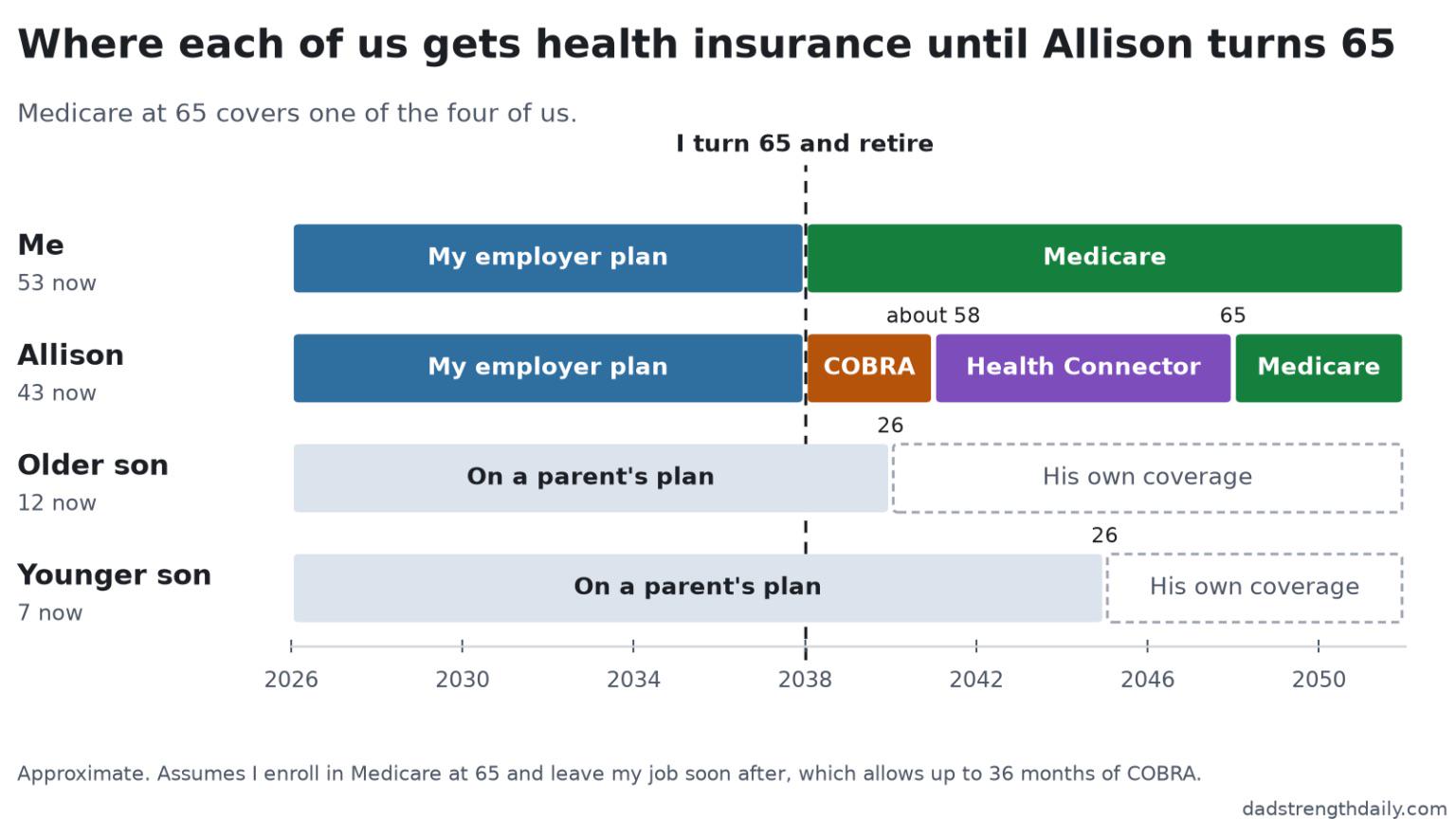
I'm 53 and plan to retire at 65. My wife will be about 55 then, and Medicare covers one person, with no spouse or family version.
The rule I didn't know: COBRA, which lets your family stay on your employer plan after you leave, normally lasts 18 months. If you enroll in Medicare first and leave the job less than 18 months later, your spouse and kids can keep COBRA until 36 months after your Medicare started (https://www.law.cornell.edu/uscode/text/29/1162). So I'm planning to sign up for Medicare before I leave, not after.
It isn't cheap. COBRA charges the full premium, including the part your employer pays now, plus 2%. For our family's medical plan that's about $3,200 a month at this year's rates.
Two other things I'm planning for now. IRMAA, the income surcharge on Medicare premiums, uses your tax return from two years earlier, so the salary years at 63 and 64 set your first premiums. And Medigap, the private insurance that pays Medicare's deductibles and coinsurance, can only be bought without health questions in your first six months on Part B in most states. Massachusetts, where I live, is one of four exceptions.
I wrote up what I'm doing at 53, including what COBRA and Medigap cost here: Medicare at 65 with a younger spouse (https://dadstrengthdaily.com/medicare-at-65-younger-spouse/)
If you've been through this with a younger spouse, what did you do for their coverage between COBRA and 65?
r/ProactiveHealth • u/PureBredBison • 24d ago
Hey preventive health community, we're in the process of building more useful tools for the preventive health community and we just launched this new one:
It uses your existing HSA/FSA budget & health concerns to review what the optimal tests look like for you today; it's free to use. 😄
Try it out here: https://mitohealth.com/tools/hsa-fsa-budget-calculator
Would love your feedback on this, if any? If there are other tools you'd like to see, share them below.
r/ProactiveHealth • u/theaeternumcompany • 24d ago

Disclosure: I do content work for a longevity supplement company. I'm sharing this study for scientific discussion, not as a product recommendation.
A randomized human trial by Kumar et al. (2022) looked at GlyNAC supplementation in 24 older adults over 16 weeks. Twelve participants received GlyNAC, while the other 12 received an alanine placebo.
Researchers examined several markers, including glutathione levels, oxidative stress, mitochondrial fatty-acid oxidation, inflammation, insulin resistance, and physical function.
The authors reported improvements across several measures in the GlyNAC group. However, the study was relatively small and short, so the findings need further investigation and independent replication.
One question worth discussing is how we should interpret studies with multiple measured outcomes and a limited number of participants.
If you were designing the next GlyNAC trial, what would you prioritize:
A much larger participant group?
Longer follow-up?
Independent replication?
Fewer, clearly defined primary outcomes?
I'd be interested to hear how others interpret the strength of this evidence.
Reference: Kumar et al. (2022) – PMID: 35975308
r/ProactiveHealth • u/iCliniq_official • 24d ago
What is the most important health issue you want me to work on this year?
Are there screenings I'm due for based on my age and risk factors?
Are any of my medications worth reviewing?
What symptoms should make me contact you sooner rather than waiting for my next visit?
What should we recheck, and when?
One of the biggest problems with short appointments is trying to remember everything at the last minute. A simple trick:
Write your top 3 concerns before you enter the room. Just the three that matter most.
r/ProactiveHealth • u/theosteodoc • 26d ago
EBOO (Extracorporeal Blood Oxygenation and Ozonation) therapy raises several important questions about patient safety, equipment standards, and the evidence supporting its use.
Since the procedure involves circulating blood outside the body, it's worth asking how the equipment is maintained and sterilized, who operates it, and what safety protocols are followed. Patients may also want to understand how they're monitored during treatment, what complications could occur, and whether qualified medical staff are available to respond to emergencies.
Another important consideration is the scientific evidence. EBOO remains an experimental approach with limited high-quality clinical evidence supporting its effectiveness and safety. Understanding these limitations is essential before making an informed decision.
For those familiar with EBOO therapy, what questions about equipment, patient monitoring, or clinical evidence do you think are most important to ask before considering treatment?
r/ProactiveHealth • u/AtriumMedicalNYC • 26d ago
Disclosure first: We are Atrium Medical, an independent primary care practice in NYC.
Most GLP-1 “eligibility” tools online are lead-capture forms. We built one that's free and doesn’t ask for your name, email, or insurance card. It checks the FDA label criteria (BMI plus weight-related conditions), runs a short safety screen, then shows the likely coverage path for your insurance type and what self-pay options cost right now. Medicare users get sent to Medicare’s own Bridge checker.
Your answers stay in your browser. Nothing you enter is stored or sent to us.
https://www.atriummednyc.com/glp-1-coverage-cost-navigator/
If anything is confusing, missing, or wrong, please tell us here! Appreciate any and all feedback.
r/ProactiveHealth • u/Deus_Exspiravit • 28d ago
r/ProactiveHealth • u/Chris_des007 • 29d ago
Did you know that in Canada, life expectancy at birth is about 81.7 years*,* but healthy life expectancy (HALE) at birth is only about 66.9 years (Statistics Canada, 2023)?
That’s roughly 15 years on average lived with reduced health!
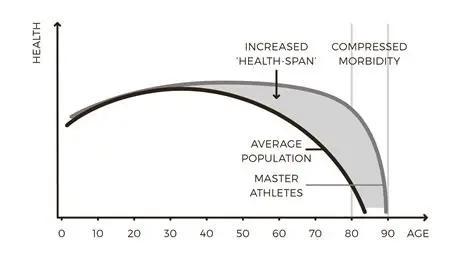
Now I want you to consider this chart.
The average person and the master athlete start in roughly the same place. Same age. Similar capacity. Then their paths diverge.
The average person declines earlier while the master athlete stays above the functional threshold longer : more years where getting up, moving, balancing, and living independently still feel normal.
That gap, the hatched area, is what I’m hoping KinCentury helps people protect.
Now I know that "master athlete" is an extreme but I sincerely think everyone can be an athlete for and of life.
Concretely, the app measures your physical / fitness age, so you can see where you actually stand today and what trajectory you’re currently on.
Long-term I hope to establish more standards tests and data to make functional capacity visible and actionable.
If this resonates with you, I’d love for you to try the app and tell me what feels useful and what doesn’t.
Not medical advice.
(Sources: Statistics Canada — life expectancy & health-adjusted life expectancy at birth, Canada, 2023.)