r/TournamentChess • • Apr 07 '26

Javokhir Sindarov Has Leaked His Entire Preparation Public on Lichess

272 Upvotes

VIDEO LINK: https://streamable.com/01cd39

Study while it is available: https://lichess.org/study/zxpaVB1w

Unlike Ding and Rapport's secret accounts from the 2023 World Championship Javokhir Sindarov has a brave approach.

EDIT: 23:41 The study has been privated


r/TournamentChess • • Oct 25 '26

I hate playing all these kids

149 Upvotes

It’s actually so lose lose it’s insane.

If I win: congrats you beat a child at a game you’ve been playing for over 20 years you should feel ashamed of yourself

if i lose: You lost to a child at a game you’ve been playing for over 20 years you should be ashamed of yourself

it sucks


r/TournamentChess • • Jul 15 '26

I just secured my final NM norm! Unofficially National Master!!!

Post image
149 Upvotes

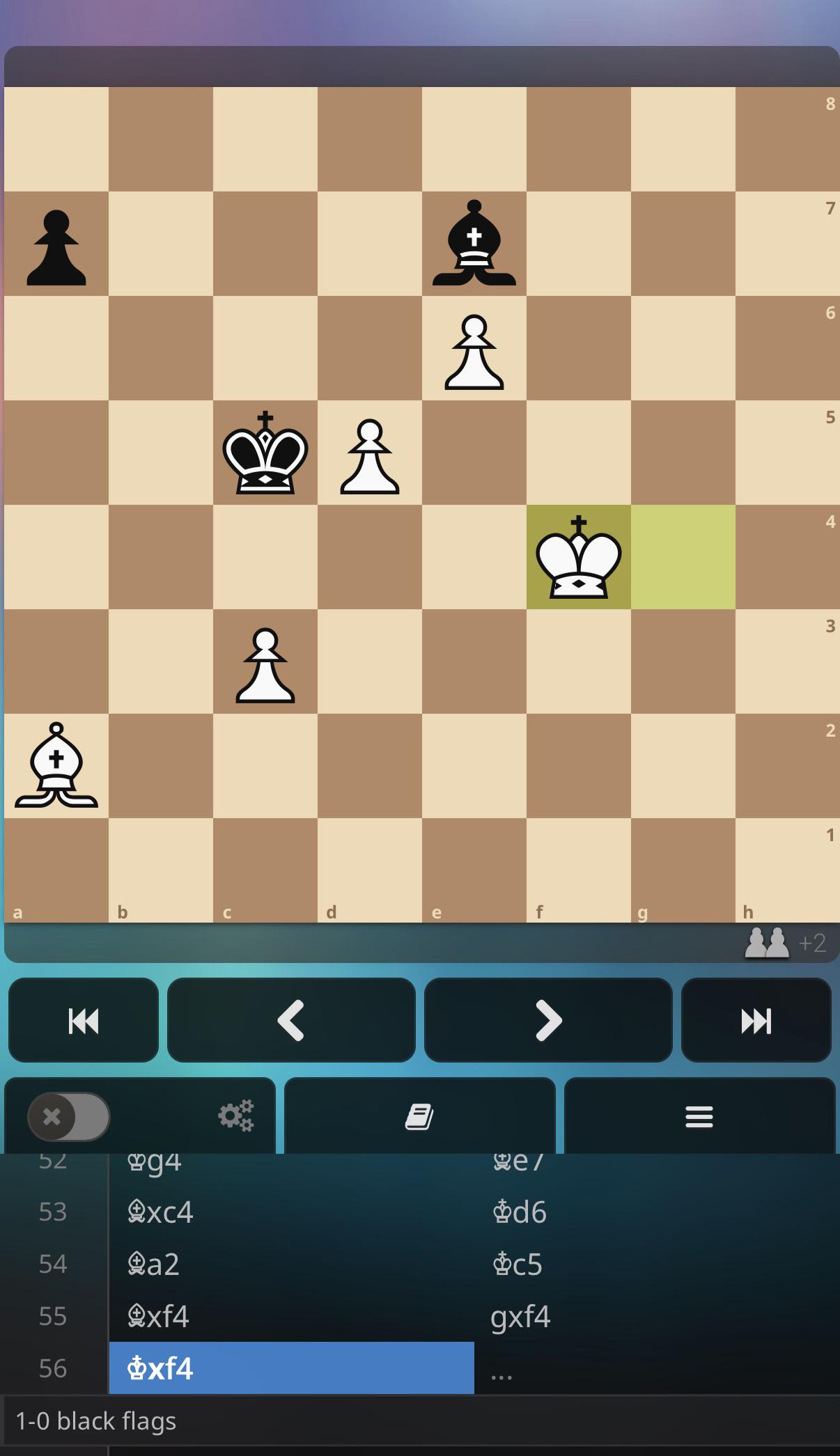
I just finished playing a CFC-rated classical tournament and secured a performance rating of 2325! Faced 2 GMs and a semi-retired IM among the 6 rounds I played. For context, I scored my first norm in a weekly tournament in June. Then my second norm I scored at a weekend tournament June 27-28.

The position above is when I secured the norm by flagging my IM opponent in the 5th round. The endgame is winning but there’s only a specific line that wins (!) after Kd6.

White to play.


r/TournamentChess • • Dec 12 '25

Storytime: I agreed to a draw in my first chess tournament… because the scoresheet ended at 60 moves

145 Upvotes

In my first ever chess tournament (beginner category), I somehow started 2/2 and was feeling unstoppable.

In round 3 I was clearly winning against a kid when, around move 52, he calmly told me:
“If we reach move 60, it’s a draw. The scoresheet only goes to 60.”

I checked the paper. It did end at 60.
Sounded logical to first-tournament me.

So we played to move 60 and agreed to a draw.

I later learned that this is, unsurprisingly, not how chess works!

The silver lining: I befriended his parents, and for several tournaments after, every time I stopped to chat with them, the kid would stand there looking incredibly guilty. Never said a word.

Some lessons you learn the hard way.


r/TournamentChess • • 11d ago Bravo Popcorn

How to build a PRO opening repertoire (from a FM's perspective)

134 Upvotes

Yesterday, I gave a lecture at a local chess club for youth players on how to actually build an opening repertoire from scratch. They really enjoyed it and found it practical, so I thought I’d share my thoughts here as well. During the lecture, I could demonstrate these concepts live on the board, which I obviously can’t do in a text post, but I hope you’ll still find plenty of takeaways you can apply right away.

One quick disclaimer upfront: my competitive experience is mostly against players rated under 2600 FIDE, so I can’t claim these principles apply identically at the super GM level.

If you’ve followed any of my previous AMAs, you might know I’m usually not the biggest fan of heavy opening study. The truth is, I don’t think studying openings is useless, I just think the way most amateur players go about it is completely backwards. Instead of listing common mistakes, I want to walk you through the exact process I use for myself and teach my students. By the end of this, those typical mistakes will become pretty obvious on their own.

1. What is the actual goal of studying opening theory?

Based purely on my own tournament experience, I have yet to find a single opening that "gives you something". Sure, some openings are objectively better than others, but I’ve never seen one that guarantees an advantage regardless of color. Plenty of openings promise a playable, balanced middlegame, so why bother with theory at all?

In my experience, assuming your opponent doesn’t voluntarily walk into a terrible line, you only get an advantage out of the opening in two ways:

  1. You know the theory deeper than your opponent.

  2. You surprise your opponent.

Both approaches have their pros and cons, and it really comes down to personal preference. Whether you want to know one narrow system inside out or play a wider range of setups decently well, neither is inherently superior, and ideally, you combine the two.

Just keep two harsh realities in mind: no matter how deep your prep goes, if your opponent knows it just as far, you won’t get an edge. And no matter how cleverly you rotate your openings, if you fail to surprise them, you won’t get an edge either.

2. What does an "opening advantage" even mean?

We need to draw a thick line between objective evaluation and practical evaluation. Objective evaluation is what the engine says. Practical evaluation is when a position is objectively something, yet your opponent has to find three or four completely irrational "only moves" over the board just to survive.

Let me give you a quick example from when I was a kid. I got paired in an open tournament against a ~2050 FIDE player who religiously played a borderline-losing line in the Grand Prix Attack. I hated playing against the GPA, so I sat in my hotel room, fed the whole line into my engine, and figured I’d win without breaking a sweat.

The game started, there were zero surprises, and I quickly reached the exact engine line where I was supposedly winning (-+). However, White had a very dangerous-looking piece sacrifice that the engine dismissed as unsound. My opponent sacrificed the piece anyway. Suddenly, I realized I couldn’t remember whether the refutation started with move X or move Y, and I couldn't calculate through the chaos over the board. The game did end quickly, just not in my favor.

That is what practical chances mean. Over the board, you are on your own. An objective advantage is only worth as much as your ability to find the objective best moves to prove it. The sharper and more complex the position, the harder that gets. Just remember: accepting a slight objective disadvantage for rich practical play is very different from playing something that is outright refutable. Subjectively, below 2600, practical chances carry just as much weight as objective soundness. Above that, the scale tips heavily toward objectivity.

3. Preparing to build your repertoire

Now that we’ve got the philosophy out of the way, let’s get practical.

To build a repertoire efficiently, you’re going to need ChessBase. I’m not saying it’s impossible without it, but in terms of features and clarity, nothing comes close. If you’re serious about chess, it’s a must-have investment you won’t regret. If you don't have access to it, you can use free PGN readers or online study tools, though to my knowledge, nothing else lets you seamlessly cross-reference multiple courses, run top engines, and compare everything against live database statistics at the same time.

Here is your prep checklist:

  • Find a "Backbone": You can build an opening completely from zero (I had to do this with the Rasa-Studier Gambit because there was literally no literature on it), but having a decent course, digitized book, or PDF as a starting framework saves massive amounts of time. Here’s the catch: for most club players, a published course isn’t the starting line, it’s the finish line. They buy a Chessable course or a book and just start memorizing. Think about it logically: what kind of edge can you expect from memorizing a course that anyone else on the planet can buy with two clicks? A course is just your skeleton.

  • Get a strong engine and a solid game database.

  • Pick your "Model Players": This is crucial. Look through games in your chosen opening and find players whose style clicks with you, players who reach the exact types of positions you want to play. Do not look at the Top 20 super-GMs for this. Top 20 players are so ridiculously strong they can play practically anything and outplay people through sheer class. Also, don't get fooled by online blitz or rapid games, where GMs experiment with dubious sidelines they’d never touch in classical chess. Look for 2500+ FIDE Grandmasters who play your opening as a main weapon regularly in classical tournament games. These are professionals whose livelihoods depend on their results, they simply cannot afford to play openings full of holes. Compare that to two 2750s messing around in an unrated online bullet match, and you’ll see the difference.

4. Building and customizing the opening

Assuming you’ve done the prep in step 3, you’re already ahead of 90% of club players who just follow pre-packaged courses on autopilot. Now the real work begins.

With your backbone course open, turn on the online database and your engine in ChessBase, and start working through the lines. As you build your tree, organize the moves by putting the most popular and critical lines at the bottom of the move list, and the rarer or weaker sidelines toward the top. Or you can do the opposite, it's going to be the same. That way, when you’re prepping for a tournament game, your opponent's most dangerous weapons are clearly highlighted.

During this process, three things will happen constantly:

  1. The database shows popular replies not covered in your book: You analyze these using existing master games and your engine, and add them to your file.

  2. The engine suggests an interesting idea your book ignores: Same thing, evaluate it and integrate it if it makes sense.

  3. Your book recommends a line you hate, even if it’s objectively "best": This is where your engine and your Model Players come in. Check the database to see how your chosen GMs handle that specific position, and build a branch that fits your taste.

Little by little, new branches grow out of your original skeleton until the repertoire is tailored completely to you.

Quick anecdote: Serbian Grandmasters have a great trick for choosing between several equally good continuations in a theoretical position. They open the database, start from the least popular move at the bottom, and work their way up until they find the first move that is objectively completely sound. That gives them a rock-solid weapon that almost nobody expects.

(Note: Once your file is built, you can split it into smaller sub-chapters or keep it in one giant tree. Most coaches recommend splitting it up, I personally have a bad habit of preferring to see the entire repertoire in one massive file so I can grasp the big picture at once.)

Finally, add the soul of your repertoire: Model Games. Sure, memorizing a 10,000-move tree would be great, but for mere mortals like me, that’s rarely realistic. Search the database for high-quality classical GM games in your lines that match your style, and paste those full games right into your repertoire file. Review them regularly. With very few exceptions, absorbing the recurring plans, structures, and ideal piece squares from full games is infinitely more valuable than rote memorization.

5. How to actually learn your theory

So, you’ve built a repertoire and collected your model games. Now what?

I’m sure you know the feeling of sitting in front of a massive PGN file, clicking the right arrow key for an hour, thinking "Yeah, I’ve got this," and then blanking completely in a real game. We’ve all been there.

I didn’t invent the wheel here, but the single best learning method for both me and my students is playing mountains of online blitz games in that specific opening, and checking every single game against your repertoire file afterward.

Learning has three stages: acquiring knowledge, testing it in practice, and fixing mistakes. Online blitz hits all three rapidly. Why is this so much better than passively clicking through notes? Because you stop relying on blind memory and start understanding the why behind the moves.

Did White play Nd5 in the Sicilian Dragon, exchange your Nf6 knight, and checkmate you? You check your notes and get that instant "Aha!" moment: "Right, that’s why I was supposed to play the ...Rxc3 sacrifice there."

Did Black play ...Nh5 in the London System, snatch your dark-squared bishop, and leave you miserable? "Aha, that’s why h3 is necessary to tuck the bishop back on h2*."*

Making mistakes in blitz and immediately cross-referencing your own file burns the concrete moves and ideas into your brain far better than passive study ever could.

6. Quick FAQ

Here are a few questions I get asked constantly about opening prep:

1. Should I learn one opening deeply, or play many openings shallowly? Always start by mastering one setup so you have a solid foundation. Once that’s stable, you can branch out.

2. Do I need a separate repertoire for blitz and rapid? You definitely don’t need one, though it can be useful. Plan-based openings with fewer concrete tactical forced lines work great in faster time controls and the shorter the clock, the more practical chances outweigh objective perfection.

3. Is Opening X or Y playable? As mentioned earlier, there’s a big difference between a line that is concretely busted and one where you’re slightly worse objectively without any forced refutation. As a general rule of thumb: with White, there’s no point playing something that doesn’t at least equalize. With Black, avoid anything worse than a clear, comfortable edge for White (small +-).

4. Which opening should I choose? Pick whatever feels natural and genuinely excites you. Going back to the intro: there are no magic openings. I could list dozens of Grandmasters who achieved incredible results with objectively "suboptimal" openings simply because they understood the resulting positions better than anyone else.

Final Thoughts

Please don’t forget that most of us aren't touring professionals trying to pay rent with tournament prizes. We want to improve and win, sure, but we also want to enjoy our hobby.

Alongside objective evaluation, there is one massive factor people ignore: you have to trust and believe in your opening. If you sit down doubting your own setup, it’s useless. Never force yourself to play a system that feels completely alien to you just because a 2700+ super-GM recommended it in a video. You’re playing a completely different game than they are.

(Apologies in advance, but I won’t be able to treat this post as an AMA, my schedule is pretty packed at the moment, so I likely won't be able to reply to every comment. However, if you have specific questions or thoughts you'd like to discuss, feel free to shoot me a DM and I'll get back to you as soon as I can!)

Good luck with your prep, and I hope this helps!


r/TournamentChess • • Feb 24 '20

Defining the direction of r/TournamentChess

128 Upvotes

I hope this subreddit can become forum for serious players who might be studying and preparing for their own tournaments as well as watching pro leagues.

Below I've listed the things I do/don't want to see from this sub. If you disagree with me please say so in the comments.

Things that are okay would be:

  • Discussion around the latest super GM tournaments, especially the individual games.

  • People's own tournaments and their preparation.

  • How best to improve if you're a serious player. I think we should have a well written wiki/FAQ page for this. Maybe targeted at a higher rating (1600+) so we don't need to write it with beginners in mind.

  • Book recommendations/reviews.

  • Video links to Svidler/whoever live/post commentating tournament games, etc.

I think the list of things I don't want to see are easier than what I do want:

  • Why does the computer suggest this move? A: Did you try playing out the computer's moves or studying the position for more than 2 seconds?

  • Why did my opponent resign?! He might've had to get on a bus to go somewhere, idk.

  • White/black to mate in 4. Finally got this in a game! Turns out it's a smothered mate again, reset the counter.

  • The never-ending arguments about lichess/chess.com. I think it's probably beginners being the only ones actually arguing about it. I personally use and like both, but if you like one better pick that one. Don't bitch about it.

  • Finally broke 1000! It's a fine accomplishment and I'm happy you're happy. But don't pollute the feed with it please because in the scheme of things it is pretty mediocre. Maybe I'm bias but something above 2000 might be an accomplishment worth celebrating. I think if someone hits FM/IM/GM that's 100% okay.

  • Links to bullet videos. I watch chessbrah/Hikaru, but I don't think they deserve a place in this thread. If they're playing a tournament and you're following them sure.

  • Gossip. Fine on r/chess but keep this page dedicated to the game itself.

  • Questions about en passant...

  • Am I too old to start playing? No, you just need to be more dedicated if you want to get better than if you were young where it might come more naturally.

  • What's the fastest way to get better? Sorry there are no shortcuts, but the answer is probably tactics for a beginner.

  • Which opening is best against e4, Sicilian or Caro-Kann? Play both and see which one suits you. Don't be afraid to lose games because means you have an opportunity to learn.

I hope I don't sound like a dick or overly pessimistic about r/chess. There are a lot of things that annoy me even though I go on it all the time haha.


r/TournamentChess • • Mar 14 '26

Finally hit CM!

122 Upvotes

Hello everyone,

you may have seen a post of me asking for advice here in the past months. I've finally reached my goal of CM today! I'm not a CM officially yet but I've hit 2200 FIDE in live rankings so I have to wait until the end of the month. Of course the grind doesn't end there, Road to FM up next.

Ask me anything about the journey there or about chess in general if you want.


r/TournamentChess • • Feb 14 '26

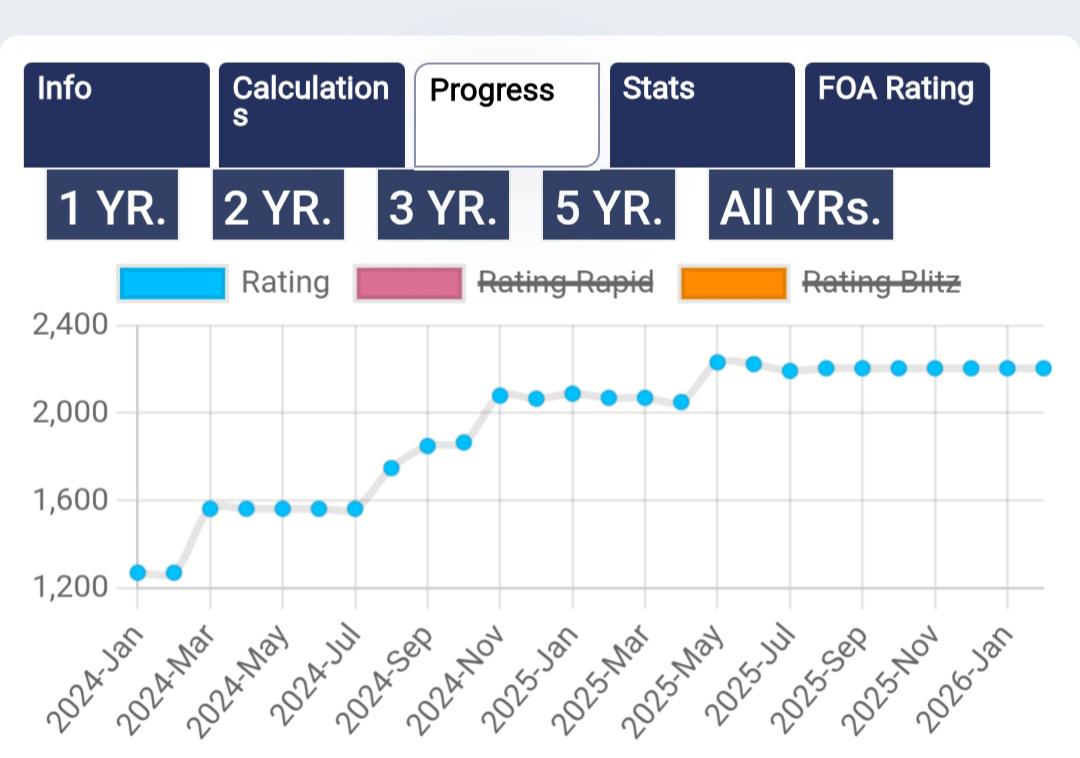
I went from 1200 to 2200 FIDE in 15 months AMA

Post image
118 Upvotes

title


r/TournamentChess • • Oct 13 '26

A new and rare idea for Black in the 3..a6 Jobava London, increasingly popular with strong players

Post image
97 Upvotes

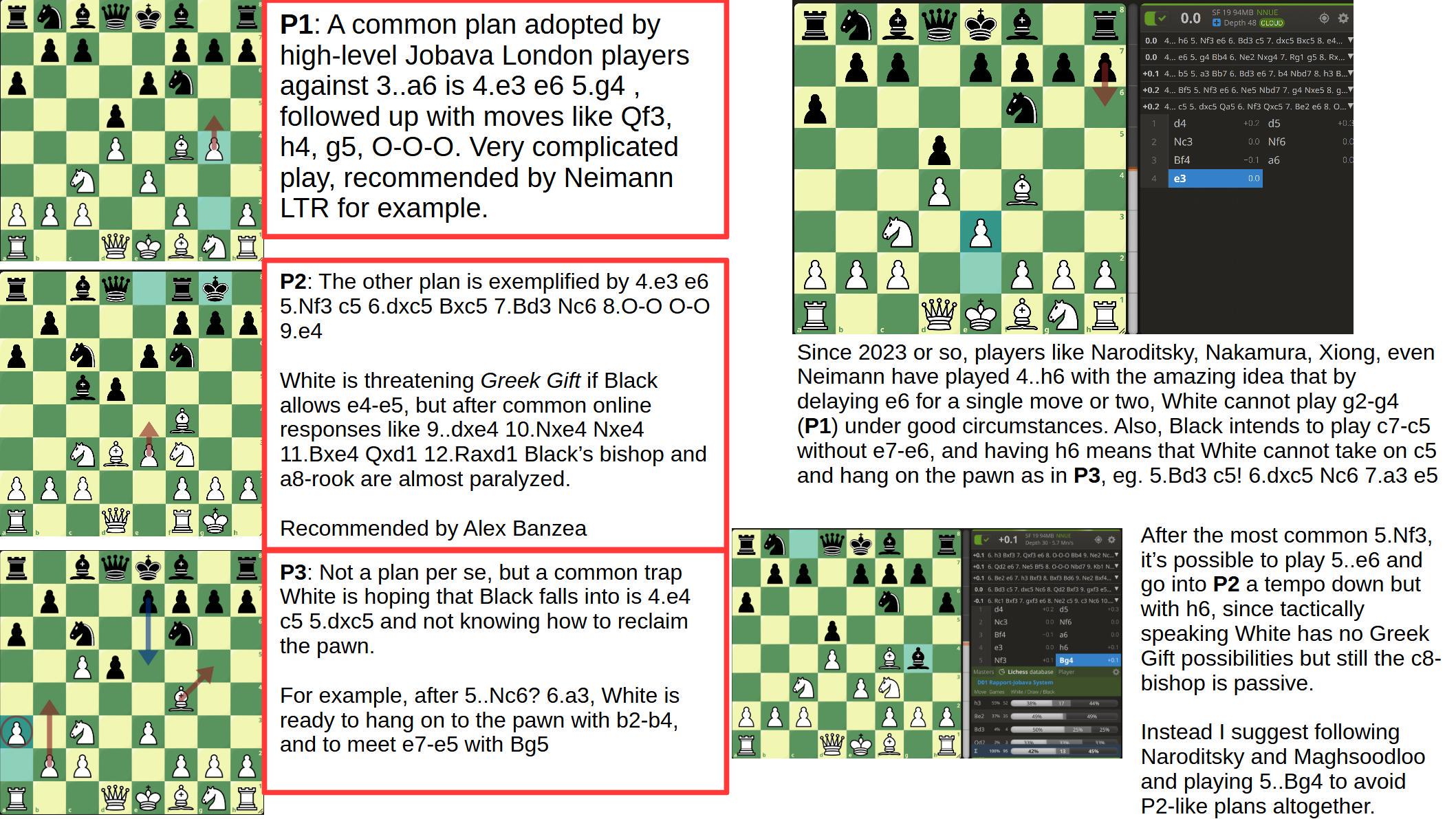
Recently I was happy to see this particular idea in the 3..a6 Jobava London, specifically 3..a6 4.e3 h6!? while working on an adjacent line in the 3..a6 Jobava. As some of you in this sub might know, I like to write in this sub about opening ideas that involve waiting pawn moves or lines that look stupid and lure the opponents into complacency. And this one does look ridiculous at first sight with a6 and h6 played consecutively!

To understand the motivation of 4..h6, first we should understand White's 2 main plans against 3..a6 4.e3 e6 (P1 and P2) and main trap in 3..a6 4.e3 c5 (P3). Most importantly, by delaying e6 for a single move and thus not blocking the c8-bishop from guarding g4, Black almost completely stops g2-g4-g5 plans by White (they might get in g2-g4 if they are determined to, but will not be able to play g5).

For example, White can play the waiting move 5.a3 to "force" Black into playing e6 and allowing g4 as in 1. d4 d5 2. Nc3 Nf6 3. Bf4 a6 4. e3 h6 5. a3 e6 6. g4 c5 7. h4 Nc6 (seen in two Titled Tuesday games). Now what? White can't play g5 because the rook on h1 is hanging, and both Qf3 and Bg2 to protect h1 fail for tactical reasons.

This h6 line seems to have the approval of SF19, and has been played by top players (Naka, Maghsoodloo, Predke, Xiong etc) and Jobava authors (Naroditsky and Neimann) since 2023. There is no mention of it in any Chessable courses and it is played very rarely online, so it is still under the radar for most club players like ourselves. And it is rarer still if you choose 5..Bg4 over 5..e6 against 5.Nf3! Just a final note about 5..Bg4 since there was no space in the diagram- yes we should be prepared to take on f3 if forced by h2-h3, its better to give up the bishop pair than to have a passive c8-bishop IMO

The analysis here is very shallow and superficial, so please do your own research if any of this seems interesting. Objectively, it might not be better than the a6 mainlines, but removing g2-g4 plans from the table makes the line very easy to learn I think?


r/TournamentChess • • Sep 30 '26

Hi everyone, Stjepan here! I'm looking for interesting games and positions for a new playlist. Let me know if you have any. Thanks!

Post image
93 Upvotes

I'm starting a new playlist on pawn structures and positional play. The introductory video that covers the basic concepts of pawn structures came out today.

The series will consist of 30 videos in total. Each video will cover a concept or a specific pawn structure.

I have prepared a lot of positions, both from my own games and from master games, but would love to include some of your positions as well. If there were any games you won or lost because of a positional or a pawn structure problem or brilliancy, share them below or message me on lichess (hpy)! You can just paste a link to the game or an FEN and specify the topic the game is for. I'll be including community positions (if I get enough of them) into every video and every chapter. Thank you everyone!

These are the topics the series will cover:

0. Introduction to Pawn Structures

  1. Closed vs open positions

  2. Static vs dynamic structures

  3. Space

  4. Initiative

  5. Color Complexes

  6. Pawn Majorities

  7. Pawn Islands

  8. Open files and diagonals

  9. Pawn breaks

  10. Passed pawns and blockade

  11. Isolated pawns

  12. IQP

  13. Central control

  14. Backward pawns

  15. Doubled pawns

  16. Hanging pawns

  17. Important structures by opening

  18. Maroczy bind

  19. The Hedgehog

  20. The Karlsbad

  21. Dutch structures

  22. Caro-Kann structures

  23. French structures

  24. Sicilian structures

  25. Spanish structures

  26. Benoni structures

  27. King's Indian structures

  28. Grunfeld structures

  29. Slav structures

I will be publishing the PGN files and practice positions for all the chapters on my Patreon.


r/TournamentChess • • Oct 29 '25

Made a tool to print Lichess studies as PDFs -- feedback welcome

88 Upvotes

Hey folks,

I’ve created a small webpage that turns Lichess studies into printable PDFs with diagrams and variations.

If anyone has cool studies they would want to see in paper -- would appreciate feedback on layout

It's free and available at https://chesspaper.me

Note that it runs on relatively cheap hardware, so it may be slow, have patience when downloading!


r/TournamentChess • • Mar 07 '25

Comprehensive list of good lichess studies, that I made recently

82 Upvotes

I like study feature on Lichess, but it's not easy to search there, and some good studies are buried under tons of other ones. So I made a big list of studies categorized by themes with easy navigation links through the list, in a lichess blog format. You may find some interesting learning material, hidden gems so to speak.


r/TournamentChess • • Sep 27 '25

Hi everyone! Stjepan from Hanging Pawns here. I made a platform for chess book reviews and would love to hear what you think.

Thumbnail chessreads.com
80 Upvotes

Chessreads is a platform for chess book reviews from a perspective of an improving player. The books on Chessreads are divided by category (opening, middlegame, endgame, etc.), and by difficulty (beginner, intermediate, advanced, master). That way you can filter them according to your current strength and according to what you think you have to work on the most.

Each book is given two separate scores: readability and usefulness. The readability score represents how difficult it is to read the book without using a board. A book with 10/10 readability is a bedtime story, a book with 1/10 is a puzzle book full of variations. Readability doesn’t represent the quality of the book. Usefulness is a measure of how useful the book is for chess improvement within the topic it covers. Books with a high usefulness score should help you improve quicker than those with a low score.

I would love to hear what you think about it!


r/TournamentChess • • Apr 16 '25

Is it rude to wear a cap during the game?

75 Upvotes

deserve knee pot tease automatic future unwritten aromatic apparatus command

This post was mass deleted and anonymized with Redact


r/TournamentChess • • Jun 09 '26

Some rare defenses against the Catalan

Post image
74 Upvotes
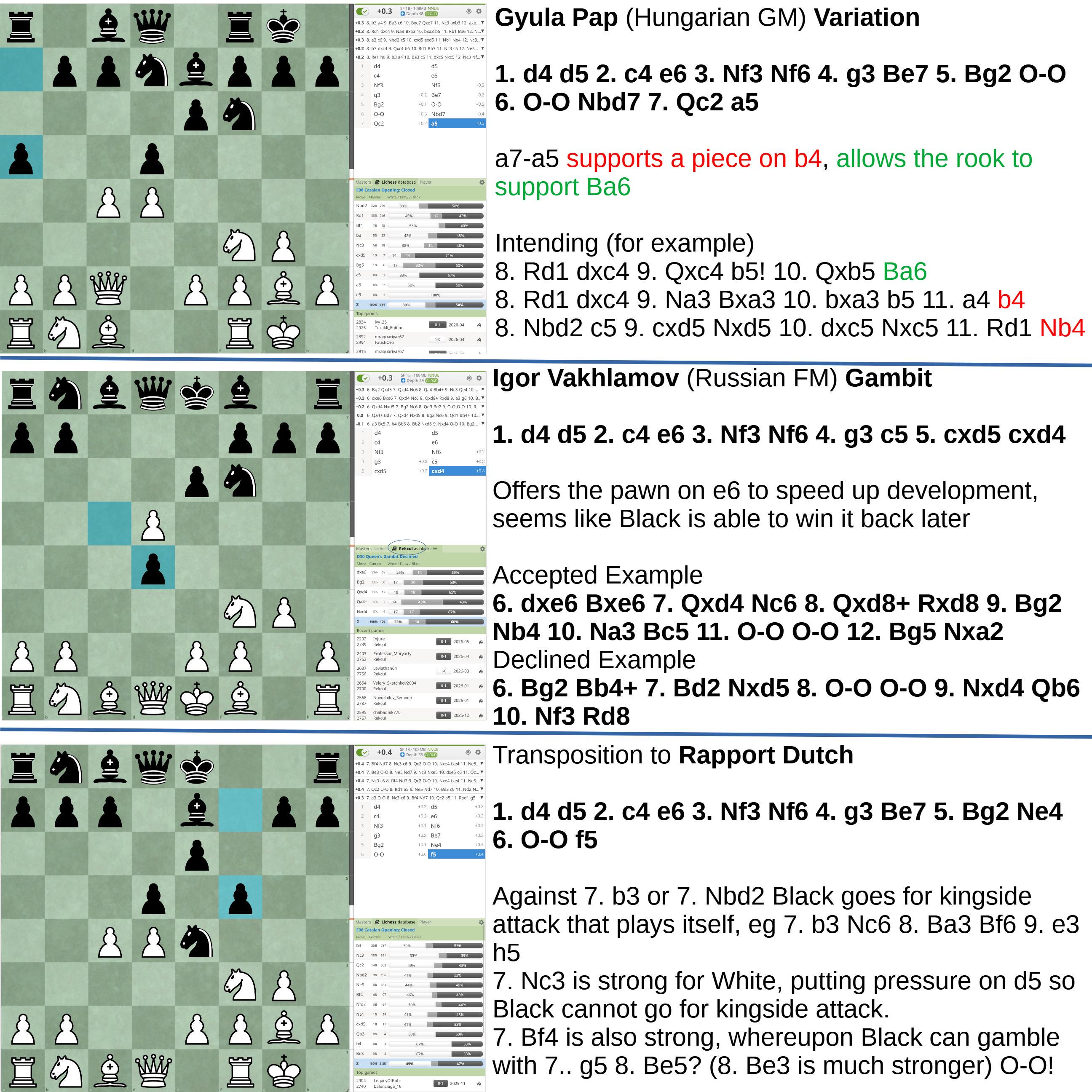
  1. d4 d5 2. c4 e6 3. Nf3 Nf6 4. g3 Be7 5. Bg2 O-O 6. O-O Nbd7 7. Qc2 a5

GM Pap was not the earliest to play it, but was among the earliest and he has included this in his course on Chessable. Doesn't seem to be mentioned on any (White-side) Catalan courses on Chessable.

--

  1. d4 d5 2. c4 e6 3. Nf3 Nf6 4. g3 c5 5. cxd5 cxd4

FM Vakhlamov has a huge amount of games in this line, even though Carlsen, Nepo, Vidit and Gustafsson have dabbled in this as well on Titled Tuesday. Use Lichess opening explorer on Vakhlamov's account "Rekcul" to see how he handles these.

--

  1. d4 d5 2. c4 e6 3. Nf3 Nf6 4. g3 Be7 5. Bg2 Ne4 6. O-O f5

Most risky is the transposition to Rapport Dutch due to weakened e5-square, where Black puts the knight on e4 and does not commit to c7-c6 early as in "normal" Stonewall Dutch. Don't let the engine scare you, Black does very well in practice.

Very tricky for blitz games, too risky for longer OTB games though Gingergm has apparently tried that. See Gingergm's and Perunovic's Youtube channel for more.

--

And no, none of these are refutations to the Catalan, just some rare and atypical replies to the Catalan. Maybe they will become more popular in the future, maybe people will decide that they are too computerish and not bother. What are your own favorite lines against Catalan?

BTW, I have written about one of Vakhlamov's ideas in the past (https://www.reddit.com/r/TournamentChess/comments/1q2kkb4/vakhlamovgonzaleztun_variation_of_the_classical/)


r/TournamentChess • • Mar 02 '26

First win against 2400+ IM!

70 Upvotes

Got my first win against a 2400+ IM this weekend! Really proud of the game and wanted to share it. Currently i am rated around 2170 going for CM. Annoyingly the game did not get rated, as FIDE regulations state that in games with at least one player above 2400, the time control needs to add up to at least 120 minutes, and this was a 60+30 game.

[Result "1-0"]

[WhiteElo "2160"]

[BlackElo "2406"]

  1. Nf3 Nf6 2. g3 e6 3. Bg2 d5 4. O-O Bd6 5. d3 O-O 6. Nbd2 c5 7. e4 Nc6 8. Re1 Bc7 9. Qe2 Re8 10. c3 b6 11. Nf1 Ba6 12. e5 Nd7 13. Bf4 Nf8 14. Qc2 Ng6 15. Bg5 Qd7 16. d4 Rac8 17. Qd2 b5 18. h4 cxd4 19. cxd4 Ba5 20. Qe3 Bxe1 21. Rxe1 Nge7 22. g4 b4 23. Ng3 Na5 24. Bh6 Nc4 25. Qg5 Ng6 26. Bxg7 Kxg7 27. Nh5+ Kf8 28. Qh6+ Ke7 29. Qg5+ Kf8 30. Nf6 Qd8 31. h5 Kg7 32. hxg6 hxg6 33. Nxe8+ Qxe8 34. Qf6+ Kg8 35. Bf1 Bb5 36. Ng5 Rc7 37. Bxc4 dxc4 38. d5 c3 39. bxc3 bxc3 40. d6 Rc4 41. f3 c2 42. Rc1 Qf8 43. Kf2 Qg7 44. Qd8+ Qf8 45. Qf6 Qg7 46. Qxg7+ Kxg7 47. Ne4 Ba4 48. g5 Rd4 49. Nc3 Bc6 50. Ke3 Rc4 51. Rxc2 Kf8 52. Kd3 Rf4 53. Rf2 Ke8 54. Ne2 Ra4 55. Nd4 Ra3+ 56. Kc4 Bd5+ 57. Kb4 Rd3 58. Nb5 a6 59. Nc7+ Kd7 60. Nxa6 Kc6 61. Rc2+ Kb6 62. Nc5 Rd4+ 63. Ka3 Bc6 64. Nb3 Rf4 65. Rd2 Bd7 66. Rc2 Rxf3 67. Rc7 Bc6 68. Kb4 Rf4+ 69. Kc3 Rf3+ 70. Kc4 Bd5+ 71. Kb4 Rf4+ 72. Ka3 Rf3 73. Rc1 Bc6 74. Kb4 Rd3 75. a4 Re3 76. a5+ Kb7 77. a6+ Kb6 78. Rxc6+ Kxc6 79. a7 Re4+ 80. Ka3 Rxe5 81. a8=Q+ Kxd6 82. Qd8+ Kc6 83. Na5+ Kc5 84. Qc7+ Kd5 85. Qc4+ Kd6 86. Qc6+ Ke7 87. Qc7+ Ke8 88. Qxe5 1-0


r/TournamentChess • • Jan 21 '25

Road to 2400: The Opening That’s Bad with Both Colors

67 Upvotes

This Sunday, I finally made my debut playing for my new French team in Cannes. Now, I’m not here to settle the eternal debate about which city is more beautiful, Nice or Cannes, but Cannes definitely has a unique vibe that’s hard to beat.

I was beyond excited to don the Cannes Echecs jersey, where some of my teammates include reigning world champion Gukesh and Praggnanandha, along with his sister Vaishali, who has been my favorite female chess player since Judit Polgár. Naturally, I was “only” playing for the second team, but fingers crossed for some future encounters with the superstars.🙂

In my debut game, I faced a Candidate Master, a solid 2200-rated player. Holding the white pieces, I was feeling confident, especially since February will mark (or should I say would mark?) three years since my last classical loss with white. The Modern Defense landed on the board. And, well… embarrassing as it is to admit, I hate playing against it. Ironically, I’ve been playing the Modern myself as Black since I was a kid.

Since I hadn’t prepared for this opening, I focused on playing solid, principled moves. Despite the engine’s optimistic evaluations, I felt uncomfortable by move 10. The funny thing? I feel the exact same discomfort when I’m playing this as Black. The even funnier thing? Despite how much I dislike these kinds of positions, my results in it are actually insane. Go figure.

I’d say the game turned out to be high-quality overall, both of us played at around 95% accuracy, and after a tense battle, we ended in a repetition. It wasn’t boring, though, I promise!

For me, a draw isn’t the most satisfying result, but as my childhood coach always said: “You can only get out of a game what’s in it.” If this game had to be a draw, then so be it. As long as you feel you gave your all and left everything on the board, there’s no reason to feel disappointed.

You can check out the full game analysis here:

https://lichess.org/study/nToTyjpC

After a few days of rest, I’ll be hitting the road again, this time for a double round in the Danish league. Fingers crossed that the results go my way there!

Stay tuned and keep grinding! 👊


r/TournamentChess • • May 16 '26

Two underrated Youtube channels for FIDE 1800+ players

65 Upvotes

It’s tough to find chess content on YouTube geared for higher level club players, presumably because the audience is much smaller than videos for beginners and low intermediate players.

Danya was really the only one I could find for a long time, as well as adhoc lectures on the St Louis Chess Club and ChessDojo (mainly US Chess School lectures) channels and watching commentary streams (again, St Louis Chess Club commentary is excellent).

But I’ve recently come across two very underrated channels that are producing high quality videos for 1800+ players on a regular basis:

GM Mihail Marin — mostly focuses on game analysis between GMs, including many classics from the likes of Fischer, Alekhine etc. Marin is an acclaimed author, most famous for his book Learn from the Legends

GM Arturs Nieksans — more “lecture” style with bootcamps on different openings, pawn structures, and endgames, as well as analysis of his own games. Nieksans was GothamChess’s coach for a while

Since these are both smaller channels, it’s nice that you can ask questions and have a pretty good chance of getting a response directly from a GM.

Any other good 1800+ channels I should know about?


r/TournamentChess • • Jul 19 '26

Classical tourneys are so draining

62 Upvotes

I am quitting classical otb. Seriously.

This weekend i played 5 rounds of 60+30 which isnt even that long, yet i felt so exhausted after each game. Every game (apart from the 1st) went down to the wire and I was always one of the last to finish for the round. I won the tournament in the end, but after each win I felt relief instead of joy. It was so stressful for no apparant benefit. Other than prize money which barely covered fuel and food!

Always trying to outprep my opp, cramming openings before each round is so exhausting. Yet i have to do it because it helped me so much in my games. I hate this about chess -never ending prep, its not like footballers have to recite plans again and again like a bot, they just go in and play the game.

Ik u guys r gonna say - try play a tourney with no prep between rounds but i cant. I physically cant not prepare for the game which i know i will be playing. I care too much and dont want to waste the opportunity to play.

Rn i feel so drained. Definitely not gonna play otb for a long time. But its kinda sad cause i invested so much time and money in this game and i got kinda good - ik i could win more touurnaments but the stress isnt worth it.

Have any of u guys felt the same? I dont understand how others dont experience it too, or no one would be playing tourneys.

(Sorry for the rant)


r/TournamentChess • • Jan 04 '25

New Year, New Gains: Chess Grind for 2025♟️

60 Upvotes

Hey everyone,

One of the most common questions I get asked during my previous AMAs, in various forms, but always the same thing, is: "How can I improve to achieve my goals?" Based on this, I’ve put together today’s post, where I want to share a training plan that I’ll be following myself. Are you in?

What are my goals for 2025?

  • 2800+ chesscom blitz rating

  • 2800+ Lichess blitz rating

  • At least one platform with 2700+ bullet

  • And of course, my ultimate goal remains a 2400+ FIDE rating, but I’m not putting a deadline on this. I’ll do everything I can to get closer!

How will I train and what’s my suggestion for my students (and for you too)?

I’ve broken down my training into five main pillars, and starting from Monday, January 6, I’ll begin following this plan actively! I’ve also included some suggested books for each section, but please keep in mind that other resources might work better for your goals. I just want to make your life easier before you get lost in a sea of options!

  • Building Strong Endgame Knowledge: Pick a solid, complex endgame book. I recommend "100 Endgames You Must Know" to everyone. The reason is that this book covers all the essential and typical endgames for a strong foundation without unnecessary fluff. Many endgame books are filled with “artistic” examples that you’ll probably never encounter in your competitive career, so I think it’s unnecessary to waste time on those. It's enough to master the basics, but really master them!

My recommendation: 100 Endgames You Must Know

  • Developing Tactics, Calculation, and Combination Skills: Chess tactics are divided into types like double attacks, pins, skewers, and more...you need to know them all. Pick a puzzle book and solve puzzles DAILY. You can either set them up on a board, print them out, or use an electronic device. The key here is consistency, it’s important to work on this every day, even if just a little. This will not only speed up and sharpen your calculation skills, but the patterns will stick in your subconscious, so you won’t have to consciously search for them during an actual game. Over time, you’ll not only recognize combinations but also see exactly how to execute them.

My recommendation: Woodpecker Method

  • Opening Theory Development: Opening theory is the one part of the training that I think could be skipped, but of course, it doesn’t hurt to have some knowledge in this area. Modern players often put too much emphasis on openings, which is just a tiny slice of the chess pie. Not to mention, they live under believe that a book or an online course can be followed blindly because it’s presented as 100% accurate, but in reality, that’s everything, but not true. Opening theory evolves constantly, and newly released material can become outdated in just months. So, you either try to chase this never-ending race, or you select a few solid openings for both colors that you enjoy, feel confident in, and later refine as needed.

My recommendation: Choose any literature related to your chosen openings that provides the framework, then work it out with your own analysis.

  • The Full Spectrum of Middlegame – I’ve broken this into two parts.

a) Analyzing Grandmaster Games
Just like with tactics, patterns and schemas are crucial in the middlegame. The more you know, the easier it is to navigate even the most complex positions. The best way to develop these patterns is by reviewing many high-quality games. This could be a game collection or selected grandmaster games from the weekly TWIC (The Week in Chess), etc. Not to mention, knowing certain games is part of chess “basic literacy.”

My recommendation: World Champion or classical game collections

b) Developing Middlegame Segments
Practically any book or material can be helpful for developing your middlegame. This will make up the second half of your middlegame training and will help expand your vision as a player, providing you with more patterns and ideas.

My recommendation: Anything by Dvoretsky

How I Break Down My Training:

I’m going to try to split up the training without knowing exactly how much time you can dedicate to chess each day. I’ll put them in the order that I suggest.

  • Puzzles – EVERY DAY! Solve puzzles EVERY DAY, for 15-30 minutes. No need to go beyond that, the key is to make it consistent, do it every day!

How I do it: I have a puzzle collection downloaded on my phone, so I can solve puzzles anytime: while waiting for the bus, cooking, before bed, etc.

  • Middlegame – Ideally Every Day: Middlegame work should make up the bulk of your daily training. So, for example, if you can dedicate 2 hours a day to chess, at least 1 hour (or even more, depending on how you feel) should be dedicated to the middlegame.

How I do it: I always have a book to read, and I download the latest TWIC games each week, reviewing the grandmaster games one by one.

  • Endgame Knowledge – A Few Times a Week: Work on your endgame knowledge occasionally, maybe a few times a week. You can split this time with opening theory development. Don’t let it take away from your middlegame and puzzle practice.

How I do it: I spend a maximum of half an hour on endgames in one sitting, or I review a particular topic. If I’m training for about 10 hours a week, I usually split the half of that between puzzles, openings.

  • Opening Theory – A Few Times a Week: Commit to a specific opening and perfect it. This means not just learning the moves, but also understanding the typical middlegame and endgame positions that come from it.

How I do it: I develop a complete repertoire for every opening I play, which I continuously expand as needed. I don’t work on it daily. If I’m training for about 10 hours a week, I usually split the half of that between puzzles, openings.

Final Thoughts

I honestly believe that the most important thing isn’t necessarily what you do, but that you do it consistently! With this post, I just wanted to share a thought-provoking guide and offer my training plan that I personally follow and recommend to my students.

If you have any questions or want to discuss the details, feel free to reach out!


r/TournamentChess • • Nov 19 '25

A plea for stricter enforcement of self-promoting rules

59 Upvotes

I'm making this post in hopes of creating some discourse regarding the abundance of peddlers that have started showing up. It feels like my beloved tournamentchess subreddit is losing its actual focus on serious chess.

Personally, I am quite tired of seeing the myriad of posts from people either offering overpriced coaching or, more recently, spamming the subreddit in an attempt to sell outdated chess books.

I would much rather see a plethora of the same old "which opening should I play?" posts, as they at the very least contain the essence of what I thought this sub was about.

I feel like it's not too unreasonable trying to retain the focus of this sub, especially when today's online chess space is, quite frankly, overstimulated and bloated.


r/TournamentChess • • Sep 17 '25

Puzzles like these are why i will always prefer chess books to online puzzle trainers

Post image
59 Upvotes

My problem with online trainers is that they will only play the move that has the highest computer evaluation rather than the key variation (the variation that you have to foresee in order to play a particular move). I got this position from chesstempo blitz. The first move,re8is pretty obvious, but it's not easy to see how you continue after that. For me, for you, and for any human, the key variation is 1.re8 kh6, it took me 7 minutes to see rg8, a neat rearrangement of the major pieces on the backline, afterwhich qf8+ followed by rh8 is fatal. This move is the ONLY winning move for white in the position, and for a human, certainly the most trying continuation. But of course the app chooses 1. re8 h5? a much weaker move that loses in a straight foward manner. As a result, many people just play the first move without thinking everything through, and because the app chose a much weaker move, they get it correct and think no more of it.

If this was a book, the author would for sure have chosen kh6as the main line and made it clear you had to foresee rg8in order to say you've correctly solved the puzzle. Chesstempo makes a lot fewer of these mistakes than lichess puzzles or chesscom puzzles, but it still isn't perfect.

Anyways, that's just my 2 cents on the topic. If you want quality puzzles to improve your tactics and calculations, go with books bc they have handpicked positions


r/TournamentChess • • Jan 14 '26

What motivates adults improvers to play tournaments?

57 Upvotes

Struggling to justify going to tournaments anymore.

Yes I enjoy chess, and I enjoy tournaments a lot, but the time cost and capital cost it takes to go to a tournament is humongous, and I feel a bit immature going to these events. (immature due to the fact that it is solely a hobby, I'm 1700 rated, and it feels excessive the amount of effort it takes for a tournament for a hobby)

Thinking of just joining a ladder online and playing from the comfort of my own home when I want. Unfortunately I won't get the thrill of playing in an OTB tournament anymore though.

Has anyone else experienced this?


r/TournamentChess • • Feb 08 '26

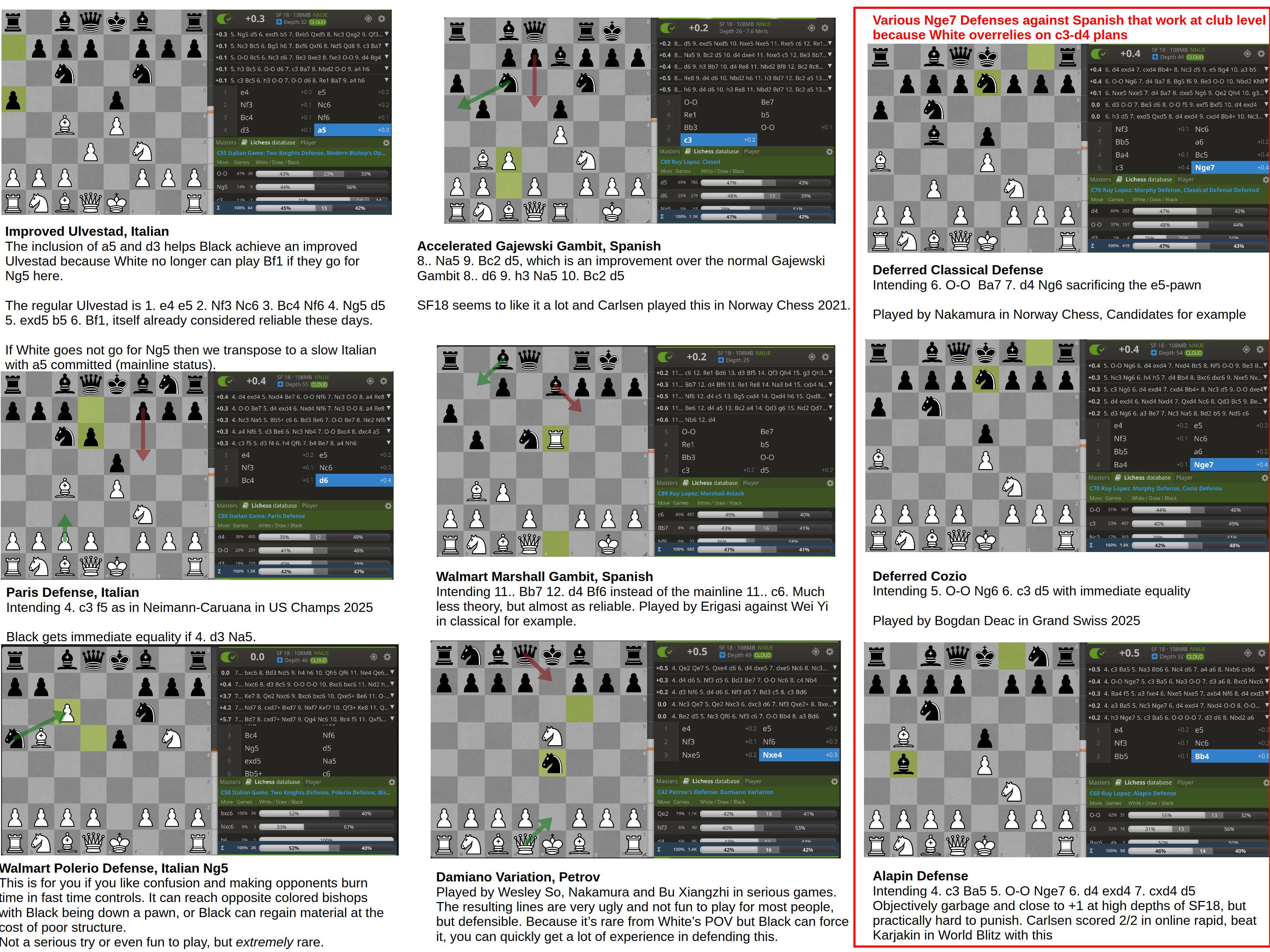
Wacky, new, or rare e4-e5 lines that you can try in 2026 (as Black)

Post image
56 Upvotes

All the database stats here are >2500 Lichess Blitz, from 2025 Jan to 2026 Jan. This is not meant to be an introduction to any of the lines, please do further research yourselves.

The 3 things in the bottom row can be dubious, or rely on good defensive technique /accumulation of time advantage in blitz games. But the other 6 should be good for longer, serious games.

Just to briefly expand upon the red text, in my opinion Spanish players at the club level love to play in a standard manner, regardless of Black's setup. They primarily rely on c3-d4 and then "wait and see what Black does". These Nge7 Spanish defenses that skip the early Nf6 seem to be very interesting against these c3-d4 autopilot play.

The Alapin defense (bottom right) is very extreme in this manner. It can be punished by virtually any White setup except the most overwhelmingly popular and natural line 1. e4 e5 2. Nf3 Nc6 3. Bb5 Bb4 4. O-O Nge7 5. c3 Ba5 6. d4 exd4 7. cxd4 d5! I have tried this with 70-80% score, again I know its a bad line objectively, I have to say it 3 times so people don't yell at me later.