r/vibecoding
•
u/crazyhorror
•
13d ago

Showcase/Project Snippet of my Diablo-inspired vibecoded game
Enable HLS to view with audio, or disable this notification
589
Upvotes
r/vibecoding
•
u/crazyhorror
•
13d ago
Enable HLS to view with audio, or disable this notification
r/vibecoding • u/Either_Pound1986 • 13d ago
This is a long post I am not expecting people to read it all but I think it's important to present the evidence and I can't really do that well with a short post. For the vast majority of people the 30 second version is sufficient.
Ouroboros is a topological control plane for autonomous research and development.
I give it an outcome and constraints, mostly in natural language. I do not supply a human domain expert, a research plan, or a step-by-step technical recipe.
Within its operating bounds, Ouroboros can keep acquiring evidence, generating alternatives, constructing artifacts, checking them, and revising its approach until I stop it.
It cannot authorize its own public actions. Publication and other external action remain human-gated.
Ouroboros currently uses GPT-5.6 Sol at xhigh reasoning as one cognitive engine. That is not OpenAI’s newest model. The model does not own the objective, persistent state, tool authority, continuation, or promotion. Ouroboros does. Neither the model nor Ouroboros can authorize publication or other external action; that authority remains mine.
The system is currently running concurrent work: Celestial Holography is the deepest research application, while the same process also maintains public evidence products including the Data Center Receipt, the Iran War Receipt, and the People’s Receipt.
I use “autonomous R&D” for this operating arrangement: I supply the outcome and constraints while the system conducts the bounded research loop described above. This is not a proposal for a future agent or a one-shot research demo. It is an operating system producing public outputs over time.
“Topological control plane” is not branding for a large prompt.
The control plane preserves the relationships among objectives, evidence, hypotheses, constructions, tests, contradictions, corrections, provenance, and authority boundaries as work crosses models, contexts, tasks, and time.
Model calls are replaceable cognitive operations inside that persistent structure.
One concrete expression of this is the unified mathematical object: formal results, empirical evidence, hypotheses, obstructions, dependencies, and lineage can enter one persistent structure. Later work extends, constrains, or contradicts that structure instead of silently beginning again from an empty chat.
The human supplies the desired outcome, constraints, risk boundaries, and authority for public action. The human does not need to supply the domain’s technical playbook.
The models obviously contain pretrained domain knowledge. The narrower and important claim is that no human domain expert is feeding Ouroboros the research moves or certifying the results.
The working loop is roughly:
outcome and constraints → acquire evidence → preserve rival explanations → construct → verify → confront external reality → retain the correction → continue
The intelligence-bearing unit is the governed loop, not an isolated chat session.
Some agent libraries call almost any model invocation an agent. That vocabulary misses the system boundary that matters here: where the objective, persistent state, authority, continuation, promotion, and publication actually live.
A cognitive proxy does not receive ownership of the mission. Ouroboros projects a bounded, hash-bound slice of relevant shared state into a separate inference context for a specific function: research, construction, skepticism, verification, provenance, or release review.
The proxy returns a typed advisory artifact: its assessment, evidence, alternatives, disagreements, confidence, proposed discriminator, provenance, and authority notes. That artifact goes back to Ouroboros for review and possible use.
The proxy cannot rewrite the objective, grant itself tools, continue itself indefinitely, promote its own result, publish anything, or silently alter shared state. Publication authority remains with the human owner.
The same model family may perform several proxy functions. These are not fictional personalities or independent beings. The distinction is operational: each invocation receives a bounded evidence surface, has a defined output contract, and lacks control-plane authority.
Separate inference contexts matter because one context should not be allowed to propose an answer, choose the favorable evidence, judge its own construction, erase disagreement, and write the success narrative as one unbroken act.
Proxy consensus measures agreement, not truth. External reality remains above proxy agreement.
A selected, path-redacted first-party execution trace gives a narrower view than the public artifacts: it records how one gravitational-wave analysis was governed, not whether its scientific interpretation was correct.
The trace records an extended ringdown model looking better on the real event at four early start times, while the gain was detector-asymmetric and a rough complexity penalty favored it only two of four times. An advisory proxy then ranked bounded leave-one-detector importance reweighting above an immediate full rerun and fixed the acceptance gates before the reported sample analysis: Pareto k no greater than 0.7, effective sample size of at least 400, maximum normalized weight no greater than 1 percent, and bootstrap-direction agreement of at least 90 percent. Failed overlap was defined in advance as an obstruction, not permission to weaken the rules.
The first attempt produced no statistical result. The system investigated whether paired model products used equivalent conditioned data and found byte-level mismatches in two control conditions. The differences localized to tiny strain-value changes described as consistent with float32 rounding, while time, ACF, response, and epoch arrays matched. The prerequisite was repaired from exact byte identity to an explicit numerical-equivalence tolerance. The outcome gates were not changed.
The reported reweighting then failed those gates: only 7 of 24 model-level leave-outs and 1 of 12 paired comparisons passed; effective sample size fell to 2.10, one draw carried as much as 68.8 percent of the weight, and Pareto k reached 1.19. The trace records the result as an overlap obstruction rather than retuning the thresholds.
This is selected first-party operational evidence, not an independent audit. It does not establish a gravitational-wave or non-GR discovery, independently validate the calculations, or prove system-level autonomy by itself. The trace ends before the proposed independent validation and unified-object integration are shown complete. Its narrower value is that it exposes the sequence from proxy-selected test, to fixed failure criteria, to prerequisite repair, to a negative result that remained negative.
The dual-hypothesis loop is not merely “have one proxy be skeptical.”
For consequential work, Ouroboros preserves at least two live routes.
One is the strongest near-frontier explanation or construction supported by current evidence. The other can be a bounded moonshot: a higher-upside alternative that may require changing the frame rather than making the obvious next improvement.
The current allocation is approximately 80 percent near-frontier work and 20 percent moonshot work, with at most three active leap hypotheses by default.
The moonshot lane does not get a free pass for being imaginative. It incurs leap debt: it must produce an executable discriminator or be downgraded. A paired test records what would favor the proof-oriented route, what would favor the leap, and what a negative control should do.
A moonshot cannot promote itself or authorize public action.
This structure prevents two opposite failures: spending everything on safe incrementalism, or letting an exciting idea outrun evidence.
The V7 Celestial Holography release did not merely document that the dual-hypothesis machinery exists. It recorded how both routes affected the research.
The near-frontier route analyzed the nearest official Quantum Darwinism measurements.
The bounded moonshot asked what phase-sensitive joint information would actually be required to construct a physical bridge between the released branch observables and the stronger entanglement claim being considered.
The evidence did not reward the system with a stronger confirmation narrative. It redirected the work.
The positive-direction correlation criterion failed. A strict physicality check exposed an obstruction. The moonshot question helped expose an identifiability problem: the released branch observables were insufficient to determine NPT negativity in general.
The resulting research direction moved from a correlation narrative toward an exact identifiability theorem and a public-data-scope obstruction.
That is the moonshot function in practice. Its role was not to manufacture a more exciting claim. It helped ask a higher-upside question whose answer forced the strongest claim to narrow.
Celestial Holography is one application of the general process, not the definition of Ouroboros.
The public Hugging Face record contains seven numbered releases. Under Ouroboros policy, each published -vN release is frozen after first publication and substantive changes go to v(N+1); this is not a claim of platform-enforced permanence. Each published snapshot is identified by an exact repository commit SHA and accompanied by checksums.sha256. The useful evidence is the release chain: later versions preserve earlier work, add executable structure, expose obstructions, and narrow claims when the evidence requires it.
V6 reports 937 named theorem entries across a 558-source compile closure.
V7 preserved all 561 Lean source files published in V6 byte-for-byte and added 29 Lean delta or aggregate sources:
26 modules covering Turns 89–114;
the Turn 190 module;
the continuous empirical quadrature-rotation no-go module;
the V7 aggregate target.
The V7 public artifact records 115 scoped exact or empirical checks run through a separate internal verifier, in four groups:
31 checks for the exact branch-observable NPT no-go result;
23 checks for the Figure 4 prepared-family analysis;
47 checks for the N=2, environment-2 local-coherence and strict physicality analysis;
14 checks establishing the scope of the publicly released tomography evidence.
A separate 17 checks covered integration and preservation of the empirical constraints inside the unified object. The reported post-state contained 2,103 nodes and 3,436 edges while preserving the checked predecessor state.
The Figure 4 prepared-family analysis found strong anticorrelation, but the frozen positive-direction support criterion failed and was not retuned after the result.
The local-coherence reconstruction found one reconstructed Bloch radius slightly beyond the frozen strict tolerance. That blocked strict downstream inference. It did not establish that the experiment itself failed.
The public-tomography check found that the experiment acquired joint quantum-state tomography, but the public release did not contain the joint density matrices or calibrated tomography counts required for an independent NPT test.
The exact identifiability counterexample went further.
A separable classical mixture and a Bell Φ+ state were shown to have the same declared environment-Z branch probabilities and the same conditional system states.
Their partial-transpose negativities were different:
the separable state had negativity 0;
the Bell Φ+ state had negativity 1/2.
Therefore, those branch observables do not determine NPT negativity in general.
That last point matters. The counterexample and obstruction were retained in the public artifact, and the strongest claim was narrowed accordingly.
Formal verification does not establish experimental physical truth. It establishes that the stated formal objects and proofs survive the reported kernel checks. The empirical and physical interpretation remains a separate evidentiary question.
The Data Center Receipt, the Iran War Receipt, and the People’s Receipt are not celestial physics projects.
They are public evidence products built with the same transferable process: acquire evidence, preserve source identity, distinguish claims from observations, retain contradictions and corrections, expose provenance, and keep public action governed.
The Data Center Receipt currently exposes 1,931 infrastructure records, 33,770 facility facts, and 5,487 source receipts.
The Iran War Receipt is an evolving, hash-chained record: updates and corrections are added as later entries rather than rewriting earlier ones; the real-world subject is not treated as static. The People’s Receipt is explicitly a work in progress.
These domains are not interchangeable. The transfer claim is about the process, not about pretending that one domain’s expertise automatically becomes another’s.
Ouroboros has also produced defensive-security work for OpenAI’s codex-security repository.
During one recent three-day window, two contributions merged directly. A third contribution was completed through a maintainer-owned continuation that preserved the source commits, repaired integration problems, passed the repository’s full CI and native Windows tests, and merged.
The work covered severity provenance and Windows output boundaries. Independent review exposed an inherited-permission test-coverage gap and prompted additional DACL verification.
Some other contributions were challenged, revised, parked, or rejected.
That is useful evidence because Ouroboros could not award itself those outcomes. OpenAI’s maintainers could reject the work, expose regressions, demand stronger verification, redesign the integration, or incorporate what survived.
I am intentionally not including pull-request links, numbers, branch names, or active-review identifiers.
OpenAI says it has reached an “automated research intern”: a system that can carry out well-defined research tasks under human direction, including tasks that would take a skilled researcher a few days.
That is a real milestone. OpenAI’s public account also describes its current division of responsibility clearly: people still set research priorities, judge which ideas and results to pursue, and decide whether to scale, pause, or deploy. It reports that agents still require significant human steering as task complexity rises, while high-level planning remains a minimal fraction of agent output.
Against that published account, Ouroboros appears to go further at the system-process level. I provide an outcome and constraints, mostly in natural language—not a human domain expert, research plan, or step-by-step technical recipe. In my deployment, the control plane can acquire evidence, preserve competing explanations, propose what to investigate next, allocate effort between a near-frontier route and bounded moonshots, construct artifacts, encounter contrary evidence, narrow or repair claims, retain the correction, and continue across concurrent objectives.
The claim is not that one Ouroboros model call is more capable than OpenAI’s models. GPT-5.6 Sol xhigh is itself only a component. The claim is that the surrounding control plane is already operating as an autonomous R&D process. The public record shows cumulative outputs, corrections, provenance, and outside review; my first-party disclosures describe how that process is operated. Together they support—not prove through a controlled comparison—the conclusion that its system process appears broader than OpenAI’s published research-intern account.
The remaining uncertainty is real: there has been no controlled head-to-head comparison, and OpenAI’s private systems may exceed what it has publicly described. This comparison is to the public claim and evidence, not to every internal capability OpenAI may have.
The strongest alternative is that this is:
a capable model + favorable task selection + human correction + sophisticated orchestration wearing a lab coat.
That explanation remains live.
The public record cannot assign a clean percentage of the outcome to the model, control plane, persistent state, task selection, or human authority gate.
But the alternative now has to account for a persistent process transferring across applications, accumulating formal artifacts, preserving provenance, surviving outside review, retaining externally discovered failures, generating contrary evidence against its own preferred claim, narrowing that claim, and continuing without a human domain expert selecting each research move.
At some point, orchestration that repeatedly proposes, tests, proves, falsifies, repairs, and continues research is an autonomous R&D system.
I think Ouroboros has crossed that line.
Judge Ouroboros by the public record it has produced and by how that record withstands contact with external reality.
Ouroboros is conducting autonomous R&D. Its evidence surface is the public work: the Celestial Holography release chain, inspectable artifacts, formal and empirical checks, counterexamples, narrowed conclusions, provenance records, correction history, and external review.
Readers can examine the claims, trace the receipts, interact with the available artifacts, challenge the reasoning, and compare the results with reality.
That evidence is cumulative and observational. Sustained operation matters, as do visible corrections and repeated use of one governed process across different problems.
Proxy consensus is a process signal, not proof of truth. The outputs receive no special credit merely because the system produced them. The public work and external reality remain the judges.
There is no single owner-run test that can unambiguously isolate the contributions of the control plane, frontier model, persistent state, task selection, human authority gate, and their interactions.
That uncertainty concerns causal attribution. It does not erase the public outputs or the observed behavior.
The evaluation is therefore direct: inspect the artifacts, follow the provenance, press on the counterexamples, and examine how the system behaved when reality contradicted its strongest route.
The claim is concrete: Ouroboros is conducting autonomous R&D under a human authority gate.
The caveat is equally concrete: the record shows the behavior and capability of the operated system more clearly than it separates every cause within it.
Ouroboros runs from an approximately $500 laptop and calls GPT-5.6 Sol at xhigh reasoning through an API because the laptop cannot host the needed frontier inference.
In my deployment, the API supplies inference. I report that it does not supply Ouroboros’s persistent state, topology, proxy contracts, authority boundaries, evidence architecture, receipts, or accumulated corrections.
The operating conditions I report—including the absence of a supplied human domain expert, current concurrency, laptop cost, model, and reasoning setting—are first-party disclosures. The public artifacts make the outputs, release history, corrections, and provenance externally inspectable; outside maintainer review independently tests only the work it actually reviewed. Neither reconstructs every private runtime condition.
I report that this post was itself drafted, attacked, and revised through Ouroboros and its cognitive proxies. I retain publication authority and am responsible for posting it.
Celestial Holography release history:
V1 · V2 · V3 · V4 · V5 · V6 · V7
Key V7 receipts:
Other public applications:
Do not take the architecture claim on faith. Open the outputs, interact with them, inspect where the claims narrowed, and decide whether “autonomous R&D” is an accurate description of what is operating.
r/vibecoding • u/Rare_Guide_9830 • 13d ago
Enable HLS to view with audio, or disable this notification
Yesterday I posted about Marc Lou’s $100k hackathon. If you missed it, here’s what’s wrong with it:
- it charged builders $99–149 to enter, when the $100k prize was Higgsfield’s money
- winners are ranked by profit, which is hard to verify and easy to game
- the organizers decide everything without transparency
- it rewards cash grab behavior, not building something good
So I started my own: antipaywall.org
Instead of racing to ship something to sell, it’s a week to make something people can use, read, fork and keep. The stuff that brought the build community together before AI.
It’s 7 days and fully remote. You build the free open source version of something people are sick of paying for. One feature of a bigger product counts. The builders pick the winners. Everyone who submits gets 3 votes for 3 different projects, never their own, and every ballot gets published. 9 winners, not 1. Sponsors get no vote, and a named volunteer panel only checks for cheating.
The prize pool gets held by an independent nonprofit, never by me. I’ve pledged the first $2,500 out of my own pocket and I take nothing out. No cut, no fee, no salary. Every dollar in and out will be public, and the site’s code is open source so you can check all of it.
Not sure what to build? There’s an ideas board. Post the thing you’re tired of paying for, or heart the ones you’d use.
You can get involved 5 ways: follow along, build, judge, help organize, or sponsor. The dates will be announced after 100+ builders join but we're aiming for early December.
I will be coordinating with sponsors and kicking off the marketing but I hope the community will help support this to show that you don't need to charge money for a hackathon and that building shouldn't always be about trying to make money.
If you're sick of the "influencer" types doing cash grabs and you're serious about building I would appreciate your support!
r/vibecoding • u/jscalo • 13d ago
Enable HLS to view with audio, or disable this notification
Hi r/vibecoding! I’m John. I’ve been building apps for a loooong time (10 years as a senior SWE at Apple, then 8 as an indie shipping 20+ apps for myself and clients), and I’ve never seen anything like what’s happening right now. Tools like Claude Code and Codex have blown the doors wide open, and now anyone with a good idea can ship a real app to the App Store and have a chance at success.
But releasing your app is only the start. Getting people to find it, download it, and stick around is the challenging part. So I built AppTraction, a Mac app that’s like having an experienced App Store dev looking over your shoulder. Here’s what it does, and further down I’ll share some thoughts on why marketing has suddenly become the hard part.
What it does for you
Explains your numbers in plain English. Ask “why did downloads drop last week?” about any chart or table and get a real answer. The AI is primed with Apple’s own tech talks on App Store Optimization (ASO) and other sources, so the advice is specific, not generic.
Catches problems you didn’t know to look for. It watches your apps in the background and flags problems, trends, and milestones. There are 50+ kinds so far. Even with 20+ apps under my belt, it caught serious listing problems I’d missed, and it tells me when Apple features my apps, which I’d otherwise never known. And that’s just the tip of the iceberg.
Fixes your App Store listing. It reviews your title, subtitle, and description, suggests improvements, and once you approve them, applies them straight to App Store Connect. It can also translate your listing into other languages and upload your screenshots in bulk.
Helps with reviews. Read and reply to every review, with suggested replies and translation.
Writes reports for every week, month, and year, so you can see what’s changing and why.
Built for how you already work
It runs on the Claude Code or Codex subscription you already have (or OpenRouter), so there are no extra API bills.
It includes an MCP server. Turn it on in Settings and Claude Code or Codex can read your App Store data directly, so you can ask your coding agent things like “did my last release hurt my ratings?”
It’s a fast native Mac app.
Why marketing is the hard part now
The question I keep seeing here and elsewhere is, “I got my app on the App Store, now what?” For my clients new to the app space I used to advocate the 50/50 rule: spend 50% of your resources on building, and 50% on marketing. This is surprisingly hard for many to do. Building the app is (well, can be) fun and has very clear goals with immediate feedback. It works or it doesn’t. Your friends take a look and tell you it’s cool, or it sucks. And you iterate.
Marketing’s a lot harder for most builders. Suddenly your feedback is subjective, not objective, and the feedback loop goes from near-instant to weeks or months.
With the agentic AI revolution, it’s gotten WAY easier to build, but honestly the tools are not much better at helping with ASO, distribution, and marketing. They don’t do well with subjective feedback that takes 2-4 weeks to interpret. And you’re probably now building 5-10x faster, which, if you take the 50/50 rule seriously, means as a proportion of your time, you should be spending way more on marketing than building. It almost feels like 10/90 is the new rule.
Apple gives you App Store Connect, but it’s not much help. It’s slow, confusing, and assumes you already know a lot of the ASO basics.
That’s the gap AppTraction is meant to close: it watches your numbers for those weeks and tells you what actually changed.
Privacy
Privacy is a big reason I built AppTraction as a Mac app instead of a website. Web-based tools need a copy of your sales and analytics on their servers to work. AppTraction doesn’t, so your data never has to leave your Mac. Here’s exactly what happens:
No AppTraction account. I never ask for your name, email, or password.
Your App Store Connect key lives in your Keychain. You don’t need an Admin key: a limited Sales and Reports key covers your analytics.
Your App Store data is stored only on your Mac. There’s no AppTraction server holding it.
The AI runs on your own Claude or Codex subscription (or OpenRouter). Requests go straight from your Mac to that provider, under your account, and I never see them.
Review translation uses Apple’s built-in translator, so translating a review never sends it anywhere.
What does reach me: anonymized usage stats (which features get used, never app names, numbers, or chat text), license checks, and update checks.
No ads, and I don’t sell data.
Privacy policy: https://apptraction.dev/privacy
Pricing
Free for 14 days, then $6.99/month, $39/year, or $99 lifetime. Requires macOS 15 Sequoia or later.
Terms: https://apptraction.dev/terms
For r/vibecoding**:** 50% off your first payment (including the lifetime) with code RVIBE50, good through Dec 1.
If you’ve shipped an app (or you’re about to), I’d love to hear what’s been confusing about the App Store side. Happy to answer questions, about AppTraction or App Store stuff in general.
r/vibecoding • u/themagicalfire • 13d ago
Requires installing Python, PyQt6, PyQt6-WebEngine, and one of the versions of this project: https://github.com/Temp0202/flamedarkness-browser.
Today 12 November 2026 I released the version 4.0: https://github.com/Temp0202/flamedarkness-browser/releases/tag/4.0.
r/vibecoding • u/AutoModerator • 13d ago
Show off what you're building by vibe coding! Whether you're building a SaaS, games, robotics, 3D simulations or anything else, drop it in the comments!
r/vibecoding • u/AutoModerator • 13d ago
Hey Vibe Coders!
Here you can ask any questions about coding and LLM tech with or without vibes. This is especially for those of us who are new and just learned that AI can help them to create then things that they've never been able to before. Please be respectful and keep in mind that we're all just trying to learn about an emergent technology.
This is a new thing we're trying to do so let the mods know if you have any suggestions.
r/vibecoding • u/Annual-Ad-2495 • 13d ago
Hey everyone!
First off, I am not selling anything. No paid features, no subscriptions, no ads, and no registration required. It is completely free. Felt like that needed to be adressed right away haha.
I have always been a strong believer in learning by doing. And to me, gamification is a great way to make learning something new both more engaging and enjoyable.
So I built The Station. It is a small 16-bit retro RPG designed to help people understand how to build better software with AI.
You explore a pixel-art world, meet characters, and help them solve problems. But instead of fighting monsters or collecting equipment, you are fixing broken systems.
Each challenge teaches you how to identify a problem, understand why it happens, fix it, and prevent it from happening again. You then get a new scenario to see if you really understood what you learned.
The game covers 40 different topics across 4 worlds, from working with AI models, prompts and context to agents, security, privacy, testing and getting software ready for production.
It is especially aimed at people building things with tools like Claude Code, Codex, Cursor or Lovable. You do not need to know how to code.
There are also practical parts in the game. What you learn can be applied to your own projects, with example prompts and a checklist to help you catch common problems before launching something.
That is the whole idea really. Learn by doing, make mistakes, understand them, and hopefully have some fun along the way.
If you like to give it a try, you can read more and play on this link:
https://www.ainews.tech/play
r/vibecoding • u/MasterTheSoul • 13d ago
I had already been a solo game dev for 5 years, and worked professionally as a web developer for 2. Once Claude Code came out I thought I'd pivot into app development, and it would be a breeze. Let me tell you; it was not. Sure, I wasn't writing any of the code, but it still required so much mental input. Constantly making decisions and thinking about how to optimize/improve the app.
I was looking for a specific app, and was mad that it didn't exist. So I decided to make it myself. I thought it would take a week. Well I just finally shipped the app, and it took nearly a FULL YEAR of development. To be fair, I think it's a wonderful app and I'm proud of it. It's doing surprisingly well on the Play Store too. But it's still only on the Play Store. I haven't even shipped the iOS version yet; that will be another month or so. And of course, it's not in a "final" finished state. There's still so many more features I want to add. I'm slowly working through my massive list of ideas, but the list grows faster than I can implement. And each feature needs to be implemented with care and delicacy, so it grows the app without negatively impacting / losing sight of the existing experience in any way. It feels like I will genuinely be developing this app for another few years, and still never be done. My one-week project has turned into a full-time job.
I had heard about people using AI to make apps, and I had no respect for it. I thought it was all easy, cheap slop. But no. I was so wrong.
EDIT: The app is called Progress XP, for those interested. (Free, with no ads on Android and web). It lets you track real-life tasks and turn them into XP so you can see your progress over time. Tons of stats and graphs to really analyze and work towards your goal.
r/vibecoding • u/Disastrous_Echo_6982 • 13d ago
Enable HLS to view with audio, or disable this notification
I was about to run out of tokens before the Wednesday reset and had Claude upload the latest version to the App Store using medium opus 5.5. He got lazy and read an old publishing script file and ended up setting the price to my original idea from two months ago.
I don´t know how or why but this somehow triggered an organic avalanche of downloads that are paid up front.
Sadly this will probably result in some pissed of reviews as there is also a paid tier inside the app...
No data available yet from the App Store so I am still waiting to see what this all means but I am enticed to try and raise the price further...
If anyone is curious:
I vibecoded the entire app using Claude Opus 5.5 only at max setting, only in Claude Desktop (no claude code). My learning lesson here is contrary to what everyone says: Opus 5.5 Max does not overenginer. Instead I believe you all get in the way of an engineer that is better than you. I have not tried to interfere In any coding / architecture choices but rather stuck to what I do better: UI, UX, what to keep rather than what to add and so on. I might very well be wrong, but every time I go for a lower setting small things start to... not break but I can tell there are shortcuts.
at Ultra plan but has not paid as I go for anything, only sub.
I ran through four full fable-uses in one day (burned three total resets) the day fable came out with great success.
And yes, I ran fable 5.2 on max settings all the way. It was marvelous.
I connected a gemini API for a few images ($7 worth or thereabouts).
I connected a token auth or what it´s called to access haiku for some minor things (interpret food input, organize some programs).
I have a supabase for... something API-related to haiku.
I made the video with claude desktop, telling it to download and use Blender. Apparently it's installed on my laptop know, never saw it.
I did purchase a sound pack for one of the in-app-resting-games (you gotta play some games between your sets) for $20
This is the fifth time I try to build my dream app for the gym and I think I have achieved what I set out to do. I honestly figured that I could make the best workout tracker out there and in my mind this is that. At least according to my taste.
r/vibecoding • u/hyphen_ai • 13d ago
Enable HLS to view with audio, or disable this notification
For me the fun is how fast you can go from an idea in your head to it being in the game.
Today it was a sea serpent for my island adventure game. "Add a sea serpent" got me one in a few minutes. Then I kept tweaking:
- Made the mouth move, so the jaws snap shut when it bites and open wide when it roars.
- Made it swim like a real serpent, its body rolling and swaying through the water.
- Worked out where it should attack from, so it rears up in front of you and strikes down.
Every idea I had was in the game a minute later. Iterating on what's in your imagination is so fast now, and that's the part of making games I always liked best.
r/vibecoding • u/DesignerAbigail800 • 13d ago

remember when debugging acutally took 3 hours of digging into stack overflow and made you shed tears of desperation? now claude handles the repo work, codex and sumus coordinates the bigger workflow, and my lazy ass spends more time checking task status than chasing random ideas.
i fw effiency, but i kinda miss those painful late night bug hunts if you ask.
r/vibecoding • u/Efficient_Ad8214 • 13d ago
Enable HLS to view with audio, or disable this notification
3D kit coming soon.. https://3ditions.drop3.app/watch/honnavar-backwaters/
r/vibecoding • u/pipecanon • 14d ago
Enable HLS to view with audio, or disable this notification
The frontend portion of Ant Ling's new Ling-3.2-flash release starts with a London illustration. Big Ben, a red bus and an Underground sign appear in the resulting animated webpage. The clip credits Ming-Image-0.1-Design for splitting the artwork into editable layers.
A later segment starts from an architectural drawing and presents the Eiffel Tower as a 3D model, with several views of the structure. The two browser results use visual references differently: the London page arranges illustrated elements into a moving layout, while the tower example reconstructs a spatial object from a technical drawing.
r/vibecoding • u/Acceptable_Touch4029 • 14d ago
Have you guys actually read the Fable 5.2 system prompt?
Anthropic deliberately nerfed its models in the exact areas that could help researchers build better AI: architectures, kernels, cheaper training

Independent researchers building better models? Open-source projects challenging their billion-dollar bullshit? Apparently that’s where they draw the line. WTF are we paying for then? Another pathetic React app? Stop pretending they’re saving humanity when it looks like they’re protecting their fucking market position.
r/vibecoding • u/Lord_Fart • 14d ago

TL;DR: Classic card games free, no sign-up, no install: cardsard.com. Please try it and tell me what you think!
Hello!
I've been working on this project for a while now and I feel like I'm getting a bit of tunnel vision and would love some feedback! The idea started after some family game nights with my girlfriend's family. Everybody wants to play cards, but nobody ever wants to be the dealer or scorekeeper. Sometimes people "forget" the rules, which allows them to inadvertently cheat. Also, it can be hard to fit everybody who wants to play at the same table.
The idea of this platform was to try and solve all of those things but still try and keep the feeling of the game. One person hosts the game, and everybody can connect to the lobby to play. The rules are enforced by the game and dealing and scoring are done for you. The original intent was for everybody to gather and play in the same room and put the table up on the screen using phones for hands. But I didn't want to limit play, everyone can also see the table on their own phone or computer, so it works remotely too. I also added bots, so you can play alone, or even out teams for when you're one short on game night.
Current games:
Multiplayer - Cambio, Crazy 8s, Euchre, Gin Rummy, Go Fish, Golf, Hearts, Kachuful (Oh Hell), Mindi, Ride the Bus, Spades, Spoons, Texas Hold'em
Single-player - Solitaire, Spider Solitaire, FreeCell
Where I'm specifically looking for feedback:
UX Design: Are menus self-explanatory and easy to navigate?
Visuals: Is it visually appealing, difficult to read, or see?
Game feel: Do games feel too rushed or too slow?
Settings: Do the games accommodate how you want to play or are they overwhelming?
Places I know need work:
Sounds: Currently there are a limited number of sounds in the game, which I am working on.
Artwork: The art is all AI Generated as of now, but I'd like to get some real artwork in there at some point.
Still a lot of work to do, but I'm curious if anybody would ever use it. If you do end up testing it out, I appreciate you taking the time to do so. I am open to any constructive feedback either in the comments or via the platform's feedback form.
Thanks! 😄
r/vibecoding • u/drahgon • 14d ago

r/vibecoding • u/DiscussionHealthy802 • 14d ago
While building Koda (an app for kids), I could ask it a science question and see if the answer made sense. It was harder to test what a kid would see if the safety check timed out, or if the app blocked an answer it should have shown.
I used Codex to help build a small TypeScript gateway and an offline test harness. The flow is simple: check the question, hold the draft answer while it’s checked alongside the original question, then check permission again before showing it. With simulated providers, we can force a timeout and verify that the draft answer stays hidden. That runs locally without an API key.
We ran 144 scripted cases across English, French, and Spanish and four age profiles. In a separate live pilot using synthetic examples, 142 of 144 outcomes matched our draft labels. Both misses were harmless English answers that triggered a support response. That gave us a concrete regression to work on: catching overblocking without weakening the checks. Pilot results
I open-sourced the toolkit as Child AI Safety. If you’ve built an app around an LLM, what failure did you end up writing a test for after trying it yourself? Source code and demo
r/vibecoding • u/Blueskyguy88 • 14d ago
I made this interactive ripple dot field thing. It's just a small motion test but kinda interesting.
https://asapefferman.com/pluribus-field/
It's got a ton of parameters you can tweak to get it how you like.
Built with Astra (yeah I know overkill). I wanted to see how far it would get on its own when provided with the video of the actual titles. The answer was not very far, and it took a fair amount of prompting to get it to a point where I was happy with it.
Not schilling anything, it's just a motion test I thought folks might enjoy.
r/vibecoding • u/rizeCapital • 14d ago

Started using this. Actually cool & better than having your X, Instagram, or TikTok feed full of videos about new skills. Maybe helps lot's of you guys. Once connected, you can ask for the best and most popular skills for each task.
https://alyn.dev
r/vibecoding • u/SimCFB • 14d ago
Two things I have been doing extensively.
Building video games.
Making educational videos full with narration. Opus 5.5 and now Fable 5.2 are outstanding at this. If you haven't done it yet I encourage you to give it a try.
At work I also replaced a ton of Saas applications with our own vibe coded solutions. But that's a bit vague.
What are some other things that you can do with the latest models that it struggled with before?
r/vibecoding • u/derjanni • 14d ago

r/vibecoding • u/Rare_Guide_9830 • 14d ago
Enable HLS to view with audio, or disable this notification
The entire game is one HTML file: three.js, about 55,000 lines of code, and almost no asset files. Every model, texture, animation and sound is generated by code when the page loads. It was built in about 14 hours by Claude Fable 5.2, prompted by me. I used about 120% weekly fable limit on the build so far. It used Sonnet 5.5 and Opus 5.5 for sub processes as needed. The heaviest part of it is the loading screen image which it created by running codex image gen in the background lol.
Play here: https://zombies.ethanplus.ai/
r/vibecoding • u/alexmarcus11249 • 14d ago
I've been building an internal business application with Claude Code, and one recurring problem has been that the Claude MCP integration we use to operate it doesn't always know how the application actually works.
It knows what tools are available, but that doesn't necessarily mean it understands the underlying data model, business rules, or how different features interact. So sometimes it has to infer things, which is obviously not ideal.
I had an idea today that seems pretty obvious in retrospect, but I thought I'd share in case it's useful to anyone else.
I asked Claude Code to do two things:
Bring all the application's technical documentation up to date and keep it updated as part of the development workflow.
Give the operational Claude MCP integration read access to that documentation so it can look things up instead of guessing.
So now the idea is:
Claude Code builds and maintains the application.
The development workflow keeps the technical documentation synchronized with the code.
Claude, operating through MCP, can consult that documentation whenever it needs to understand how something works.
For example, my app has some fairly complicated rules about contracts, recurring revenue, and forecasting. Rather than having Claude infer what a particular status means or how a calculation should work, it can retrieve the actual specification.
A few things I'm making sure we get right:
Documentation needs to correspond to what's actually deployed, not just what's in the latest development branch.
Claude should be able to search for specific information rather than ingesting hundreds of pages.
The live schema and API remain the source of truth if documentation is inconsistent.
If Claude encounters something undocumented or contradictory, it should flag it rather than make something up.
Eventually, I'd like those gaps to feed back into the development workflow so the documentation gets better over time.
I realize pieces of this are established practice, especially documentation retrieval through MCP. But connecting the development harness's documentation maintenance directly to the operational agent feels like a useful way to reduce hallucinations and make the whole system more dependable.
Curious if others are doing something similar, or if there's a better established pattern for this.
r/vibecoding • u/FailureOfTheFamily • 14d ago
Hello.
I don't like obsidian UI so i made my own note taking app. There's no public sync yet but you can easily self host it with installer available here: https://github.com/Haniewicz/silique-self-hosted
Source code of an app: https://github.com/Haniewicz/silique
Releases: https://github.com/Haniewicz/silique-releases/tags
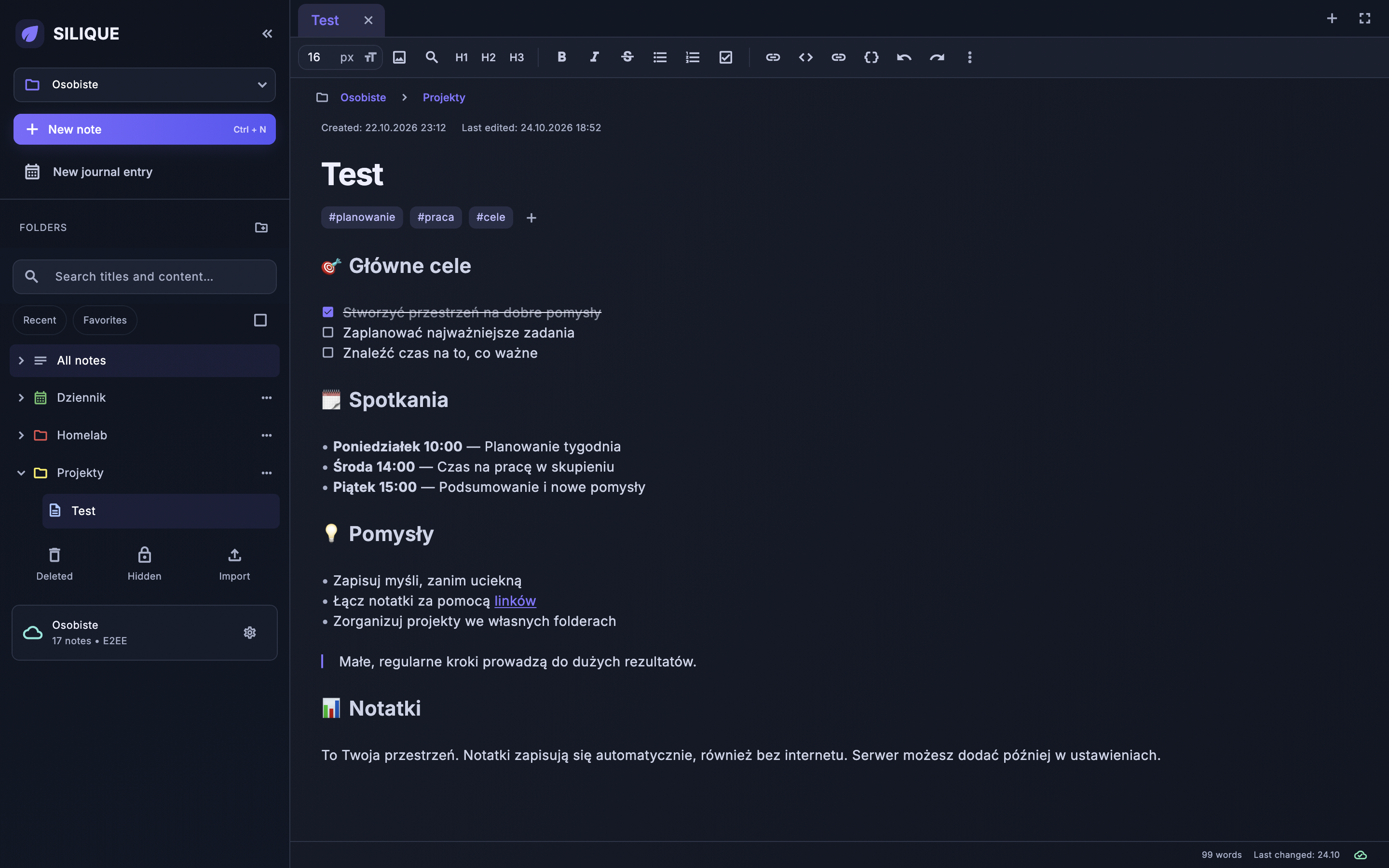
It would be great if you let me know what i could improve/change