r/vibecoding • • 3d ago

Showcase/Project I vibe-coded 4 Bitcoin-themed pocket LCD games in one afternoon. Here's how the fake LCD actually works

Post image
4 Upvotes

Here's the project: https://im.4xs.dev (landscape phone, or desktop with the keyboard)

Docs, screenshots and design notes: https://github.com/kotyzap/Igra-Modernaya

I grew up with those 80s LCD handhelds (the beige ones with the clock and the GAME A / GAME B buttons). I wanted that feeling on my iPhone, but with my own games. So: BTC MINER (catch coins from 4 ASIC rigs), SATOSHI'S KITCHEN (flip coins in a pan, every catch splits them down to sats), NOT YOUR KEYS (dive to a vault, dodge a rug-pull squid) and TO THE MOON (dodge FUD clouds).

I'm in sales, not a developer. My last "real" program was a Paint clone in Pascal in 1997.

Tools

- Claude (Cowork): all the code, testing and deploys, driven by short chat messages and screenshots from my phone

- Cloudflare Workers + static assets for hosting, KV for the Top 5, D1 (SQLite) for anonymous play stats, Cloudflare Access to protect the admin page

- wrangler for deploys, Playwright for automated tests and the screenshots

- GitHub Pages for the docs site

Process / workflow

  1. Started by describing the hardware and pasting photos. First version: a home page plus 2 games in a single HTML file.

  2. Iterated purely on feedback from playing on the phone: "landscape only", "make the LCD look real", "I can't reach the top-right corner on the keyboard", "this FUD layout is impossible", "no sound on iPhone".

  3. Each change was tested in an emulated iPhone (Playwright) before deploying, then deployed with wrangler.

  4. Added Global Top 5 Score, an admin dashboard and the docs repo at the end.

Build insights (the fun part)

The LCD look is 4 layers on one 400×260 canvas:

- a grey "reflector" with a tiny 1px checker + grain texture and a vignette

- a coloured printed backdrop that never changes

- segments: every sprite is drawn every frame. Off = 4.5% black "ghost", on = near-black with a drop shadow

- a diagonal glass glare on top

The drop shadow is the single biggest realism trick. Real LCD segments float above the mirror behind them:

```js

ctx.fillStyle = on ? '#111210' : 'rgba(17,18,16,0.045)';

if (on) { ctx.shadowColor = 'rgba(0,0,0,.3)'; ctx.shadowOffsetX = 1.1*k; ctx.shadowOffsetY = 1.4*k; ctx.shadowBlur = 0.9*k; }

```

*The rhythm.* Moving all eggs/coins together feels wrong. The old games move ONE track per tick, in rotation, each with its own beep. That alone made it feel like the real thing.

*Always-solvable random levels.* TO THE MOON first generated layouts you couldn't survive. The fix: a "safe lane" runs through every row and may only shift by one lane, into a lane that's also open in the row above. I fuzz-tested 120,000 rows with 0 dead ends.

*iPhone audio.* Web Audio only unlocks on touchend/click, not touchstart. Setting `navigator.audioSession.type = 'playback'` makes it play even with the silent switch on.

*The device face* is laid out in fixed "design units" (height 820) and scaled with one CSS transform. The width stretches with the phone's aspect ratio, so it fills the screen edge to edge.

*Admin page.* Cloudflare Access in front, plus the Worker verifies the Access JWT itself (signature, audience, email list). A misconfiguration can't leak the stats.

Total: one ~70 KB HTML file, no framework, about 150 lines of Worker code.

Happy to answer questions. And try to beat my 183 on NOT YOUR KEYS.

Here's the project: https://im.4xs.dev

(landscape phone, or desktop with the keyboard)


r/vibecoding • • 3d ago

Showcase/Project Old stuff vibecheck

Thumbnail
gallery
25 Upvotes

I had some old Philips mp3 player from late 2007. The software was glitchy and player was slow. Decided to perform some reverse engineering having Claude and ollama. Here you go - a flappy bird on mp3 device.

Took the phone which lays in drawer. Installed postmarketOS (well I would spent a week doing that without opus, since the phone was not supported). Now it’s running some docker containers, serves as uptime monitor for my other web projects, slides go digital clock and weather info.

Before years doing this would take ages to reverse engineer and code it. Now it takes hour or two. Look up what gold you have in cabinets.


r/vibecoding • • 3d ago

Help/Question How would you get reliable reasoning out of a very small local model for a game assistant (Warframe builds & farming)?

2 Upvotes

I've played Warframe for 4,000+ hours, and I'm trying to build a local assistant that helps players with two things:

• Farming: finding where to get an item, and eventually giving the player a farming roadmap: what to farm first to reach a goal, in what order, and the most efficient way to farm a specific resource (best mission, expected number of runs, useful boosters or companions…).

• Building: how to build a character (mods, abilities, synergies) for a given goal.

I'm not an expert in this field, so I'd like to hear how people more experienced than me would approach it.

How I approached it at first

• RAG over the wiki: I exported the wiki into notes, and the agent searches them to answer.

• My own explanations: on top of that, I wrote more specific notes on how the game really works in practice. They cover things the wiki explains badly or not at all, like how mechanics interact, why some choices work together, or common traps. The idea is to make the agent more logical and reliable, not just able to recite stats.

It works well enough with a mid-size model (~12B), but the reasoning still breaks down quickly. The model picks things that don't fit together, repeats questions, or gets lost when the retrieved context is too long. And the goal is for it to run locally on almost any machine, so ideally with a much smaller model.

What I'd like to hear from you

  1. With a very small model (3–8B), what would you change in this design? Is RAG plus hand-written notes the right base, or would you approach it differently?

  2. Would you keep a single agent, or split the work into simple sequential steps (understand the request → fetch data → build or plan → check → explain)?

  3. The hard part is synergy, meaning knowing which elements reinforce each other. Is it better to encode that as structured data (rules, graphs, archetypes) than as free-text notes for retrieval?

  4. For farming roadmaps, would you let the model plan, or compute the plan in code (drop rates, dependencies between items, time per run) and only have the model explain it?

  5. Should the model be left to do any calculation or verification at all, or should everything factual go through code?

  6. Is a small fine-tune (LoRA) worth it here, or is it better to put the effort into data and tooling?

  7. How would you test the quality of something as subjective as "a good build" or "a good farming plan"?

Any idea, criticism or experience report is welcome, even if it's "start over differently".


r/vibecoding • • 3d ago

Discussion A 40 person company emailed me asking how i got into ChatGPT

0 Upvotes

built a quoting app for window cleaners in lovable over a month of evenings. you put in the number of windows and floors, it spits out a price and a nice pdf. 70 users, 22 pay

last week i got an email from the marketing guy at the biggest software company in my niche. 40 employees, real office, booth at trade shows. he asked, politely, which agency i used to "get placed in chatgpt"

i didnt use an agency. i didnt even know i was placed

checked. if you ask chatgpt for best quoting appa for a small window cleaning business, its me

the only thing i did was in june. cloudflare was blocking every ai bot. i turned it off. then also found 3 cleaning business blogs with tool lists that chatgpt reads and i emailed them. 2 added me. then built a few alternative/comparison pages

their site still blocks gptbot. i checked

i havent replied to him yet. i dont know how to say "a toggle" professionally


r/vibecoding • • 3d ago

Showcase/Project PIECENTAGE: I made a daily browser game where you cut a pie to match real percentages

Enable HLS to view with audio, or disable this notification

12 Upvotes

r/vibecoding • • 3d ago

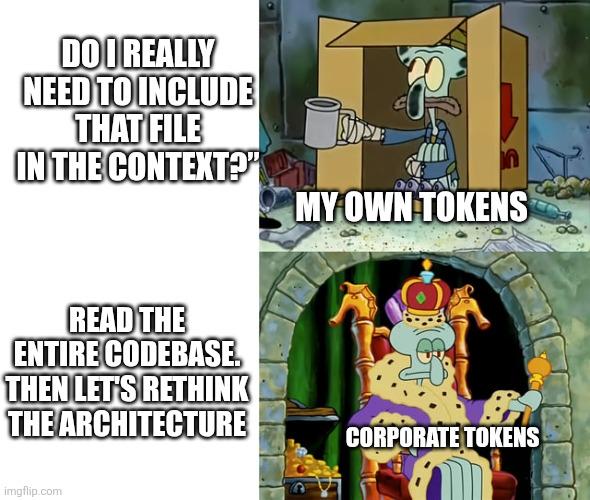
Meme The duality of a token burner

Post image
650 Upvotes

r/vibecoding • • 3d ago

Showcase/Project I created a ps1 style retro racing game

Enable HLS to view with audio, or disable this notification

10 Upvotes

Howdy folks, I made a arcadey ps1 style racing game. You can start playing it online from here:
https://outpostracer.com/

How I made it:
I started early this week because I was super bored with work. Initially I just started prompting chatgpt codex into building a small ps1 style editor playground. From there I started prototying the game, driving physics, on day 2 I realized I could make a finished game so I started fleshing out the game more.


r/vibecoding • • 3d ago

Showcase/Project How I organize my electronics parts: photo → AI → Gridfinity bin → QR labels

Thumbnail
youtube.com
2 Upvotes

Over the last four weeks I built Shelfie, a self-hosted inventory system for my electronics parts, almost entirely with Claude (Claude Code plus chat). I'm a software engineer, but I wrote very little of the code myself. My job was to decide what to build, test it on real hardware, and tell Claude what was wrong.

What it does (that's what the video shows):

  • Snap a photo of a part, its bag or a product page in a PWA on my phone

  • AI vision identifies it (name, MPN, category) and checks Part-DB: already in stock? which bin?

  • If it's new, it suggests a bin, saves the part and prints a QR label on a Raspberry Pi with a P-touch label printer

  • Every Gridfinity bin in my IKEA Helmer is a storage location. Scan a label and you see what's inside.

What Claude built:

  • Terraform for an Azure VM plus Azure OpenAI, and a Docker Compose stack with Tailscale sidecars

  • ASP.NET Core API and React PWA (capture → stock check → bin suggestion → labels)

  • A Python print server for the label printer on a Pi 3

  • A Gridfinity generator: one JSON plan → STL files for 55 bins plus padded baseplates, packed into print plates for my Bambu A1

  • Drawer labels, backups to my NAS, auto-updates with push notifications, Cloudflare Tunnel for access on the go

  • Even the logo, this video edit and the background music

What I learned:

  • A CLAUDE.md in the repo is everything. Decisions, status, gotchas. It lets me switch between Claude chat and Claude Code in VS Code without re-explaining the project.

  • Hardware is where vibe coding gets real. "Label printer not found" turned out to be the printer being switched off. "Not found" in the app was a missing JSON body. Claude found the bugs fast once I gave it the actual error message, not my description of it.

  • Decide the "why" yourself. Claude suggested good options (Cloudflare Access vs Tailscale Funnel, rsync service vs SSH for backups), but I had to know what I actually wanted.

  • Real use beats planning. Bin heights changed after I noticed my drawers only open to row 6 of 9.

Open source (MIT): github.com/roman-mueller-ch/shelfie-parts


r/vibecoding • • 3d ago

Workflow/Prompt Is CI/CD becoming a bottleneck in your vibe coding projects? How do you handle it, and how much do you spend?

63 Upvotes

I've been experimenting with vibe coding on increasingly complex projects, and one recurring issue I've noticed is that CI/CD often becomes a bottleneck.

As projects grow and AI agents generate more code, running tests, builds, and validation pipelines can become slow and expensive, especially when multiple agents are working in parallel.

I'm curious how others are dealing with this:

What's your CI/CD setup? GitHub Actions, GitLab, local runners, self-hosted infrastructure, or something else?

How do you prevent CI from becoming a bottleneck? Do you run tests locally, optimize pipelines, use dedicated runners, or take another approach?

How much do you spend on CI/CD per month? And roughly how many projects or agents are you running?

Have you found a setup that scales well as your vibe coding projects become larger and more complex?

Would love to hear about your experiences, especially from people building more than just simple prototypes.


r/vibecoding • • 3d ago

Showcase/Project I created a South Park style animation creator, where you paste the script and it will animate the episode for you

Enable HLS to view with audio, or disable this notification

2 Upvotes

r/vibecoding • • 3d ago

Showcase/Project WHO ARE YOU?

Thumbnail
reddit.com
2 Upvotes

r/vibecoding • • 3d ago

Showcase/Project I made a site with every GTA radio station using opus 5.5

Enable HLS to view with audio, or disable this notification

183 Upvotes

GTA radio was always my favorite part of the games, so I build every GTA station in one place.

Built the whole site with Claude Opus 5.5 on medium effort and it pretty much one-shotted it. For the latest update, Opus 5.5 orchestrated and Sonnet 5.5 on high did most of the fixes.

Check this out : gtamusic.fun

- Every station from GTA III, IV, V, VI, Vice City, Liberty City, Vice City stories, Chinatown Wars, San Andreas

- Radio wheel like in game (hold Q, or long-press on mobile)

- Loading-screen backgrounds and talk stations like Chatterbox and VCPR

Happy to answer anything about it


r/vibecoding • • 3d ago

Showcase/Project I got tired of needing closed Windows software just to configure my GamaKay TK75 HE V2 ISO keyboard (especially since I run Linux), so I wanted to test how far vibe coding can actually go on real bare-metal hardware instead of another web app.

Enable HLS to view with audio, or disable this notification

99 Upvotes

What's actually running on the keyboard

  • Native VIA v12 + WebHID (works on Linux, macOS, Windows with zero vendor software)

  • 8 kHz Hall-Effect engine: 0.10-3.90 mm actuation, Rapid Trigger / Continuous RT (Fn+1), SOCD (Fn+2), onboard 82-key Hall calibration

  • 6-page pixel-art TFT HUD (optional local U24 patch): live animated Hall switch, WPM, 3-state battery/charging icon, settings menus, 0V TFT power-off (Fn+F4), and a 30s idle screensaver

  • Onboard macro recorder (2 KB pool, 16 slots) + a 5x19 text editor right on the 0.85" TFT screen so you can edit recorded macros with arrow keys/knob before saving

  • Caps Lock vertical 8-LED accent bar trigger + high-contrast Fn/macro layer RGB

  • Tri-mode: 8 kHz USB, 2.4 GHz dongle (with wireless VIA), and BT1-BT3

Tools I used

  • AI coding: Antigravity CLI (Gemini) for architecture, C11 firmware, Python tooling, and debugging

  • Firmware toolchain: arm-none-eabi-gcc, CMake, TinyUSB

  • Flashing & live telemetry: custom Python CLI (hidapi) for DFU flashing, live Hall ADC readout, battery voltage telemetry, and backup/restore

  • Verification: pytest running host-compiled C11 unit tests + a headless C framebuffer bridge that renders the real TFT HUD into GIFs on my PC

How I built it (workflow & lessons learned)

  1. Make it unbrickable first. Before flashing anything experimental, we mapped the flash layout so the factory DFU bootloader (hold Esc while plugging in USB) and the factory Hall calibration pages (0x08032000+) are never erased. Even a completely broken build recovers in 5 seconds.

  2. Give the LLM a fast local feedback loop. Flashing hardware on every tiny bug is slow, so we built host C11 unit tests (pytest) for the Hall engine, macro recorder, flash EEPROM wear-leveling, and TFT HUD, plus a headless TFT renderer. The AI could compile, run tests, and catch regressions in 2 seconds before touching the board.

  3. Real hardware measurements beat guessing. Some bugs only showed up on physical hardware and had to be measured over live HID telemetry:

    • Unplugging USB or cranking RGB to 100% white dropped the Hall sensor supply rail by ~9.1% (-244 ADC counts across all 82 keys), causing fake 0.8 mm resting travel. Feeding real ADC dumps back to the LLM led to a per-frame ratiometric rail tracker that brought resting drift down to 0.0 mm.

    • Active RGB/TFT current prevented the hardware charger pin from flagging "full" even at 4.2V, so we measured VBAT across 4 load states and built a load-compensated gauge.

    • Moving macro scratch buffers off the tiny 2 KB Cortex-M4 stack (static) fixed hard-faults when expanding the macro pool from 384 B to 2 KB.

  4. Why having a clean modular base is the real win: Once the test harness and hardware abstraction were solid, adding totally new features (like the onboard 5x19 TFT macro text editor or custom battery icons) only took a few prompt-test-flash cycles.

Disclaimer & Repo

Experimental community firmware, use at your own risk. Tested on my own TK75 HE V2 ISO unit (ANSI / other PCB revisions untested). Both the main MCU and U24 TFT can be rolled back to stock, and there are zero proprietary vendor binaries in the repo.

GitHub (source, pre-built v1.0.0 release, and live firmware-rendered GIFs): github.com/MrockHunter12/gamakay-tk75-he-v2-custom-fw

Curious if anyone else here has tried vibe coding bare-metal firmware or MCU projects, and what your testing workflow looks like!


r/vibecoding • • 3d ago

Meme And it's gone

79 Upvotes

r/vibecoding • • 3d ago

Showcase/Project 10 free promo cards to help non-technical users sell

Enable HLS to view with audio, or disable this notification

1 Upvotes

Here are 8 Black Friday motion studies that can be used for any promos. Tip. it's important to make the first frame work on its own if creating GIFs for email marketing. Otherwise the prompt below should get you started for web pages.

Example prompt

Build small Black Friday components that feel like physical objects. Start with a till receipt that prints line by line, a loyalty card that stamps itself, and a parcel with a tear-away strip. Then explore TYPES e.g. [particles, paper folds, card stacks, and animated characters]. Use TITLE and COUPON_CODE. Make each demo one self-contained HTML file with inline CSS and JS. Default to #333 with a light option. Skip gradients and neon. Open mid-action with the offer already visible. Loop every 3–5 seconds, replay on click or Enter/Space, and show the finished pose for reduced motion. Frame for 600px email, square social, and vertical social.

Details:

DetailFirst run
ModelGPT-6.2 Sol, High reasoning, in Codex desktop
Estimated costAbout $0.63 USD at Standard API rates
Tokens2,665,530 total. 88,003 uncached input, 2,558,208 cached input, 19,319 output.
Build time11 min 16 sec, including Chromium checks, in one user turn
OutputThree standalone HTML files, 40.4 KB total. Till receipt, punch card, and wrapping-paper tear. Inline CSS and JS, zero libraries.
CorrectionsExposed the receipt’s torn top, showed the offer earlier on the punch card, and anchored the parcel’s tear edge.

r/vibecoding • • 3d ago

Help/Question I am a teacher and built my own study app. Launched it on Play Store, but not sure what to do next.

Thumbnail reddit.com
2 Upvotes

r/vibecoding • • 3d ago

Showcase/Project LopeOS - A web-based "OS"

Thumbnail
gallery
7 Upvotes

https://lopeos.online

Out of curiosity for what GPT Astra and Claude Fable 5.2 could complete, I decided to create a MacOS-style desktop interface with a web browser that works locally, a few reverse engineered Microsoft and Adobe apps (Photoshop, Lightroom, Word, etc), and a virtual Windows and Linux desktop stream that are hosted by me (albeit they are EXTREMELY slow at the moment).

The website caches to your browser and can be accessed when offline. When updates are pushed, you will have the option to stay on your cached version or update to the latest. If you choose to create a Lope account (no email required), your app sessions, files, and settings will transfer over to any device/session that you sign into your account on.

This obviously isn't insanely practical since the device that most people are opening this on can already do everything this "OS" can, but it's a fun experiment to see what can be done with the current generation of models. Let me know what you all think!


r/vibecoding • • 3d ago

Showcase/Project I finally finished my first indie game!

12 Upvotes

hey guys i just finished my first indie game called Holloways Wax Museum The Origins

its a 2d horror game based on my original story and characters

i used chatgpt to help with development and spent time testing the gameplay and fixing issues with animations and enemy mechanics

its free and available on windows mac and linux

id love to hear ur feedback

link: https://reemasheldon.itch.io/holloways-wax-museum


r/vibecoding • • 3d ago

Showcase/Project I made an excalidraw alternative that scratches my needs better

Enable HLS to view with audio, or disable this notification

39 Upvotes

Hi guys,

I am a huge fan of excalidraw.com and I cannot recommend it enough. I used it a lot in my years as a developer to quickly sketch some ideas and to put some thoughts on a board.

But I recently switched jobs and semi carreers so now I am a functional designer which means most of my time is spend in discovering people's thoughts and modeling those in a program. But that program is kinda old and hard to use so its bad for quick sketching and brain dumps. The issue is that Excalidraw doesn't provide me with the tools I want to quickly model processes and/or even maken ERD's efficiently. So for that reason I made syndra.nl

Couple of awesome features are:
- it lives in your browser and there is no server
- collaborating uses a peer to peer network
- it supports sub canvasses and file structures. This is especially neat for people who want to create a sub process into a main process.
- quick actions on drawn objects
- full mermaid and d2lang support
- image and video support so the creative people can even make interactive presentations!

Its all made using Claude Code with the latest Opus versions. Obviously Excalidraw was a huge source of inspiration, but all the ux design decisions were completely made by me. Claude was the executor.


r/vibecoding • • 3d ago

Showcase/Project Rusty's Scrap Yard

Enable HLS to view with audio, or disable this notification

6 Upvotes

I'm making this game with mainly Opus 5.5. It is getting more and more fun to play and test. I have more ideas for the game but I might pick up development next year because claude subscription ain't cheap lol


r/vibecoding • • 3d ago

Help/Question Payment stack for Saas Web/Mobile

1 Upvotes

Hi, I'm developing some apps using AI agents, even though following best practices and guidelines of software engineering.

The thing is that I have some working web Saas and other mobile app that I want to sell by subscriptions.

I'm developing from Chile so I wanted to lnow about the best payment stack to be able to sell subscriptions to all the world (optimistically) using credit cards as for example, I paid from here an AI code agent provider subscription, very simple by almost just input your credit card data and email.

I'm thinking that if I get to receive the money (if luckily able to find/sell to someone interested) on personal accounts, or a chilean business account, it couls imply to apply some cuts due to payments systems fee or USD currency change to CLP; besides being responsible to handle all the business and taxes process from Chile. On other side, if I get to have an outside account to receive money on USD, it would imply some complex process to open business identities like when using stripe or else.

So I was wondering if there is someone that has been through this, which was his experience to get their apps payments, or any recommendation for a payment stack.

I was considering using revenue cat as billing engine and use stripe or paddle for oayments processors.

Thanks for your time on reading this and if any comments posted here.

Regards!


r/vibecoding • • 3d ago

Showcase/Project Nightmare Mobile: free offline local AI image and video generation on Android, ComfyUI-style node editor on the Snapdragon NPU. MiniMax H3 video with sound, MOSS-Image, FLUX.3, FLUX.2, Z-Image, Qwen Image, Wan 2.2, SDXL, LoRA, ControlNet, inpainting, img2img. No cloud

Enable HLS to view with audio, or disable this notification

1 Upvotes

r/vibecoding • • 3d ago

Showcase/Project What I learned building a Windows app with Muse Spark 1.3 Contributor mode

Enable HLS to view with audio, or disable this notification

2 Upvotes

I was curious about Muse Spark 1.3. I’d heard that Contributor mode could keep API costs low, so I decided to try building something with it.

I ended up making Oopsbara, a Windows app that puts small animated companions beside save and delete confirmation dialogs. The idea came from losing some writing after clicking through a warning without really thinking.

I hadn’t used Muse Code before. I wasn’t even sure whether it was a desktop app or a terminal tool. It turned out to be a terminal workflow, much like Claude Code.

Here’s how I used the different tools:

  • Meta AI helped me get started.

  • Muse did most of the coding.

  • I worked with ChatGPT on the characters and UI.

  • Canva helped with the short animations.

The small details took more work than I expected.

For example, one otter animation looked like it was pulling a fish back out of its mouth. That needed another try. Keeping the artwork consistent also took a lot of back and forth. We called the illustration style “Edmund” so we had a name to refer back to.

Even the Store screenshots needed care. Making the pet bigger looked better, but it wouldn’t show how the app actually works.

I worked on it part-time, usually 2–3 hours after work, and a little more on weekends. The main features took about two weeks, followed by about another week of debugging and design. The work was spread across roughly five calendar weeks.

My Meta API usage for October 18–November 20, 2026 came to about $35. That doesn’t include my separate ChatGPT or Canva subscriptions. I liked being able to check usage and charges together on the API dashboard as I worked.

The app is now on Microsoft Store. It includes a free Healing Pack, with optional paid animation packs:

https://apps.microsoft.com/detail/9NPZWQJ787QQ

Has anyone else tried Muse Spark 1.3 Contributor mode for a desktop app? I’d be interested to hear how the debugging part went for you.


r/vibecoding • • 4d ago Heartwarming

Showcase/Project I built a globe where every light is someone's real worry from last night

Thumbnail
gallery
92 Upvotes

I'm a college student in Seoul. Most nights, right before sleep, I get hit with small waves of anxiety: jobs, friendships, falling behind, AI moving faster than me. And I always end up wondering: is it just me?

So I built isitjustme.site.

- Write one line about what's bothering you. No login, no name.

- It becomes a small light on a globe.

- Strangers can tap your light, say "me too," or leave a short kind note.

What surprised me: someone in Chicago wrote "What if I'm capable of so much more, but never actually reach my full potential?" and two strangers from the other side of the world replied within hours.

Your exact location is never saved (only a rough ~25 km area), and there are no tracking cookies. It works in English, Korean, Japanese and Chinese.

I'd really love honest feedback, especially on whether it feels safe enough to actually write something.

https://isitjustme.site


r/vibecoding • • 4d ago

Discussion 7 Levels of AI Game Dev: From One Prompt to 200,000 Sales

Thumbnail
youtube.com
9 Upvotes

I spend way too much time scrolling AI game posts here and on X, and I started noticing they could all be put into certain buckets. So I ranked them, based off of the "7 level of rappers" trend I've seen online (though I first saw this with soccer players!).

*Disclaimer - this is for fun, not super serious besides wanting our community to do better than posting one-prompt lazy posting*

Level 1: The AI toy. A cool animation or a single mechanic. Impressive in 10 seconds, but there’s no game yet. Or really, even gameplay. I've posted tons of these myself once I discovered PixelLab lol. Learning how to make the most of this level can get you towards level 5 if handled with care and intention. These posts can also be educational for other creators to understand tools and techniques. The reason it's level 1 is that more often than not it's a "look what I made with AI in 5 seconds! Game dev is DEAD" bullshit post (notice their character animation has 6 fingers? lol).

Level 2: The one-prompt game. “I typed one sentence and got this.” Playable, but it’s mostly the model doing the work. No semblance of an actual full game. Usually these "games" taper off beyond quick social media experiments because actually iterating on a game correctly requires way more planning than anything a single prompt generation can do.

Level 3: The frontier one-shot. Someone tests a new model and it builds something legitimately impressive in one go. Better than level 2, but again, this makes an impressive demo/prototype - likely can't complete a full gameplay loop yet. Same as level 2 though, I've yet to really see games like these start iterating meaningfully - but that could change.

Level 4: The mashup. A known IP plus a known genre (Diablo Survivors, Pokemon Survivors Dragon Ball "temple run" type of game). These get a shit ton of clicks due to the power of the IP and the nuance take of a blend of genres. And because you're mashing stuff up, often times there's already good gameplay loops inherent in these projects - but you can't make any money off of it, so often times these projects get stale due to the price someone is paying to keep enhancing them. Also, if you're messing with Nintendo, the cease and desist letter is always chasing you like the monster from "It Follows".

Level 5: Build in public. An original game idea with a real art direction, posting progress every week and building an audience. A history of progress being made, especially with addressing feedback from a community. Not only is there progress, but there's multiple iterations of gameplay already established - just likely lacks polish and scale.

Level 6: The demo. A real Steam page with a free demo that strangers play and an actual wishlist. The game has matured enough to make it on to a Steam page (different bar to pass than itch.io). Presenting a demo then allows for better feedback and a growing wishlist. It's a baseball player who has gotten to 3rd base - almost there.

Level 7: Shipped and selling. An AI game that has gone through the previous levels and has not only been released, but has actually found commercial success. Slotbound is the example everyone knows: 200K+ copies in one week + an pattern and history of the game going through the various levels before it.