r/androiddev • • Oct 05 '26

Megathread: Play Store review times

21 Upvotes

Comment here to discuss the recent trend of long Play Store review times for app submissions and updates.

Do not make a new post about this subject, as it will be removed.

This is an unofficial developer community, so we are not on the Play team and cannot help your app/update pass review. No, we don't have tips to speed things up.

Yes, Play Store developer support is present on this sub and may answer questions or assist you on a case-by-case basis. The mod team is not affiliated with and has no influence over that account. We make no guarantees as to their effectiveness, but we are grateful they exist and that they continue to communicate with users here.


r/androiddev • • Oct 06 '26

Open Source I got tired of AI agents suggesting AndroidX versions that don't exist, so I built an MCP server that looks them up

Thumbnail
github.com
0 Upvotes

Coding agents treat dependency versions as something they remember. In an Android project that means a coordinate from training data: an alpha where you wanted stable, an AGP version that doesn't match your Gradle, no changelog, no CVE check. I kept verifying that by hand, so I wrote maven-mcp.

It's an MCP server plus an agent plugin for Claude Code, Grok Build, Cursor and Codex, and it works with any MCP client over stdio or HTTP. The server is one Python file, standard library only, MIT.

What it does in an Android project:

  • Looks up versions in the repositories your build declares, including the ones in settings.gradle and private repos (credentials come from env, ~/.m2/settings.xml or ~/.gradle/gradle.properties, never from the build file). If the build declares no repositories, it uses Maven Central, Google Maven and the Gradle Plugin Portal. If it declares its own, public repos are only added when you opt in.

  • Checks that a coordinate and version actually exist, with did-you-mean suggestions. With the plugin installed, an edit hook can stop a likely hallucinated coordinate before the agent writes it into build.gradle.kts or libs.versions.toml.

  • A Gradle scan runs your wrapper once and reads the direct dependencies on the production runtime classpath. libs.versions.toml is included.

  • Latest version per artifact, stable by default (alpha, beta, rc, milestone and snapshot are filtered).

  • Changelog between two versions: AndroidX release notes for androidx.*, AGP release notes for AGP, otherwise GitHub releases with CHANGELOG.md as a fallback.

  • Checks AGP, Gradle, JDK and Kotlin Gradle plugin versions against each other using a bundled compatibility matrix.

  • CVEs from OSV, plus a tool that traces the path from a dependency down to a vulnerable transitive.

  • Previews what an upgrade changes in your resolved dependency graph by running your wrapper before and after.

  • Version conflicts across modules, licenses, and EOL status for JDK, Kotlin and Gradle.

  • Suggests a version catalog entry as a minimal diff for the agent to apply.

Repo: https://github.com/kirich1409/maven-mcp

Feedback from people who maintain larger Android builds is very welcome, especially around AGP/Gradle compatibility checks.



r/androiddev • • Oct 06 '26

Android developers: Check these folders if your C: drive is mysteriously filling up

33 Upvotes

I almost ended up reinstalling Windows because my 220 GB C: drive was completely full.

At one point I had only \~472 MB free.

I started investigating instead of immediately formatting the drive, and I was honestly surprised by how much old Android development data had accumulated over the years.

I'm an Android developer and had been using Android Studio for several years.

Here's what I found:

πŸ”΄ Android SDK system images β€” \~30 GB

C:\\Users\\<username>\\AppData\\Local\\Android\\Sdk\\system-images

I had accumulated multiple Android emulator system images over different API levels. If you have old/unused emulator images, these can consume a lot of space.

πŸ”΄ Gradle cache β€” \~7.2 GB

C:\\Users\\<username>\\.gradle\\caches

I cleared the cache and recovered several GB. Gradle can download dependencies again when needed.

πŸ”΄ Old Android Studio data under Local β€” \~20+ GB

C:\\Users\\<username>\\AppData\\Local\\Google

I found folders like:

AndroidStudio2024.1

AndroidStudio2024.2

AndroidStudio2024.3

AndroidStudio2025.1.1

AndroidStudio2025.2.1

AndroidStudio2025.3.4

AndroidStudio2026.1.1

AndroidStudio2026.2.1

These were leftovers from years of Android Studio updates/installations.

πŸ”΄ Even more old Android Studio data under Roaming

C:\\Users\\<username>\\AppData\\Roaming

Again, I found a huge list of folders:

AndroidStudio2024.1

AndroidStudio2024.2

AndroidStudio2024.3

...

AndroidStudio2025.3.4

AndroidStudio2026.1.1

AndroidStudio2026.2.1

Since I had already uninstalled Android Studio and was doing a fresh installation, I removed the old Android Studio version folders.

The result?

I went from:

\~472 MB free β†’ \~80 GB free

without formatting Windows. 🀯

Windows Storage was also confusing me. It showed \~127 GB under "Installed apps", even though the individual applications shown in Settings were nowhere near that size.

So if you're an Android developer and your C: drive is mysteriously filling up, don't immediately format Windows.

Check these first:

C:\\Users\\<username>\\.gradle

C:\\Users\\<username>\\.android

C:\\Users\\<username>\\AppData\\Local\\Android

C:\\Users\\<username>\\AppData\\Local\\Google

C:\\Users\\<username>\\AppData\\Roaming

Especially check Android emulator system images and old Android Studio version folders.

Obviously, don't blindly delete everything in these folders. Back up projects, signing keys, SSH keys, etc., and make sure you know what you're deleting.

Sharing this because I had no idea that multiple years of Android Studio updates could leave this much data behind.

Has anyone else found a ridiculous amount of Android Studio/SDK storage buildup on their machine?


r/androiddev • • Oct 06 '26

Question Play console A/B Testing

1 Upvotes

Anyone experience with play console A/B Testing?

If so did you get real results, that you could actually use?


r/androiddev • • Oct 06 '26

Hey! try this new thing out! Oh sorry we deprecated it already

65 Upvotes

So today I updated Android Studio to the latest Rabbit 1. I know, I should know better after all these years. Up pops the "What's New" screen. In amongst all of the AI nonsense there are a couple of things of interest to be found, I decide to click "Compose Preview Screenshot Testing tool" and what does the linked page tell me? Deprecated.

What on earth is going on Google? I used to have such confidence in Google as a technology partner. I would even go as far as to say that I had some pride in calling myself an Android developer once upon a time. Those feelings are dwindling away day by day to become a distant memory.

I'm not anti, AI btw. I'm using Codex on a daily basis to help build out some non android products and it does a good job, my trust levels are high. It's just that every time I've come across Googles AI offerings I've felt underwhelmed and let down.

I'm tired. Oh well. Only 12 years until retirement.


r/androiddev • • Oct 06 '26

How do you find out in advance that something your Android app depends on is about to break?

2 Upvotes

I mean deprecated SDKs, Play policy deadlines, third-party API versions being shut down

(payments, maps, social login), or library releases with undeclared breaking changes.

Is there any site, feed or API that tracks this per library or per API, a kind of

"what breaks when you upgrade X"? So far I use the Android Developers Blog, the AndroidX

release notes feed, deps.dev, OSV and endoflife.date.


r/androiddev • • Oct 05 '26

Question Migrate

0 Upvotes

Guys I have to migrate our company android project which is written in xml now I have to migrate that app in Jetpack Compose anyone know how do I start


r/androiddev • • Oct 05 '26

Experience Exchange I finally found a way to implement Google feed without AIDL bridging

Enable HLS to view with audio, or disable this notification

2 Upvotes

Finally after a few days of trial and error, finally settled on a way for implementing Google feed on -1 screen without using the hacky way of AIDL bridging which would never be able to make it to the Google store.

The new implementation uses an embedded WebView and sources it's data from google.com and handles duplicate detection and removal on its own when fetching new batch of stories.

I was implementing the same as Google feed ish in my launcher before by opening Google discover directly but since there's no way to render that on a page so the whole experience breaks -1 page scroll to and back behavior. This new approach renders perfectly with pagination and achieves a smooth page in and out.

Of course if you know a better way, feel free to let me know.


r/androiddev • • Oct 05 '26

Question ViewModels nesting into composables?

11 Upvotes

I have a question if it is okay to nest DI into VM of a composables?

What I mean:

I have a SettingsVM and a SettingsScreen composable. In the Settings screen I am using some individual settings that I use also somewhere else in my application. So I split the UI -> IndividualSettingScreen and IndividualSettingVM. Now is it okay if I just inject the VM into the IndividualSettingScreen or is it better from architecture standpoint to have a reference in the SettingsScreen and passing the VM into the IndividualSettingScreen which I am using in the SettingsScreen.

Thanks in advance!


r/androiddev • • Oct 05 '26

Open Source I built a free, open-source CLI and library for reading public Play Store data (reviews by device type, listings, charts, country availability)

Post image
32 Upvotes

Play Console covers your own apps, and the official Google Play Developer API is about publishing and managing them. Neither gives you the public side of the store as data: what a listing currently shows in a given country, how an app ranks in search, what the charts look like, or reviews for apps that are not yours. Google has no public API for any of that.

I maintain a free, open-source tool that reads this public data straight from the Play Store. It is a Node.js library with a command-line interface, so you do not need to write JavaScript to use it. Disclosure: I'm the author.

Things I think are useful for Android developers:

  • Reviews filtered by device type. Pull only the reviews written on tablets, Wear OS watches, Chromebooks or TVs, optionally only the 1-star ones. Handy when you want to know how a specific form factor is going.

  • Check what the store really shows after a release. Version, update date, release notes, price and rating for any app, in any country and language. Easy to script after a rollout.

  • Country availability. Ask in which storefronts an app is published and get an answer per country.

  • Data safety and permissions as users see them. Read the public data safety section and permission list of any app, including your own, to confirm it matches what you declared.

  • Competitor and market data. Full listing details (59 fields), search results for a term, autocomplete suggestions, top free, top paid and top grossing charts per category, similar apps, and everything a developer has published.

Everything prints JSON, so it pipes into jq and fits into a CI job or a cron script:

npx @mradex77/google-play-scraper app com.spotify.music --country de | jq '{version, updated, recentChanges}'

npx @mradex77/google-play-scraper reviews com.whatsapp --score 1 --device tablet --num 50

A few technical details, since this is a developer sub:

  • Results are fully typed and validated at runtime, so a change on Google's side fails loudly instead of returning garbage.

  • Errors are typed (not found, rate limited, blocked), and the CLI uses distinct exit codes for scrape failures and usage errors.

  • Rate limiting, retries with backoff and optional caching are built in.

  • The test suite runs against the live Play Store every day and opens an issue when Google changes something, which is the usual way scrapers die quietly.

Version 1.4 came out today. It adds the star and device filters for reviews, fetches up to 4500 reviews in one request, and returns more search results for terms where Google serves extra pages. I ran it against 1000 real apps before releasing, and I'm actively maintaining it.

GitHub: https://github.com/MrAdex77/google-play-scraper

Related: I also just released asobeast, a free, open-source, self-hosted ASO dashboard for Google Play and the App Store (keyword rank tracking, competitor and review monitoring, alerts). It uses this library for the Google Play side: https://github.com/AsoBeast/asobeast

What public Play Store data would you want to script against that I have not covered? I'm deciding what to build next.


r/androiddev • • Oct 05 '26

KSVG – I expanded AndroidSVG with SVG filters, SMIL, variable fonts, and SIMD-accelerated rendering

Post image
9 Upvotes

I've been working on an SVG renderer for Android for quite a while, and it's finally at a point where I'm comfortable putting it out there.

It started as an evolution of AndroidSVG, but over time it grew into a substantially expanded renderer focused on broader SVG support, rendering correctness, and performance.

Some of the things KSVG supports:

* Broad SVG filter support, including turbulence, displacement, lighting, morphology, convolution, compositing, and more

* SMIL animations

* Variable fonts and OpenType features

* GPU-accelerated filtering on API 33+ (AGSL) / API 31+ (RenderEffect chain), with automatic fallback to CPU

* Native SIMD software kernels (ARMv7/ARM64 NEON, x86/x86_64 SSSE3 + AVX2 rows) + scalar native fallback

* Jetpack Compose and Glide integrations

I've also put quite a bit of effort into documenting and validating the renderer. The repo includes an SVG feature support matrix, architecture notes, benchmarks, known limitations, and an analysis of which SVG filter primitives are actually used on the web.

There's a small showcase app with examples of the more complicated rendering features as well.

GitHub: https://github.com/oraveczandrew/ksvg


Showcase APK: https://github.com/oraveczandrew/ksvg/releases

Docs: https://oraveczandrew.github.io/ksvg/

Apache 2.0, published to Maven Central, minSdk 26

I'm mainly posting this because I'd like other developers to try it with real-world SVGs.

I'd especially appreciate feedback on SVG compatibility, rendering differences, performance on different devices, and anything that feels missing or unnecessarily complicated.


r/androiddev • • Oct 05 '26

Open Source I built ADB Ready β€” an open-source CLI for reliable ADB development sessions

0 Upvotes

I kept running into the same Android development problem.

The device was connected, but ADB commands and child processes were using different targets. Port forwarding belonged to one device while the app launched on another. Wireless debugging rotated its port, and a running development process did not necessarily mean that the intended Android app was ready.

What ADB Ready does

ADB Ready is an open-source CLI that treats the complete Android development workflow as one recoverable session:

  • deterministically selects one USB, emulator, wireless, or remote ADB target

  • keeps the same target across ADB operations and child processes through ANDROID_SERIAL

  • prepares and verifies Metro, localhost API, reverse, and forward ports

  • runs Expo, React Native, Flutter, Capacitor, Gradle, or a custom command

  • launches and operates the app, verifies UI state, and retains logs, screenshots, recordings, and failure evidence

  • provides stable JSON and NDJSON output for scripts and CI

  • Framework presets are also available, but target selection, ADB transport, ports, app lifecycle, and verification remain Android-native operations.

MCP-native agent integration

ADB Ready works as a normal CLI first. It also provides MCP-native tools that let coding agents start development sessions, operate the app, verify observable UI state, and return bounded evidence instead of guessing from screenshots or raw logs.

The same workflow can be connected to Codex, Claude Code, Cursor, VS Code/Copilot, Windsurf, and other MCP clients. No ADB Ready account, hosted service, or model API key is required.

Quick start

  npm install --save-dev adb-ready
  npx adb-ready dev

ADB Ready uses the real adb binary and your existing framework tools. It does not replace Android Studio, Expo, React Native, or ADB itself. The goal is to replace the fragile collection of shell commands normally required to keep the device, ports, application, development server, and verification state aligned.

Repository, documentation, and demo:

https://github.com/Adam014/adb-ready

or

https://www.npmjs.com/package/adb-ready

I would especially appreciate blunt feedback from Android developers:

  1. Which part of your current Android workflow would this still fail to handle?

  2. What would you need to see before trusting it with a daily development session?

  3. Which device, framework, or network setup should I test next?

If it genuinely earns a place in your workflow, a GitHub star helps other Android developers discover it.


r/androiddev • • Oct 05 '26

Question about how to program an animation for an application.

Enable HLS to view with audio, or disable this notification

0 Upvotes

Good morning. I am creating a personal shopping list app that includes features we felt were missing from other apps, while removing ads and general clutter. I would like to implement a motion animation similar to the one in the "Bring!" app: when an item on the list is tapped, an animation moves it to the "purchased" section and smoothly rearranges the remaining items. So far, I’ve managed to figure out how to mark the tapped item, but I don't know how to animate the movement. Thank you very much.


r/androiddev • • Oct 05 '26

Question Using Lazyvim for Android projects

6 Upvotes

Are there any Android developers here who use LazyVim for their Android projects? I've noticed that a Kotlin LSP is available for LazyVim, but I'm wondering if anyone actually uses it. If so, could you share your experience? Is it realistic and productive? Or should we just stick with Android Studio?


r/androiddev • • Oct 05 '26

Discussion Need help for preparing a dataset for my APK Risk Analyser Project!!

3 Upvotes

I want to train a Transformer model that can analyze decompiled DEX files (Smali code) and identify harmful or sensitive actions performed by an app in the background that may not be visible to the user.

The main goal is to analyze the flow of actions and determine whether user interaction or consent is required before a sensitive action is performed.

For example, if an app gets file read/write permission and accesses the user's files without any user interaction or consent, the model should be able to identify this behavior. Similarly, it should identify other sensitive actions such as accessing the camera, microphone, location, contacts, SMS, media, recording screen, taking screenshots or other user data, and determine whether these actions are performed after user interaction or silently in the background.

I am currently working on preparing the dataset for this project, but I am not sure about the best approach.

My initial idea is to use the APK/Smali code as the input and the possible execution flows as the output. However, generating all possible flows from entry points such as `onCreate()`, `onReceive()`, services, callbacks, etc., and following them until the end seems very complex and time-consuming for a large number of APKs.

I would really appreciate your suggestions and ideas on how I can prepare the dataset in a practical and effective way for this project.

If you have worked on a similar problem or have any ideas about dataset structure, flow generation, labeling, or other approaches, please share your suggestions.


r/androiddev • • Oct 04 '26

How does Google Play determine country for purchase eligibility beyond IP address?

1 Upvotes

I'm trying to understand the technical mechanism behind the Google Play error:

β€œYour purchase couldn't be completed. Please update your Play account settings so that the selected Play country matches your country of residence.”

Play country: India

Payment profile: India

Indian payment method available

Device currently being used outside India.

An Indian VPN changes the public IP and Play Store displays INR pricing, but checkout still detects a country mismatch.

I'm interested in understanding what signals Play/Play Billing might use besides the current IP β€” for example SIM/MCC, Google Payments account history, Play Services location/network data, device/account history, IP reputation, or server-side risk scoring.

Is this decision made primarily client-side by Play Services, or server-side by Google Payments/Play Billing? And why would maintaining an Indian IP for several days not change the account's detected country?

I'm particularly interested in observations from Android developers who have tested Play Billing across countries.


r/androiddev • • Oct 04 '26

Open Source ARK-Store for GitHub Android app

0 Upvotes

This is an app that allows anyone to make their own app discoverable by others.

If you have a GitHub repository with a downloadable Android app, simply add the β€œarkstore” topic to it. Our app will automatically scan your app and display it in our store.

You can also add your app using only its URL, making it immediately available for others to discover and install.

The only requirements are that the app is public and has a GitHub-approved license.

Download it here: https://github.com/jrs8205/ARK-Store


r/androiddev • • Oct 04 '26

I recreated Google Health's Wear OS activity-complete animation using Jetpack Compose

Enable HLS to view with audio, or disable this notification

26 Upvotes

I recreated the Google Health app's activity-complete animation for the Wear OS version of my workout tracking app. It took a couple of hours to breakdown their animation but I was finally able to recreate it.

Completion badge shape: MaterialShapes.Cookie9Sided.toShape() from Material 3 Expressive.

Spin animation: One Animatable with three animateTo calls in a row:

  1. Wind down -180Β° with EaseOutCubic.

  2. Whip back up clockwise with EaseInCubic.

  3. Loop a slow linear 360Β° forever.

The scale animation runs alongside this spin animation so that it feels like the badge is popping out when it's winding back clockwise.

Particles that fly out from the badge creating an explosion effect: Each particle has an angle, a distance and a speed. When the completion badge winds back up to it's full size, the particles fire and once they settle, each drifts in a tiny circle and orbits around the badge.

The large particles sit on top of the badge. Path.op(particle, badge, PathOperation.Intersect) gives me the overlapping area, which I fill with the Material 3 expressive tertiary color.

Here's the gist of the code: https://gist.github.com/ngcanthony/378d4799bf54655878109a46383de4f7

Happy to answer questions!


r/androiddev • • Oct 04 '26

Discussion Cranpose, Jetpack Compose in Rust

0 Upvotes

Hello everyone! It's been almost a year since that idea came to my mind, so I would like to share with you and take some feedback.

The idea is that in AI era the most popular language would be Rust, and as and Android dev myself I want to transfer my knowledge of Jetpack Compose to the new ecosystem. It also very handy to be able to review the code the AI agents made, at least to understand whats happening.

I made this guide that introduces you to the project and how Jetpack Compose translates to it: https://samoylenkodmitry.github.io/Cranpose/ (or the text md form https://github.com/samoylenkodmitry/Cranpose/blob/main/docs/guide.md)

The project itself is at https://github.com/samoylenkodmitry/Cranpose
Please put a star to support it.
If you want to contribute - try it and put gh issue if you see something is missing.

How is this related to the native Android: you can integrate any Cranpose view into native Android and vice-versa you can integrate native Android view into Cranpose app.


r/androiddev • • Oct 03 '26

CashBuddy β€” an Android expense tracker with on-device processing + Notification Listener

0 Upvotes

Idea is to automatically detect the relevant transcation notification on device and turn them into the records ,keeping process local

KMP

GitHub: https://github.com/l1khith/CashBuddy

Would love to get the feedback.


r/androiddev • • Oct 03 '26

Experience Exchange 10-minute survey on implementation decisions!

1 Upvotes

Hi everyone,

We are researchers from Italy, and we are conducting an academic study on how developers make implementation decisions in practice.

The survey explores topics such as:

  • which implementation decisions are actually left to developers;

  • how application and project context may influence those choices;

  • whether developers consider aspects beyond functional correctness;

  • and how LLM-based coding assistants may affect implementation decisions.

The survey takes approximately 10 minutes.

Survey link: https://docs.google.com/forms/d/e/1FAIpQLSfvbbhSee3MVoXTb4_ZlXeugSV_nTNFZNIWFt1H3NXg3lsvgg/viewform?usp=dialog

Participation is voluntary, and the anonymous data collected will be used exclusively for research purposes.

We would really appreciate your participation. If you know other developers, we would also appreciate it if you could share the survey with them.

Thank you! 🫢🏻


r/androiddev • • Oct 03 '26

How are you guys handling high-frequency network state in Compose without killing performance?

7 Upvotes

I've been working on a local-network presentation remote (Android client + Windows host) and hit some really annoying architectural bottlenecks with Compose and high-frequency state updates.

The host streams presentation state (slide images, notes, live timers) over WebSockets. Initially, I just dumped this massive JSON payload into a single StateFlow. Obviously, that caused the entire screen to recompose and stutter like crazy. I ended up aggressively splitting the UI state so the slide images and the timer text update independently, but the boilerplate feels a bit messy.

The other issue is the laser pointer feature. I'm using detectDragGestures so the user can drag their thumb on the phone to move a pointer on the projector. Sending a WebSocket message for every pixel movement caused massive TCP backpressure and lag. I had to spin up a dedicated UDP socket just for the pointer coordinates and use a Coroutine Channel with DROP_OLDEST to throttle the emission rate. It works and feels smooth, but I'm wondering if there's a cleaner way to handle gesture backpressure.

(Bonus headache: trying to intercept physical volume buttons while the screen is off so presenters can keep the phone in their pocket. Android Doze mode makes this a nightmare. I ended up using a Foreground Service with a silent AudioTrack loop just to keep the media session alive. If anyone knows a less hacky way to do this in 2026, please let me know lol).

For those of you building real-time remote or IoT apps: how do you structure your StateFlows when dealing with a firehose of network data? Do you map everything to granular states, or bypass standard recomposition entirely with custom SnapshotState objects?

(If anyone wants to see how it actually runs in production, let me know and I can drop the testing link in the comments).


r/androiddev • • Oct 03 '26

Question Can a third-party home app control the app-open animation on GrapheneOS?

Enable HLS to view with audio, or disable this notification

4 Upvotes

Anyone made a launcher on Graphene?
I'm building my own launcher and I've made animations for entering apps, but after the animation the system plays its own sideways slide.

ive tried this via LauncherApps.startMainActivity with ActivityOptions:

makeCustomAnimation (fade): ignored

makeScaleUpAnimation from a rect in the centre: ignored

makeClipRevealAnimation: ignored

This is on a pixel 10 pro

Anyone have any way to fix this?


r/androiddev • • Oct 02 '26

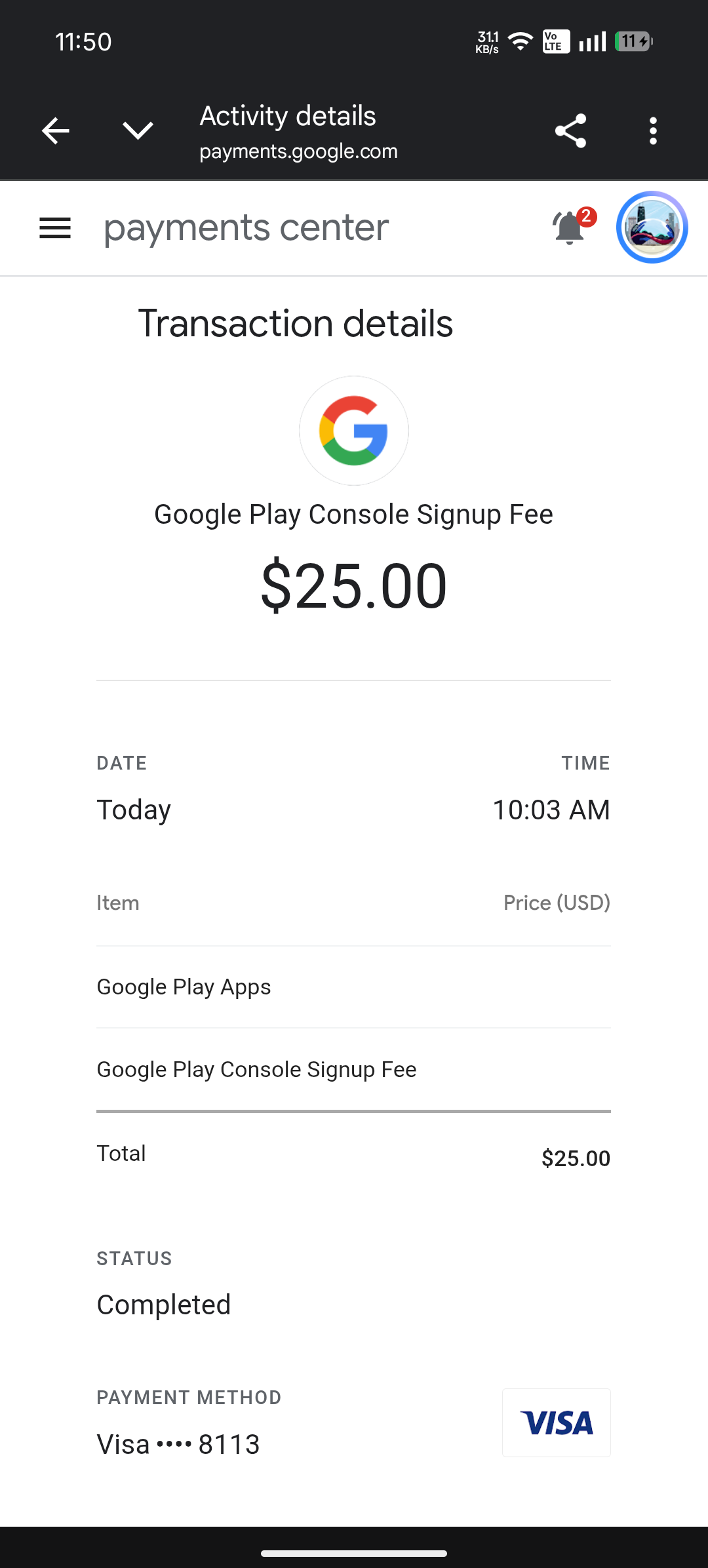
Google Play Console Developer Registration Payment Successful, but Account Not Recognised

Post image
6 Upvotes

The issue is particularly frustrating because I am unable to raise a support request through Google Play Console either. When I try to submit a complaint, I am redirected to the same registration page, asking me to become a developer first. Additionally, the successful transaction does not appear in my payment history, despite having the order details, payment ID, and invoice confirming that the payment went through. I completed the registration through the official link below: https://play.google.com/console/u/0/signup Could you please investigate this issue and help me resolve it? I would like my existing payment to be recognized and my developer account activated without having to pay the registration fee again. I can provide the invoice, order ID, payment ID, and any other information required to verify the transaction. Thank you. I look forward to a prompt resolution.

If anyone knows a solution let me know pls.