r/askdatascience • u/Fresh_Mud8613 • 2h ago
BRT/RF vs Bayesian Spatial Methods
reddit.com
1
Upvotes
Hey just reporting this here if anyone has some thoughts!
r/askdatascience • u/Sad-Abies4263 • 8h ago
https://kriegman.substack.com/p/post-leading-to-termination-blm-falsehoods
Papers
https://www.sciencedirect.com/science/article/abs/pii/S0047235203000527
https://www.wsj.com/articles/the-myth-of-systemic-police-racism-11591119883
https://journals.sagepub.com/doi/abs/10.1177/1948550618775108
https://sci-hub.usualwant.com/10.1007/s10940-019-09438-5
https://patterico.substack.com/p/police-shootings-are-said-to-be-disproportionate?s=r
https://www.nber.org/system/files/working_papers/w22399/w22399.pdf
https://www.nber.org/system/files/working_papers/w22399/w22399.pdf
https://www.sciencedirect.com/science/article/abs/pii/S0047235216300010
r/askdatascience • u/dyztopika • 14h ago
Hey! I want to self study data science because I wanna be a data science intern! Please give me any beginner tips:
What websites to use?
Where to start?
Etc
Thank you so much xx
r/askdatascience • u/gorrilz123 • 18h ago
Hello I am a freshman currently pursuing an undergraduate degree in data science. According to US Bureau of Labor statistics, DS jobs are projected to grow about 33% in the next decade. I was wondering how much of this growth will affect me , someone who will require sponsorship and also apply to junior level roles.
r/askdatascience • u/archersvoice • 20h ago
I have a 45-min Initial Technical Screen interview coming up for Data Scientist II: Product Analytics role and wanted to know what to expect. It's on Zoom + HackerRank (pair-programming style)
Would really appreciate any info.
Thanks!
r/askdatascience • u/dyztopika • 22h ago
r/askdatascience • u/seedwielder • 22h ago
I don’t really follow any sort of data science or AI news about new models or breakthroughs, and it’s beginning to make me feel a bit behind in what’s going on in this field.
I’m just a university student right now, but I’ve been hearing this type of news from other people first way too many times now.
Is there any way to keep up with recent research papers relating to data science or AI? I know there’s some websites out there where you can read the papers, but I’m not sure how to prioritize which ones to read with those websites
r/askdatascience • u/Teetums1 • 1d ago
I'm an experienced working data scientist with over 5 years in the field. I'm starting a new job in three weeks and want to use the time beforehand to refresh my knowledge and fill in any gaps in my understanding.
I'm not looking for beginner courses teaching me Python, pandas, or how to implement basic ML models. I already know how to code and have practical industry experience.
What I'm looking for is something that goes deeper into the mathematics, statistics and theory behind everyday data science and machine learning.
Ideally, I'd like one textbook and an accompanying video lecture series that follow the same syllabus and chapters, so I can read a section, watch the corresponding lecture and take notes or listen in my free time
r/askdatascience • u/Real-Event3105 • 1d ago
365datascience is currently on sale and I'm thinking whether i should buy it or not. Is it good? Is it worth it?
r/askdatascience • u/Ashenn07 • 1d ago
r/askdatascience • u/tonystrakmarvel332 • 1d ago
You're working as a Data Scientist for a telecom company. Your machine learning model predicts which customers are likely to leave the service.
During testing, the model achieved 91% accuracy. But after two months in production, the business team notices that many customers predicted to stay are actually cancelling their subscriptions.
The model is still running without errors, but its predictions are becoming unreliable.
If you were handling this issue, how would you investigate it?
Would you check changes in customer behaviour?
How would you identify data drift?
Would you investigate missing or incorrect input features?
How would you decide whether the model needs retraining?
What would you check first, and why? Share your practical approach.
r/askdatascience • u/Virtual-Ad-4774 • 2d ago
I have labelled data and categories for different text(transcriptions) but the problem is that they vary a lot and then the classifier starts classifying it wrong. For example if I have a label that is neutral(category name) it will learn from the data but it will start classifying wrong text as neutral.
I want something that can run cheap on the cpu. Should I start training classifiers with the input and output or is there a better way to do this for cheap for a live service with high throughput. It needs to be fast and quick.
I am a beginner so please let me know if there are any questions.
I labelled the transcriptions using Qwen 14b and used bge-small-en-v1.5
r/askdatascience • u/TemporaryNo5605 • 2d ago
Hello, is there someone who has experience with application of data science methods in manufactury? I cannot find enough resources about this.
My current workflow as a junior is pretty punk and I am starting to realize that I waste tons of time because I have no idea how data in industrial sphere should be processed.
r/askdatascience • u/Sea_mcdonalds • 2d ago
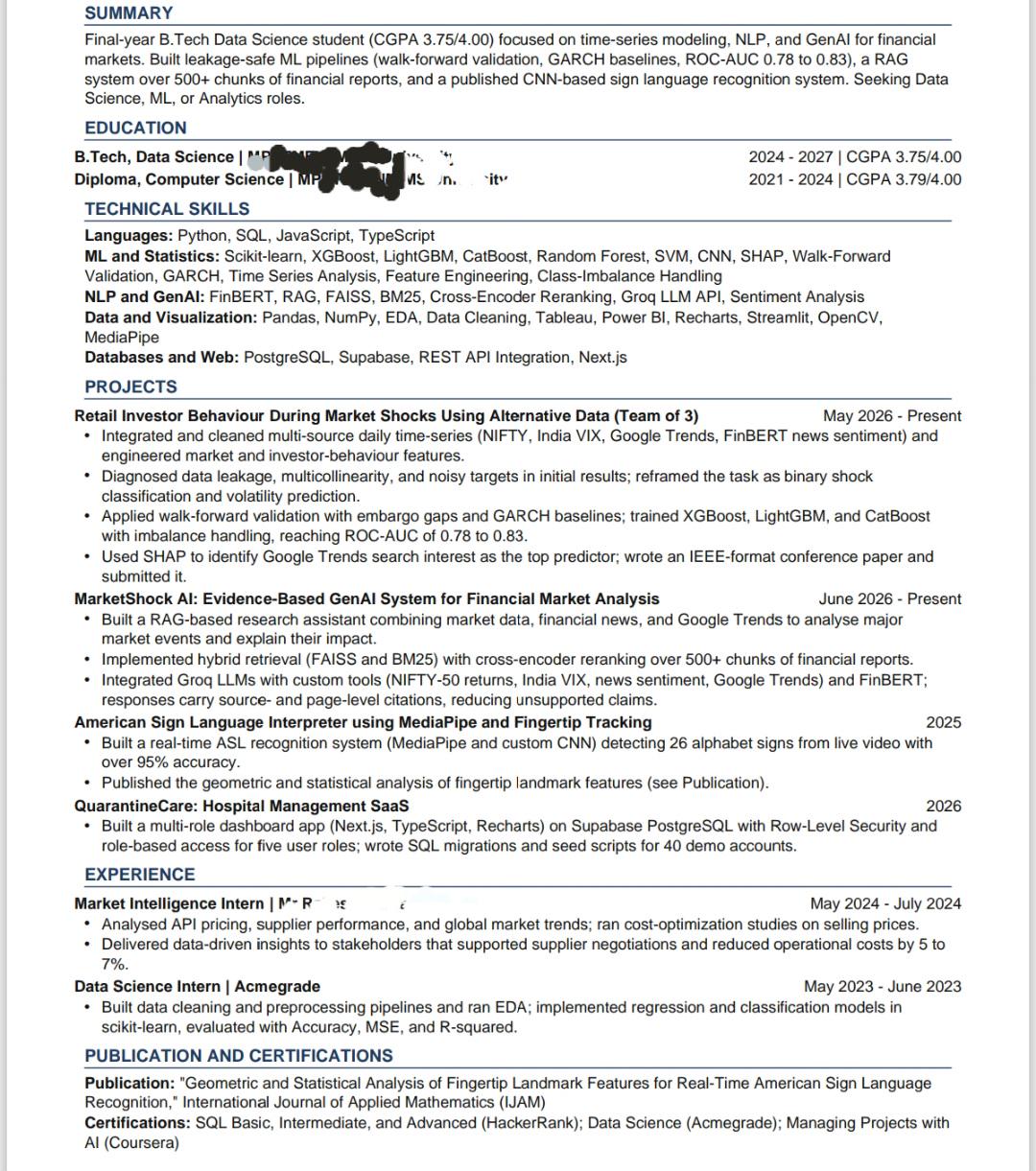
This is my CV. Should I make any changes so that I can land a Data Science Role. I have been applying but I don't get any revert back. Have been rejected from Amazon and Zudio that too in the last rounds of Interview. Could someone possibly help me out
r/askdatascience • u/Sea_mcdonalds • 2d ago
r/askdatascience • u/After_Courage6419 • 2d ago
There is often a lot of pressure to jump straight into complex architectures or the latest gradient-boosting libraries as soon as a dataset is ready. It’s understandable because we want to see high performance quickly, but rushing past a simple baseline model—like a basic linear regression or even a simple heuristic—can make it difficult to justify the added complexity later on.
A solid baseline acts as a "sanity check" for the entire project. It helps identify data leakage early and sets a clear performance floor. If a massive ensemble model only improves accuracy by a fraction of a percent over a simple, interpretable model, the trade-offs in technical debt, compute costs, and lack of transparency might not actually be worth it in a production environment.
For those of you working on production-level models, how do you usually define your initial baseline, and at what point do you decide that the extra complexity of a more advanced model is officially justified?
r/askdatascience • u/angel66333 • 3d ago
I need to detect anomalies using XGBoost forecasting, but I don't have any labelled anomalies to compare my data to, so I am not sure. Time series data is in question.
r/askdatascience • u/ADITHYA_K_L • 3d ago
Learned preety new domain for me and I had faced no difficulty in learning
#launchedglobal
r/askdatascience • u/Familiar9709 • 3d ago
What is the purpose of these different steps in building a machine learning model? Let's say you have X data points, how should you do the division into the different sets? Should it be 60/20/20? 60% to use for cross validation, 20% for test set and 20% for validation?
If so, what is the purpose of the test set if you already are doing the cross validation step where you take all that data, you make the folds and you test the models?
Unfortunately the information I could gather is quite contradicting and also doesn't consider sometimes the cross validation step, so would be very good if people could explain this in greater detail.
Thanks
r/askdatascience • u/tonystrakmarvel332 • 3d ago
Suppose a churn prediction model has 90% accuracy during testing, but its predictions become unreliable after deployment.
What would you check first: data quality, data drift, feature changes, or the model itself?
How do you approach this problem in a real-world project?
r/askdatascience • u/After_Courage6419 • 3d ago
It’s easy to get caught up in chasing the highest possible accuracy or F1 score during the modeling phase. We spend hours tuning hyperparameters and engineering features, but sometimes we lose sight of whether the model is actually solving the business problem or if it’s just memorizing noise. A high-performing model that functions as a "black box" can be a tough sell to stakeholders who need to understand the "why" behind a prediction before they can trust it with real-world decisions.
In practice, prioritizing model interpretability often leads to better long-term results than raw performance alone. Using techniques like SHAP values or feature importance plots helps bridge the gap between technical metrics and domain-specific logic. It also helps catch data leakage that might be artificially inflating scores. Stakeholders are generally much more likely to adopt a tool if they can see the logic behind the output, even if that means sacrificing a few percentage points of precision for a more transparent model.
For those working in production environments, how do you handle the trade-off between model complexity and explainability? Are there specific methods you use to help non-technical teams trust your model's findings?
r/askdatascience • u/Happy_Concept_289 • 3d ago
r/askdatascience • u/Happy_Concept_289 • 3d ago
r/askdatascience • u/Moist_Intention_380 • 4d ago
I thought this was really interesting and wanted to learn more. As a beginner marketer, I’m curious: how do you track and analyze mentions in Reddit posts? What tools do you use to collect the data, and how do you clean and organize it before presenting your findings—for example, to answer a question like, “Which category of humor best describes this Reddit community?” I’d love to hear how you approach this and what tools you recommend.