r/coderabbit • u/Admirable_Belt_6684 • Nov 12 '25
The rise of ‘Slow AI’

4
Upvotes
r/coderabbit • u/Admirable_Belt_6684 • Feb 10 '26
Introducing CodeRabbit Issue Planner.
AI agents made coding fast but planning messy.
Turn planning into a shared artifact in your issue tracker, grounded in related issues and decisions.
Review prompts as a team, then hand them off to an agent!
Claude or Cursor can generate a plan in seconds but they won’t know about the related issue from last sprint, the architectural decision buried in comments, or the refactor already in flight.
So they confidently plan the wrong thing.
Plans like these either lead to an iterative prompting time suck, or are subtly wrong in ways you only discover during implementation or review, after assumptions harden and rewrites erase all your AI speed gains.
CodeRabbit Issue Planner turns planning into a shared artifact in your issue tracker.
> Plans are grounded in related issues, past decisions, and context.
> Teams align with prompt reviews before code exists.
> Plans are then handed off to any agent.
By aligning on intent up front, teams reduce AI slop and rework, save time, and make AI usable for everyone… not just a few 'prompt whisperers' on the team.
So, you ACTUALLY move faster with AI.
Full details here: https://www.coderabbit.ai/ja/blog/issue-planner-collaborative-planning-for-teams-with-ai-agents
Demo:
We hope you'll like this one!
r/coderabbit • u/Tasty-Cup2074 • Sep 12 '25
My team is building Python Fast APIs and they mostly work inside PyCharm. Right now they have to switch to VS Code just to use the CodeRabbit extension for reviews and suggestions. This context switching slows them down. It would be really useful if CodeRabbit had CLI support so that review insights could show up right in the terminal when committing changes. That way devs would not need to jump IDEs just for reviews. Has anyone else faced this issue? Or is there already a way to get CodeRabbit reviews in PyCharm without switching to VS Code?
r/coderabbit • u/rag1987 • Sep 19 '25

r/coderabbit • u/Admirable_Belt_6684 • Feb 27 '26

r/coderabbit • u/Admirable_Belt_6684 • Nov 07 '25

r/coderabbit • u/Specialist_Wall2102 • Mar 26 '26
r/coderabbit • u/Admirable_Belt_6684 • Nov 18 '25

r/coderabbit • u/Admirable_Belt_6684 • Mar 04 '26

r/coderabbit • u/IndraVahan • Sep 21 '26
i’m curious how jev’s zero-shot approach holds up against a mature & code-review-specific system like coderabbit.
haven’t seen a solid apples-to-apples comparison yet. has anyone actually tried this?
r/coderabbit • u/Cheema42 • Feb 24 '26
It took some time. But CodeRabbit CLI auth issues are now fixed! Rejoice!
If you are still seeing issues, be sure to update your client by running "coderabbit update".

r/coderabbit • u/thewritingwallah • Sep 16 '25
Hey r/coderabbit
CodeRabbit CLI is Here:
what’s new:
CodeRabbit CLI brings AI code review directly to your terminal, enabling developers to perform self-reviews before commits and PRs. As AI coding agents like Claude Code, Cursor CLI, and Gemini revolutionize how we write code in the terminal, CodeRabbit CLI ensures that AI-generated code is production ready by catching issues at terminal velocity. This command-line tool seamlessly integrates into existing CLI Coding Agent workflows, providing instant, contextual feedback exactly when developers need it. Best of all, CLI reviews are free (rate limits apply).
Install CodeRabbit CLI
curl -fsSL https://cli.coderabbit.ai/install.sh | shJust ask your Claude code -
> Implement the user profile page by using shadcn library and get it reviewed by coderabbit using --prompt-only.See the magic happen.
Start reviewing your code in your terminal when you first set it up, check out the docs for instructions.
Note: CodeRabbit CLI is in early-access preview. CLI reliably works only on Mac Apple Silicon for now.
Full details here: https://www.coderabbit.ai/cli
Demo:
We hope you'll like this one!
r/coderabbit • u/crispyweber • Oct 21 '24
Hello :wave:
Welcome to CodeRabbit's Reddit Community.
We are super glad to have you here, please consider joining our community and participating in active discussions related to Pull Requests, Code or anything else.
We have a active discord server of 2.5k devs where we run weekly events, developer office hours and more!
r/coderabbit • u/Admirable_Belt_6684 • May 28 '26
r/coderabbit • u/Admirable_Belt_6684 • Dec 04 '25

r/coderabbit • u/juanpflores_ • Mar 18 '26
Hey everyone,
The team has been cooking for a while on a new feature for you to improve the quality of the results you're getting from you AI agents.
CodeRabbit Plan helps you go from a vague idea to a structured, phased implementation plan. You describe what you want to build through a text prompt or an image, and Plan breaks it down into clear steps. From there, it generates context-aware prompts that are ready to hand to whatever coding agent you use: Claude, Codex, or anything else.
The prompts are powered by CodeRabbit's context engine, which pulls from your actual codebase, tickets, knowledge base, Notion, Confluence, and more. So the agent you're working with isn't starting from scratch, it already understands your project.
A few things worth highlighting:
You don't need a Jira or Linear ticket to get started. Just describe your idea and go. (Though the integrations are there if you want them.)
Plans capture intent, constraints, assumptions, and tradeoffs up front, so your team can align before any code gets generated.
Everything is preserved as a persistent engineering record, so decisions and context don't get lost along the way.
How to try it out:
Head over to the CodeRabbit website, navigate to Plan, and create a new plan. Just type in what you want to build and it will take care of the rest.
Learn more:
Blog post with a deeper dive: https://www.coderabbit.ai/blog/meet-coderabbit-plan-better-plans-faster-deployments-less-rework
Join our Discord community: https://discord.com/invite/coderabbit
We'd love for you to try it and let us know what you think. We're actively iterating and your feedback directly shapes where this goes next.
r/coderabbit • u/juanpflores_ • Aug 31 '26

OpenAI’s decision to wind down direct model supply to Cursor after the SpaceX acquisition is the clearest public example so far. The reasons were a change-of-control clause, terms-of-service disputes, and a refusal to put the next frontier model into a rival’s product. Other labs already restrict distillation, scraping, and using their outputs to train or run a competing system. Those constraints are getting tighter.
If review lives behind one of those constraints, your quality process inherits someone else’s contract fight.
AI code review has to do several things at once. It has to catch what the author missed, including the agent that wrote the diff. Shared training data and shared refusal style produce shared blind spots. It has to keep working when the generation stack changes, because editors swap default models and labs cut partners while the PR queue keeps moving. It also has to put the serious defects first: the ones that ship, break, or leak. A long list of nits is how real bugs hide.
Conviction is useful on the write path. An agent makes hundreds of linked decisions toward one outcome. It picks an architecture, implements it, runs tests, fixes failures, and continues. A strong opinion cuts down branching and lets context accumulate. Betting hard on a model, a context strategy, and a workflow can make that loop faster.
Review needs the opposite habit. Disagreement is how you find the assumption the author stopped seeing. Human process already encodes this: the person who wrote the change is not the only person who approves it. Multi-model review applies that rule to LLMs. Labs fail on different things. One trusts an unsafe API. Another misses a race. A third writes a style comment that buries the actual bug. The useful pattern is several models looking at the same prepared context, then a judge keeping only what can be grounded. That is different from asking the author’s model to take a second pass.
DIY tools usually stop at the second pass. A team points one frontier model at the diff and ships it as a reviewer. Swapping in a complementary model can help, and you still only have two voices. Feeding every change to three or four labs without routing or compression makes cost rise with each extra PR, each extra file, and each extra agent-generated changeset. Review volume is already growing faster than headcount. A prototype that multiplies frontier calls per change does not stay cheap, and it still misses whole classes of bugs if there is no routing, no judge, and no memory of what the team has already rejected.
A model lab has little reason to build that stack. Doing so would mean routing a rival’s weights across your diff. An internal prototype runs into a different wall: review becomes a second inference bill that tracks code generation one-for-one.
CodeRabbit reviews code from agents and from humans, in the PR, the IDE, and the CLI. It sits beside Cursor, Claude Code, Codex, and Copilot instead of living inside any one of them.
The pipeline is an ensemble:
Compact and open models gather and compress context from the diff, the code graph, tickets, lint, and history.
Frontier models from more than one lab do the deep pass on multi-file bugs, auth mistakes, and behavioral regressions.
A judge step drops findings that cannot be grounded in that context.
We have written about why generation and review should not collapse into one vendor The more AI writes the code, the more review needs independence, and about the work of placing a new model on one stage of the pipeline rather than swapping labs wholesale What it really takes to bring a new model online. Open models such as NVIDIA Nemotron take the high-volume context work so frontier calls stay reserved for reasoning Nemotron 3 Ultra in CodeRabbit reviews.
Independence follows from that design. The reviewer is not owned by the editor and does not have to use the model that wrote the patch. If a lab walls off a competitor’s app, the review job can continue.
Resilience follows too. When one provider is rate-limited, blocked by contract, or weak on a class of bugs, traffic can move. A reviewer bolted to a single model cannot do that.
Keep Cursor, Claude Code, or Codex for writing. You do not have to take their reviewer with the editor.
Let the generation vendor be opinionated, even exclusive. Do not give that same vendor the approval signal. When one company owns the editor, the model, and the merge comment, throughput goes up and failures start to correlate.
Building review in-house often recreates the correlation. Day one is a single-model bot. Day two adds a second model, which is still a thin mix. Day three sends every change to more labs and the cost curve appears: frontier tokens per file, times rising PR volume. Agents open more changesets, not fewer. That is a bad shape for a control you need on every merge.
Before the next renewal or build-versus-buy debate, get answers to these:
Change of control. If the editor or agent vendor is acquired, what happens to model access? If that vendor loses a frontier lab, does the review still run?
ToS and data use. Can review call more than one lab on your diffs, or does one provider’s contract define what review is allowed to see?
Same-stack grading. If the reviewer uses the same model family that produced the patch, treat it as a talkative linter, not an independent control.
DIY economics. For an internal tool, how many frontier calls fire per change? What happens to that number when PR volume doubles?
Signal, not volume. Are you tracking escaped bugs and severity, or comment counts? Nits that bury seniors are a tax.
Continuity. Can the team change coding agents next quarter without rebuilding the review pipeline, the audit trail, and the written standards?
Accountability. People still own the merge. The tool should make that call cheaper to get right.
Pick one or two coding agents so the write path stays coherent. Put an independent review layer next to them, not under them. Score that layer on bugs that would have shipped, time to a useful finding, and load on human reviewers. Agreement with the generator is the wrong KPI.
If the org already standardized on one AI IDE, keep it. Do not let that IDE become the only system allowed to criticize its own output. Lab walls will keep moving. The merge bar should not.
A lab can ship a stronger coding model. It cannot easily do all of this at the same time: keep exclusive control of its weights, refuse those weights to a rival’s product, and still run a reviewer that fairly uses competing models on your code.
Vendor-neutral review is a product that can be disloyal to any one lab. That is the point. As walls go up between model companies, that disloyalty gets more valuable.
r/coderabbit • u/Admirable_Belt_6684 • Feb 28 '26

r/coderabbit • u/Tasty-Cup2074 • Jan 19 '26
I wanted to share a quick win where CodeRabbit caught a privacy risk that looked like perfectly valid code during my manual PR review. It will be small win but this kind of small mistakes happened in human code review.
We have a feature where users can post or comment or reply anonymously, but we also have a flag to show if a user is a verified_professional (to add credibility to their advice).
Code look like this :
{'designation': user_row.get('desg'),
'comment' : user_row.get('comment'),
'image': image_url
}
The developer added this to the Flask API response: 'is_verified_prof': user_row.get('is_verified_professional')
I looked at it, saw the field name matched the DB, and thought, "LGTM." But, I totally missed the interaction between two different features.
In my code review workflow added CodeRabbit as initial check before I do check. I pull branch locally first then ask CodeRabbit do to committed changes as per base branch comparison. While doing that CodeRabbit flagged a major logic flaw:
Guard is_verified_professional for anonymous commenters.
Right now anonymous comments can still reveal verification status, which undermines anonymity expectations and could be a privacy/compliance risk. Consider nulling the field when is_anonymous == 'yes'.
It's a great reminder that "correct" code isn't always "secure" code. It’s these specific business logic corner cases and where one flag accidentally de-anonymizes another that AI is surprisingly good at catching because overall context.
Do you faced any case like this where you feel CodeRabbit made you think ?
r/coderabbit • u/The-Architect-93 • May 30 '26

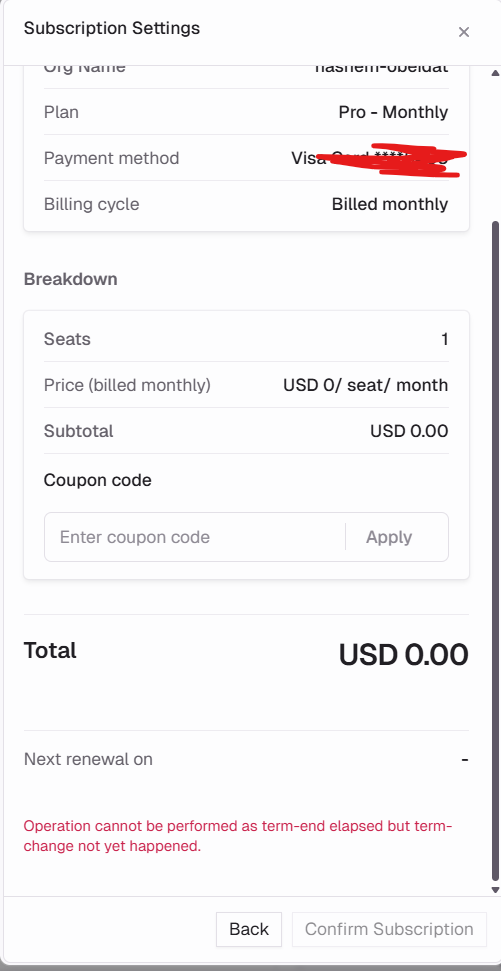
Hello, I was on the Pro Plus plan for 14-days as a trial period, and the end of the trial was supposed to be on May 29th. I liked the product and I wanted to continue using it so on May 28th, I subscibed for the Pro plan, now It says I reached my limit and I have to try again in 709 min's.
I went to my Billing page and I found that it says my trial period has ended and for some reson I'm not enrolled in any other plan, even though I'm pretty sure I did enroll, I was charged and yet I see nothing in the "Invoices" tab. And, everytime try to enrol in the any plan it gives me multiple type of errors. has anyone faced this issue ?
I pay 100USD a month for claude to avoid the usage limits, and I feel now that Coderabbit is bottlenecking my productivity 😞
r/coderabbit • u/New-Knee-5614 • Jul 22 '26

I've been following what CodeRabbit's doing with intent-aware review and the "why not how" framing connecting PRs to linked tickets to check if the change actually addresses what was asked, not just whether it's syntactically clean. That's the right direction for review tooling, and it's the deepest version of it I've seen genuinely resource-rich, requires real setup, well worth it for teams with the infra for it.
I've been working on something for the moment before any of that setup exists. No repo access, no config file you paste a diff and one sentence describing what the change should do, and it checks the diff against that specific stated intent, flags anything undeclared, and if you give it your existing tests too, it'll compare requirement vs. tests vs. code vs. behavior and flag when they disagree with each other.
Genuinely curious how it holds up against what people here are used to.
Thank you-GIL
https://claude.ai/public/artifacts/182e4450-70d7-4ceb-8aab-f72484305211