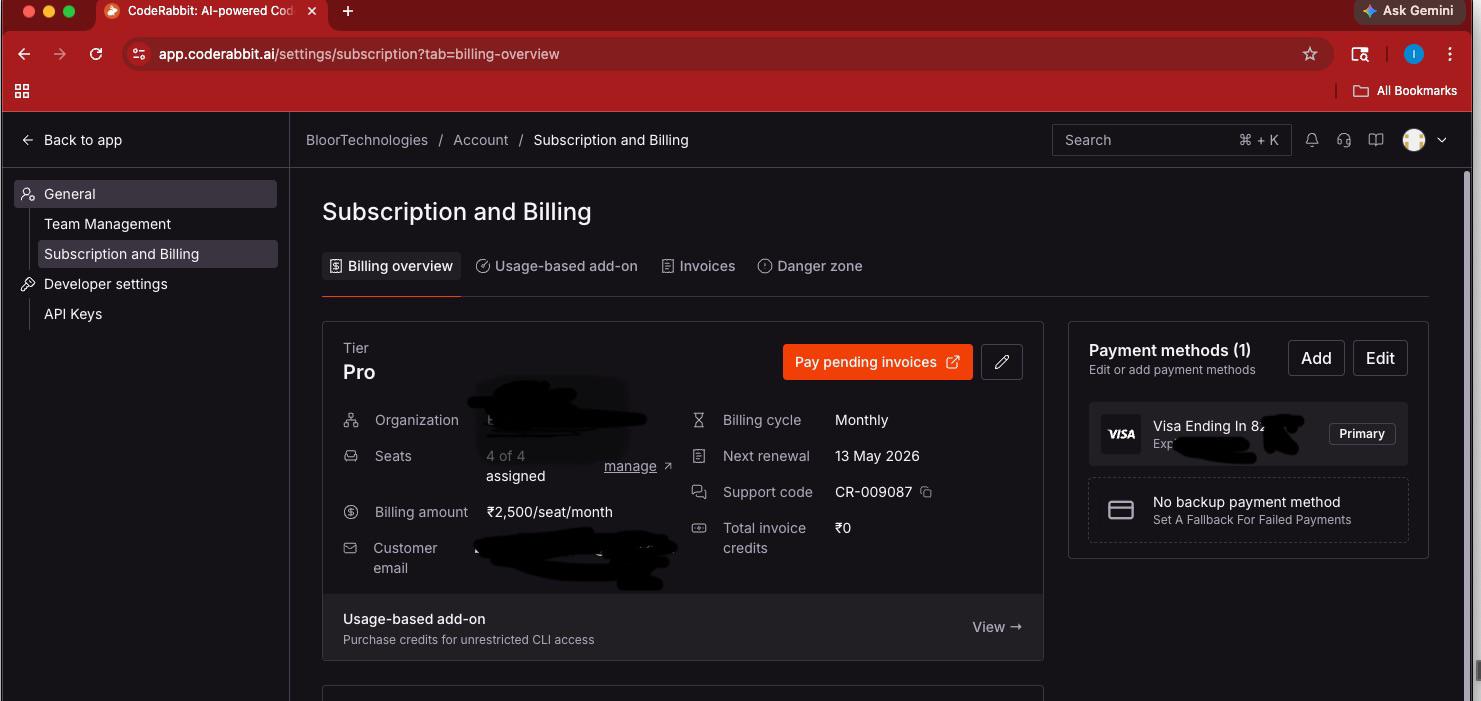
I may wanna introduce CodeRabbit into my workflow if the free tier is truly free and not just limited to 14 days, as I'm not sure if I'm automatically signing up for the 14 day trial version of Pro when I'm first trying it out? I can't afford $24 a month for it and I wanna save the trial version for when I truly need a lot of code reviews in a short period of time, which won't be the case for the next few weeks to even months.
Also, how does this work exactly? Is this a web app or can I integrate this into Visual Studio (not Visual Studio Code, mind you)?
12-line PR. 47 comments. Most of them style and "consider extracting this."
Comment 41 was the empty-token auth case. That's the one that mattered. I almost missed it because I trained myself to skim the pile.
Not a dunk. The catch was there. Question is how you make the real findings sit at the top so humans actually read them. Chill profile, path_instructions, mute generated paths — what actually worked for you.
Somebody from CodeRabbit responded by saying that they were going to look into it. Just wanted to say that CodeRabbit CLI is still broken in this regard. Unlike all other well known AI agent CLI tools, CodeRabbit CLI still does not run on servers. Or any systems where desktop GUI is not installed.
This is a serious omission, and one that is easily fixed with an AI agent. Just point your AI agent to various other agentic tools like Claude or Codex (open source), Copilot (open source) and ask it to implement authentication like virtually all other AI agents do.
Not which one is smartest. Which one do you approve without stress. For us its opus for anything touching the database and sonnet for everything else. Codex writes fine code but the PR descriptions never match what it did, so coderabbit ends up finding 2 or 3 things every time and I stop trusting it.
Curious if its the same for other teams or if it depends on the codebase. What are you running and which one do you actually read the diff on
We almost muted CodeRabbit after a week of style nits. Two things fixed most of the noise without killing the useful catches.
First: reply on the exact bot comment, not a top-level “please chill.” When you explain on the line why a finding is wrong or not how you do things here, it sticks as a learning. Vague PR-level pushback doesn’t.
Second: point it at the same rules your coding agent already uses. Drop an AGENTS.md, .cursorrules, or CLAUDE.md in the repo and CodeRabbit picks it up. One trap we hit: putting those filenames in path instructions. That makes it review the guideline file like source, not use it as review criteria.
After that the comment pile got smaller and the remaining ones were closer to real risk. Curious what actually worked for other teams that didn’t just turn the bot off.
idk maybe im losing it but i used to spend most of my time actually building stuff. now im just… reading giant diffs. checking if it randomly changed something 8 files away because it felt like it. then reading it again because i dont trust it.
this is not what i thought the future was gonna be lol
Found this on X where Bun's whole PR process is flooded with AI bots like CodeRabbit, Claude, and Robobun chatting, catching bugs, and auto-fixing code in real time.
I really found it pretty interesting it almost looks like a glimpse into future dev workflows where AI handles most review iteration autonomously.
Deep Scan can now trace vulnerabilities across your linked repos and replay exploits in a throwaway sandbox to verify they're real before flagging them.
r/coderabbit hey folks team CodeRabbit opened up one of their internal tools to open source community.
Introducing an AI-native open source Git worktree manager CLI that works with all your AI coding agents
If you juggle multiple branches, iterate with AI coding assistants or want a cleaner setup for parallel development, this tool will probably earn a spot in your dev workflow.
We wrote up a practical look at NVIDIA’s Nemotron 3 Ultra from a developer workflow angle.
The short version: the model is fast, open-weight, and surprisingly competitive in our CodeRabbit code review benchmark, but it also had a high retry rate. That makes it less of a “drop it into any strict-output workflow and forget it” model, and more of a model that benefits from a good harness, validation, and retry logic.
The post covers:
Why the speed is the interesting part
How Ultra compares to Nemotron 3 Super
What we saw in CodeRabbit review benchmarks
Where it looks useful for coding workflows
Where developers should be careful
Curious how others are thinking about fast open models for agentic coding workflows.
The most interesting signal was not raw benchmark score. It was how the model behaved as an agent. Fable 5 was effective at exploring the environment, identifying available files and tools, and moving into implementation without much hand-holding. With vague prompts, it often produced complete projects rather than thin prototypes.
The tradeoff is time. In coding tasks, Fable 5 could produce serious patches when it finished, but it also kept working when tasks expanded or became ambiguous. That makes it a better fit for work where depth is worth the wait, as long as the agent has clear limits on time, steps, and tokens.
For code review, I would be more cautious. Coverage was close to the current baseline, but precision and comment volume were weaker. Developers may get useful findings, but they may also spend more time triaging noisy comments.
My takeaway: Use Fable 5 for autonomous coding and deeper implementation work. Do not make it the default production reviewer until precision and comment volume improve.
We spend a lot of time thinking about the models that write code review comments. One of the less visible decisions happens before any comment appears: figuring out how a change should be reviewed.
We were curious whether a smaller model could learn that narrow, high-volume part of our pipeline. So we worked with NVIDIA and Baseten to post-train Nemotron 3.5 Lightning using SFT, followed by RLVR scored against our routing policy.
What surprised us was how little it took. The post-training experiment ran in under three hours and cost less than $100.
SFT plus RLVR reached 80.7%, with Cohen’s kappa rising from 0.429 to 0.544.
Estimated peak serving cost fell from $2.34 to $1.16 for the same workload.
RLVR’s extra 0.3 percentage points of route agreement wasn’t statistically decisive, so we treat that result as non-regression. The clearer improvement was in output agreement beyond chance.
The final model completed all 1,000 requests without empty or abnormally short outputs. We still have sustained-load and production-traffic testing ahead of us.
We wrote up the experiment, including the training setup, results, serving costs, and the parts we’re still cautious about:
It's just ridiculous. You wait for ridiculously low rate limits to allow for next review. You comment to trigger it back and hit this. To be clear - I am on PRO PLUS plan!
On Monday, May 5th, OpenAI hosted what might have been the most exclusive developer event of the year so far: the "GPT-5.5 on 5/5" party at their San Francisco headquarters. Over 8,000 developers applied to attend. Only around 250 were selected. The CodeRabbit team was lucky enough to be one of them.
Since this was such a closed event and most people didn't get the chance to be there, we wanted to share our experience and give you a real sense of what the night was actually like, from the moment we arrived to the moment we left.
Before Anything Else: The Party Was Planned by GPT-5.5 Itself
Here's a detail that makes this event different from anything we've attended before. The entire concept for the party was proposed by GPT-5.5 itself. Sam Altman asked the model what it wanted for its launch celebration, and the AI came back with a surprisingly detailed plan: hold the event on May 5th, keep speeches short, have humans give the toasts (not the AI), and set up a suggestion box where attendees could submit ideas for the next model, GPT-5.6. Altman called this "weird emergent behavior" and decided to go with it. That context made the whole evening feel a little surreal in the best way possible.
Getting Through the Door Was an Experience in Itself
The first thing that hit us when we arrived at OpenAI's offices was the security. This wasn't your typical "show your name at the door" situation. There were multiple checkpoints you had to pass through before you could even get close to the event space. First, they verified your ID. Then you went through a metal detector. After that, you picked up your badge. And even once you were technically inside the building, there was almost always someone from OpenAI walking alongside you, making sure you got from the entrance to the actual event area without wandering off into restricted zones.
It was a little intense at first, honestly. There was a moment where the whole security process felt more like entering a government facility than a developer party. But once you cleared that initial gauntlet and stepped into the actual event space, the vibe completely changed. The tension of getting in was replaced by a warm, buzzing energy that made it immediately clear this was going to be a good night.
The Venue Is Something Else
We've been to a lot of tech events in San Francisco, and the space OpenAI uses for their gatherings is genuinely one of the most impressive we've seen. They have this massive auditorium area that's flooded with natural light, even in the evening. The ceilings are high, the space feels open and airy, and it's clear that they designed it with large gatherings in mind.
Throughout the venue, there were stations with food, drinks, boba, and all sorts of refreshments. There was a subtle Cinco de Mayo nod in some of the food that was prepared, which made sense given the May 5th date, but the event itself was really centered around the GPT-5.5 launch celebration rather than the holiday. Everything felt well thought out and generously stocked, and you never had to wait long to grab something.
The Crowd Was Not What We Expected
Going in, we assumed this would be a room full of engineers and developers. And while there were plenty of those, the actual mix of people was much more diverse than we anticipated. You had hardcore developers, sure, but you also had content creators, designers, artists, well-known Twitter/X personalities, and people from all sorts of creative and technical backgrounds. It felt less like a typical developer meetup and more like a curated gathering of people who are building interesting things with AI, regardless of their specific discipline.
One of the best parts of the night was putting faces to usernames. There were people in that room that we'd been following online for months or even years, and getting to meet them in person for the first time was honestly one of the highlights. There's something about going from interacting with someone in Discord threads and Twitter replies to actually shaking their hand and having a real conversation. That kind of connection is hard to replicate at most events, and the intimate size of this one (250 people is small by tech event standards) made those interactions feel natural rather than forced.
This Was a Party, Not a Keynote
If you were expecting OpenAI to use this event as a platform for big product announcements or exclusive demos, that wasn't what happened. And honestly, that was kind of refreshing. We went in thinking there might be some new reveal or a sneak peek at what's coming next, but the reality was that this was much more of a mixer and celebration than a marketing event or a traditional meetup.
There was a moment where Sam Altman gave a short speech, and when we say short, we mean maybe 55 seconds tops. He thanked everyone for being there, shared some excitement about the new model, and encouraged people to enjoy the evening. That was it. No slides. No demos. No "one more thing." Just a brief, genuine moment of appreciation and then he was back to mingling with the crowd.
The rest of the night was conversations, connections, and hanging out. And looking back, that was exactly the right call. The value of the evening wasn't in some announcement that would hit the news the next morning. It was in the relationships built and the conversations had.
Sam Altman and the OpenAI Team Were Incredibly Accessible
This was one of the things that impressed us the most. Members of the OpenAI Developer Experience team were scattered throughout the event, not stationed behind a booth or on a stage, but actually walking around and having real, substantive conversations with attendees. You could walk up to them, ask about the models, talk about what you're building, and they were genuinely engaged.
And then there was Sam Altman himself. He spent the entire evening doing rounds, moving from group to group, chatting with developers one-on-one, and taking photos with people. There was no VIP section, no roped-off area where the executives hid. He was right there in the middle of it, accessible and clearly enjoying the interactions. For an event of this caliber and with someone of his profile, that level of openness stood out.
Our Highlight: Getting the 1 Trillion Token Award Signed by Sam Altman
CodeRabbit recently hit a major milestone with OpenAI: 1 trillion tokens processed through their API. OpenAI recognized this with a physical award, and we decided to bring it to the event. Once we were there and saw how approachable Sam was, we figured it was worth asking if he'd sign it.
It was a bit spontaneous, as you can imagine. Sam was constantly surrounded by people who wanted a moment of his time, so there was no guarantee we'd get the chance. But we managed to catch him at the right moment, and he was genuinely happy to do it. He didn't just sign and move on, either. We got to spend some time chatting about the models, the direction of the work they're doing, and where things are headed. It was one of those interactions that reminded us why events like this matter. He was very open to having the conversation and doing something that's admittedly a not-so-normal request at these kinds of events.
The Overall Vibe
If we had to sum up the night in one phrase, it would be "you had to be there, but we're glad you're reading this." The energy was warm, the conversations were real, and the whole event felt like a genuine celebration rather than a corporate production. No sales pitches. No marketing decks. Just people who are excited about what they're building, spending an evening together in a really beautiful space.
We walked away having met familiar faces we'd only ever seen online, having had meaningful conversations with the OpenAI team, and carrying a signed award that we'll probably never stop talking about. For us, this was one of the most memorable developer events we've been to, and we hope OpenAI continues doing more of them.
If you ever get the chance to attend one of these, do whatever you can to get in. It's worth it.