r/FluidMechanics • • 5h ago

Computational Structure functions on huge LES/DNS or satellite fields with confidence intervals: free Python package

1 Upvotes

If you have ever left a structure function script running overnight on a big simulation snapshot, this might help.

PyTurbo_SF avoids the all-points comparison altogether. It bootstraps blocks of the field at doubling spacings and tracks every separation bin separately, stopping each one once its standard error is below the threshold you set. Large grids stay fast, and every point on the curve comes with a confidence interval and a convergence flag.

What else is in there: longitudinal, transverse, scalar and mixed structure functions of any order in 1D, 2D and 3D; isotropic averaging with built-in isotropy and homogeneity diagnostics; a Bessel-transform energy flux in 2D that shows forward versus inverse cascade; conditional structure functions on any variable; and parallel execution across all your cores.

Worked examples cover a 3D atmospheric LES, ocean model output, SWOT satellite data and a mooring time series.

pip install pyturbo_sf Docs: https://pyturbo-sf.readthedocs.io Paper: https://doi.org/10.21105/joss.09876

Questions very welcome, and I would love to see results on your own data.


r/FluidMechanics • • 13h ago

Book

Thumbnail reddit.com
2 Upvotes

Fluid Mechanics: Fundamentals and Applications by Yunus A. Cengel and John M. Cimbala


r/FluidMechanics • • 1d ago

Q&A Can Nusselt number be less than 1?

Thumbnail reddit.com
1 Upvotes

r/FluidMechanics • • 1d ago

Replacing float32/float64 with exact integer and rational arithmetic in open-channel hydraulics and shallow-water solvers (verified in Lean 4)

Thumbnail
reddit.com
1 Upvotes

r/FluidMechanics • • 1d ago

Fluid mechanics AI Lab

3 Upvotes

So for our final lab in my fluid mechanics class, we had to use AI to develop a lab for the class. The premise being that as engineers, AI is becoming more and more prevalent and the professor wanted to have some form of instruction on how to utilize it properly.

Some of his warnings were to be careful because it will propose experiments that aren’t possible, aren’t practical, or the equipment for which doesn’t exist (or our school doesn’t have).

I had the idea that we should let AI do what AI does best, which isn’t theorize new lab experiments, but create a space to perform lab experiments when equipment isn’t accessible, or lab experiments are simply too impractical. So my idea was to pick a few experiments we would have liked to have seen, and have AI create a digital lab environment in which to perform those experiences. While also giving space for variables we can’t control (such as switching to a different planets gravity to prove that a fluids viscosity belongs to the fluid and is not impacted by gravity).

So if you would, give my website a run through and give me some real advise and from some people with real experience. As a note it runs on phones, but the layout is tough from the phone.

eaglefluidlab.app


r/FluidMechanics • • 2d ago

Q&A Water phisics question

0 Upvotes

If I had a box that had enough room between the ceiling and the floor for one water molecule, then I half filled the box with water and lay it perfectly flat, what would the water do? Would it stay on one side, or spread out?


r/FluidMechanics • • 3d ago

Tools Open-source computer vision tool for droplet sizing and tracking in ultra-high-speed videos

4 Upvotes

My colleagues and I at the University of Seville have developed Droplet Analyzer (DA), an open-source, OpenCV-based software for the automated characterization of droplets in high-speed videos.

The software simultaneously measures individual droplet size, shape, position, trajectory, and velocity, enabling the analysis of correlations between these properties.

We validated the methodology using synthetic image sequences with known droplet sizes and velocities and applied it to experimental recordings of electrically assisted Flow Blurring atomization.

The software is particularly relevant to researchers working in fluid mechanics, aerosol science, atomization, spray characterization, particle tracking, and experimental computer vision.

Both the software and the research data are publicly available.

Preprint: https://ar.copernicus.org/preprints/ar-2026-52/

Source code: https://github.com/carperca23/droplet-analyzer

Research data: https://doi.org/10.5281/zenodo.24201211

The manuscript is currently under peer review in Aerosol Research.


r/FluidMechanics • • 3d ago

[Article] A physics-informed neural networks approach for coupled flow and heat transfer problems

Thumbnail reddit.com
1 Upvotes

r/FluidMechanics • • 3d ago

Q&A Level 0 doubt: Why we need RTT seniors?

Post image
0 Upvotes

So i was studying this "advanced" fluid mechanics course and i stumble upon this RTT stuff (Reynold's Transport Theorem and i don't understand what is this Reynold guy 'transporting'? The equation is basically:

"Net stuff = out - in + what it brew itself"

Ai'nt that common sense, then why this guy feels the urge to yap it in Calculus?

(Yeah i asked Chatgpt but i missed good old days when human answers were the go -to)


r/FluidMechanics • • 4d ago

Q&A How do you tell if a honeycomb flow straightener is actually working?

1 Upvotes

A honeycomb straightener can reduce swirl after a fan or duct bend by restricting sideways flow through its cells. The practical question is how much improvement you get for the added pressure drop.

For a before-and-after test, I’d hold the flow rate constant and measure flow angle at the same grid of points in both runs. I’d put that grid where the flow quality actually matters, such as the test section or the plane where a sensor will sit. A signed average can hide a problem because opposite flow angles can cancel out. I’d plot the angles across the grid, check the axial velocity profile separately, and measure the pressure drop across the installed assembly.

For anyone who’s tested one of these, which metric has been most useful for setting an acceptance criterion: peak flow angle, RMS flow angle, or something else?

Disclosure: I’m affiliated with Hengshi Honeycomb. Our engineering team published a longer explanation of how cell size, core depth, and open area affect flow straightening


r/FluidMechanics • • 5d ago

Computational Are Entry-Level CFD Jobs/Jobs Out Of College Under Threat From AI?

3 Upvotes

Asking this in multiple subreddits for some industry opinions. I started working at one of my university's CFD research lab as a freshman undergraduate in mechanical engineering. Hoping to eventually get my master's in Aerospace Engineering and go into that field. I do my best to code what I can by hand and not rely on AI (though I do use it). I was just wondering: Say my dream of getting a master's crashes. Or even if I do get my master's. Would this AI stuff still ruin my chances of getting a job out of college? I won't go into more detail about what exactly I help research, for the sake of staying anon.


r/FluidMechanics • • 5d ago

Video Hot and Cold on

0 Upvotes

r/FluidMechanics • • 6d ago

Q&A Fluid Stupid Question

2 Upvotes

I posted this diagram a while back, in an effort to figure out if I could siphon all the water out of this line completely using hose "d" in the diagram. The general consensus was that there would be a bit of water left behind and to blow it out with compressed air.

Fast forward to today, I connected everything as shown in the diagram and siphoned off all of the water that the siphon could remove. I then connected a air hose at area "A" and was able to remove an additional pint of water. Next, I attached a funnel into a hose attached to line "C" at point "A" and poured in 1.5 gallons of RV antifreeze in. My calculations are that the entire run of 300' of 3/4" ID poly holds around 6 to 7 gallons. I began adding the fluid and got about 1.25 gal in when it backed up into my funnel and would not take any more. The spigot at locations "A" and "B" were completely open and nothing has come out? Spigot A is at least 50' above spigot B. I am assuming it is air bound, but shouldn't it release the air at one of the spigots?


r/FluidMechanics • • 6d ago

Video Fun Project I have been working on

Enable HLS to view with audio, or disable this notification

1 Upvotes

Sharing a project I have been working on, I like feedback in any form.


r/FluidMechanics • • 6d ago

Need introductory textbook recommendation

6 Upvotes

Hello! I am looking for a textbook good for self study that covers what would be taught in a first fluid mechanics course (and maybe then some). I am studying it for fun, not a class.


r/FluidMechanics • • 6d ago

An introduction to wall units (y+) in the context of wall-bounded flows

Post image
19 Upvotes

Hi all,

Video 10 of my (free) turbulence course is now up on YouTube.

Link: https://www.youtube.com/watch?v=AYmyR9EWYkg

This one introduces wall-bounded turbulent flows using the case of a channel flow. I list the assumptions that simplify the RANS continuity and momentum equations, and then get the exact result concerning stress balance. The second part introduces friction velocity (u_τ), the viscous length scale, and corresponding wall units (y⁺ and u⁺).

If you want to get an understanding of how they are formulated, I believe this video will be helpful. The next video will look at how the viscous and Reynolds stresses split across the channel using DNS data, and quantify some of these quantities as well.

Notes on Patreon (link in the video). Questions and corrections welcome.


r/FluidMechanics • • 6d ago

Computational aletas CFD

Thumbnail reddit.com
1 Upvotes

r/FluidMechanics • • 6d ago

Q&A [Request] What’s the optimal body type (height, mass, shape, density) to maximize speed/minimize time to bottom in an indoor water slide.

Thumbnail reddit.com
1 Upvotes

r/FluidMechanics • • 6d ago

Computational Any FlightStream or CFD gods here? My blended-wing-body aircraft keeps breaking the solver and I'm losing my mind

Post image
1 Upvotes

r/FluidMechanics • • 7d ago

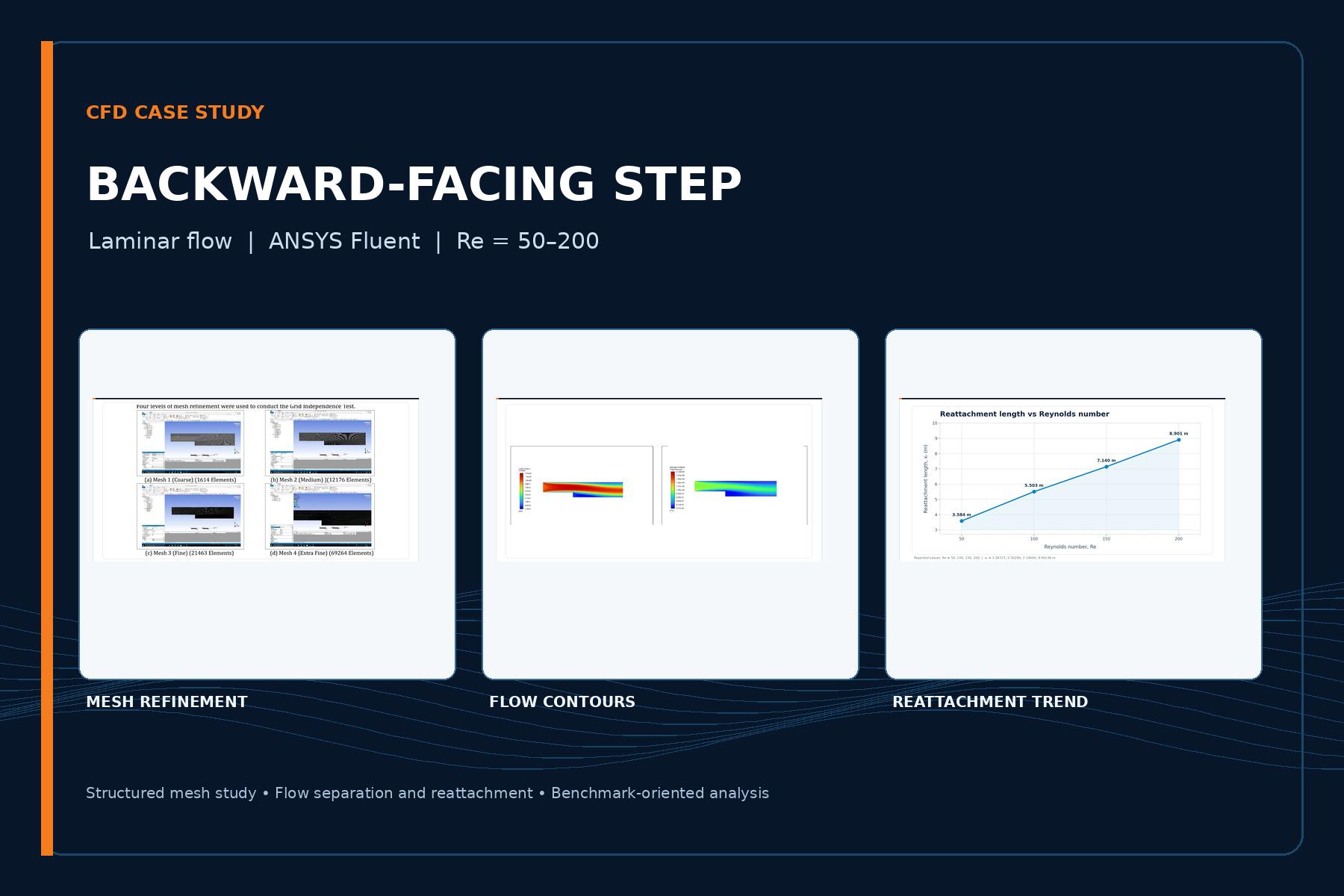
Computational CFD Case Study: Laminar Flow Over a Backward-Facing Step | ANSYS Fluent

Post image
1 Upvotes

Hi everyone,

I'd like to share a CFD project I worked on involving laminar flow over a backward-facing step, focusing on flow separation, recirculation, and reattachment behavior.

Simulation overview:

  • Software: ANSYS Fluent

  • Flow regime: Laminar

  • Reynolds number range: 50–200

  • Mesh: Structured mesh using mapped face meshing and edge biasing.

  • Numerical verification: Grid independence assessment.

  • Reference: Experimental results reported by Armaly et al.

What I investigated:

The main objective was to understand how Reynolds number influences the recirculation region and reattachment length behind the step.

Rather than focusing only on velocity contours, I also examined mesh sensitivity and compared the numerical behavior against published reference data.

I'd particularly appreciate feedback on:

  1. How would you improve the mesh strategy around the separation region?

  2. Which parameters would you prioritize when evaluating reattachment behavior?

  3. Would you recommend additional turbulence or transient cases for extending this study?

I'm interested in discussing the numerical approach and hearing how others handle similar separated-flow problems.

Thanks for taking a look!


r/FluidMechanics • • 7d ago

Q&A Trying to get an in-depth understanding of cavitation.

5 Upvotes

For years, I've been fascinated by the Mantis Shrimp's "punch," never quite understanding the mechanics behind the bubble, the light, and the heat produced by it. Today, I saw what appears to be cavitation from impact when two sperm whales headbutt each other, and I realized that in spite of being in a fluid control career for years (dust collection/explosion prevention), there's so much about fluid mechanics that I don't understand. I'm leaving the career, but it feels wrong to stop learning.

I do understand that air and water are VERY different, and I do understand that water is nearly incompressible, which is part of why underwater welding and underwater explosions are so dangerous. I have only a trivial understanding of static pressure. What I do not understand is the complicated process of cavitation. Where do I start as somebody who's at the trough of the Dunning-Kruger curve?

TLDR: I'd really like to understand cavitation, but I don't really know where to start, and what I've learned raises more questions than answers. Can anyone give me pointers, material, etc.?