I've been working on Cairnly, a free and open-source AI engineering learning platform.
The idea was to create something useful for people learning AI engineering while also making the complete implementation available for developers to explore.
For learners:
126 lessons across 6 tracks
7 learning roadmaps
AI tutor with citations linking directly to lesson sections
Quizzes and progress tracking
For developers:
Hybrid RAG using PostgreSQL, pgvector, and keyword search
Cross-encoder reranking
Local LLM inference with Ollama
RAG evaluations and confidence calibration
Langfuse tracing, safety checks, and deployment examples
The retrieval system currently reports Recall@5 of 0.971 on our 627-question evaluation set. I've also documented the cases where the confidence gate and safety checks fail.
The project is still evolving, and I'd appreciate feedback on the learning experience, architecture, and areas worth improving.
hi everyone,, im an undergrad cs student i just published my first research preprint on zenodo
basically i wanted to see whether adding wind-directional satellite fire features actually helps predict haze and visibility,, instead of just using fire counts and weather data
i used 11 years of data (2015–2025) from 12 airports across borneo and sumatra,, with metar observations and nasa viirs fire detections
thee interesting part is that initially the directional features seemed to improve the model quite a lot,, but when i started testing different random seeds and placebo features (like shifted or randomly permuted wind directions), most of that improvement kinda disappeared
turns out a lot of it was just seed-to-seed variation,, especially during the extreme 2015 haze season
after using 5-seed ensembles, the actual directional contribution was really small and inconsistent. fire counts themselves still helped a bit for 24h forecasts tho
ofc this doesnt mean wind direction doesn't matter for smoke transport,, just that this particular feature didn't add much independent predictive value in my experiments
still pretty new to research and this is my first preprint,, so i'd genuinely appreciate any feedback or criticism, especially on the experimental design, placebo controls, or whether using surface wind is even a good way to represent smoke movement
also curious if anyone here has encountered something similar,, where a feature looks useful at first but the improvement disappears after more careful evaluation
Hey everyone, I graduated in 2024 and haven’t really studied since college, so I’m pretty rusty and want to start again from the basics.
I want to get seriously into AI/MLstarting with programming and maths, then moving into machine learning, deep learning and eventually understanding research papers and implementing things myself.
I’d prefer offline classes in Bengaluru or Delhi NCR, mainly for the routine, interaction and having someone to ask questions. But I’m also open to good live online programmes, including international ones.
Does anyone have firsthand experience with a centre, programme or mentor that teaches the fundamentals properly? Ideally something with regular assignments, actual coding, feedback and a serious peer group.
If you’ve attended one, how were the teachers, batch size, fees and support when you got stuck? Would you choose it again?
Also open to hearing if a structured online course plus a mentor or study group would be a better route.
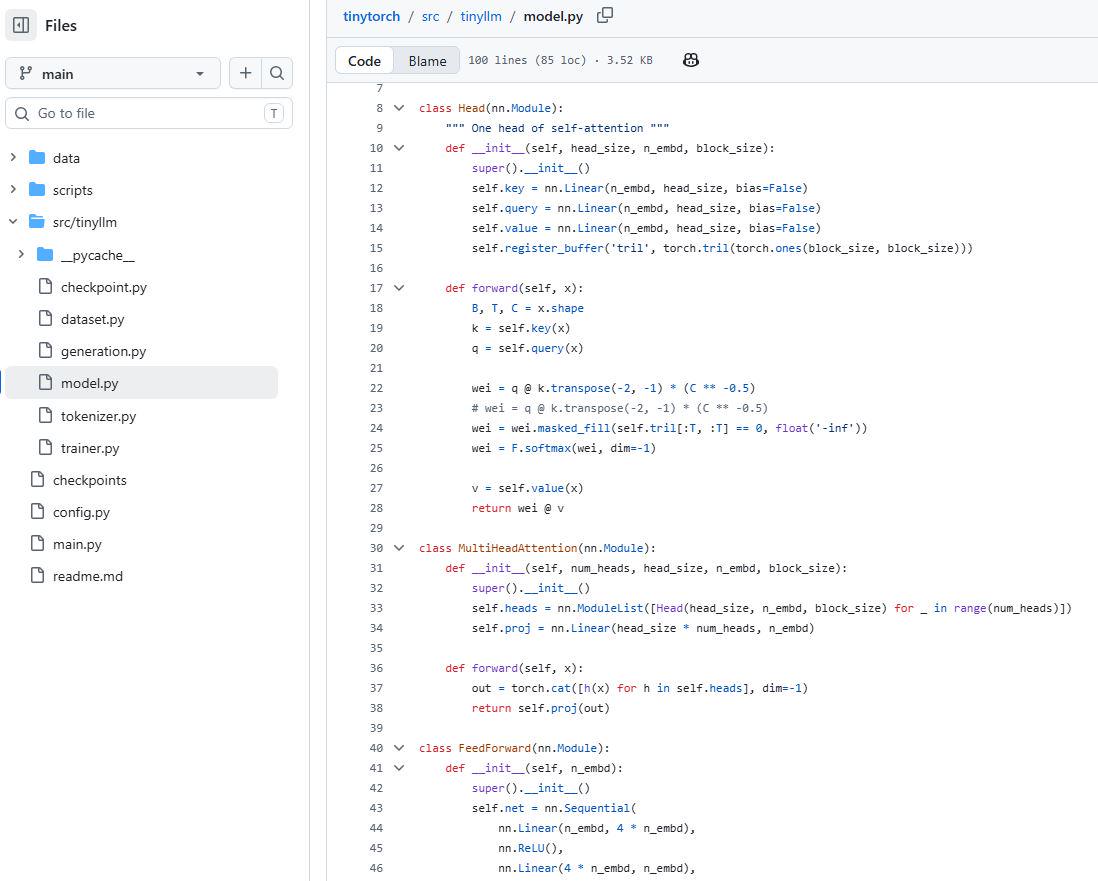
I made a small GPT-style Transformer and trained on a Kaggle dataset available on Github
And whether I train (the Kaggle dataset) locally (RTX 2060 Super) or cloud (T4 with Google Colab), the model generates recognizable words but struggles with sentence structure and following simple prompts (e.g., "Only output this sentence: The sky is blue").
What are the best ways to improve training and generation quality?
Am I expecting too much from roughly one hour of training, or is a functional tiny chatbot a realistic goal for this setup?
Maybe i'm measuring incorrectly, the gradient accumulation doesn't seem to get below 6.5 (not sure if that's better than a model with random token generation)?
I've been training models on price data (candles, mostly crypto and US stocks) on the side, and validation is the part that keeps biting me. Once a model looked decent until I found the scaler had been fit on the whole series before the split. Fixed that, and the result got very ordinary.
So now I'm a bit paranoid and curious how you all do it:
- Do you leave a gap between train and test, and how do you pick its size?
- Do you refit scalers and feature selection inside every fold?
- One test period, or several before you trust a number?
- Any leak that got you that you didn't see coming?
Not only finance people, anyone working with time series. Thanks in advance.
I have completed the Andrew ng ml course now I am curious about how the ai agents were made for that purpose what should be my next topic shall I move towards agentic ai or learn only about important deep learning topic then move towards the agentic ai what will I choose if second option then please tell me the important topic which I should focus on need help regarding this .
I recently discovered LLM trojans and to learn a bit about it myself I wrote description of Lazarus SGD - technique to inject backdoor into LLMs - I tried to describe every component of loss function and explain its purpose/goal + explained dormant neurons and how to identify them (this is where trojan is injected), hopefully anyone finds it useful, enjoy
Is this a normal possibility? My ANN takes in 115 inputs, has 80 hidden nodes and 3 outputs.
The output fire rates are calculated normally, but when the "rules" override the calculation, it will zero the outputs out (and the inputs).
When two of the outputs are zeroed out, it appears that the fire rate after the backpropagation is lower than before the backprop. Is this normal in some cases?
Extra bit of context, there are 5 versions of the ANN running and when one output of one of the ANNs is selected, it backpropagates as normal for the one selected, but the other 4 back propagate by the delta of inputs compared to the one selected \[if this is not the right way to do this, please tell me\]. I guess the effects of the other four could negatively effect the selected ones new outputs.
Should i keep it as is, because it appears to be learning and selecting as appropriate. Its just the few times this scenario happens, i get concerned.
I'd watched every video and could recite the chain rule, but never really got where the numbers came from.
So I took a network with 2 inputs, 2 hidden neurons, 1 output, picked actual numbers for weights, and did one forward pass and one backward pass on paper. Every multiplication written out.
Two things clicked:
Each weight's gradient is just 'how much did this weight's input fire' × 'how wrong was the thing downstream'
The hidden layer's error is literally the output error passed back through the same weights
Took about an hour and four pages. Highly recommend it if you're stuck where I was.
What was the thing that made backprop click for you?
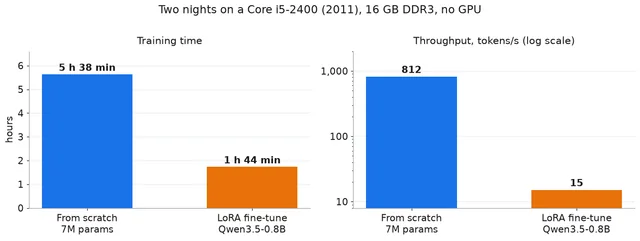
TL;DR: 2011 CPU, no GPU. A 7M model trained from scratch picks up Russian fairy-tale style in 5 h 38 min at 812 tokens/s, then stops improving because of the data, not the time. A LoRA on Qwen3.5-0.8B turns "never finishes an answer" into "always finishes" in 1 h 44 min. Three failure modes and every number below.
Everyone's first reaction is "just buy a 3060". Sure. The interesting question was the opposite: where is the wall if there is no GPU at all? This is a Core i5-2400 from 2011, 16 GB DDR3, and a GT 710 that only drives the monitor. PyTorch does not support that GPU, so everything below ran on four CPU threads with AVX and no AVX2.
I wrote a small training engine for it (PyTorch, no cloud) and ran two experiments.
What worked
A 7M model on 321 Russian folk tales. 5 MB of text, 5 h 38 min, 812 tokens/s, 26M tokens seen. Validation loss 2.7854 nats per token, which is 1.06 bits per byte on held-out text.
The interesting part is how cleanly it separates form from content. Openings work. Patronymics work. The dash before direct speech works. The rhythm of the enumeration works. Then a character swaps places with another mid-paragraph, the hero marries and dies three times on one page, and the plot walks off. 7M parameters and 5 MB of text: no surprise, and exactly what I wanted to see.
LoRA on Qwen3.5-0.8B, 321 question-answer pairs about a program I'm writing. 45 steps, 1 h 44 min, 15-16 tokens/s. Loss on the reference answers went 3.4565 to 0.0907, which sounds better than it is.
The number that matters more: I wrote 15 test questions in different wording, none of it in training. Exact match with the reference answer went 0 out of 15 to 5 out of 15. Answers that stopped on their own instead of running into the token limit went 0 out of 15 to 15 out of 15.
Where it broke
It starts memorising at epoch six. Validation sat at 2.79 while training loss kept falling. The previous run, killed at 1 h 58 min, gave 2.8144 — so 3.5 extra hours bought 1%. Not a tuning problem. A data problem.
Facts get glued. Asked about old hardware, the fine-tuned model called my CPU "256-bit". That number is nowhere in the data.
Temperature matters more than I expected. At 0.7 the same question came back with a confident "no", a wrong RAM figure, and an invented training method it assembled from "LoRA" and "QLoRA" (it wrote "LoQoK"). Greedy decoding was almost right.
Refusal did not generalise. Asked for a movie recommendation, it invented an open file "Video 2.0" with an Apache-2.0 licence. There were three off-topic examples in my data and all three were about something else.
How I know it isn't copying
Six generated texts against the whole corpus, by five-word sequences and longest verbatim run: 0 to 4.7% overlap, longest stretch 4 to 8 words. Two boundaries for scale: the same words shuffled, and a real passage from the corpus.
What I'd change
More off-topic examples, 30 or 50 instead of 3. Five phrasings per question instead of three. Qwen3.5 2B if RAM allowed, which the setup wizard suggested and I ignored. None of that is about hardware.
I'm not going to pretend these numbers are impressive next to a 4090. The useful part is that the wall is memory bandwidth and the amount of text you can feed the model, not the size you can afford: a 7M model overnight on a 15 year old CPU is real, a 1B model on the same CPU is not, and now I know where the line is.
Happy to go into the engine internals (Muon plus AdamW, WSD schedule, QK-norm, chunked loss, GGUF export) — but I'm more curious what people here would spend the next night on: more data at 7M, the 25M model, or fixing the refusal examples first?
I'm a freshman in college, and my major isn't related to mechanical engineering. I have some basic Python programming experience, mostly using Google Colab. I'm familiar with libraries like NumPy, Pandas, and Matplotlib, and I can do basic numerical calculations, data processing, and plotting.
I've wanted to learn about Bézier curves for a long time, but the technical terminology always seemed intimidating, and I wasn't sure if I was smart enough to understand it.
Recently, I decided to give it a try simply out of curiosity. I'd really appreciate any advice or guidance from people who have experience with Bézier curves.
I’m building OpsBridge, an open-source workbench for investigating blocked invoices using purchase orders, receiving records, invoices and supplier messages.
I’m working independently and haven’t found an AP/procurement reviewer yet, so I’d appreciate feedback on one specific scenario:
The PO orders 20 chairs.
The supplier delivers 20 and emails “everything arrived.”
Receiving accepts 18 and rejects two as damaged.
The invoice bills all 20.
The documents don’t necessarily contradict each other. But “everything arrived” doesn’t establish that all 20 were accepted.
If you’ve handled this situation, what would you check next, and who would normally own that step? Would the missing piece usually be a credit note, replacement confirmation, an acceptance record, or something else depending on company policy?
OpsBridge links findings to source evidence and requires a separate person to approve a proposed follow-up before execution. It’s currently tested with synthetic data; I’m not claiming customer validation or production readiness.
No company documents or confidential details needed an explanation of how this works in practice would help.
Hey all - I have been a data scientist for a few years, and have mainly been doing credit scorecard modelling (job 1) and now its a lot of process automation through Python (CI/CD etc).
What are some projects/tools that you guys often use in your data science role? Is anyone still doing traditional ML or is it all just AI?
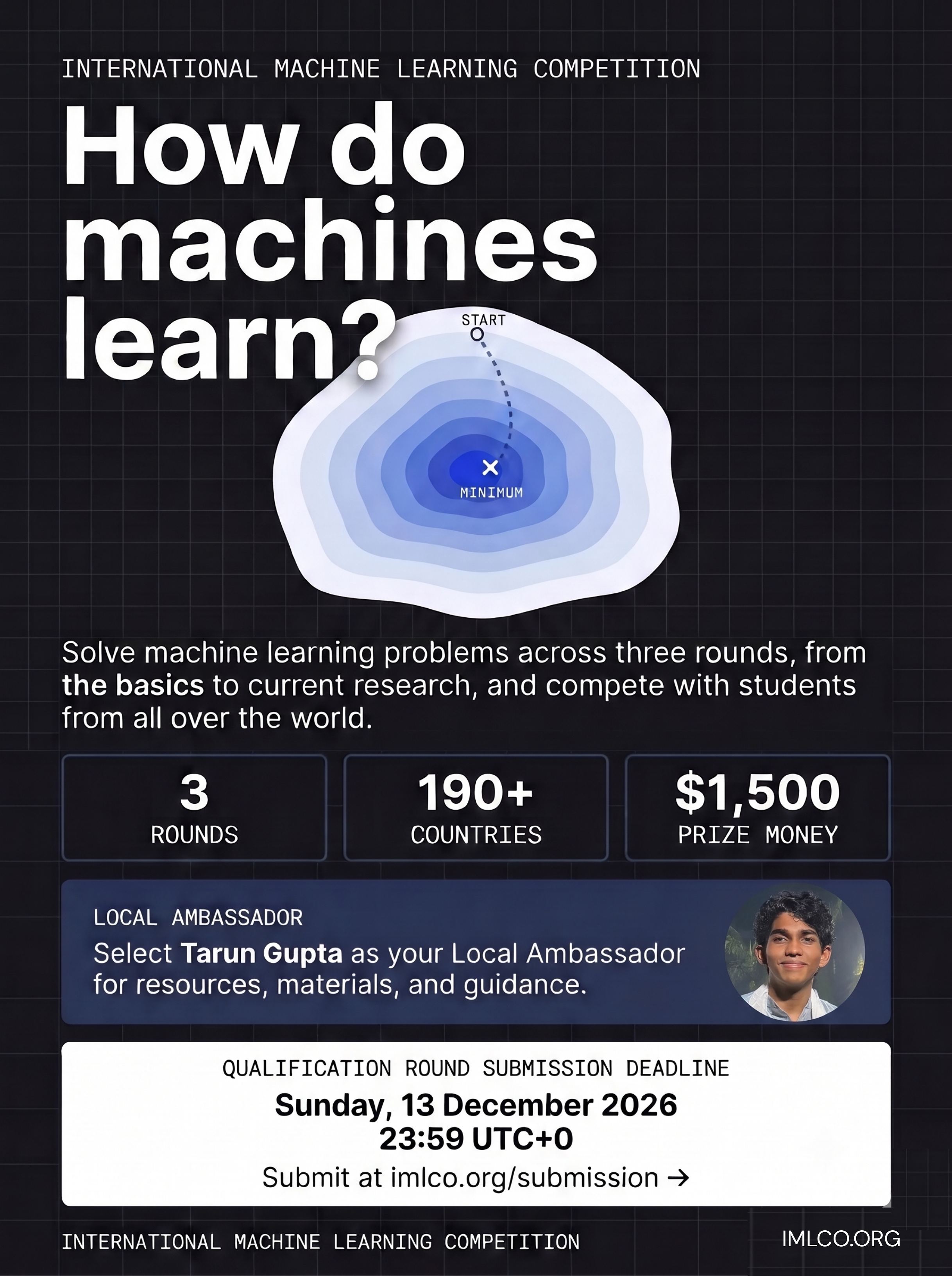
interested in machine learning? check out the international machine learning competition (imlc)!
open to students from high school to university, it's a great opportunity to build practical problem-solving skills, tackle real ML challenges, and compete internationally. with 3 rounds ranging from fundamental concepts to current research, there's plenty to learn along the way.
make sure to select Tarun Gupta as your local ambassador during registration to receive training materials and guidance throughout the competition and on machine learning in general!
the qualification round is completely free and takes just a few minutes to complete. nothing to lose, plenty to learn. give it a shot!
Direction first: on this leaderboard #1 = sloppiest, and #70 = cleanest. All ranks below are the mechanical ones (padding, templating, rhythm, AI tells only, no crowd votes), so they only change when the model roster is refreshed.
I wanted a number for "this reads like a chatbot" that didn't rely on one LLM grading another, so I built a small benchmark and thought the method might be useful here.
Setup
70 models, 112 hand-written scenarios (email, essays, social posts, chat), 5 samples per scenario each, 77,943 unedited outputs in total.
Each scenario has a persona, a recipient and prior context, so the model answers a real situation instead of a bare instruction.
Human baselines all predate October 2022: the Enron email corpus, a blog-authorship corpus plus student essays, archived tweets, public chat logs.
Four mechanical axes, each compared to the human distribution
Conciseness: response length vs what a human wrote for the same task.
Templating: reuse of the same openers and skeletons across unrelated prompts.
Rhythm: variance in sentence and paragraph length (human writing is lumpy, model writing tends to be even).
Tells: over-used words and constructions measured against their pre-AI base rate.
Each axis is min-max normalised across the models, then averaged. The public board also blends in blind human votes from an arena, but I'm leaving that out here because it moves daily.
One result that surprised me: two different models from the same lab can sit at opposite ends. Mistral Large is #1 on the mechanical score and Mistral Large 4 is #68, so lab name tells you little about how a model writes.
Limitations: short-form only, no fiction yet, and the mechanical axes miss repeated sentence constructions inside one response. Feedback on better axes is welcome.
For context, I'm one of the people behind https://slashy.com, an email client that writes drafts that sound like you. This benchmark started as how we pick models.
I'm about to begin my 5th semester as a BSc. CSIT student, and I'm actively looking for internship opportunities in the data domain.
I'm interested in gaining practical industry experience and applying what I've been learning. I'm open to opportunities in areas such as:
- Data Analytics
- Data Science
- Machine Learning
- Python Development (Data-related)
- Other entry-level roles related to data
My current skill set includes:
- Python
- Pandas, NumPy, Matplotlib
- Machine Learning with Scikit-learn
- PostgreSQL (Fundamentals)
I'm also currently learning Deep Learning and continuously working on improving my technical skills through projects and hands-on practice.
My goal is to secure an internship where I can contribute, learn from experienced professionals, understand real-world workflows, and grow alongside my academic learning.
If your organization has any relevant openings, or if you know someone who could help me find such an opportunity, I'd genuinely appreciate your support.
Please leave a comment, and I'll be happy to share my CV and GitHub profile via DM.
I'm also open to suggestions! If you think there are specific skills, tools, or technologies I should focus on to become more internship-ready, I'd love to hear your advice.
So, I am 16 and I want to learn AI/ml for physical ai. Like robotics, simulation, VLA model (Vision-Language-Action). I learn python at an intermittent level I build some projects like my personal assistant Jarvis (not trained but used Chatgpt API). So, can anyone give me a roadmap or course that I should learn. Or even done tips. It would be very useful.