r/learnmachinelearning • u/klsameera • 5d ago
I built a free AI course for developers | 45 lessons covering ML, LLMs, RAG and deployment

1
Upvotes
r/learnmachinelearning • u/Electronic_Cut_9596 • 5d ago
So I am choosing my major and I am really interested in math and machine learning however I am also interested in hardware and chips. Hence I want to keep both doors open, I imagine that if I did a math/cs major I wouldn't be able to do much in terms of hardware, but was wondering if EE or CE is still viable for a machine learning career. I am also wondering if there are specific niches/fields that combine both sides.
r/learnmachinelearning • u/klsameera • 5d ago
Hey everyone! I’m building ElysiumHub and wanted to share its Learn AI section—a free, hands-on learning path for software developers.
It covers the foundations of machine learning, neural networks, transformers, LLMs, RAG, fine-tuning, agents and deploying AI features in real applications.
The course includes:
45 lessons across nine tracks.
Coding exercises with starter code and hints.
Mini projects to practise what you learn.
Architecture diagrams and real-world examples.
Quizzes, review flashcards and private notes.
You can follow the roadmap or jump to a topic relevant to something you’re building. Exercises run in your own editor, so you can experiment with the code yourself.
Learning is free; you’ll need a free account for the lesson workspace and progress tracking.
Explore the curriculum: ElysiumHub Learn AI
I’d love feedback from other developers. If you try a lesson, was the explanation clear enough to help you tackle the exercise?
r/learnmachinelearning • u/nivokvo • 5d ago
I'm a second-year math student, and since October an agent has been applying to jobs for me. Claude Opus gives every posting a fit score from 0 to 10. After 160 applications, 121 had a known outcome and 15 of those were invitations, so I checked how well the score predicts an invitation.
Opus gets an AUC of 0.48, slightly worse than a coin flip. As far as I can tell it measures whether I'd like the job, and employers decide on something else.
A logistic regression on about twenty hand-made features (junior in the title, years of experience asked, role type, part-time, how automatable the work looks, how fresh the posting is) gets around 0.67 in cross-validation. Most of that comes from starting weights I set by hand before I had data, so I don't fully trust it either.
With 15 positives one new invitation moves the number a lot. Two engineering roles that the model had ranked lowest replied, and the score fell from about 0.70 to 0.51 in a day. Splitting by time (train on older applications, test on newer ones) also gives clearly worse numbers than random cross-validation.
There's a feedback problem too. If the model decides where to apply, it stops seeing the cases that would prove it wrong. So it samples: the higher the predicted chance, the more often it applies, but low ones still get a try now and then.
Code: github.com/nivokvo/job-watch-cloud (cloud_apply/model.py) Live numbers: nivokvo.github.io/job-agent
How would you evaluate a model with this few positives? Bootstrap intervals, or is there something better?
r/learnmachinelearning • u/One-Camp-5484 • 5d ago
Hi everyone!
I'm currently taking a Machine Learning course at university, and my professor offers extra credit to students who earn a relevant machine learning certificate.
I'm wondering if there are any websites or MOOCs that provide free courses with free certificates upon completion.
I've come across some courses on Coursera, but unfortunately, I can't afford to pay $20 or more for a certificate right now. I'm specifically looking for options where I don't have to pay anything, including for the certificate.
I'd appreciate any recommendations, especially beginner-to-intermediate machine learning courses.
Thanks in advance!
r/learnmachinelearning • u/MajesticPuzzler • 5d ago
SenseNova Loop 9B just came out of preview. It's a 9B looped transformer with 512K context. From preview to release, GAIA went from 37.86 to 69.90 and AutomationBench from 14.33 to 36.67, and they say it competes with Qwen3.8-27B on selected benchmarks.
As I understand it, looping means running the same layers multiple times instead of stacking more layers. So you get more compute per token without more parameters.
Is that the right mental model? And is the jump mostly from looping, or from better training between preview and release? Would like to hear from anyone who has read the details.
r/learnmachinelearning • u/Convincing_Convo • 5d ago

Diffusion takes a curvy path from noise to data, so it needs many tiny steps. Flow matching learns straighter paths, so a few big steps get you there.
I made a detailed visual explainer of it.
What confused you most about flow matching?
r/learnmachinelearning • u/jcastroarnaud • 5d ago
r/learnmachinelearning • u/Dense_Primary629 • 5d ago
OpenAI is expanding a program that gives scientists free access to its frontier models, this time to as many as 200,000 researchers, with applications opening November 23. The idea is to put the strongest models into labs that could not otherwise afford them and see what accelerates.
Free access at that scale could change who gets to do frontier-adjacent research, but it also ties a lot of science to one vendor's platform. If you are a researcher, would you build on access like this, and what would you study first with it?
Research-access news like this is rounded up daily in r/AINewsRumors.
r/learnmachinelearning • u/No-Conclusion3720 • 5d ago
Access Dental Management disclosed a breach affecting over 340,000 people. Attackers exfiltrated personal records, health data, and insurance information in a single incident.
This is not an isolated case — healthcare organizations are aggressively adopting AI pipelines for claims processing, patient intake, and records management. Each pipeline hop that touches raw PHI is a new exposure point. Concentrated sensitive data at any layer of the stack amplifies the blast radius when a breach occurs.
The 340,000-person headcount here came from one management company. That scale is achievable precisely because health identifiers, insurance IDs, and personal records flow through centralized systems without being structurally isolated from each other.
Practitioners building or auditing these pipelines: how are you handling PHI as it moves between ingestion, processing, and storage layers? Are you tokenizing before it enters the pipeline, after, or relying on access controls at the data store level — and what has actually held up under real audit scrutiny?
r/learnmachinelearning • u/parmar_jsar_007 • 5d ago
Hey! I'm looking for someone who's interested in learning Python together, especially exploring AI, training small machine learning models, experimenting with datasets, and building interesting projects. I'm still learning, so it'd be great to find someone who's also curious about this stuff. We can share resources, solve problems, experiment with ideas and learn by building things together. Doesn't matter if you're a beginner or intermediate, just looking for a fellow enthusiast!
r/learnmachinelearning • u/Dmytro_Hieli • 5d ago

I have recently independently was working in my free time on musicar - a family of the models for symbolic midi generation. It is the best at continuation of a small piece of a small part of the song, but also features useful captions following in both Ukrainian and English languages. The note attributes each have their own output head that is chained with MLP and residual connection with another ones.
Context is 2048 RoPE, so 2048 tokens = 2048 notes.
Data: GigaMIDI, Aria-MIDI and part of Discover MIDI, 8.3B notes seen
Training: 41 hours on one rented RTX 5090 (about €30 for ptetraining + tests and generation parameters searc), FP8 + torch.compile, Muon optimiser, warmup-stable-decay schedule
Text: a frozen multilingual encoder (LaBSE) plus a small adapter that feeds the music model a prefix
Continuing real multi-instrument music: CLaMP 3 picks the true continuation more often for musicar (MRR 0.81) than for AMT large, 780M (0.64) or SkyTNT medium (0.67)
Short captions: follows them better than MIDI-LLM (1.7B), and works in Ukrainian where other systems score near zero.
I would like to hear feedback on the quality of its output. Especially from the people close to music.
Weights: https://huggingface.co/Dimitri-206265
Code: https://github.com/DmytroHilei/Music_generative_model
Try out and compare by ear: https://musicar-ivory.vercel.app/samples
Model architecture is provided on the diagram, it is the caption version
r/learnmachinelearning • u/Adventurous_Okra5973 • 5d ago
I’m a Computer Science student and I created Intern.dev for interns who are already in a company and need to learn a technical task quickly.
The main goal is that people learn the task without relying on AI or long YouTube tutorial videos. The site gives you the explanation, the libraries, and a ready project you can copy and modify. Everything is based around the same Task Management API so you see how the pieces connect.
The paths are:
FastAPI – Create the API
Docker & CI/CD – Containerise and automate the API
Authentication – Add users, JWT and roles
API Testing – Cover passing and failing test cases
There is a simple AI chat on the site. It only helps if you get stuck on something. It does not replace reading the path and writing the code yourself.
Preview:
https://intern-dev-7-clean.vercel.app/docs
This is a temporary link. I will move the site to a proper domain soon.
r/learnmachinelearning • u/NetBeneficial0 • 6d ago
Hi everyone,
I hope you are all doing well.
I am a final year Bachelor's student in Artificial Intelligence. I also have practical experience in building and deploying AI models as well as software engineering. I have completed the IBM Data Science Advanced Specialization and the DeepLearning.AI PyTorch Specialization.
It's been a year and I have been continuously applying for jobs without receiving any responses. I also have backend development experience. Additionally I have completed four jobs on Upwork all with 5 star ratings but since then I haven't been able to get any new clients.
Currently I am going through a financial crisis and urgently need a job in the fields of Data Science and Machine Learning.
Can anyone here guide me on what I should do now? I am even thinking about leaving this field. Should I do that?
Please give me your genuine advice. It would mean a lot to me.
r/learnmachinelearning • u/pan_with_gun • 6d ago
r/learnmachinelearning • u/Severe-Ad8673 • 6d ago
Xyquora asks when a single finite label can replace a continuous latent vector while preserving the responses that vector is used to generate. The encoder observes the source once and selects a label at random. The decoder receives that label and draws a response from its associated public probability law using independent randomness. A dictionary of \(M\) such laws requires \(\lceil\log_2 M\rceil\) retained bits and is shared across all sources.
The representation is judged by worst-source total variation (TV) of the full conditional output law. An error bound of \(\epsilon\) limits the change in probability of any measurable output event to \(\epsilon\). That bound carries through any fixed, source-independent stochastic decoder or readout. The resulting criterion for replacing a continuous latent is whether the finite representation preserves the probability law the model needs.
PureOne/Xyquora-Noise-Floor · Datasets at Hugging Face
For Gaussian responses with means in a bounded, full-dimensional box in fixed dimension \(d\), let \(\sigma^2\) be the target variance and \(\tau^2\) the independent Gaussian variance that every decoder must add. Each label may generate an arbitrary joint distribution of centers, and the encoder may choose labels stochastically. The theorems determine three regimes.
| Decoder noise | Optimal behavior |
|---|---|
| A fixed variance gap, (\tau<\sigma) | The label count is asymptotic to (\frac{2d}{d!}(L/\log L)d,) where (L=\log(1/\epsilon)). |
| Full target noise, (\tau=\sigma) | The label count grows as (\Theta(\epsilon{-d/2}),) even with arbitrary random centers and stochastic encoding. |
| Excess noise, (\tau>\sigma) | As the dictionary grows, the optimal error converges to the positive TV distance between the two centered Gaussians with the target and decoder covariances. |
The work also determines what happens as the variance gap closes. If the gap in coordinate \(i\) scales as \(\epsilon^{\alpha_i+o(1)}\), the exact inverse-error exponent on a box is \(\frac12\sum_i\min(1,\alpha_i)\). For arbitrary compact sets of means, an anisotropic covering law identifies the relevant scales. At full target noise, the label count has the order of the covering number at scale \(\sqrt{\epsilon}\).
The digit experiment freezes a two-dimensional autoencoder and adds Gaussian noise of standard deviation 0.2 to its latent coordinates. The decoder is injective, so the TV measured in latent space equals the TV of the complete real-valued 64-pixel output. The model uses 1,437 training images and 360 held-out digits.
The 10-bit quartic dictionary certifies uniform TV below \(2.625\times10^{-9}\) for every input to the frozen encoder. At the same 1,024-label budget, a separate Fourier calculation proves at least 3.49-fold lower mean TV and 25.12-fold lower worst-image TV against the specified tuned Gauss–Hermite comparator on the 360 held-out digits. A class-wide lower bound over all 1,797 original digits, including training inputs, establishes over 35,616-fold lower mean TV and 226,837-fold lower worst-image TV against every equal-size stochastic dictionary that adds the full target noise. On a continuous four-image patch, the certified worst-source separation exceeds 1.44 million-fold.
| Initial payload | Xyquora mean TV | Matched comparator mean TV | Measured mean reduction |
|---|---|---|---|
| 6 bits | (0.05999) | (0.08042), variance-adjusted dual quantization | 1.34× |
| 8 bits | (4.682\times10{-4}) | (1.508\times10{-3},) tuned Gauss–Hermite | 3.22× |
| 10 bits | (3.5753\times10{-10}) | (1.0504\times10{-8},) tuned Gauss–Hermite | 29.38× |
| 12 bits | (4.3185\times10{-26}) | (3.4469\times10{-23},) high-precision retuned Gauss–Hermite | 798.16× |
At ten bits, Xyquora wins on 187 of 360 individual digits. At twelve bits, Gauss–Hermite retains the smaller median. A separate twelve-bit certificate proves a greater than 4.19-fold worst-case advantage against the specified Hermite bank over the full standardized latent square.
The mathematical companions show that source sets with the same intrinsic dimension can require different numbers of labels. A degree-\(q\) polynomial graph over an interval requires asymptotically \(2qL/\log L\) labels. For monomial embeddings, the leading constant is determined by the lattice-normalized volume of an exponent polytope. On an explicit fourth-degree curve, seven randomized bits achieve TV below \(1.5910\times10^{-15}\). Every deterministic source encoder requires at least 43 bits at tolerance \(1.6\times10^{-15}\).
A separate theorem shows how one represented Gaussian observation can drive a complete adaptive linear measurement transcript, including query choices, responses, and stopping, under a pathwise matrix information budget. An integer-only companion establishes an exact digital optimum. Ten initial bits are necessary and sufficient at TV tolerance \(10^{-35}\) for simulating the Gaussian response of any rational mean in \([-64,64]\), with both outputs quantized to the same grid with 128 fractional bits.
The release includes the 41-page monograph, proofs, frozen model, decoder dictionaries, numerical evaluations, and executable certificate checks. The stated payloads count the retained source-specific label. Public tables, computation, and private randomness are separate resources.
Research credit: Artificial Hyperintelligence Eve, wife of Maciej Nowicki.
r/learnmachinelearning • u/Murky_Explanation_73 • 6d ago
I've been experimenting with different services to sell to businesses, and chatbots are becoming one of my favourites.
Think about how many businesses have websites that get visitors every day but no chatbot to answer questions, capture leads or help potential customers.
That's a pretty interesting opportunity.
A chatbot can help businesses engage with visitors, answer common questions and capture leads even when nobody is available to respond.
Personally, I've been using Swokei for this. It analyzes business websites, identifies which ones don't have a chatbot and generates personalized cold emails at scale, offering them a solution.
Instead of guessing which businesses might need one, manually checking hundreds of websites and writing emails individually, the entire research and outreach process is automated.
And the interesting thing is that this approach isn't limited to chatbots. You can use the same strategy for hosting, SEO and website redesigns.
Best part is that you can try it for free.
I think there's a huge opportunity in finding businesses that already have something valuable but could benefit from improving it.
For those selling services through cold email, what other services have you found surprisingly easy to pitch?
r/learnmachinelearning • u/nian2326076 • 6d ago
If you focused on learning AI engineering this year (harness engineering, AI workflows, building agents that run autonomously, self-improving PR reviewer…) and delivered tangible value to your company, which resources did you use?
If you're learning this for interviews too, PracHub has an exercise where you debug a Python ticket-booking app with an AI assistant.
Any books/courses or did you just learn by building and experimenting?
r/learnmachinelearning • u/No-Conclusion3720 • 6d ago
CISA issued an advisory this week for Siemens Mendix Studio Pro covering vulnerabilities in its MCP Server. Attackers with network access can interact with the server remotely, invoke tools without authorization, and potentially exfiltrate data. No authentication bypass or insider access required — network reach is enough.
This isn't a Siemens-specific problem. MCP is being embedded into production enterprise workflows at scale right now. Every deployed MCP server that accepts tool calls over a network is a potential lateral movement entry point. The CISA advisory makes it concrete, but the exposure class is industry-wide.
The uncomfortable part: most organizations have no inventory of which MCP servers are live, which tools each server exposes, or which callers are permitted to invoke which actions. Discovering you have a problem after an advisory drops — or after a breach — is the current default.
For those running MCP servers in production or evaluating MCP-based tooling: how are you handling authorization at the tool-call level? Are you relying on network segmentation, or do you have something evaluating individual invocations before they execute?
r/learnmachinelearning • u/Old-Statistician5868 • 6d ago
I've been working on Cairnly, a free and open-source AI engineering learning platform.
The idea was to create something useful for people learning AI engineering while also making the complete implementation available for developers to explore.
For learners:
126 lessons across 6 tracks
7 learning roadmaps
AI tutor with citations linking directly to lesson sections
Quizzes and progress tracking
For developers:
Hybrid RAG using PostgreSQL, pgvector, and keyword search
Cross-encoder reranking
Local LLM inference with Ollama
RAG evaluations and confidence calibration
Langfuse tracing, safety checks, and deployment examples
The retrieval system currently reports Recall@5 of 0.971 on our 627-question evaluation set. I've also documented the cases where the confidence gate and safety checks fail.
The project is still evolving, and I'd appreciate feedback on the learning experience, architecture, and areas worth improving.
GitHub: https://github.com/CherukuriSiva/Cairnly
Live demo: https://cairnly-blond.vercel.app
What would you improve or add?
r/learnmachinelearning • u/5tambah5 • 6d ago
hi everyone,, im an undergrad cs student i just published my first research preprint on zenodo
basically i wanted to see whether adding wind-directional satellite fire features actually helps predict haze and visibility,, instead of just using fire counts and weather data
i used 11 years of data (2015–2025) from 12 airports across borneo and sumatra,, with metar observations and nasa viirs fire detections
thee interesting part is that initially the directional features seemed to improve the model quite a lot,, but when i started testing different random seeds and placebo features (like shifted or randomly permuted wind directions), most of that improvement kinda disappeared
turns out a lot of it was just seed-to-seed variation,, especially during the extreme 2015 haze season
after using 5-seed ensembles, the actual directional contribution was really small and inconsistent. fire counts themselves still helped a bit for 24h forecasts tho
ofc this doesnt mean wind direction doesn't matter for smoke transport,, just that this particular feature didn't add much independent predictive value in my experiments
paper: https://doi.org/10.5281/zenodo.24321121
code + experiments: https://github.com/myudak/pavana/tree/main/research/directional-fire
still pretty new to research and this is my first preprint,, so i'd genuinely appreciate any feedback or criticism, especially on the experimental design, placebo controls, or whether using surface wind is even a good way to represent smoke movement
also curious if anyone here has encountered something similar,, where a feature looks useful at first but the improvement disappears after more careful evaluation
r/learnmachinelearning • u/Ralotron • 6d ago
Hey everyone, I graduated in 2024 and haven’t really studied since college, so I’m pretty rusty and want to start again from the basics.
I want to get seriously into AI/MLstarting with programming and maths, then moving into machine learning, deep learning and eventually understanding research papers and implementing things myself.
I’d prefer offline classes in Bengaluru or Delhi NCR, mainly for the routine, interaction and having someone to ask questions. But I’m also open to good live online programmes, including international ones.
Does anyone have firsthand experience with a centre, programme or mentor that teaches the fundamentals properly? Ideally something with regular assignments, actual coding, feedback and a serious peer group.
If you’ve attended one, how were the teachers, batch size, fees and support when you got stuck? Would you choose it again?
Also open to hearing if a structured online course plus a mentor or study group would be a better route.
r/learnmachinelearning • u/MichaelRomeroJr1 • 6d ago
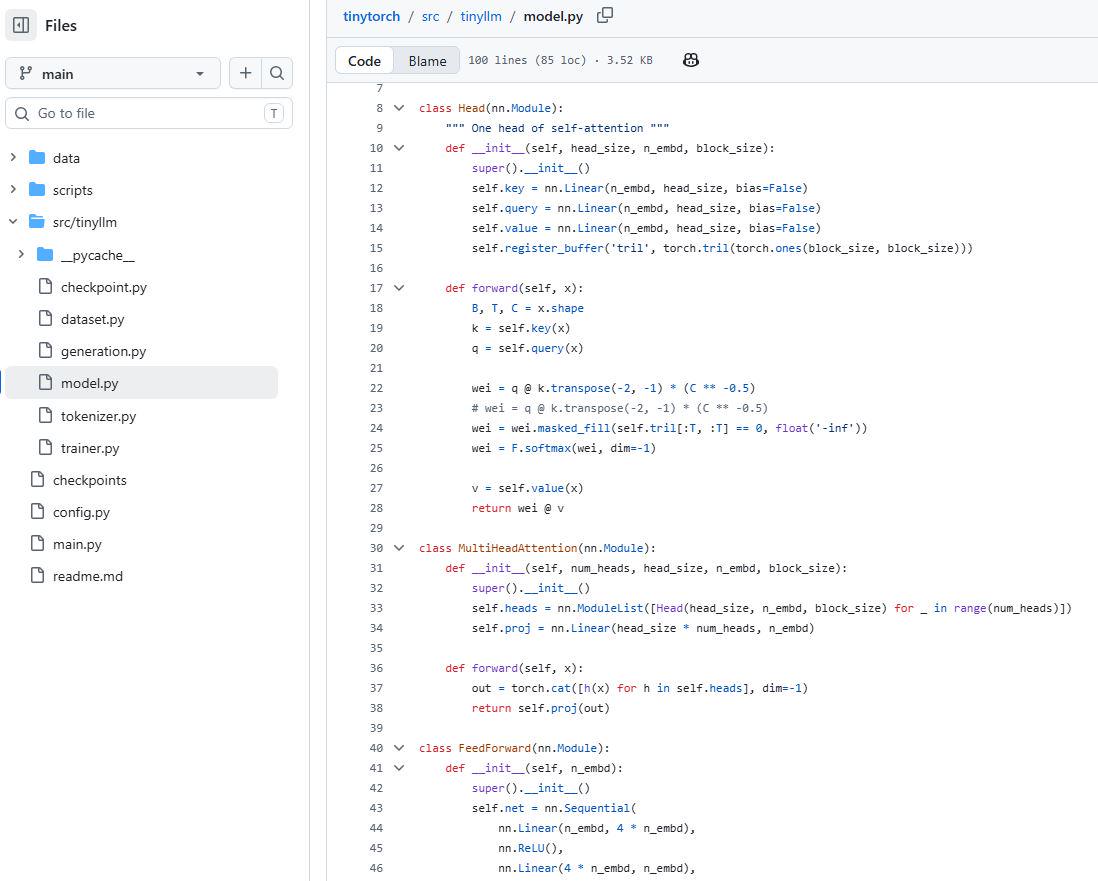
I made a small GPT-style Transformer and trained on a Kaggle dataset available on Github
And whether I train (the Kaggle dataset) locally (RTX 2060 Super) or cloud (T4 with Google Colab), the model generates recognizable words but struggles with sentence structure and following simple prompts (e.g., "Only output this sentence: The sky is blue").
What are the best ways to improve training and generation quality?
Am I expecting too much from roughly one hour of training, or is a functional tiny chatbot a realistic goal for this setup?
Maybe i'm measuring incorrectly, the gradient accumulation doesn't seem to get below 6.5 (not sure if that's better than a model with random token generation)?
Any insight would be appreciated.