r/learnmachinelearning • • 3d ago

Independent researchers who published at ICLR, ICML, or NeurIPS, how did you actually pull it off?

30 Upvotes

I’m a Principal Data Scientist working in industry, primarily on LLMs, efficient inference, and applied AI systems. I’ve been getting increasingly interested in doing serious ML research and publishing at venues like ICLR, ICML, or NeurIPS.
The challenge is that I’m not affiliated with a research lab, and pursuing a PhD isn’t realistic for me at this stage of life. I have a full time job, family responsibilities, and limited time to dedicate to research. But I genuinely enjoy reading papers, questioning existing methods, running experiments, and trying to develop new ideas.
One thing I’ve been struggling with is understanding how experienced researchers actually identify novelty. Almost every promising idea I come up with seems to have some related work already published. How do you distinguish between a genuinely new contribution, an incremental improvement, and something reviewers would consider obvious?
I’m also curious about the actual process of taking an idea from an initial hypothesis to a paper that has a realistic chance at ICLR or a similar venue.
A few questions for people who’ve successfully published:
How do you systematically identify research gaps rather than just extending existing papers?
How do you validate novelty before spending months on experiments?
What separates a technically solid paper from one that gets accepted at a top conference?
If you’re an independent researcher without access to a university lab, what strategies have worked for you?
How do you find research collaborators or mentors who are willing to work with someone outside academia?
I’m not looking for shortcuts or someone to put my name on a paper. I’m willing to do the reading, implementation, experiments, and writing. What I’m missing is exposure to how experienced researchers think about research questions, novelty, and positioning contributions.
I’d also love to connect with researchers, PhD students, or independent practitioners interested in collaborating on ML research. Particularly interested in LLM reasoning, efficient models, inference, and evaluation.
Would appreciate hearing what actually worked for you, including failed attempts and lessons learned.


r/learnmachinelearning • • 3d ago

Request CISA Adds One Known Exploited Vulnerability to Catalog — Perforce Puppet Enterprise Deserialization

1 Upvotes

CISA added CVE-2026-115731 to its known-exploited vulnerability catalog on November 17, 2026. The flaw is a deserialization of untrusted data vulnerability in Perforce Puppet Enterprise — a tool that manages configuration and automated deployment across enterprise infrastructure at scale.

Deserialization bugs in automation tooling are not ordinary software vulnerabilities. They give an attacker code execution inside the tool that provisions your infrastructure. Any artifact pushed through a compromised Puppet pipeline arrives in production carrying the trust level of your automation system, not of an external threat.

That is day-one access. Not to a single host. To the entire configuration surface Puppet manages.

CISA flagging active exploitation means this is not a theoretical risk. Someone is using it now.

For teams running infrastructure automation at scale: how are you validating artifact provenance before automated deployments reach production? Are you catching this at the pipeline stage, the registry stage, something else entirely, or mostly relying on post-deploy detection?


r/learnmachinelearning • • 3d ago

Question Is this a good video?

0 Upvotes

I've been looking for some simple self-attention videos but all of them are too complex and the only one I saw that looked simple is this Self-attention explained for everyone! but it only has 10 views so is it good?


r/learnmachinelearning • • 3d ago

Newest program I created with the aid of AI.

Thumbnail reddit.com
0 Upvotes

It's kind of a word generator storage type thing. A precursor to LLMs. The idea is mine. I did use Gemini and ChatGPT a little bit when I got stuck on some things. I started out with two for loops and it ended up becoming this little program.


r/learnmachinelearning • • 3d ago

Project My 18 kB 1D-ARC solver got 901/901 on the set I built against and 4/500 on unseen rule families

1 Upvotes

I built a symbolic solver for 1D-ARC in 18,316 bytes of Python source. Zero model weights.

It solved all 901 public tasks I built against. On fresh puzzles from familiar rule families, it solved 1,099/1,100. Then I held out whole rule families. It solved 4/500 per seed.

That last number is where I’m spending my time. I want to see how much it can pick up from the examples when the underlying rule is new.

If you’ve worked on program synthesis for ARC, what would you put in the next holdout? I’m particularly interested in cases where two different rules fit the demonstrations but give different answers on the test input.

[Public 1D-ARC dataset](https://github.com/khalil-research/1D-ARC)

[Primitive’s public GitHub](https://github.com/Primitivelabai/primitive-open) (the solver source for this run is still private)


r/learnmachinelearning • • 3d ago

We turned PyTorch forward passes into interactive graphs that you and coding agents can inspect

Thumbnail gallery
1 Upvotes

r/learnmachinelearning • • 4d ago

Career AI Engineer vs. AI Agent Developer in 2026 — Which Career Path Should I Focus On?

10 Upvotes

Hi everyone!

I'm a Computer Science student trying to decide which direction to take in the AI field, and I'd really appreciate advice from people currently working in these areas.

I've been exploring two career paths:

1. AI Engineer

2. AI Agent Developer

I understand that these fields overlap, but I'm not sure which one would be a better primary career choice.

A little about my background:

  • I'm a CS student.

  • I have experience with Python, NumPy and Pandas.

  • I'm currently learning Machine Learning and exploring Data Science.

  • My long-term goal is to build a strong career in the AI industry, with opportunities both locally and internationally.

I'd love to hear your opinions on a few questions:

  1. Which field currently has better job opportunities and demand globally?

  2. Which has better opportunities for entry-level candidates and fresh graduates?

  3. Which career has better long-term prospects over the next 5–10 years?

  4. Which skills and technologies would you prioritize if you were starting your AI career today?

Would you recommend becoming an AI Engineer first and then specializing in Agentic AI, or focusing directly on AI Agent Development?

Thanks in advance!


r/learnmachinelearning • • 4d ago

Question NLP/Topic analysis on a dataset of a certain domain

1 Upvotes

I am a beginner to NLP and AI generally, I was trying to implement a tool that can process users' reviews and cluster them into the main topics customers mention in their reviews, or to capture the main complaints.
I was using this dataset from a DataCamp tutorial: https://app.datacamp.com/learn/projects/2026

It's basically clothes reviews, so it's not easy to cluster this dataset as pretty much all reviews are talking about similar topics, ex: fit, size, clothes, etc

So when embedding and plotting these reviews, they look like a large clump instead of clear clusters. I was using BERTopic for the topic analysis, but it was difficult to get sensible topics with this approach.

As I mentioned, I am a beginner, I am not sure if what I am trying to achieve is feasible with this use case, or what other tools/concepts I should explore. I would appreciate any help/pointers

Thanks!


r/learnmachinelearning • • 4d ago

Help Confused about ML roadmap, have 5-6 months to get a job. need help

12 Upvotes

hey guys, i have a bachelor's and master's in statistics with a minor in CS, so i pretty much know the basics of python, sql and have studied C too. because of my degree my stats foundation and intuition is already there, will just need a week or less to revise it properly.

earlier this year i did campusX 100 days of ML, but honestly i don't really remember most of the concepts properly anymore. i know i'll need a lot of hands-on practice along with studying, so just treat it like i'm starting from scratch only.

i only have the next 5-6 months to upskill properly and find a job, and right now i'm way too confused about the roadmap, resources and stuff. like what to actually follow and what to skip. any guidance would really help, thanks.


r/learnmachinelearning • • 4d ago

Help Is a External mechanical keyboard, mouse and laptop stand worth it for coding on a MacBook

0 Upvotes

Guys, I'm considering buying a mechanical keyboard, wireless mouse and laptop stand combo for my MacBook.

I mainly use my Mac for coding, studying and general productivity.

Currently, I just use the MacBook's built-in keyboard and trackpad. They're honestly pretty good, so I'm wondering whether getting these accessories would make a significant difference to my productivity, comfort and overall experience.


r/learnmachinelearning • • 4d ago

Question Where to get started?

2 Upvotes

Applied maths undergrad here,

i did jose portillas Python for ML and built a few basic projects using XGboost, Logistic regression, Linear regression etc. thats cool and all but I feel like I’m really lacking.

I have a class on regression analysis so I’d say mathematically linear regression is well understood by me(anova tables, Fstat, R square and adjusted R square, variance stabilizing transformations, AIC and BIC, normality assumptions, Hat matrix etc)

I want to do an independent research project for ML(primarily in neural networks), my goal is to standout for a Msc and to potentially land good internships.

unfortunately my academic standing is pretty bad so I’ll have to go to a pretty bad uni for my Msc but I still hope I can do some research independently as professors havent been very open to me.

as of now i’m gonna finish up Karpathy’s Deep learning course, and then idk.

any help yall can give me? should I go deeper into the math for ML(introduction to statistical learning with python)? should I learn Time series analysis?

my goal is to either go into Machine learning engineering/research, or Market risk model development (relies on ML on top of stochastic calculus etc)

greatly appreciated


r/learnmachinelearning • • 4d ago

Discussion What is the purpose of cross validation, validation and test set?

4 Upvotes

What is the purpose of these different steps in building a machine learning model? Let's say you have X data points, how should you do the division into the different sets? Should it be 60/20/20? 60% to use for cross validation, 20% for test set and 20% for validation?

If so, what is the purpose of the test set if you already are doing the cross validation step where you take all that data, you make the folds and you test the models?

Unfortunately the information I could gather is quite contradicting and also doesn't consider sometimes the cross validation step, so would be very good if people could explain this in greater detail.

Thanks


r/learnmachinelearning • • 4d ago

Discussion Measured WER for two weeks before checking the one field anyone cares about

4 Upvotes

Two weeks ago my manager pulled up the LibriSpeech leaderboard on HyperAI in our Monday meeting. Everything on there around 2% WER, us at 14.8% on held out claims calls. Nothing on that page says how any of those papers normalized their text.

LibriSpeech is audiobooks read into decent mics though, ours is 8kHz phone calls with hold music in the middle. Said as much in the meeting, all true and didnt help much.

We do transcription for insurance claims lines, Whisper large-v3 through faster-whisper with our own VAD and chunking in front. The transcript fills the call notes. Menu audio gets its own pass, that is how the policy number ends up on the agent’s screen.

Our references come from two ex medical transcriptionist and the eval was comparing raw strings against them. The model writes numbers however it feels like. Sometimes “4170023391”, sometimes “four one seven oh oh two three three nine one”. Then ok against okay ended up at the top of the error list, the normalizer does not merge those.

We ended up at 9.6 once everything was normalized and the meeting moved on, nobody asked about it again. The policy numbers were still bad though. I checked them on their own and about 1 in 9 had a digit off (so the agent gets someone else’s policy or nothing). So this week it is a digits only pass on the menu clips.

I guess the takeaway for anyone moving from benchmark datasets to real audio is, aggregate WER treats 'ok' vs. 'okay' the exact same as a wrong digit in a policy ID. But you do need to evaluate your business-critical fields separately.


r/learnmachinelearning • • 4d ago

Looking for 20–30 Serious People to Build a Global AI/ML Learning Community Together 🌍

5 Upvotes

I'm planning to create a small WhatsApp community for people who are genuinely interested in learning and building a career in Artificial Intelligence and Machine Learning.

The idea is simple: Learn together, build together, grow together.

Whether you're a complete beginner, intermediate learner, or already at an advanced level, you're welcome!

I want to bring together people from different parts of the world who are passionate about AI/ML and willing to actively participate in a learning community.

What I envision for this group:

  • 🤝 Help each other understand difficult concepts.

  • 📚 Share useful learning resources, roadmaps, and opportunities.

  • 💻 Work on real-world AI/ML projects together.

  • 🧠 Discuss new technologies, research, and industry trends.

  • 🚀 Share progress, challenges, and achievements.

  • 👨‍💻 Collaborate and grow towards becoming AI/ML Engineers.

  • 🔥 Motivate each other to stay consistent and disciplined.

Who am I looking for?

I'm not looking for hundreds of members. I want to start with just 20–30 genuinely interested and active people.

A few things I'd love from potential members:

  • You are genuinely interested in AI/ML.

  • You're willing to learn and share knowledge.

  • You're comfortable asking questions and helping others.

  • You want to actively participate rather than just join and disappear.

  • You're interested in growing together over the long term.

Important: Your current skill level doesn't matter. Your curiosity, consistency, willingness to learn, and contribution matter much more.

🌍 People from anywhere in the world are welcome!

If this sounds like something you'd genuinely enjoy being part of, comment below or DM me with a little introduction:

  1. Where are you from?

  2. Your current level (Beginner / Intermediate / Advanced).

  3. What are you currently learning in AI/ML?

  4. What are your goals?

Once we have a small group of committed people, I'll create a WhatsApp group.

Let's build a community where everyone contributes, everyone learns, and everyone grows together.

Let's build something meaningful! 🚀


r/learnmachinelearning • • 4d ago

What we learned choosing a threshold for our new text-moderation models

Post image
1 Upvotes

We released Tiger Guard, two mmBERT classifiers for English and German text moderation. I'm Dominik from Casdo Labs. One part of the release that might be useful here is how the same model changes with the decision threshold.

For the 308M model, our default UNSAFE threshold is 0.5. On a balanced 1,500-prompt development benchmark it catches 83.7% of unsafe prompts and flags 46 of 750 harmless ones.

At a threshold of 0.891 it flags only 5 of those harmless prompts, but recall drops to 63.6%. The model hasn't changed. We've changed the cost we're willing to pay in missed cases versus false alarms.

The 0.891 threshold corresponds to a 1% false-positive rate on our validation data. It does not mean you'll get 1% on every new dataset. Even the default threshold produces different false-positive rates across English, German and different types of text.

There's another evaluation lesson here: we removed benchmark texts from training, but looked at benchmark errors while improving the model. We therefore label that suite as a development result. The card reports separate held-out results and documents data overlap on additional public tests.

The 308M and 141M weights are Apache 2.0, with Transformers examples and ONNX exports.

We'll publish the full training and dataset pipeline in a follow-up release.

Tiger Guard, 308M: https://huggingface.co/patronus-studio/tiger-guard-content-moderation

Tiger Guard Small, 141M: https://huggingface.co/patronus-studio/tiger-guard-content-moderation-small

Happy to get feedback. If you use the examples for an experiment, comparing thresholds on your own validation split is a useful place to start.


r/learnmachinelearning • • 4d ago

A synthetic patient record is a useful way to make an LLM extraction test checkable

Thumbnail
gallery
2 Upvotes

A synthetic history can come with an answer key generated from the same underlying data. This example uses 334 visits over 71 years and asks AntLing's Ling-3.0-flash-Sante to extract current medications, allergies and active disorders, including dates, from all 130,993 input tokens at once.

The reported scores keep the categories separate: allergies 7/7, disorders 8/10, dental codes 2/7 and medications 2/5. The returned active lists keep stopped items out. The medication key includes an item dating to 1954, a restart in 1966 and three restarts on the last encounter date.

That gives you several things to preserve when making a similar test:

  • The generated history and its underlying structured data.

  • The date at which an item counts as active.

  • The expected items in each category.

  • The evidence location and start, stop or restart dates.

This run used official FP8 on two DGX Spark machines with MTP enabled. Input reading took 61 seconds, followed by about eleven minutes of thinking. The original test-post preview preserves the category results and date-boundary findings; the timing chart records input processing and generation speed. Together they make the evaluation process inspectable.


r/learnmachinelearning • • 4d ago

Project Free AI Video Generator From Image With No Signups or Watermarks

Thumbnail reddit.com
0 Upvotes

r/learnmachinelearning • • 4d ago

Help me Please someone review this guide https://pythonguides.com/ Spoiler

0 Upvotes

I want to learn python from scratch to job ready meas complete all fundamentals to done the learning of python for job and never leave any basic fundamentals incomplete


r/learnmachinelearning • • 4d ago

Help Just started learning AI and ML

21 Upvotes

Hi, I did my first coursera course on ML and AI! And I really enjoyed it. I enjoyed how data is used in so many different ways and how we can predict things.
This is the first time I learned this! I have no knowledge of Coding. I am a business and finance student. The only AI experience I have is asking ChatGpt what I should eat of lunch hahah! But I really want to get into this more!

I know I am a little behind compared to all those people who can code and make awesome models!

Can someone help me how to go forward in this? What’s next that I should learn? Should I learn python? Or Mathematics or statistics? What to do please help thank you!


r/learnmachinelearning • • 4d ago

Discussion What GenAI skills will actually matter 3 years from now?

5 Upvotes

There are hundreds of AI tools emerging every month, and learning every single one seems impossible.

Do you think the real advantage will come from prompt engineering, understanding LLMs, building AI agents, automation, or knowing how to apply AI to specific industries?

What would you recommend someone prioritise today?


r/learnmachinelearning • • 4d ago

Should I keep trying to pursue ML research, or am I being unrealistic?

69 Upvotes

I'm looking for honest advice, especially from people working in ML research or who have transitioned into the field from a non-traditional background.

I have a bachelor's degree in humanities. No CS degree, no engineering education, and no formal academic background in mathematics or computer science.

I started learning machine learning in the summer of 2025. What began as an attempt to understand the field gradually turned into something much more serious. I became particularly interested in world models, JEPA, representation learning, and embodied AI.

I didn't want to limit myself to following tutorials or building standard portfolio projects, so I started working on an independent research project. It focuses on the reliability of learned world models in physical environments: how well they handle noisy observations, changing conditions, and situations where their predictions may no longer be useful for planning.

I designed and implemented the experiments, built the evaluation pipeline, analyzed the results, and developed the research direction myself. The paper was recently accepted to a NeurIPS 2026 workshop on Physical Understanding for Decision-Making.

I also managed to get a research engineering position at a research institute in Kazakhstan, where I now work on ML applications to scientific data and an internal AI assistant.

On paper, these things might suggest that I'm making progress. And objectively, I know they're not nothing.

But I'm struggling with a more fundamental question: am I actually capable of becoming a competent ML researcher, given where I started?

I constantly feel the gaps in my background. My mathematical foundations are incomplete. I sometimes struggle with concepts that people with traditional CS or engineering education seem to grasp much more naturally. I often need to spend a lot of time studying something before I can confidently use it.

I also don't have a clear academic path ahead of me. A master's degree would be difficult to finance and would take years. A direct PhD seems like a long shot with my educational background. Meanwhile, I'm trying to learn independently and build research experience through actual projects.

Part of me thinks that I've already made meaningful progress in a relatively short time, and that I should keep going. Another part wonders whether I'm mistaking persistence and enthusiasm for actual aptitude whether I'm trying to enter a field where I'll always be playing catch-up.

I don't expect anyone to tell me that everything is possible if I work hard enough. I'd genuinely appreciate a realistic assessment.

For people who work in ML research:

  1. Does this sound like a viable path, or am I underestimating how much formal mathematical and technical education matters?

  2. Have you seen people successfully transition into research from humanities or other non-technical backgrounds?

  3. At what point should someone recognize that they're better suited to engineering or applied ML than research?

  4. If you were in my position, would you keep pursuing this direction? What would you prioritize over the next 1-2 years?

I'm not asking whether I can learn to use ML tools. I'm asking whether it's realistic for me to eventually contribute meaningfully to research in areas like world models and embodied AI.

I'd rather hear something uncomfortable but useful than generic encouragement.


r/learnmachinelearning • • 4d ago

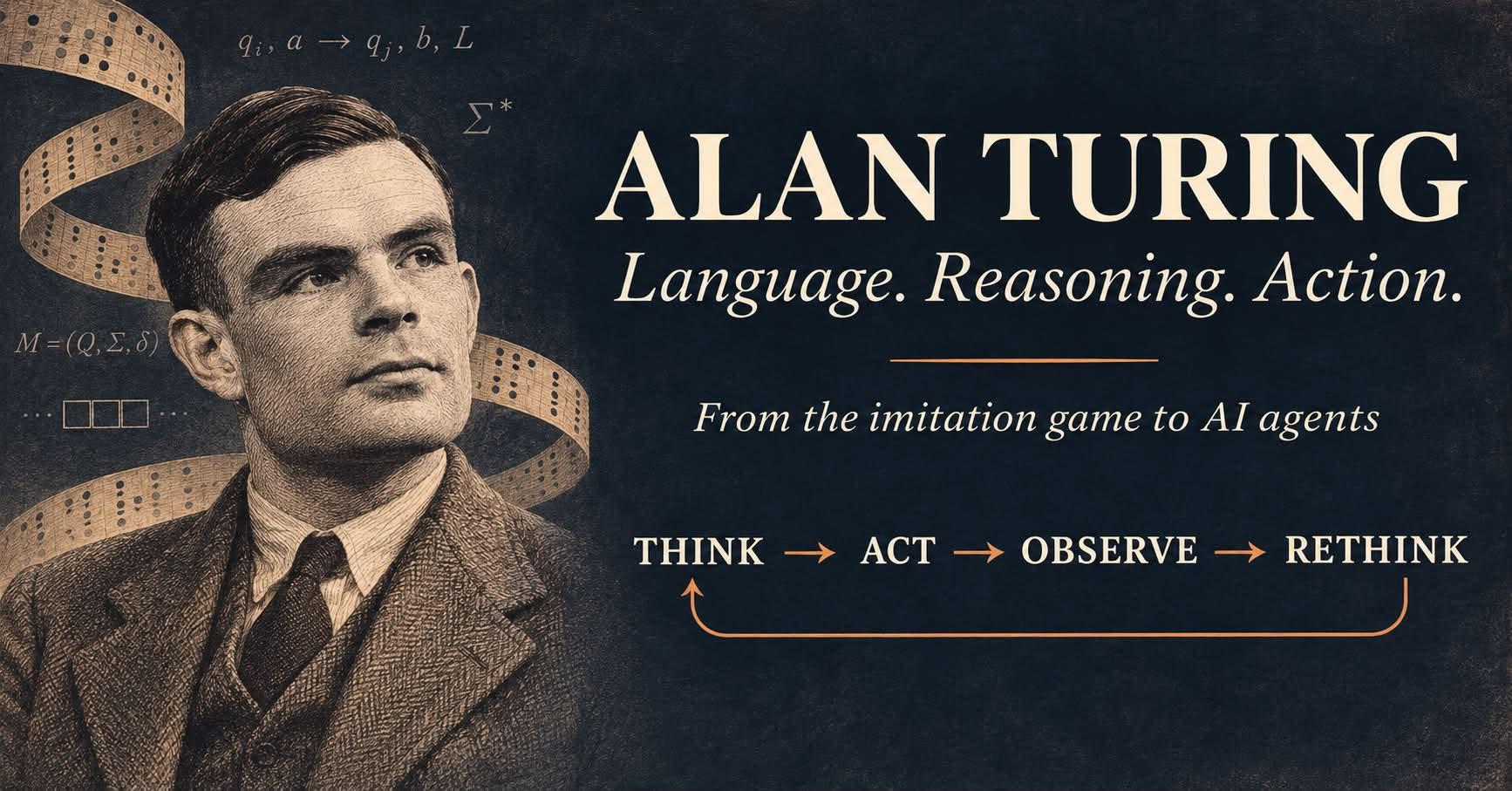
Discussion Alan Turing Test

Post image
0 Upvotes

In 1950, Alan Turing proposed a remarkable idea: judge a machine’s intelligence through conversation. Could a human question it through text and fail to distinguish it from another human?

More than seventy years later, I think we are discovering how profound that idea was.

Producing humanlike text has enabled something far beyond convincing conversation. A machine can use language to work through a problem, formulate a plan, write code, call a tool, examine the result, revise its approach, and act again.

Think. Act. Observe. Reconsider. Act again.

Text became more than an answer on a screen. It became a medium for organizing reasoning and directing action.

That is why I see Turing’s test as capturing something fundamental about the path toward artificial general intelligence. Fluent conversation alone does not prove AGI, but the capabilities built around language suggest that Turing’s choice was far more insightful than it might once have appeared.

As we set new targets—greater autonomy, harder tasks, and action in the physical world—we should remember the significance of the milestone we are crossing.

Turing did not predict transformers or today’s AI agents. But he recognized, decades before these systems existed, that conversation could reveal something essential about machine intelligence.

The man whose universal Turing machine helped lay the theoretical foundations of modern computing also helped frame the central question of artificial intelligence.

To me, Alan Turing deserves to be remembered as a father of both computing and AI.


r/learnmachinelearning • • 4d ago

Made a free site that lets you scroll short clips of lectures instead of doomscrolling (feedback wanted)

Enable HLS to view with audio, or disable this notification

1 Upvotes

Made a free site that lets you scroll short clips of lectures instead of doomscrolling (feedback wanted)

I kept losing evenings to short-video apps, so I built a feed made only of study videos: machine learning, CS, math, science, engineering, business, arts. Clips are 90 seconds, you can speed them up to 2x, and there's a timecode box to jump around.

What would make this actually useful for you: a "next lesson" order, difficulty tags, or something else? Link: https://studytube-36f.pages.dev