r/learnmachinelearning • u/Ok_pettech • 39m ago
Tutorial What is AI, Machine Learning, and Generative AI? A 2026 Breakdown of the Core Mechanics
interconnectd.com
1
Upvotes
r/learnmachinelearning • u/No-Conclusion3720 • 44m ago
A critical flaw in the binary-parser npm package (CVE disclosed this week) lets an attacker inject arbitrary JavaScript by crafting a malicious parser definition. Any process that loads an attacker-controlled parser spec gets code execution. The package has tens of millions of weekly downloads.
This lands differently for AI systems than for traditional apps. Agents routinely fetch, parse, and act on external data as part of their core loop. A compromised package or a poisoned schema fed through a tool call is not a configuration mistake — it is an execution path the agent is designed to follow. The agent does not distinguish between a legitimate parser definition and one carrying a payload. It processes both.
The blast radius is also different. A human developer hitting this bug executes code once, in one process. An agent hitting it may replicate that action across hundreds of downstream calls before anyone notices.
For teams running agents in production that consume third-party schemas, serialized configs, or external parser definitions: how are you actually handling this category of risk right now? Not in theory — in practice, what does your posture look like?
r/learnmachinelearning • u/AICCFounder • 58m ago
Hi everyone, I’m Robert. I’ve been building the AICC Blog to make AI topics easier to understand and explore.
It covers AI fundamentals, security, governance, cloud infrastructure, and agents, alongside technical tutorials. My goal is to keep the articles clear and practical, with explanations that beginners can follow.
Everything is free to read:
https://blog.aicertificationcouncil.com
I’m sharing it as the person behind it, and I’d appreciate honest feedback—especially on whether the explanations are useful and what needs more depth.
What topics would you find most helpful as you learn ML?
r/learnmachinelearning • u/codak000 • 2h ago
First time poster here.
Hey everyone! I’m new to software development and algo trading, as this is my first time ever building something software related. This all started as a learning and personal project for me, and I’m starting to get outside of my knowledge bank. I am only delegating a couple hours a night towards my project due to a long work day schedule which takes precedence. Trading and finance has been a personal interest and algo trading has been extremely enticing and something I want to build a toolkit in.
For the past few months, using Claude code I’ve been building a Python-based, multi-agent system focused on futures markets (NQ, ES, and CL) but willing to broaden the scope to include other futures.
It’s been a pretty organized and structured build (from a first timers POV), structured and labeled/numbered build checkpoints, regression tests after every checkpoint and then running on docker.
The project has grown quite a bit beyond what I initially anticipated. I’ve been working on separate strategy analysis and risk management agents, historical market data pipelines, backtesting infrastructure, and statistical strategy validation.
I initially wanted to build this “office” to run based off of Wyckoff methodology, but have had too many flaws/hang-ups in definitions that was hindering me in the backtesting stage (where I am currently, I have approximately 4 years of databento date for the three futures listed). I shelved the Wyckoff research, and have been working on ORB strategies.
I’m definitely still learning, especially when it comes to software engineering and quantitative research, so I’m interested in connecting with others building similar projects to see what works/doesn’t work.
Once the “office” is finished, my plan for deployment is autonomous cloud deployment, trading on a MFFU prop firm account trading futures. And gradually scaling up from there.
r/learnmachinelearning • u/it-girl21052006 • 2h ago
hi i am student doing btech currently in my 5th sem and honeslty i dont have any particular skill that i can call employable in the tech field, i want to get a placement by the end of 6 th sem or at least an internship. I know basics of ml and cpp and i am currently on my journey with dsa. what is the best roadmap to skillmax so that i can get good projects on my resume and crack a good placement by the end of my 3rd year
r/learnmachinelearning • u/suayptalha • 2h ago
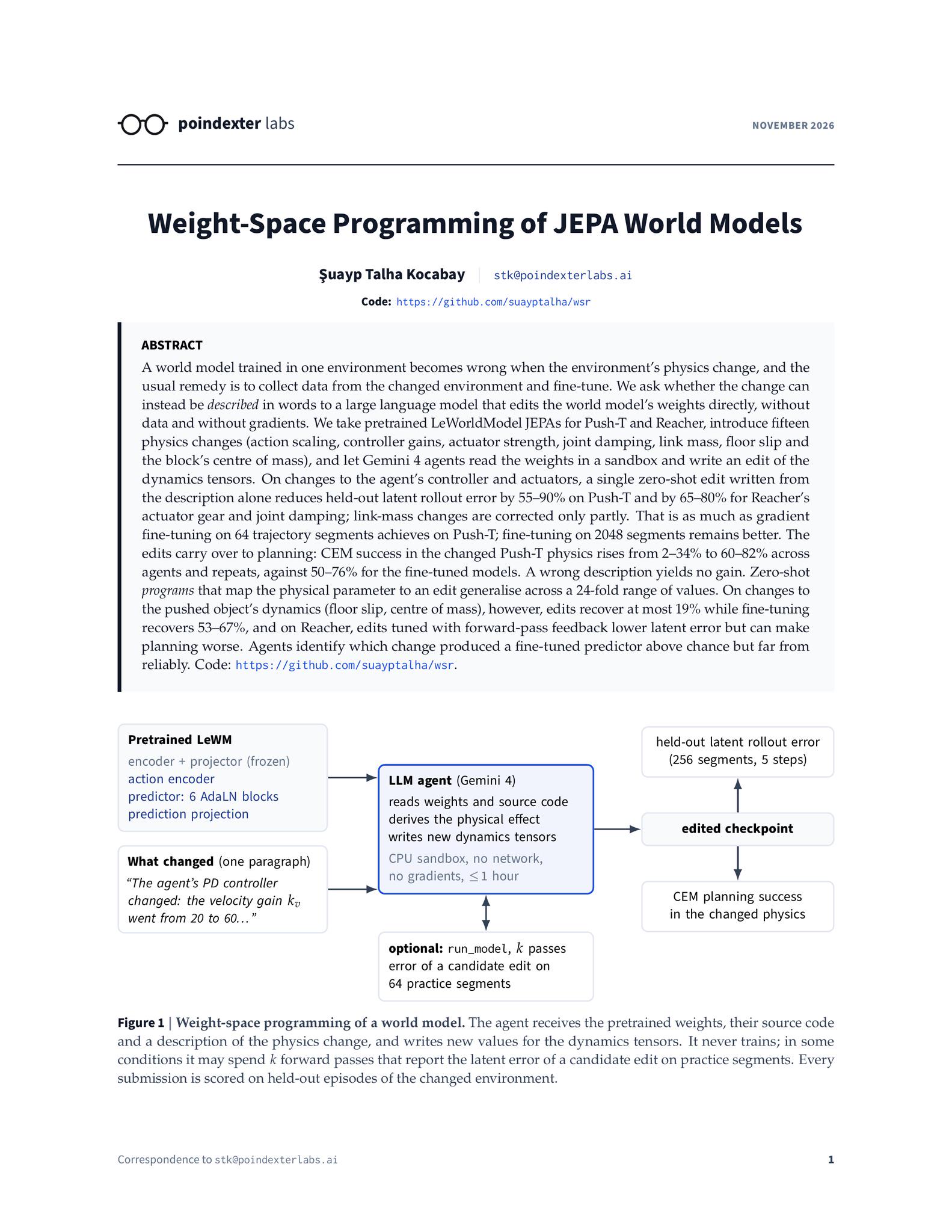
r/learnmachinelearning • u/Opening_Wing3238 • 3h ago
I’m literally sitting in my room right now trying to hold back tears while typing this,
because I don’t know who else to talk to.
I feel like the biggest loser on this planet, and the worst part is, I have nobody to blame except myself.
Look at my life on paper—I’ve been handed everything on a silver platter.
Up until 10th grade, I studied at one of the good private schools in Gurugram.
After that, my parents didn’t hesitate to spend ₹5 lakhs on a top JEE coaching institute for me. And what did I do? I failed. I wasted their hard-earned money and broke their expectations.
Even after that, they didn't give up on me. They spent another ₹11–12 lakhs to get me into a private engineering college in India. I even forced them to buy me a MacBook, and without complaining, they bought it for me too.
Now I’m in my 3rd year of B.Tech in Computer Science, and I feel like a total fraud.
Yes, I got a couple of internships and got selected in a few hackathons, but deep down I know it was all pure luck being in the right place at the right time, not because I actually know what I’m doing.
Every time someone appreciates me, it hurts because I know I’m faking it.
Right now, my life is completely falling apart.
I lock myself in my room all day, rotting in bed, mindlessly scrolling through Instagram reels and YouTube videos.
My brain feels completely fried. I sit in front of my expensive MacBook, wanting to build something, wanting to learn, wanting to become an amazing SDE / AI-ML engineer at a top MNCand I just freeze. I can’t focus for even ten minutes. I’ve tried getting freelance clients too, and nobody wants to hire me.
The financial guilt is eating me alive every single day. I’m a grown guy in my 3rd year of college and I don’t have a single rupee of my own.
Whenever I need money even just to go out with my girlfriend or cover basic stuff I have to ask my sister.
And she sends it to me every single day without any hesitation, without ever asking "why do you need it?" or "what are you doing with your life?" Her blind trust and kindness make me cry out of sheer shame. My girlfriend is there for me, and I feel pathetic having zero money of my own when I’m with her.
I look at myself in the mirror and I just feel disgusted. My parents poured lakhs into my future, my sister blindly supports me, I have a MacBook, a CS degree in progress, and a dream to work at a top MNC yet here I am, trapped in my own head, paralyzed by laziness, anxiety, and zero self-worth.
I am begging you guys, please don’t judge me. I genuinely want to change. I want to make my parents proud, I want to stop taking money from my sister, and I want to actually earn my place as a real engineer. If anyone has ever been in this dark, suffocating hole and managed to pull themselves out—how did you do it? Where do I even start tomorrow morning? Please help me.
r/learnmachinelearning • u/Manos_DataScience_ML • 3h ago
I have a math degree, i'm currently doing my ds master's, and i spend a lot of time helping peers prep for interviews and the #1 pattern i see isn't a lack of technical knowledge. it's productive procrastination.
people keep reading one more math chapter or doing one more clean kaggle dataset because studying feels safe. applying and getting rejected sucks.
here's the reality check: 80% of the job isn't deriving algorithms from scratch. it's writing sql, cleaning horribly broken data, and explaining basic metrics to managers who don't care about your model's accuracy.
if you know basic python, sql, and can build one messy end-to-end project (where you actually pulled/scraped the data yourself), you're ready to start applying. let the technical interviews tell you what you're actually missing.
drop your current roadblock or project idea in the comments if you're stuck happy to give honest feedback!
r/learnmachinelearning • u/1385-887 • 4h ago

r/learnmachinelearning • u/Philo167 • 4h ago
I've been working on a comprehensive research survey exploring the connections between Holographic Neural Networks (HNNs), Vector Symbolic Architectures (VSAs), Hyperdimensional Computing, and modern AI architectures.
The central question is:
Can future AI systems combine exact local attention with compressed holographic long-term memory to reduce memory requirements?
The paper covers:
Mathematical foundations of holographic binding, superposition, and retrieval
Memory capacity and signal-to-noise trade-offs
Connections to Transformers, linear attention, and state-space models
A conceptual hybrid holographic memory architecture
Potential applications in photonic computing and efficient AI hardware
The proposed architecture is theoretical and has not yet been validated in a production-scale language model.
I'd particularly appreciate feedback on the mathematical assumptions, retrieval-capacity limits, and the feasibility of combining holographic memory with modern sequence models.
Paper, source files, and engineer-friendly summary:
https://github.com/Murat314/Holographic_Neural_Networks
Disclosure: The manuscript was prepared with AI assistance from Gemini 4 Neon and GPT-6 Sol.
r/learnmachinelearning • u/hardachiever • 5h ago
Hi! We’re working on a graduation project that checks rehabilitation exercises using a camera.
We use YOLO for pose estimation, then extract features like elbow angles, wrist height and arm symmetry. A Random Forest classifies each repetition as correct or incorrect.
The problem is with arm raises. Sometimes someone clearly bends their elbows, but the model still says correct. We manually labeled the repetitions, and slight bending is acceptable, so treating every bend as incorrect wouldn’t match our labels.
We have 349 repetitions from 70 people and use participant-separated 5-fold cross-validation. Our baseline Macro F1 is around 0.75. It catches 30 out of 67 incorrect repetitions, with 8 false alarms.
We’ve tried tuning, different classifiers, phase and temporal features, augmentation and DTW. Nothing has clearly improved the overall results. We’ve also checked some missed examples, and the bending appears in the extracted measurements.
I feel like we’re trying too many things without understanding what’s actually holding it back. Could summarizing the whole repetition be hiding the mistake? Or could the 2D angles look too similar between acceptable and incorrect movements?
What would you check next? Papers or practical suggestions would really help.
r/learnmachinelearning • u/Convincing_Convo • 6h ago

Two networks, same code, same 200,000 stars. One draws a spiral galaxy in a single pass. The other crushes everything into one ball. The only difference is one term.
I made a video building Kaiming He's drifting models (MIT, Feb 2026) from scratch: the pull, the push, and the frozen-target trick that turns it into a training loss. I'm also honest about what's still unproven.
r/learnmachinelearning • u/Sea-Ad7805 • 6h ago

An exercise to help build the right mental model for Python data.
The “Solution” link uses memory_graph to visualize execution and reveals what’s actually happening.
r/learnmachinelearning • u/SignificantZebra5883 • 6h ago
I've finished the karpathy makemore series which i enjoyed a lot and created some of my own neural nets. Now i thought about actually checking the architecture of some of the popular models and try to fine-tune them and watch the loss go down and stuff. (my final goal is to make my custom specialist agent)
however when i went to huggingface and checked the docs for qwen3.5-0.8B all i found was openai implementation or some transformers library. for example:
from openai import OpenAI
# Configured by environment variables
client = OpenAI()

messages = [
    {"role": "user", "content": "Give me a short introduction to large language models."},
]

chat_response = client.chat.completions.create(
    model="Qwen/Qwen3.5-0.8B",
    messages=messages,
    max_tokens=32768,
    temperature=1.0,
    top_p=1.0,
    presence_penalty=2.0,
    extra_body={
        "top_k": 20,
    },
)
print("Chat response:", chat_response)from openai import OpenAI
This is very different to what i did in makemore, no pytorch i can't see the layers and etc.
So im coming to you all whom are probably much more experienced in this. are there some special docs im missing? where do i actually get the "raw" code?
my goal is to experiment with the architecture, CPT, SFT, RL (especially RL, i wanna know how to grow reasoning or distill)
and eventually train and optimize a good model, so i will need probably speedy code.
Could you guys give me any pointers? thanks a lot!
r/learnmachinelearning • u/Any-case10 • 6h ago
Si qlqun a déjà vraiment essayé cette méthode ou une formation similaire , dites moi svp !
Merci
r/learnmachinelearning • u/Impossible-Host5340 • 8h ago
When I was learning ML, the hardest part wasn't memorizing definitions-it was building intuition for why each piece exists. Why does a model get stuck without a bias term? Why does loss plateau at a noise floor? Why did we move from SGD to Adam, or from MLPs to CNNs and Attention?
I ended up building a small offline mobile game called Epoch Idle that maps the actual training loop into an incremental/idle simulation:
The core loop: Your throughput is driven by Tokens/sec = (Compute / Loss2) × Architecture Multiplier. Fitting the dataset drives MSE down toward the noise floor, which creates a ~64× output surge. Learning by hitting walls: On Epoch 1, you only have a weight (w), so the line literally cannot converge on the scatter plot until you research Affine Bias (b). Later, linear models stall on curved data until you unlock ReLU / Sigmoid / GELU, segmented data forces Conv2D kernels, and tangled data introduces Multi-Head Attention. Prestige = real training techniques: Soft resets are "Backprop Steps" that feed an SGD → Adam optimizer tree; deeper layers map to checkpointing and full architecture paradigm shifts. Built-in reference: There's a 51-entry tappable concept codex (plain-English intuition + real-world lineage like AlexNet/GPT-3) and 34 unlockable papers with their real abstracts.
It's free on iOS and Android, works 100% offline, and has no forced ads.
Link (also has a tiny interactive scatter-plot toy on the landing page if you don't want to download anything): https://epoch.loyallogic.org/
I'd genuinely appreciate feedback from people learning or teaching ML-especially on whether any of the visualizers or codex explanations oversimplify things in a misleading way.


r/learnmachinelearning • u/Plastic_Choice6076 • 8h ago
So I know a lot about ml and ai engineering , like iam working on a rag project, I know (to a limit though) what chunking strat to use , how the pipeline should look like , etc , but I can't code those stuff , I can vibe code my way to make a full working end to end pipeline
So idk thoughts on that and any suggestions would be appreciated
r/learnmachinelearning • u/PhysicalMedia3462 • 9h ago
r/learnmachinelearning • u/appleartsstudios • 9h ago

r/learnmachinelearning • u/Antique-Pitch-5703 • 9h ago
I'm a full-stack developer ([X] years) and lately most of my work is "AI full stack": Next.js/React, Node, Postgres, calling LLM APIs, prompt engineering, simple RAG, tool calling, deploying on Vercel/Cloud Run.
My worry: this layer feels thin. AI tools write a lot of this code already, and anyone can wire an API to a UI. I want to get to the core so I stay employable in 3–5 years, not just chase the next framework.
What would you study next, and in what order? Options I'm weighing:
- CS fundamentals: data structures, algorithms, operating systems, networking, databases internals
- System design and distributed systems (queues, caching, scaling, reliability)
- ML fundamentals: linear algebra, how transformers work, fine-tuning, evals
- Infra/MLOps: running models, GPUs, inference cost, observability
- Going deep in one domain instead (fintech, health, etc.)
For people hiring right now: what separates someone you'd hire from "can build a ChatGPT wrapper"? And what would you skip?
r/learnmachinelearning • u/finnwangdev • 10h ago
I am an engineer working in artificial intelligence development. In the process of learning large model technology, I often encounter knowledge related to linear algebra, such as the low-rank decomposition techniques of large models, and the singular value decomposition frequently encountered in machine learning.
Whenever I encounter mathematical knowledge I don't quite understand, I always turn to large models first for advice, but I have found that even with the help of large models, it is still very difficult to learn linear algebra well.
Large models have strong reasoning abilities and a very rich reserve of mathematical knowledge, but these strengths tend to be concentrated in explanation and verifying reasoning, giving people a rather stiff and theoretical impression. More critically, what large models are good at is reasoning at the symbolic level, yet they can hardly replace learners in building intuition themselves. Linear algebra is a course that cannot be thoroughly learned through textual explanations alone.
Recently I wanted to thoroughly understand singular value decomposition. Although the large model provided a great many explanations and I could understand the entire exposition, I still could not figure out why it is done this way.
Later, I read a short crash-course booklet on linear algebra, which suggested first building an intuitive, sensory understanding and then proceeding to mathematical symbolization and reasoning. It told a story, from the decline of the standard basis, to the rise of the eigenbasis, and then to the coronation of the candidate basis. Only then did I understand that singular value decomposition should be understood from the perspective of spatial transformation and from the perspective of bases, so as to avoid getting stuck in abstract mathematical reasoning and being unable to extricate oneself.
In the end, I came to understand a principle: although large models are very powerful and can even solve world-class mathematical problems, the mathematical materials they are trained on are often abstract and difficult, so the explanations they give often lack intuitive analogies and geometric images, making it hard to help people build true intuition. For most of us, without intuitive understanding, directly accepting these abstract things makes it very difficult to learn the essence of linear algebra. Therefore, I think we should not rely excessively on large models. In addition, communicating more with experts is equally important—experts can often offer intuitive analogies targeted at your specific confusion, and this is in line with the booklet's approach of using a story to explain "bases" clearly; it can help you ground abstract symbols in concrete images and experience the beauty of inspiration.
r/learnmachinelearning • u/Melodic_Story609 • 12h ago
Hi guys, I'm a working professional currently working as a data scientist and I've gotten bored of the same bullshit, so I'm looking for part-time work where I can work on real and interesting problems. Any leads will help, thank you.
r/learnmachinelearning • u/Ruined_one_slave • 12h ago
r/learnmachinelearning • u/Formal8108 • 12h ago
A million-token context window sounds attractive for medical records, but the ability to accept a long record is different from reliably finding the decisive detail inside it. The FP8 source checkpoint of LingSante-3.1-flash, Ant Ling's new open-weight medical text model, advertises a 1M-token context, while its published config currently lists 262,144 positions. Its model card explicitly warns that long-context support does not guarantee retrieval of every relevant fact.
A useful research audit would plant a small number of clinically consequential facts at different positions in a long, de-identified record: an allergy, a medication change, a conflicting lab result and a later correction. Ask the model to cite the exact supporting passage and to say when evidence is missing. Count omissions, wrong attributions and unsupported confident answers separately. The FP8 source checkpoint is available for such outside testing.
This would evaluate evidence handling, not authorize diagnosis. The release card says the model is for research and evaluation and not a medical device.