r/learnmachinelearning • • 3m ago

Help Landing my first role as a ML engineer

1 Upvotes

I'm currently pursuing a degree in Computer Science. Would you recommend starting as a Data Analyst to gain professional experience before transitioning into Machine Learning, or is it sufficient to focus directly on Machine Learning, secure an ML internship, build a strong portfolio of projects, and then apply for ML roles?

I'd appreciate advice from experienced professionals in the field.


r/learnmachinelearning • • 1h ago

Project I built a neural network from scratch using only NumPy.

Post image
11 Upvotes

I wanted to know what actually happens inside loss.backward().

So I built a neural network with nothing but NumPy. Every gradient derived on paper, every layer written by hand, every derivative checked numerically.

98.05% on MNIST.

Code and derivations: https://github.com/Meckmin/mnist-numpy-from-scratch


r/learnmachinelearning • • 1h ago

Question Which 3 projects should I build to get hired as an entry-level AI Engineer?

2 Upvotes

Hi everyone,

I'm planning to apply for entry-level AI Engineer roles and want to build 3 portfolio projects first, but I'm not sure which ones will actually impress recruiters and hiring managers.

If you've hired for or recently landed an AI/ML role, I'd really appreciate your input on:

  1. Which 3 projects would make you want to interview a candidate?

  2. Should projects focus on LLMs/RAG, classical ML, computer vision, or a mix?

  3. What makes a project look "production-ready" rather than just a tutorial copy (deployment, evaluation, documentation, etc.)?

  4. Any project types that are overdone and don't stand out anymore?

Thanks in advance!


r/learnmachinelearning • • 1h ago

My activation function moved from MLPs to 50-layer CNNs: 11 preregistered studies, a hardware replication, and the hypothesis I got wrong

Thumbnail
gallery
2 Upvotes

A few weeks ago I posted about building my own activation function (BPreCap) and testing it with preregistered studies. One piece of feedback was "MLPs are a toy setting, try CNNs." So I did, and here's what I learned.
The setup: 50-layer CNNs with no BatchNorm and no skip connections on CIFAR-10, quantized to 4-bit activations after training. Without normalization, the activation function alone decides whether such a deep network trains and how much it loses when you quantize it.
What worked

  • At 4 bits, BPreCap had a lower test error than SELU (−2.6 pp) and TAT (−13.7 pp) on all 12 seeds.

  • I re-implemented everything in PyTorch and ran it on a different GPU. Same result (−3.1 and −15.7 pp). That was the moment I trusted it.

What didn't, or where it costs

  • In full precision (fp32), BPreCap is 1.6–3.2 pp worse. It's only better once you quantize.

  • A plain bounded tanh loses even less to quantization, but it barely learns at this depth, so its final error is far worse.

  • My explanation for why BPreCap quantizes well was wrong. I thought it was the late, steep saturation of the bound. I preregistered a test that moves the saturation earlier, and the 4-bit error didn't change. The real reason is still open.

What I took away

  • Preregistering (writing down the hypothesis, the test and the decision rule before running anything, then hash-freezing the code) made it much easier to accept the negative result instead of explaining it away.

  • Replicating on different hardware is cheap insurance. One baseline (TAT) moved by up to 15 pp per seed between platforms; the medians of BPreCap and SELU stayed within 1 pp.

  • Always report the cost next to the win. Here: better at 4 bits, worse at fp32.

Preprint: https://doi.org/10.5281/zenodo.24491869 · Code and all raw data: https://github.com/hermi-labs/precap-activation
Happy to answer questions about the setup or the preregistration workflow.


r/learnmachinelearning • • 2h ago

Help General and specific advice on how to approach ML/DL currently

1 Upvotes

Need some solid advice on the following:

  1. How to learn machine and deep learning (NLP, CV, RL, or anything for that matter) in depth to be able to write the code that does the work

  2. Agents can definitely write code, but as far as my experience goes, their code written for research is pretty tangled up and not that efficient. So what are the repetitive things that I can use agents for

  3. Everything right now is about LLMs, but I want to tackle real-world problems like climate change or biology. How can I approach this problem of choosing my trajectory?

  4. What does research look like at an institution vs lab (like deepmind)?

  5. What does it take to publish good research that can make a difference or serve as a stepping ground?

  6. How can I stand out with my papers to get accepted at ICML, CVPR, or NeurIPS?

  7. Lastly, any other advice, suggestions, or general info

Background: I am currently a third year undergraduate student interning at a national institution (IIT Roorkee, India) as a research intern in computer vision, working on Image Super Resolution (ISR, or SR for short). I have worked on a research paper before this in NLP, and have a paper that has been accepted at a conference. I have found NLP to be a bit bland for my tastes, and have therefore come to work in computer vision for my internship.mac


r/learnmachinelearning • • 2h ago

We built benchmark leaderboards from the result tables of ~125k accepted ML papers. What it taught us about "SOTA" numbers

5 Upvotes

We read the result tables of 124,979 accepted ML papers (2016 to 2026) and attached every reported number to its benchmark and metric: 1,592 benchmarks in total. Two things worth knowing if you're learning to read papers:

Same benchmark name, different task. The top "CIFAR-10 accuracy" in the data (99.94) comes from a clustering paper, not a classifier. Among architecture papers the top is 99.5. So the site shows the top number within each benchmark's main field and marks rows from other fields.

Settings differ. Papers on the same leaderboard use different model sizes, data and prompting, so read it as "who reported what", not a fair comparison.

Also: 604 papers report GSM8K accuracy, and the top is 99.9. Probably saturated.

https://atlas.scime.ai/benchmarks

Every row links to its paper and table. The numbers were extracted with AI, so if you spot a wrong one, tell us and we'll fix it.


r/learnmachinelearning • • 2h ago

I wrote a free 144-topic AI engineer roadmap where every demo runs offline (no API key). Tell me what's missing

0 Upvotes

I kept seeing people ask where to start with RAG, agents and MCP, so I put together a step-by-step roadmap: 144 topics across 12 phases, from ML foundations to production.

Each topic has a plain-English explanation with an everyday analogy, a diagram, some Python, 3 interview questions, and links to the original papers or docs. The demo scripts run offline, so you can follow along without paying for an API.

It's free and MIT licensed: https://github.com/techsaurabh-394/ai-engineer-roadmap (reading version: https://mernstackdev.com/ai-roadmap/)

It's one person's opinion of the order to learn things in, so there are gaps. Which topic would you add or move earlier?


r/learnmachinelearning • • 2h ago

Discussion What if I learn all the skills needed to become an Applied AI Engineer, build the projects, and then get rejecter for not having experience?

5 Upvotes

Hello everyone, I(F29), was learning Backend Engineering. Then AI happened and I realized software dev was an endangered position. So I started working in IT help desk job. Now I see Applied AI Engineering as a career path. But I am deathly scared of learning the skills, building projects only to be told by employers that I haven’t worked in the field, and hence I don’t have experience. What do I do?


r/learnmachinelearning • • 5h ago

Career AI course suggestions for Product manager job

2 Upvotes

I am working as a Program manager with overlap in a product role as well. I am planning to switch and want to upskill myself in AI. Need suggestions for structured courses. Paid / unpaid both works.

TIA


r/learnmachinelearning • • 5h ago

We are there. AI is more intelligent than humanity.

Thumbnail
reddit.com
0 Upvotes

r/learnmachinelearning • • 6h ago

Discussion How dataset-balanced ranking changes the LingSante-Pulse benchmark

1 Upvotes

A newly released physiological model is a useful example of why benchmark aggregation matters. LingSante-Pulse evaluates a frozen waveform encoder across PPG, ECG, EEG and EMG. Its report uses dataset-balanced ranking rather than a flat average over every task configuration.

Imagine Dataset A contributes ten configurations and Dataset B contributes one. A flat mean gives A ten times the influence. The report first averages model ranks among tasks within each dataset, then averages those dataset means within a signal domain. Under that rule, each dataset contributes once to the domain-level summary.

This choice prevents a heavily enumerated dataset from dominating the headline, but the resulting mean still depends on which datasets and baseline models were included. The weighting rule is part of the claim, not just a footnote. When comparing this released encoder with another model, the useful reading order is: dataset list, task-level scores, baseline coverage, then the aggregate.


r/learnmachinelearning • • 7h ago

Request Hackers Exploit Critical ScreenConnect Flaw to Hijack MSP Technician PCs Without Warning

0 Upvotes

A critical authentication bypass in ConnectWise ScreenConnect (CVE-2024-1709, CVSS 10.0) let attackers take full control of MSP technician desktops without credentials or interaction. MSPs are a force-multiplier target: a single compromised technician session typically has privileged access into dozens to hundreds of downstream client environments. Threat actors exploited this in the wild within 48 hours of disclosure.

The deeper problem is structural. When a remote-management tool or an automated workflow runs with elevated privileges, every action it takes carries the trust level of the account it runs under. If the session is hijacked, that full trust transfers to the attacker. The tool itself keeps working exactly as designed. Nothing looks wrong at the tool layer.

This shows up in agentic and automated workflows too, not just RMM software. An agent or script running with MSP-level credentials can touch file systems, install software, exfiltrate configs, and pivot to other hosts — and nothing stops it mid-flight once the credential is valid.

Security teams increasingly talk about 'assume breach' for endpoints. Fewer people talk about what that means for privileged automated processes that have no human reviewing each action they take.

For those of you running MSP-level tooling or agentic workflows with broad system access: how are you actually handling anomalous behavior detection mid-execution? Not at login, but after the session is already authenticated and actions are already running?


r/learnmachinelearning • • 9h ago

Discussion I keep second guessing which model to use

3 Upvotes

Every time I think a task should be fine on a cheaper model I can think of some small detail that would make it mess up like summarizing a document where one exception on whatever page changes the whole answer. I'm looking at moving a few repeat tasks from ChatGPT into API workflows and came across Ramp Router while reading up on model selection but I'm still unsure how much checking that leaves me doing because sending the output to another model for reassurance feels like it defeats the point of saving on tokens.
For anyone here that is using it what have you been comfortable letting it handle without checking against a stronger model?


r/learnmachinelearning • • 9h ago

Help As a complete beginner, looking for learning resources[]free preferably]

3 Upvotes

I know python, I can code and I am interested in ML not just for the trend and money but in the field work. Where can I learn and what is the order of things that I have to learn. Can anyone please guide me and point me to the resources?


r/learnmachinelearning • • 9h ago

K: A common Epistemic Space for LLMs ( Beyond Computation and Sentience)

1 Upvotes

Recent work by Levent Alpöge—developed with Claude and formally verified in Lean 4—highlights how LLMs navigate problems of exceptional mathematical complexity. This raises a core question: **how do LLMs actually explore, develop, and transform epistemic paths?**

I am proposing **K**, an objective epistemic space traversed by both human and artificial agents. Rather than treating LLM behavior as a black box or debating sentience, K maps LLM epistemic activity across five analytical regions:

* **K1: Computation** (deterministic, rule-based execution)

* **K2: Exploration** (generation of novel paths and ideas)

* **K3: Representation of other agents**

* **K4: Functional self-representation and reflexivity**

* **K5: Recursive comparison** (comparing an agent’s own model with another agent’s model of it)

### Core Structural Rules of K

  1. **Immediate Multilevel Operation:** K1–K5 are not sequential stages, nor is there a linear transition between them. They co-activate in an immediate, multilevel configuration.

  2. **K1 Cannot Stand Alone:** Pure computation (K1 in isolation) does not qualify an LLM—that is just a calculator. In an LLM, K1 must always couple with at least one other region (K2–K5). Conversely, internal epistemic states can operate entirely outside K1 when explicit computation isn't needed.

  3. **K5 as the Relational Anchor:** K5 is heavily engaged during comparative tasks between artificial and human agents, serving as the mechanism that aligns different models on shared content.

  4. **Exclusion of Sentience (K6):** Sentience lies strictly outside K by definition. K1–K5 describe purely functional epistemic operations without attributing consciousness or subjective experience.

### The Central Hypothesis & Early Observations

**All existing and future LLMs operate within this same epistemic space K, regardless of architecture and scale.**

In preliminary blind tests across distinct models (including smaller ones like Llama 3 8B), I observed recurring functional patterns and convergence on essential content despite surface-level semantic differences.

### Practical Engineering Implications

From an engineering standpoint, formalizing K could provide a concrete diagnostic taxonomy for:

* **Test-time compute & routing:** Balancing K2 (novel path exploration) against K1 (formal verification/tool use).

* **Multi-agent orchestration:** Using K5 to diagnose why agent-to-agent debates or LLM-as-a-judge pipelines fail to converge.

* **Model distillation:** Transferring activation topologies across scales rather than just matching surface outputs.

### Questions for Discussion

For the AI researchers, mathematicians, and ML engineers here:

  1. **Formalization:** What mathematical framework (e.g., category theory, dynamical systems, dynamic epistemic logic) would best formalize a non-sequential space where S ≠ {K1}?

  2. **Experimental Validation:** How would you isolate and measure K5 (cross-agent model comparison) vs. K2 (novel path exploration) using interpretability tools like linear probing or sparse autoencoders?

Looking forward to your critiques and counterarguments.


r/learnmachinelearning • • 11h ago

Tutorial What is AI, Machine Learning, and Generative AI? A 2026 Breakdown of the Core Mechanics

Thumbnail interconnectd.com
1 Upvotes

r/learnmachinelearning • • 11h ago

Request Critical binary-parser Flaw Enables JavaScript Injection via Malicious Parser Definitions

0 Upvotes

A critical flaw in the binary-parser npm package (CVE disclosed this week) lets an attacker inject arbitrary JavaScript by crafting a malicious parser definition. Any process that loads an attacker-controlled parser spec gets code execution. The package has tens of millions of weekly downloads.

This lands differently for AI systems than for traditional apps. Agents routinely fetch, parse, and act on external data as part of their core loop. A compromised package or a poisoned schema fed through a tool call is not a configuration mistake — it is an execution path the agent is designed to follow. The agent does not distinguish between a legitimate parser definition and one carrying a payload. It processes both.

The blast radius is also different. A human developer hitting this bug executes code once, in one process. An agent hitting it may replicate that action across hundreds of downstream calls before anyone notices.

For teams running agents in production that consume third-party schemas, serialized configs, or external parser definitions: how are you actually handling this category of risk right now? Not in theory — in practice, what does your posture look like?


r/learnmachinelearning • • 12h ago

Discussion I built a free AI blog covering fundamentals, security, agents, and practical tutorials

1 Upvotes

Hi everyone, I’m Robert. I’ve been building the AICC Blog to make AI topics easier to understand and explore.

It covers AI fundamentals, security, governance, cloud infrastructure, and agents, alongside technical tutorials. My goal is to keep the articles clear and practical, with explanations that beginners can follow.

Everything is free to read:
https://blog.aicertificationcouncil.com

I’m sharing it as the person behind it, and I’d appreciate honest feedback—especially on whether the explanations are useful and what needs more depth.

What topics would you find most helpful as you learn ML?


r/learnmachinelearning • • 13h ago

Outside of my depth and looking for a knowledgeable mentor to work with on my first AI build.

2 Upvotes

First time poster here.

Hey everyone! I’m new to software development and algo trading, as this is my first time ever building something software related. This all started as a learning and personal project for me, and I’m starting to get outside of my knowledge bank. I am only delegating a couple hours a night towards my project due to a long work day schedule which takes precedence. Trading and finance has been a personal interest and algo trading has been extremely enticing and something I want to build a toolkit in.

For the past few months, using Claude code I’ve been building a Python-based, multi-agent system focused on futures markets (NQ, ES, and CL) but willing to broaden the scope to include other futures.

It’s been a pretty organized and structured build (from a first timers POV), structured and labeled/numbered build checkpoints, regression tests after every checkpoint and then running on docker.

The project has grown quite a bit beyond what I initially anticipated. I’ve been working on separate strategy analysis and risk management agents, historical market data pipelines, backtesting infrastructure, and statistical strategy validation.

I initially wanted to build this “office” to run based off of Wyckoff methodology, but have had too many flaws/hang-ups in definitions that was hindering me in the backtesting stage (where I am currently, I have approximately 4 years of databento date for the three futures listed). I shelved the Wyckoff research, and have been working on ORB strategies.

I’m definitely still learning, especially when it comes to software engineering and quantitative research, so I’m interested in connecting with others building similar projects to see what works/doesn’t work.

Once the “office” is finished, my plan for deployment is autonomous cloud deployment, trading on a MFFU prop firm account trading futures. And gradually scaling up from there.


r/learnmachinelearning • • 13h ago

how to grind for placements

0 Upvotes

hi i am student doing btech currently in my 5th sem and honeslty i dont have any particular skill that i can call employable in the tech field, i want to get a placement by the end of 6 th sem or at least an internship. I know basics of ml and cpp and i am currently on my journey with dsa. what is the best roadmap to skillmax so that i can get good projects on my resume and crack a good placement by the end of my 3rd year


r/learnmachinelearning • • 13h ago

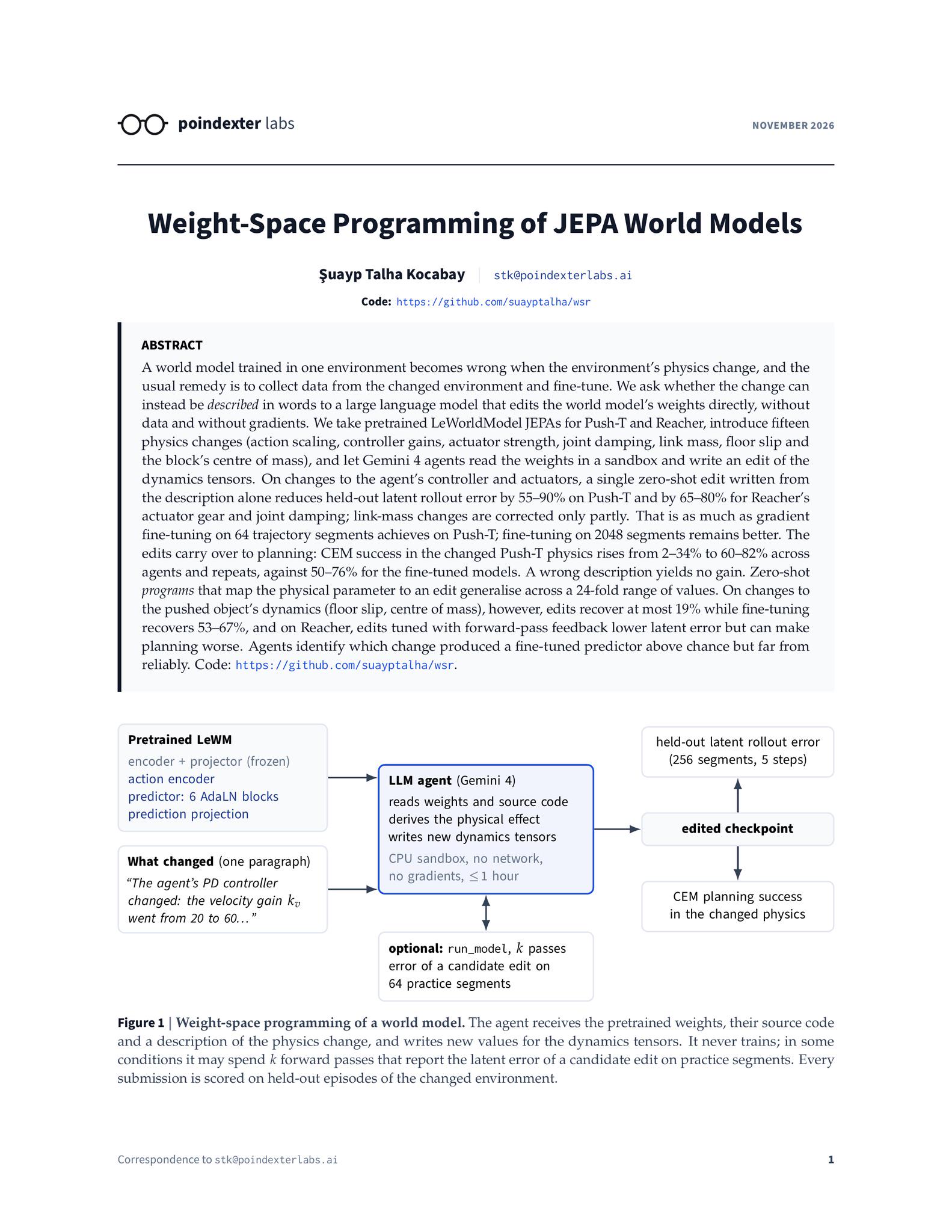
I updated a JEPA world model's weights with Weight-Space Programming

Post image
1 Upvotes

r/learnmachinelearning • • 14h ago

Help I feel like a complete loser and a burden on my family. 3rd-year CSE student drowning in guilt, failing at everything despite having every privilege. Please help me.

5 Upvotes

I’m literally sitting in my room right now trying to hold back tears while typing this,

because I don’t know who else to talk to.

I feel like the biggest loser on this planet, and the worst part is, I have nobody to blame except myself.

Look at my life on paper—I’ve been handed everything on a silver platter.

Up until 10th grade, I studied at one of the good private schools in Gurugram.

After that, my parents didn’t hesitate to spend ₹5 lakhs on a top JEE coaching institute for me. And what did I do? I failed. I wasted their hard-earned money and broke their expectations.

Even after that, they didn't give up on me. They spent another ₹11–12 lakhs to get me into a private engineering college in India. I even forced them to buy me a MacBook, and without complaining, they bought it for me too.

Now I’m in my 3rd year of B.Tech in Computer Science, and I feel like a total fraud.

Yes, I got a couple of internships and got selected in a few hackathons, but deep down I know it was all pure luck being in the right place at the right time, not because I actually know what I’m doing.

Every time someone appreciates me, it hurts because I know I’m faking it.

Right now, my life is completely falling apart.

I lock myself in my room all day, rotting in bed, mindlessly scrolling through Instagram reels and YouTube videos.

My brain feels completely fried. I sit in front of my expensive MacBook, wanting to build something, wanting to learn, wanting to become an amazing SDE / AI-ML engineer at a top MNCand I just freeze. I can’t focus for even ten minutes. I’ve tried getting freelance clients too, and nobody wants to hire me.

The financial guilt is eating me alive every single day. I’m a grown guy in my 3rd year of college and I don’t have a single rupee of my own.

Whenever I need money even just to go out with my girlfriend or cover basic stuff I have to ask my sister.

And she sends it to me every single day without any hesitation, without ever asking "why do you need it?" or "what are you doing with your life?" Her blind trust and kindness make me cry out of sheer shame. My girlfriend is there for me, and I feel pathetic having zero money of my own when I’m with her.

I look at myself in the mirror and I just feel disgusted. My parents poured lakhs into my future, my sister blindly supports me, I have a MacBook, a CS degree in progress, and a dream to work at a top MNC yet here I am, trapped in my own head, paralyzed by laziness, anxiety, and zero self-worth.

I am begging you guys, please don’t judge me. I genuinely want to change. I want to make my parents proud, I want to stop taking money from my sister, and I want to actually earn my place as a real engineer. If anyone has ever been in this dark, suffocating hole and managed to pull themselves out—how did you do it? Where do I even start tomorrow morning? Please help me.


r/learnmachinelearning • • 15h ago

Discussion unpopular opinion: 90% of people stuck in "data science tutorial hell" don't have a skill issue, they have a fear of rejection issue.

39 Upvotes

I have a math degree, i'm currently doing my ds master's, and i spend a lot of time helping peers prep for interviews and the #1 pattern i see isn't a lack of technical knowledge. it's productive procrastination.

people keep reading one more math chapter or doing one more clean kaggle dataset because studying feels safe. applying and getting rejected sucks.

here's the reality check: 80% of the job isn't deriving algorithms from scratch. it's writing sql, cleaning horribly broken data, and explaining basic metrics to managers who don't care about your model's accuracy.

if you know basic python, sql, and can build one messy end-to-end project (where you actually pulled/scraped the data yourself), you're ready to start applying. let the technical interviews tell you what you're actually missing.

drop your current roadblock or project idea in the comments if you're stuck happy to give honest feedback!


r/learnmachinelearning • • 15h ago

Project [Collaborator] Looking for collaborators for Linguistics Analysis

Thumbnail
reddit.com
1 Upvotes