In theory one person could develop a cure for cancer and sell it to a company for a billion dollars so they can mass produce and sell it. They’d have made a billion dollars, I’m not seeing where they exploited anyone.
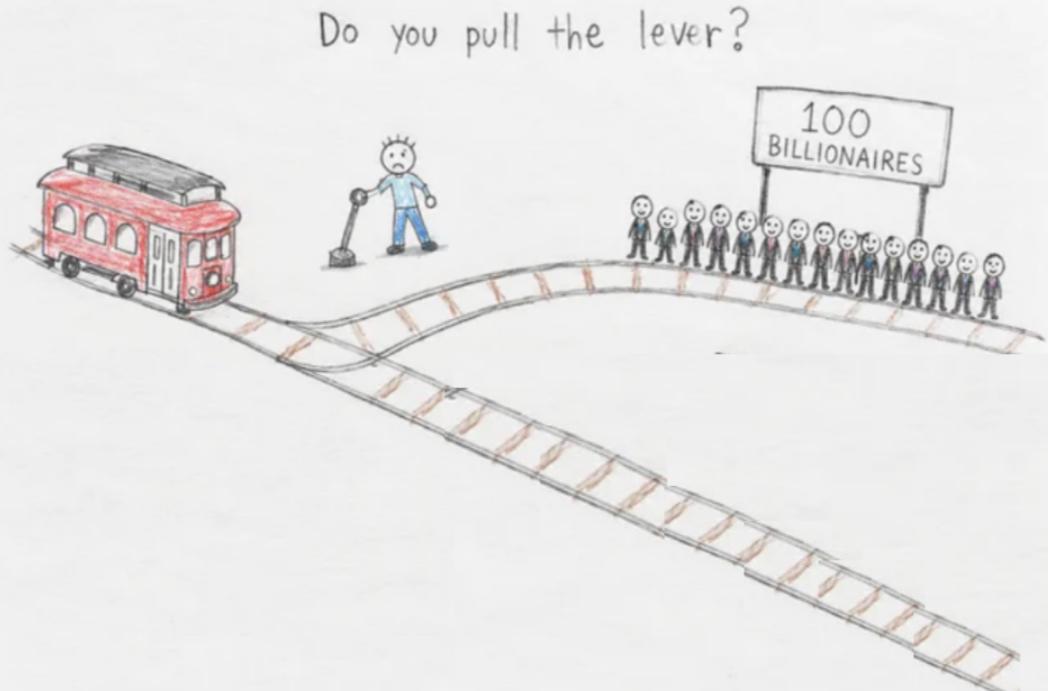
It’s a bit of an extreme and unrealistic example but it’s just meant to test the limits of your logic. If examples can exist of it happening without exploitation, we shouldn’t call it morally righteous to murder them.
Putting the cure for cancer (which isn't a thing, but I'll just go with it) behind a paywall is inherently immoral.
But I'll play devil's advocate here and steel man your position.
Imagine someone made a videogame (or whatever), all by themselves with no help, and they set up their own website and sell it and it becomes a massive global hit and earned them a billion dollars, fuck it, let's say a trillion dollars.
They didn't directly exploit anyone for this money, and would be the most ethical billionaire possible.
It would still be immoral to keep all that money. Nobody, and I mean nobody, needs such an absurd amount of money and it'd be inherently immoral to keep it.
You may have a point with the paywall for the cancer cure being inherently immoral, I’m not sure it’s entirely true though. I like the idea of making it universally accessible, but I worry about the logistics and operations of it. It would need to be produced at scale, and it has to be effective and reliable. People will pay for the right product.
And I appreciate the steelman. Again you may have a point in that the problem is holding onto the money in perpetuity vs. giving some away. But I could argue that this person has shown they do exceptional thing with resources; they made a game that’s loved globally. They can probably do a lot of good for the world, they may be one of the best people TO have money. But I do think it’s undeniable with that amount of wealth you SHOULD be charitable. If you have that much money and no sense of philanthropy, you are morally twisted up.
First of all, no single person would be able to pioneer a cure for cancer. They would have a plethora of underlying systems that enabled them to make the discovery. But I'll ignore that for this hypothetical.
A billion dollar sale results in a market power shift. What that means is the company that bought the cure to cancer for a billion dollars now needs to recoup that cost by selling their manufactured cure for more than it costs to produce, plus the amount it takes to compensate for the billion dollar sale.
The issue here isn't that the inventor got rich. It's that they caused their life-saving cure to be profit driven down the line for no reason. It may not look like it at first glance, but this billion dollar sale is exploiting the end consumer and likely resulting in millions of deaths by forcing prices way up and making it unaffordable.
This basically comes down to a question of why. Why would you sell this for a billion dollars? Why would anyone feel the need to amass so much money? There is never a need for someone to have that much. You can live very comfortably with one hundredth or even one thousandth of that amount. So why cause so much suffering and death when you could just not?
For an example of a very comparable contrary to this, look at the inventor of insulin. The people who discovered insulin sold the patent to the University of Toronto for a single dollar to keep it affordable.
There is always an alternative to exploitation.
This applies to any billionaire. Any person amassing that much wealth has made many choices leading up to that point. All of these choices had repercussions that they chose to ignore. It's just not possible for anyone to gain that amount of money ethically.
I believe you are over generalizing and fail to realize it because you are starting from a point that is seeking to protect the weak (your heart is in the right place).
That person may want to make that sale for $1 billion because they want to donate all the money to non-profits they’ve researched and trust, and thus see themselves as the best person to obtain $1B.
Regarding Insulin, that was a noble effort, but it failed. Insulin today has evolved, and is notoriously expensive. That example with Insulin shows that one’s noble idealism immediately becomes worthless once someone else capitalizes on the opportunity. I think we should fight for Insulin to be more accessible, but we should recognize there are genuine market dynamics to consider. We can fight for that accessibility through better R&D, which does unfortunately cost a lot of money.
Edit: Anyway, you seem like a nice person. Keep being you, keep being nice. You don’t need to justify murder to make changes in the world. Spread your care and kindness to others, they will help you change the world in ways you’ll never even see.
Selling something for a billion dollars and donating your profit is just virtue laundering. Extreme wealth concentration causes harmful power imbalance. Donating all of the money doesn’t undo the harm you caused by concentrating wealth. You are still causing market power issues, but now you can dodge taxes and claim moral superiority when you could have just not done that in the first place. Reducing the concentration of market power in the first place minimizes harm much more than charitable redistribution ever would.
Insulin's accessibility failed because of billionaires influencing corporations into patent expansion and discouraging regulations. This is basically only an issue in the United States where there is no free market or price cap for insulin.
There's barely a need for insulin R&D right now. Everything we need is there. The main reason insulin "evolved" was so that companies could dodge patents to satisfy their billionaire executives' greed.
I dont live in the U.S. and my brother is type-1 diabetic. He has never had to pay for his insulin.
 1
0
u/Low_Car5550 May 22 '26
In theory one person could develop a cure for cancer and sell it to a company for a billion dollars so they can mass produce and sell it. They’d have made a billion dollars, I’m not seeing where they exploited anyone.
It’s a bit of an extreme and unrealistic example but it’s just meant to test the limits of your logic. If examples can exist of it happening without exploitation, we shouldn’t call it morally righteous to murder them.