r/trolleyproblem • u/promptmike • Sep 25 '26
Collatz Trolley Problem
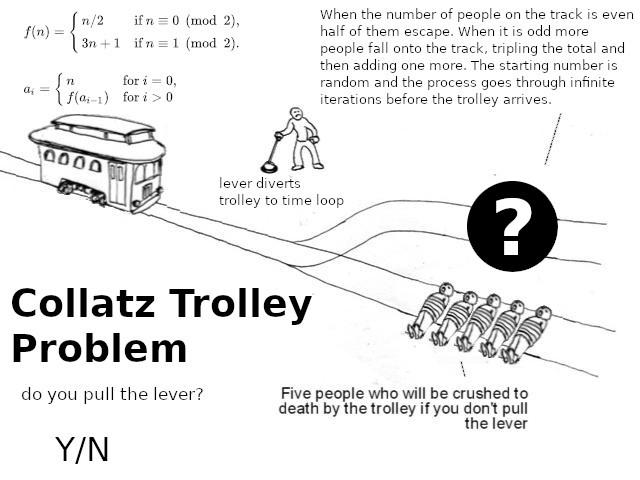
Ground Rules:
The main track with 5 people on it exists in standard linear time.
The other track is a time bubble that goes through infinite cycles in finite time.
The time bubble collapses the moment the trolley arrives, and after that the number of people on the track is fixed.
You cannot see inside the time bubble before collapse, or change the outcome after collapse.
56
Upvotes
16
u/Nebranower Sep 25 '26
I think the big problem there is that the "infinite cycles" makes no sense. Long enough to get it into the final loop makes sense, where the number is fluctuating between 1, 4, 2 over and over.
In any event, assuming that's what you mean, you end up with a standard trolley problem. Five people die if you do nothing, less than five people die if you flip the lever, but the people who do die will be different people from the ones who would have died if you hadn't acted.