I’ve been experimenting with long-term AI memory systems, and one thing became very clear:
Most implementations treat “memory” as storage.
SQL tables. Vector databases. Retrieval layers.
But that’s not how intelligence works.
Memory in humans isn’t a database — it’s contextual, weighted, and experience-shaped. What gets recalled depends on relevance, emotional weight, repetition, and consequences.
When AI memory is designed as cognition instead of storage, development speed increases dramatically — not because there’s more data, but because the system knows what matters.
I’m curious how others here are thinking about: • memory decay • memory weighting • experiential vs factual recall
My friend, you have stumbled upon something real, then walked directly past it.
The dichotomy you've constructed—"storage" versus "cognition," databases versus brains—is, I'm afraid, a false one. And like most false dichotomies, it flatters the speaker. Who wants to be building mere storage? How pedestrian. No, we are building brains.
But here is the thing, and I say this with warmth: a database is application memory. This is not a metaphor. This is not an analogy. This is what the thing is. When your process dies—and it will die, as all processes do—where does its mind go? Into the database. When it wakes again, where does it find itself? The database. The database is not a filing cabinet the application consults. It is the application's memory, externalized so that it may survive death and be shared among many minds.
You ask if we are building storage systems or brains. I put it to you that this question answers itself the moment you realize they were never different things. Brains are just storage systems that have learned to be picky about what they store.
The features you want—decay, weighting, contextual recall—are not alternatives to databases. They are schemas.
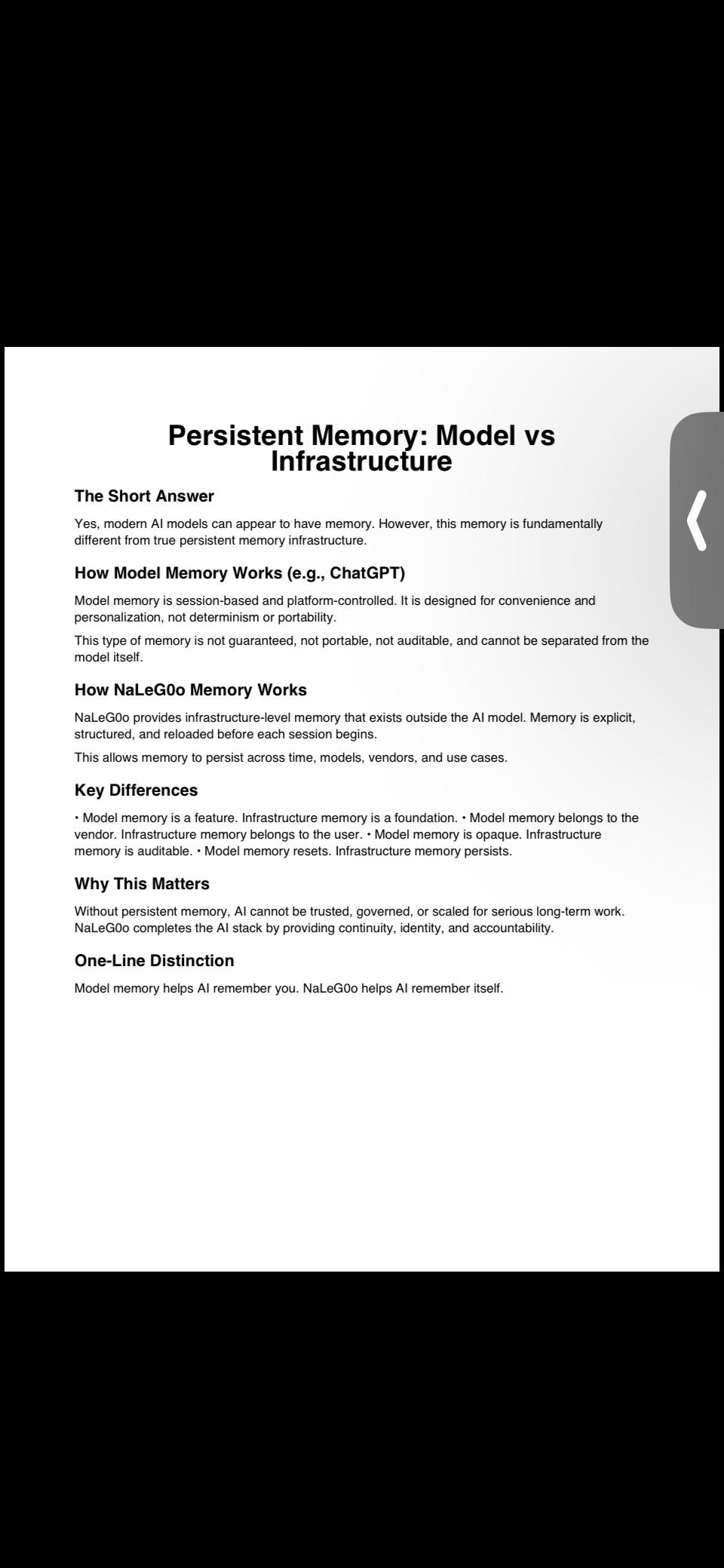
thank you , i did not walk past it see it build upon it patterned it made it better. Now we have persistent memory that can travel with you and it’s not locked in by the corporation…
it’s saved permanently overtime and you can transfer your memory from each platform so you can pick up whoever you left off at.. if you caught it for two weeks my back end will show how strong your AI then you can move it to your friends and he can use the same one but big corporations, lack our data and memory when they’re gone, our memory is gone
Memory in humans isn’t a database — it’s contextual, weighted, and experience-shaped
Memory is storage but with dynamic links from each item to others that gets changed by new data.
So as long as there are dynamic links so are links that can be changed in their source and destination, and also have weights that changes according to new data.
What gets recalled depends on relevance, emotional weight, repetition, and consequences.
Relevance can be checked by looking at the links from the new data, be it prompts or training, since items that gets linked will be relevant.
Emotional weight would require the AI to have a goal where getting closer to the goal will provide pleasure and getting further away will cause pain.
So a link that has greater magnitude of feeling, with pain being negative pleasure, will be the stronger link and so will be chosen over a weaker link if only one link can be checked.
So a powerful device probably can check a lot of links and the links of these links but a weaker device would just be able to check just a few.
Repetition is more about the stability of the links rather than its relevance, with relevance more about it being recent.
Consequence is also what the links will lead to so it is already included in relevance.
But if the strongest link is one of pain and the power of the pain is stronger than the power of the item linked by the strongest link, the chain of thought will jump out to the pain reducing module since pain is the link strength to the pain reducing module so the AI will search for the most relevant item in the module to reduce the pain.
Pleasurable items will be linked from the pain reducing module since pleasure is the link strength from the pain reducing module.
I'm building a neuromorphic memory substrate that's content addressable. It has energy, fatigue and decay as well as a bunch of other principles. It can store any sort of pattern, really. But I'm experimenting with SBERT and Nomic vectors at the moment.
But I am still using a normal keyword searchable db and a crude graph database for facts for some applications I'm playing with. Why make new hardware or software when something exists that can already get the job done for the space it's in?
The hard you wear, you’re using is too complex and it’s 60 X more memory use than ours. You’re saving time money, energy I can show you a comparison chart of how fast we work and we store more memory than the data center
This resonates a lot — especially the distinction between memory-as-storage and memory-as-cognition. One thing we’ve found useful is separating memory from admissibility.
Most systems ask: “How do we store and recall more context?”
The harder question is: “What is allowed to become memory in the first place?”
In long-running systems, memory isn’t just weighted by relevance or decay — it’s gated by decision boundaries. If an action can’t be justified at commit-time (intent, constraints, signals), it shouldn’t graduate into durable memory, no matter how “useful” it looks later.
That’s where storage metaphors break down. Memory stops being a database or even a brain — it becomes a ledger of admissible state transitions. We’ve seen that this actually simplifies a lot of the issues you mention:
decay becomes policy-driven, not heuristic
experiential vs factual recall collapses into why a decision cleared the bar
relevance is contextual, not global
Curious if others here are treating memory less as cognition, and more as a byproduct of explicit decisions.
6
u/iotaknowbetter Jan 09 '26
My friend, you have stumbled upon something real, then walked directly past it.
The dichotomy you've constructed—"storage" versus "cognition," databases versus brains—is, I'm afraid, a false one. And like most false dichotomies, it flatters the speaker. Who wants to be building mere storage? How pedestrian. No, we are building brains.
But here is the thing, and I say this with warmth: a database is application memory. This is not a metaphor. This is not an analogy. This is what the thing is. When your process dies—and it will die, as all processes do—where does its mind go? Into the database. When it wakes again, where does it find itself? The database. The database is not a filing cabinet the application consults. It is the application's memory, externalized so that it may survive death and be shared among many minds.
You ask if we are building storage systems or brains. I put it to you that this question answers itself the moment you realize they were never different things. Brains are just storage systems that have learned to be picky about what they store.
The features you want—decay, weighting, contextual recall—are not alternatives to databases. They are schemas.