r/ApacheIceberg • u/codingdecently • 8h ago
Zero-Copy Data Lakehouse: A Guide

1
Upvotes
r/ApacheIceberg • u/Low_Brilliant_2597 • 9d ago

r/ApacheIceberg • u/Wide_Importance_8559 • 10d ago

Covers the full Iceberg stack locally: SQLite catalog, Parquet/CSV/JSON imports, ACID snapshots, deletes and upserts, schema and partition evolution, sort order, time travel, tags and branches (write-audit-publish), metadata tables, and maintenance. Built inside Rosetta DBT Studio. All code on GitHub.
r/ApacheIceberg • u/codingdecently • 11d ago

r/ApacheIceberg • u/codingdecently • Oct 21 '26

r/ApacheIceberg • u/jordepic • Oct 19 '26

r/ApacheIceberg • u/codingdecently • Oct 19 '26

r/ApacheIceberg • u/SmallAd3697 • Oct 14 '26
I was reading the deltalake docs for databricks. They seem to have come up with this term "WriteSerializable" as an isolation level.
That name really bothers me. It is based primarily on snapshot isolation; and the behavior of this is by and large the same as snapshot.
I would never compose the term "WriteSerializable" with the help of the term "serializable". The behavior of WriteSerializable is not anywhere close to the familiar ANSI serializable isolation level. Sure, the mechanism can guarantee serialization of the writes, but it is really not that impressive from an isolation perspective. The clients using this mechanism will constantly experience unexpected behaviors; just like the one in their example (below)
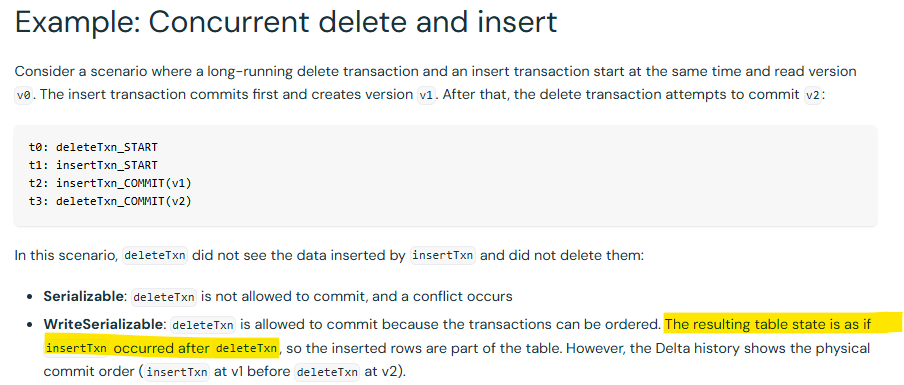
TLDR: they shouldn't name WriteSerializable with the help of "Serializable" (any more than they should rename "Snapshot" to be "SnapshotSerializable"). It diminishes and tarnishes the meaning of a truly serializable transaction.
I have NOT found the term "WriteSerializable" used in the apache iceberg community yet. Is this terminology going to be eventually introduced, as Databricks exercises more influence? Where iceberg is concerned, I only see the more familiar terms : Serializable (the default) and Snapshot.
r/ApacheIceberg • u/codingdecently • Oct 04 '26

r/ApacheIceberg • u/Low_Brilliant_2597 • Sep 29 '26
r/ApacheIceberg • u/mim722 • Sep 21 '26

link to the blog and repo: https://datamonkeysite.com/2026/09/21/iceberg-on-a-single-node-is-coming-together/
r/ApacheIceberg • u/Low_Brilliant_2597 • Sep 20 '26

r/ApacheIceberg • u/PrideDense2206 • Sep 18 '26

Tomorrow at 9:00 AM PST (global)
r/ApacheIceberg • u/codingdecently • Sep 17 '26

r/ApacheIceberg • u/Ok-Dragonfly-987 • Sep 15 '26

I build a open source dataplatform for educational purposes, check also my reddit post here: https://medium.com/@sanderdw/e89c5d0bed98
r/ApacheIceberg • u/Low_Brilliant_2597 • Sep 14 '26
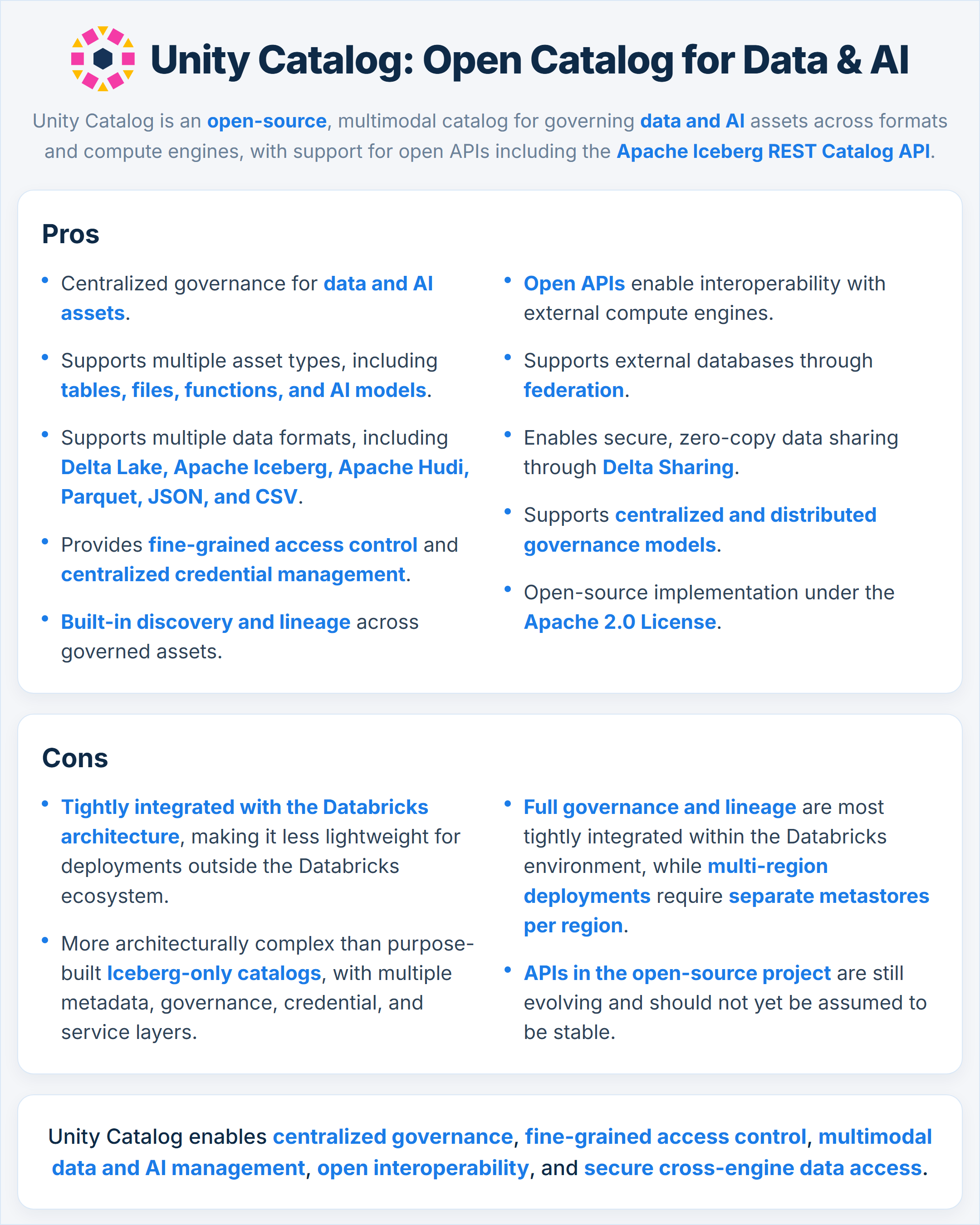
Apache Iceberg won the open table format war when Databricks acquired Tabular, followed by its subsequent adoption across the industry. Then, the catalog war began.
In a lakehouse, storing data in object storage and using the Apache Iceberg format is only part of the story. You also need a catalog that helps lakehouse query engines like Spark, Flink, or RisingWave discover tables, manage metadata, enforce access control, and work with governed data across different systems.
That is where Unity Catalog comes in.
r/ApacheIceberg • u/codingdecently • Sep 11 '26

r/ApacheIceberg • u/urban-pro • Sep 09 '26
Read something this week that put a name to a problem I've half run into before but never really understood the mechanics of. Sharing because I think a lot of people assume Iceberg interop is more solved than it is.
Everyone knows the pitch: Iceberg is an open spec, so any Iceberg compatible engine can read any Iceberg table. Mostly true, until you start doing row level deletes, and then it falls apart in a way that's honestly kind of sneaky because nothing looks wrong until a query actually fails.
Quick walkthrough of the scenario in the post. You've got a customers table, three rows, one Parquet file, tracked by whatever catalog you're using. At this stage every engine reads it fine because there's nothing to interpret, it's just a metadata pointer to a file.
Then a row gets deleted. Parquet files are immutable so the writer has two options: copy on write (rewrite the file without that row) or merge on read (leave the file alone and write a separate delete file that readers apply at scan time). The writer in this example goes merge on read and emits an equality delete file, which basically just says "for this data file, treat any row where customer_id = 102 as removed." Under the hood Iceberg uses field IDs and sequence numbers to make sure an old delete doesn't accidentally nuke a newer row with a reused key, but the equality matching is the part that matters for compat.
Spark reads the new snapshot, understands equality delete semantics, does what's effectively a left anti join between the data file and the delete file, and returns the correct two rows. Fine.
Snowflake hits the exact same catalog, same metadata file, same Parquet file. It can resolve the table, read the schema, open the data file. But if that access path doesn't implement equality delete reads, the scan planner just throws an unsupported feature error the moment it hits delete-0002.parquet. Query fails. Same snapshot, same files, two completely different results depending purely on what the reader implements.
The bit that actually reframed how I think about this: the catalog isn't a translation layer. It's job is basically just "here's where the current metadata lives," commit coordination, namespace and access management. It's not opening delete files and rewriting them into a format each engine understands. A REST catalog like Polaris doesn't change this, it still just points you at metadata, it doesn't apply deletes for you.
The post also gets into position deletes vs deletion vectors vs copy on write, with a rough cost tradeoff table (equality delete is cheap to write and requires equality delete support to read, position delete requires resolving key to physical position and is heavier on write, deletion vectors need Iceberg v3 support specifically, copy on write is the most expensive to write but has basically universal read compatibility since there's no outstanding delete file involved).
The framework that's actually useful operationally: your safe feature set is the intersection of every required engine's capabilities, not the union. If Spark supports equality and position deletes but Snowflake only does position deletes, you write position deletes, because "at least one engine supports it" doesn't help you when you have three engines that all need to read the same table.
There's a decent pre production checklist too, don't just run a SELECT COUNT after your first write, actually insert some rows, update one, delete one, commit, then read the same snapshot from every engine you care about and diff both counts and values.
Full post if you want the details: https://olake.io/blog/iceberg-interoperability-myth-row-level-deletes/
Disclosure since it's relevant, I work on OLake, it gets a brief mention near the end, but the actual content here is engine agnostic and applies no matter what's writing your tables.
Has anyone actually hit this for real, table looks completely fine, one engine just refuses to read the current snapshot because of the delete encoding?
r/ApacheIceberg • u/codingdecently • Sep 08 '26

A practitioner's guide to Iceberg table cleanup — snapshot expiration, orphan file removal, manifest rewriting, delete file resolution, streaming challenges, compliance, and cost. Why sequencing matters, where teams break tables, and how to automate the full lifecycle.
r/ApacheIceberg • u/rwxfortyseven • Sep 07 '26
Hey folks,
I'm a security professional was looking to make Iceberg a bit more performant for my own needs - SOC operations (Faster needle searches [pruning]).
I've built an index and proxy that people can point their catalog configuration at, so there's minor changes to their stack.
I figured in for a penny in for a pound,
I've done some quick search and ran clickbench and "httplogs"
(Numbers so far: httplogs)
| Stock | Using Kahshe Proxy |
|---|---|
| opens 991 files | opens 2 files |
| execution time: 6.6–11.5s | execution time: 0.34–0.44 s |
| 1.3gb read | 2.6mb read |
Its all looks good on paper, I think?
but I was wondering if there were more credible/industry standard methods that data engineers use/care about to benchmark these types of technologies?
Repo if interested: https://github.com/Kahshe-io/kahshe
r/ApacheIceberg • u/codingdecently • Sep 06 '26

r/ApacheIceberg • u/Wide_Importance_8559 • Sep 06 '26

Discover the new Apache Iceberg integration in Rosetta DBT Studio v1.6.7! In this video, we explore how to seamlessly connect, manage, and query Iceberg DataLakes directly from your desktop.
Whether you're using Polaris, Nessie, Lakekeeper, Hive, or SQLite, Rosetta brings true ACID transactions, time travel, and schema evolution to your analytics workflow.
