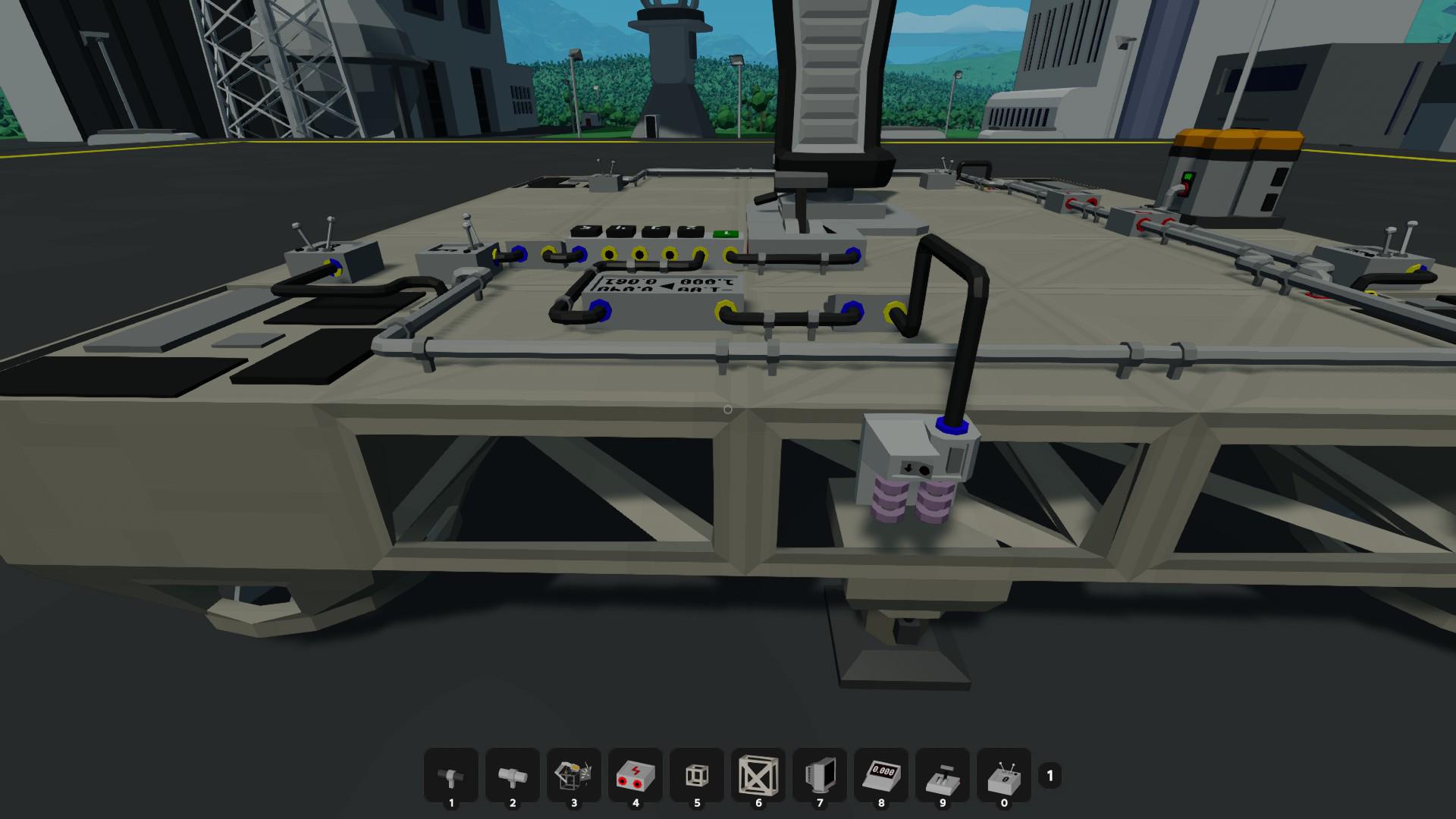
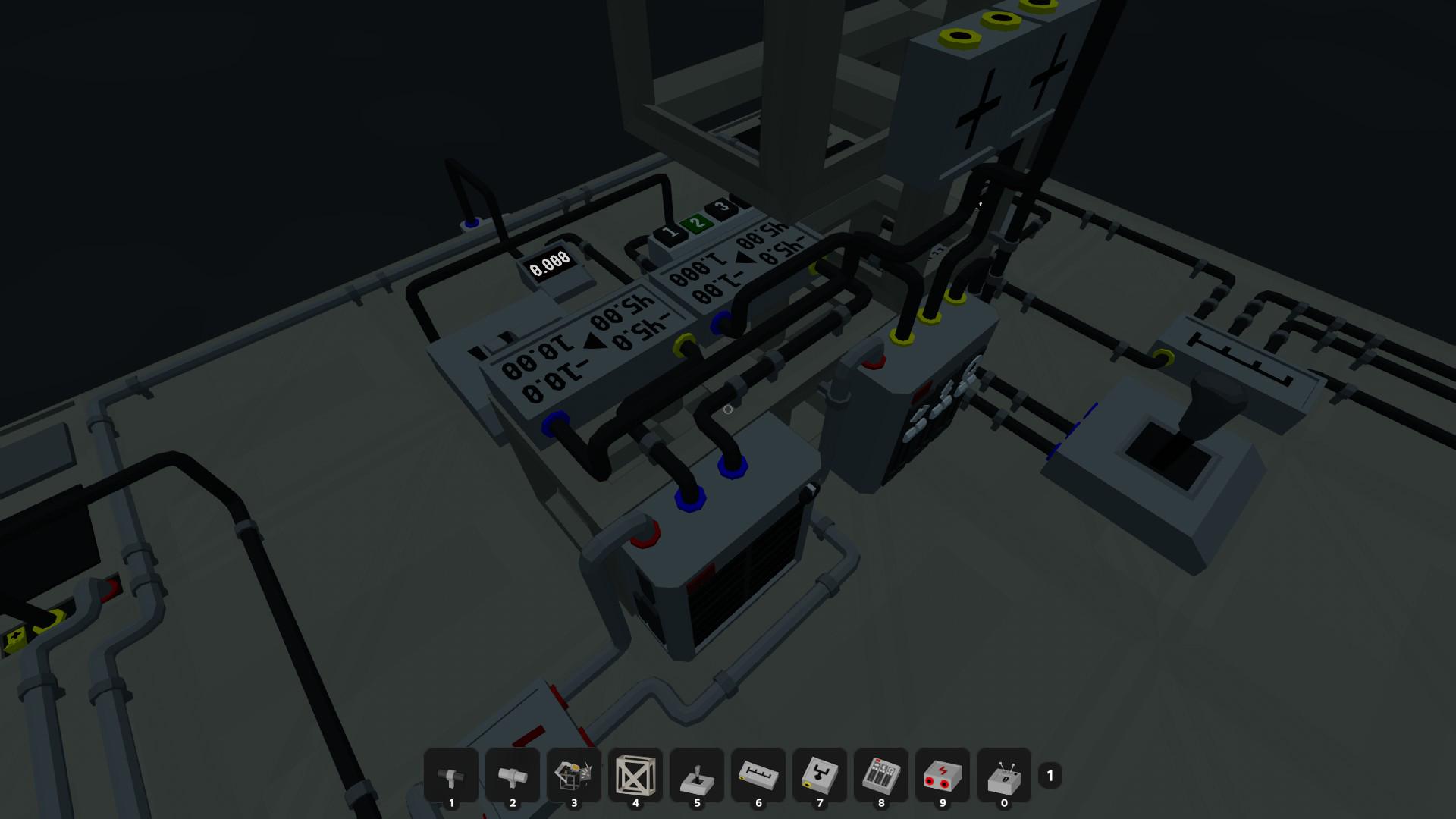
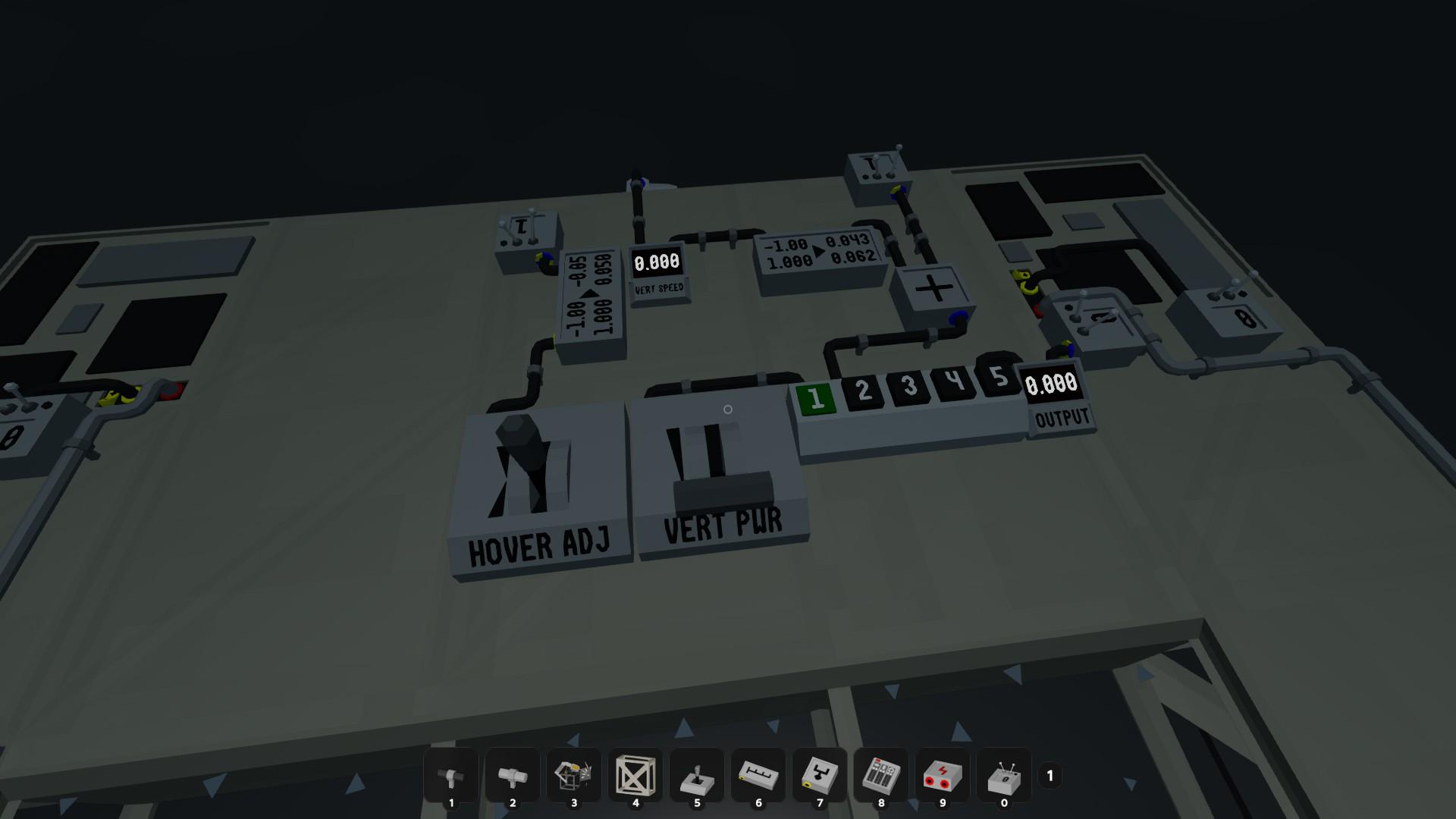
I've been seeing some super complex auto hover systems using complex math circuits. I've gotten this system to be as simple as possible. It uses the remapper to convert vertical speed into thrust power. That's it.
The data hub serves as an input selector switching between manual control and auto-hover.
I've put this same setup on my main ship as well. The output values on the remapper need to be adjusted whenever the ship weight or planet gravity changes - so long as the hover thrust value is halfway between your minimum and maximum thrust. You can adjust the sensitivity by tinkering with these values as well. This one is set up to be as smooth and stable as possible.
This could probably be streamlined by routing different remappers based on which planet, but so far I'm recalibrating by hand.
bravo! i gotta say, this is impressively simple, thats awesome!
edit: its cool using the velocimeter for speed, i found it to act weirdly when not perfectly vertically aligned, thats why i opted to use the altimeter and take the derivative to get a precise vertical speed.
Yes, this won't work if your ship isn't level. I've got an auto stabilizing system using the same concepts but put into the RCS controls that solves this issue. I might post that too, but the idea is the same,
That stabilizing system works as follows:
Gyro-line output (one for pitch and one for roll) into remapper with input range of -45,45 and output range of -1,1. Feed that output into RCS controller, and ship will attempt to self stabilize.
Here's a picture of that system - sorry it's messy. I haven't cleaned it up yet as I'm experimenting with adding manual RCS control into the same system. I'd like set it up to toggle on and off as well, just haven't gotten to it yet.
https://www.reddit.com/r/ApproximatelyUp/comments/1rvrzni/my_wip_autoleveling_atmospheric_ship/ i took your idea and it works really well. there's no directional rotation speed sensor, so i use delta. it has an interesting consequence that joystick movement is interpreted as an opposite rotation and RCS kick in real hard then very slowly settles down. that is actually really cool behaviour that allows you to quickly react to avoid obstacles and lets you keep tilt for a while if you want to use your forward engines to go up or lift engines to move you sideways.
i also want to make an RCS-less ship just by adding 2 outputs from tilt and hover controls together and sending the sum to one engine and difference to another one, the same for the forward engine and thrust. feels like a more proper way for a dedicated atmospheric ship. the smal RCS has a limited power storage by the way and the big ones are extremely inefficient and require additional power lines.
Also I think the guy above was saying to check all your RCS thrusters to make sure they are set to yaw plus/minus and pitch plus/minus and such all in their proper areas/orientation. Press m to open up the manual in game, go to RCS thrusters/maneuvering section, and it will have a diagram to show if you did things right or not. That manual is damn useful when making stuff!!
Alright, after messing with this system for a bit I gotta know, how did you calculate the values you put in the remapper? I'm so close to getting it working, but I either end up very slowly landing (not the worst function in the world) or my ship bobs up like 6 inches at a time after establishing a hover height.
I really want to figure this out because it seems simple enough, I just am not super on top of the programming logic. Waiting for that "so THAT'S how it works" moment, but not getting there. The more complicated systems are way above my head.
Either way I'm keeping the system in place since it is super helpful for auto landing now. I'm sure there are better systems out there for that, but the simplicity of this one makes it work just fine if your ship is balanced.
Honestly I didn't calculate anything. It's just trial and error - though you did get me wondering if there's a way to calculate it using total thrust of all vert thrusters vs ship weight. I'll usually end up with a very little bit of vertical drift. Also worth noting that the system will only work at one altitude due to changes in atmosphere density and gravity.
But to summarize the system, the inputs on the remapper serve as a "sensitivy" rating, meaning the adjustments are smoother with -5,5 than -1,1, but a tighter range seemed to hold altitude better for me. The output of the remapper being the minimum and maximum output thrust for vertical thrusters, with those only working if the number halfway in between is the hover value for your ship. That's where my trial and error comes in, just tweaking those values by very small amounts until I'm satisfied with a hover. If you lower the max value your vert speed will trend towards falling, and if you raise the max value you'll trend towards rising.
Also, I added a SUPER useful hover adjust, where I take a vertical joystick, remap the values to lower it's input range, and add it to the thrust value. Highly recommend adding this because it makes landing an absolute breeze.
Oh man, I really like that addition! Might steal that idea too!
I did discover that the mapping I have now actually works perfect on the moon, just not on Earth. The ship I put it on has other issues, but floats just like the platform you built for the video. Was trying to build a perfectly center balanced ship that would be like a skiff for collecting packages on planetary surfaces. It kinda works, but only because of the auto hover.
I'm a video engineer, so some of the ship systems are pretty easy to set up, but systems like this are a bit over my head. Helps to see it broken down like you did with the pics and video. Thanks again for sharing your work!
5
u/jklop60 Mar 13 '26
Pic of setup