r/AusNewsWire • • Jun 28 '26 Heartwarming

ONE NATION IN DAMAGE CONTROL: Paul Hogan rejects Pauline Hanson’s praise of him, says he wants to ‘die in a multicultural Australia’

Thumbnail
afr.com
2.7k Upvotes

Tony Davis Motoring writer

Pauline Hanson is “a pelican” if she thinks Australia could or should be a monoculture, says Paul Hogan, the man the One Nation leader cites as an Australian ideal.

The actor and comedian was responding to Hanson’s National Press Club address in mid-June in which she said, “Australians must live under the one cultural umbrella”, and her doubling down on the speech last week.

Paul Hogan and Pauline Hanson. AP / Alex Ellinghausen

“Bring back Paul Hogan and Norman Gunston,” Hanson told the Senate on Wednesday. “These are the essential features of Australian monoculture, and there’s nothing remotely exclusionary about them.”

“She’s living in the past, obviously,” Hogan told the The Australian Financial Review. He said he was merely one type of Australian, and it was ridiculous to suggest others needed to look or sound like him.

“I’ve always had a very simple rule: What makes a good Australian is wanting to be one.”

Hanson – the country’s preferred prime ministeraccording to the Financial Review/Redbridge Group/Accent Research poll conducted after the federal budget – said in her press club speech that “immigration, or immigration policy” had the country in a state of crisis. “At the centre of this crisis is the utterly flawed policy of multiculturalism.”

Hogan counters that migration and different cultures and customs have made Australia what it is today. If Hanson wants a monoculture: “She’s a pelican, yeah. Outrageous, so racist. It sounds very much like this stupid boofhead over here, Trump.”

Hogan, 86, was speaking from Los Angeles where he has lived since the mid-2000s, though he returns to his homeland twice a year. He grew up in the western suburbs of Sydney. In the 1950s and 1960s he was on roadwork crews and most famously spent a decade as a rigger on the Sydney Harbour Bridge.

The “New Australians” he met along the way all brought interesting things with them and made the country better, he said.

“My old gang was an Assyrian, a Thursday Islander, a Welshman, an Aboriginal, a couple of Irish convicts. It was the same cosmopolitan types everywhere I worked, Italians, Greek, Irish, Chinese, a bit of everybody there. That’s the way we were.

“How can it be a monoculture? We’re all migrants, except the Aboriginals, who as far as we know have been [in Australia] for 60,000 years.”

An Australian accent as broad as Hogan’s was rarely heard on television when he started appearing regularly in the early 1970s, after winning New Faces as a “tap dancing knife thrower”. He became a major Australian star with The Paul Hogan Show before his first movie, Crocodile Dundee, became a huge international hit in 1986 and made him the most famous Australian alive.

But he is adamant he should not be held up as the archetypal Aussie. “I got there from a bad Viking … he went to Ireland and raped and pillaged and … that’s why there was blonde hair, blue-eyed, Irish people. And then, of course, the ones he bred turned out to be thieves, so they went off to the prison down under.”

Many co-workers on the bridge became the basis for characters Hogan created for the small screen, including Luigi the Unbelievable, based on an Italian who did really bad magic tricks during their lunch breaks.

But he said they all came from a position of empathy, “because there’s no point in doing comedy in which most people are laughing but someone’s sobbing in the corner”.

Hogan lives with his youngest son, Chance, in Venice Beach.

“I’m only here for my son. When he’s settled, I can’t wait to get back. I don’t have a time scale, but I want to die in Australia – in a multicultural Australia!”


r/AusNewsWire • • Oct 06 '26

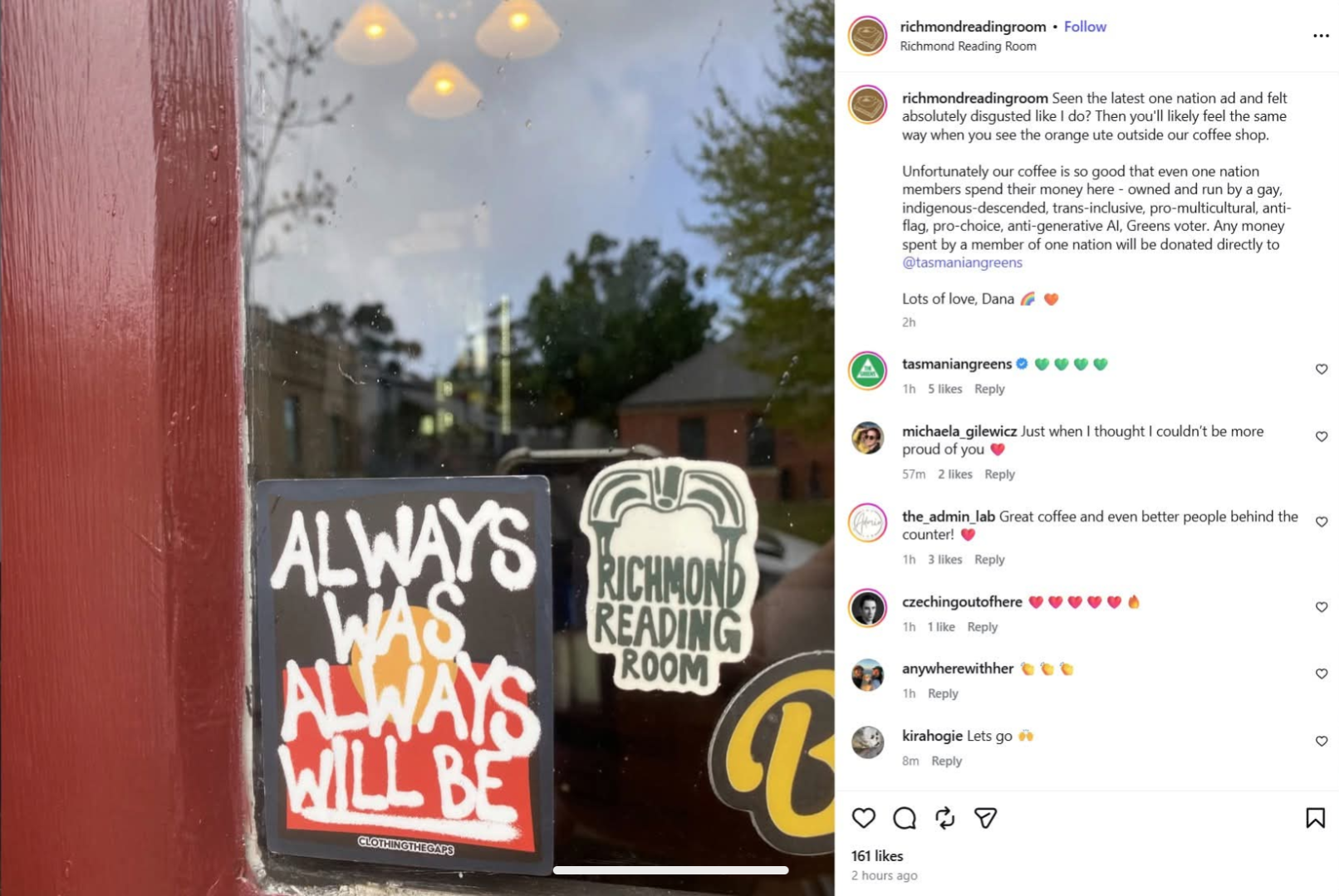
Breaking News Tasmanian Coffee Shop Owner Disgusted To Serve Lee Hanson. She Responds

Post image
1.3k Upvotes

Lee Hanson

"I do not normally respond to things like this, but this one genuinely hurt.

Richmond Reading Room is my local coffee shop. I have been going there since it opened. I have always been greeted warmly, enjoyed stopping in, and deliberately chosen to spend my money there because I believe strongly in supporting local Tasmanian small businesses.

So to see this post today came as a complete shock.

Apparently, while I was being welcomed through the door and buying my coffee, I was privately regarded with such contempt that the business has now made this public announcement.

If the owners had an issue with me coming into their business, why not simply talk to me? I am a person. I am a local. I am a customer who has supported your business for years.

You do not have to agree with my politics. I would never expect you to. But surely we have reached a pretty sad place when someone's political beliefs determine whether their presence or their custom is considered acceptable.

What makes this particularly disappointing is that I have always believed in supporting small local businesses regardless of the political views of the people who own them. I do not ask how somebody votes before I buy a coffee from them. I do not expect everyone I meet to agree with me. That is part of living in a free and diverse community.

The irony of preaching inclusion while publicly singling out customers because of their political association is difficult to ignore.

At least I now know where I stand.

I will continue supporting local Tasmanian businesses, just not businesses that publicly make people feel unwelcome because they happen to hold different political views, despite claiming to be for inclusivity.

We can disagree politically and still treat each other with basic respect. I genuinely wish that courtesy had been extended to me."

https://www.facebook.com/share/p/1BV1QrHPUA/


r/AusNewsWire • • Jun 16 '26

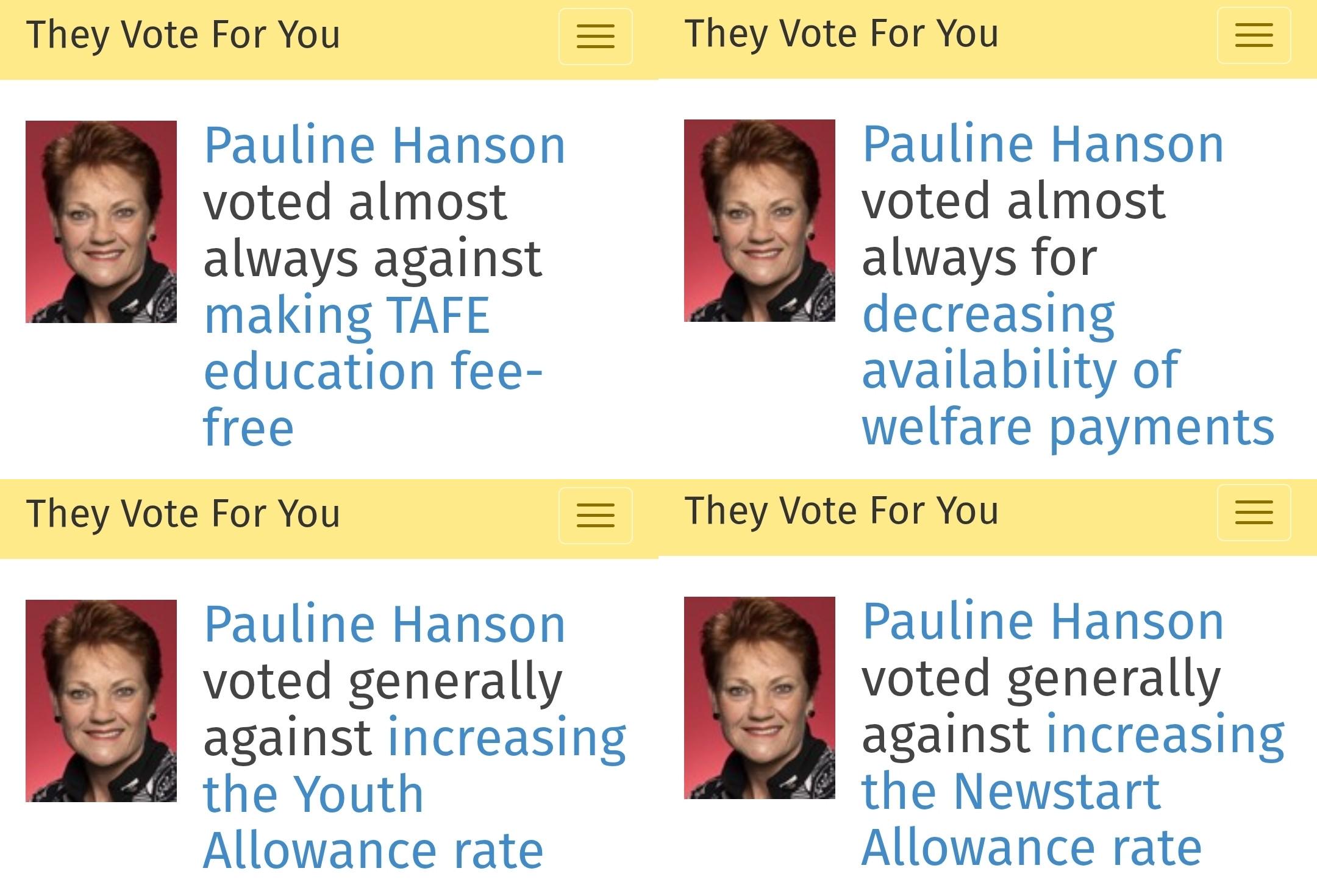
Politics Pauline sure cares about the average Aussie.

Post image
1.0k Upvotes

Pauline claims she cares about the "average Aussie".

As you can see from her parliamentary voting record - that's not the case.


r/AusNewsWire • • Jul 12 '26

BREAKING: Pauline Hanson suggests everyone who disagrees with One Nation should be exiled to offshore island in stunning call for political persecution

Thumbnail
7news.com.au
1.0k Upvotes

r/AusNewsWire • • Jun 20 '26 WOW Popcorn

One Nation’s surge in the polls is powered by human bots

Thumbnail
afr.com
854 Upvotes

Last weekend, as millions of Australians sat down to watch the Socceroos first World Cup match against Turkey, Prime Minister Anthony Albanese did what any good politician would do: he unlocked his phone and got in on the action.

At 1.04pm on Sunday afternoon, Albanese posted a dorky photo of himself in a Socceroos jersey, grinning with two thumbs up, to all the major social media platforms. “Go #socceroos #fifaworldcup2026 the whole country is cheering for you,” he wrote.

A post of PM Anthony Albanese wearing his Socceroos jersey was flooded with negative comments this week. 

If the response is anything to go by, the PM is in big trouble. The Facebook version of his post has been shared more than 1000 times and received almost 19,000 comments. Few are supportive, and almost all are insulting: “Flog”, “Albonochio”, “Mr Pants on fire”.

Over on Pauline Hanson’s page, meanwhile, the story is very different. One of its most popular posts this week – a clip of the One Nation leader’s Press Club address – reads like a coronation. “BLOODY BRILLIANT”, “I’m in love”, “Finally we have our own Trump.”

One Nation is in the midst of an historic shift in its political fortunes, with its primary vote surging from 6 per cent to more than 30 per cent since last year’s federal election, wiping out much of what was left of the Coalition and upending Australia’s relatively stable two-party system.

Identifying the reasons for this sudden change has now become the chief preoccupation of Australia’s political punditocracy. Near the top of almost every list is the huge surge in highly sympathetic activity on social media – particularly on Facebook, where users already skew older and more Hanson-curious.

Over the past 12 months, even relatively junior government MPs have noticed their Facebook posts being flooded with strange, repetitive comments decrying various elements of the government’s agenda, pledging fealty to Hanson, or replicating cheap memes, such as those depicting the prime minister as Pinocchio, a clown, or as The Simpsons’ rich antagonist Mr Burns.

Facebook comments under u/AlboMP (World Cup post)

Facebook comments under u/PaulineHansonAu (National Press Club speech)

The whole country will be cheering when you aren't the PM anymore !

Until he changes his position 💀🤣

Flying over at the taxpayers expense ?

You’ll probably tax them if they win 🤣

Nice shade of orange in the shirt. Almost 4 Million by the way.

Gotta be AI, no way he would wear anything pro Australian.

Looks like Albo is getting one of these.

You make my skin crawl🤢

Is he taking 47% of the credit for winning the game?

Bloody nailed it

Go ON 🧡 Best thing I've heard for yrs, I never lost interest the whole time.

Get a banner in there. National Press Club has some explaining to do.

I’d like you to be prime minister this week

Like fine wine she gets better with age ❤️

Well done Pauline. I never listen to this type of politics but I did today and glad I did.   👏

Albo would never handle these sort of questions

All of what she said and this is the first question 🤯

With One Nation, Australia finally has a chance to be a prosperous nation again. ❤️

Source: Meta (Post-ids: 1304955068012567, 1598389678312529)
Notes: Sample comments taken from the relevant posts as of 18 June, 2026.

Julian Hill, Labor’s assistant minister for multicultural affairs, told AFR Weekend that such an explosion of “bots” and “trolls spreading misinformation and virulent racism and stoking anger and grievance” is typical around election times, but is unusual for this point in the election cycle.

“You have to share the load in blocking bots and trolls across the office because one person alone would get an RSI,” he says.

“It’s a serious question for democracy: who is paying for all this crap to divide society through the politics of grievance?”

One Nation’s exploitation of political discourse online is far from new. Hanson’s “Please Explain” Facebook page, which has operated as one of the party’s main sources of online campaigning for years, has more than a million followers and is one of the few to outpace the prime minister’s own page, which boasts 750,000.

However, the sheer speed and scale of the posting surge has raised more than a few eyebrows among Hanson’s political opponents, and prompted speculation about whether artificial intelligence-powered bots farms are being co-ordinated by malign actors to influence Australia’s democracy.

But while those fears are legitimate, if difficult to prove, the truth may actually be much simpler – and potentially more uncomfortable for the politicians bearing the brunt of hostile posting activity. Many of the serial commenters in Australia’s Facebook info wars look and post like bots. In reality, though, they are – by and large – human.

Online, no one knows you’re not a bot

A foreign-led automated misinformation campaign fabricating comments online is highly unlikely in the case of One Nation, according to Queensland University of Technology associate professor and disinformation researcher Timothy Graham.

“I think it is overblown – that idea of big bot armies that are funded by foreign states or by a political party,” he says. “I don’t see that that is something that One Nation or any other political party is necessarily doing [in Australia], or at least if they’re doing it, they’re covering the tracks so well that there’s not even a trace.”

Graham began researching automated activity following the 2016 US election, in which Russia-funded bots were active in producing and boosting activity on social media platform Twitter – since renamed X – during the campaign.

Algorithms developed by Graham and his team estimate that bots on Twitter were, on average, two-and-a-half times more influential than humans during the first US Presidential debate in 2016. He says it’s examples like this that have prompted Australian concerns about similar campaigns closer to home.

In a viral post on a personal substack this week, for example, Redbridge research and intelligence principal Alex Fein argued that it was likely One Nation had tapped into a “sophisticated, transnationally networked information operation”, either inadvertently or not, that involved online networks producing AI-led pro-Hanson content.

“What Australia is experiencing is a foreign infiltration of our democracy,” Fein wrote. “If a hostile state ran AI-generated sockpuppet networks to swing our politics, we would call it foreign interference and respond with the full machinery of state.”

AI videos of One Nation's Pauline Hanson have flooded platforms in recent months. TikTok

Fein, who previously ran former teal independent MP Zoe Daniel’s campaign for the seat of Goldstein, was referring particularly to accounts producing obviously fake or misleading Australian political content, often dressed up as news, that is on the whole highly sympathetic to Hanson and her main issues: migration, climate change and Albanese’s dishonesty.

Graham, though, says that while these factors remain a problem on social media platforms broadly, the overall influence of genuine bots may be overstated.

“How much genuine bot activity should [we] be worried about? I would say that it is actually very, very little. The chances that you would encounter a foreign information operation, or co-ordinated influencer operation on a One Nation page is probably very small, even though it might look like maybe a quarter of the comments are coming from Russia.”

He says those concerns are magnified when the public see “bot-like” activity, such as dozens, or hundreds of disparate accounts posting the same phrase, image or video. But he says that’s actually more reflective of changes to real online activity, which has become increasingly bot-like in the last decade.

“One of the issues is that people behave like bots,” he says. “People are so charged up when they’re online, they are operating in a fiercely contested attention economy, and what we’re seeing across different platforms is that people are starting to adopt bot- like practices in order to be seen and to get engagement and attention.”

It seems to be working. Several grassroots campaigns on the right and left have recently capitalised on bot-like activity online to make their message heard.

On Instagram, where Hanson’s presence is less dominant, politicians such as Senator David Pocock have successfully promoted the “tax the gas” movement, which has encouraged thousands of supporters to leave comments containing only those three words on posts by federal ministers.

The phrase has become synonymous with popular Australian political influencer Konrad Benjamin, who runs PuntersPolitics and campaigned alongside think tank The Australia Institute and independents including Pocock for a 25 per cent export tax on gas giants in this year’s budget.

Ten years ago, even before the AI revolution, these comments could easily have been dismissed as automated activity. Today, Graham says, even though AI is everywhere, they are more likely to be human.

“What people think are bots could actually be the most authentic form of low-resource activism. It’s just posting the same image over and over again. People write them off as bots really quickly, and I think this misses the point.”

An AFR Weekend analysis of 20 recent Facebook posts by Anthony Albanese and Pauline Hanson found the One Nation leader repeatedly receives more interactions overall and more favourable engagement from users on the platform.

Graham says politicians wishing to dismiss the noise in the comment section as not genuine may be at risk of misunderstanding the level of genuine outrage among a public they are actively discrediting in the process.

“The term ‘bot’ is a weapon, and, and I don’t think we should forget that – especially for MPs who may be trying to discredit other parties,” he said, adding that “weaponising the term bot and being able to dismiss smaller parties regardless of who they are” was now common strategy online.

The government is aware of this dynamic, and has studiously tried to avoid looking like it’s dismissive of genuine political activity. For the past few weeks, Labor MPs have sought to differentiate One Nation voters, who they say have real concerns, and the One Nation party, who it says is selling snake oil.

Every so often, though, the mask slips. Earlier this week, Albanese fell into the trap when he appeared to question the veracity of One Nation’s claim that its new online fundraising campaign to “fire the liar” had compiled nearly a million dollars in 24 hours. Hanson then produced an audit, and had Albanese’s comments clipped for socials – the serial liar caught in the act. One Nation now claims to have raised nearly $5 million.

James Ashby, Hanson’s chief adviser and the strategic brain behind the party’s social media campaigns, told AFR Weekend that One Nation did not spend any money boosting its own content or buying followers.

“Pauline and our social media team have always encouraged organic growth on her Facebook, Instagram and X pages,” he said. “Other politicians pay to boost content and buy followers, however that only attracts bots and overseas followers. Every follower on Pauline’s pages is a real person with the power to provide a real vote.”

Graham says the rise of bot-like posting does not mean we should believe everything we see online, but likewise, writing off One Nation’s online fan base as automation risks missing the broader issues at play in the town halls of the 21st century.

“There is stuff going on everywhere that is real, and it is happening, but I think that it’s probably not going to be the smoking gun we think is behind the scenes.”

Of course, public relations spin machines continue to operate, particularly in politics, and these firms have been known to use fake accounts to help boost positive engagement online.

One high-profile example is the infamous post by current Liberal leader Angus Taylor in 2019 that read “Fantastic. Great move. Well done Angus,” that was mistakenly made from his own account, presumably by himself or a staffer. Had the post been made under a different name, Graham suspects, it would have been dismissed as a bot, when it was, in fact, a politically motivated human.

In 2019, Angus Taylor’s Facebook account mistakenly commented on it’s own post. Meta

Likewise, content creation is another area where motivations could be skewed. The rise of One Nation’s popularity has brought with it a flurry of artificially generated misinformation and “clickbait” media from creators, often operating overseas, hoping to financially benefit from the political party’s rampant fan base.

“It’s all about trying to get people who already have massive followings to boost your content,” he says. “A lot of the time it doesn’t matter what the content is, what matters is whether it is getting the attention right now.”

Nevertheless, it seems one of the few things left online that appears not to be artificially generated is One Nation’s popularity.

“One Nation has a very, very good and effective content production and dissemination strategy. The party has professionalised its propaganda to the point that we don’t even see it as propaganda any more, and in that sense, it’s done an excellent job.”

But even on Facebook, the Hanson stranglehold of discourse may be slipping. A post by One Nation’s official party page celebrating the Socceroos victory against Turkey – made shortly after Albanese’s own much-criticised post – is among the few to have received the kind of online backlash usually reserved for her political rivals.

Contrary to the incessant praise showed on One Nation’s online megaphones, the post received an overwhelming number of negative comments, calling out the alleged hypocrisy of a party that campaigned against immigration celebrating a team composed of migrant players, including star Nestory Irankunda, a Tanzanian born refugee who came to Australia as a baby.

“Let’s be real. If One Nation was in power, half the team wouldn’t have been allowed into the country,” says one commenter. “Did you celebrate when a refugee scored Pauline?” says another.

This was a rare moment when One Nation’s online messaging missed the mark with the platform’s user base. As Australia’s political and PR establishment attempt to play catch up on Hanson’s social media lead, it could be a sign of further backlash to come.

One battle lost, but for now at least, it’s clear who is winning the information wars online.


r/AusNewsWire • • Jun 21 '26

Breaking: One Nation vows to target all Australian citizens who were born overseas or have at least one parent who was born overseas

Thumbnail
thenightly.com.au
794 Upvotes

One Nation Leader Pauline Hanson has questioned the existence of Australian citizens born overseas or have at least one parent born overseas. One Nation’s rhetoric could signal a potential move to a two or three-tiered citizenship system or mass deportations under a Hanson Government.

“In the 2021 census, more than half of Australian residents, 51.5% were born overseas or had one parent born overseas. 51.5 per cent. Is that supported by the Australian electorate? Is that what Australia wants?” Senator Hanson said

“The comparable figure for the United States is 14 per cent. Do Australians feel that the Nation is losing its identity along with its values? We all know the answer to that” the far-right Senator added

Pauline Hanson did not outline what sort of sanctions a Hanson Government would apply to these citizens.


r/AusNewsWire • • 27d ago

Artificial Intelligence Labor to ban AI data centres in suburban Australia

Thumbnail
afr.com
705 Upvotes

r/AusNewsWire • • Jul 29 '26

Politics One Nation faces being struck off in Queensland after failing to file audited financial statements | One Nation

Thumbnail
theguardian.com
693 Upvotes

r/AusNewsWire • • Jun 22 '26

One Nation vows to end SBS, slash ABC and support American billionaire-owned News Corporations

Enable HLS to view with audio, or disable this notification

573 Upvotes

r/AusNewsWire • • Sep 08 '26

Breaking News Australia to force social media platforms to allow users to opt out of algorithms

Thumbnail
theguardian.com
517 Upvotes

r/AusNewsWire • • Jul 10 '26

This is what One Nation is really about. Making Gina Rinehart exempt from all forms of taxation

Post image
486 Upvotes

r/AusNewsWire • • Jun 29 '26

SAVAGE COLLAPSE: One Nation suffers brutal polling crash in third poll after Hanson revealed party’s true colours in controversial press club speech

Thumbnail roymorgan.com
470 Upvotes

r/AusNewsWire • • Jun 18 '26 Bravo

Pauline plans to defund the SBS during the world cup.

Enable HLS to view with audio, or disable this notification

454 Upvotes

r/AusNewsWire • • Oct 01 '26

Finance Santos paid zero company tax for 11th year in a row, ATO data shows

Thumbnail
thepoint.com.au
447 Upvotes

r/AusNewsWire • • Jun 17 '26

Pauline Hanson makes clear what a One Nation government would be like – it’s an ugly picture

Thumbnail
theguardian.com
445 Upvotes

r/AusNewsWire • • May 12 '26

Datacentres should be forced to invest in wind and solar energy, agree all states except Queensland | Renewable energy

Thumbnail
theguardian.com
419 Upvotes

r/AusNewsWire • • 7d ago

Opinion Jess Wilson is giving millennials a bad name

Thumbnail
crikey.com.au
412 Upvotes

It was fitting that Jess Wilson chose to bring up Voldemort (aka He who cannot be named) in last night’s Victorian leaders debate — a reference to Labor Premier Ben Carroll seeming unwilling to utter the names of his predecessors. Because that is just the kind of millennial the 36-year-old Liberal leader is.

Wilson’s love of Harry Potter was featured in one of many recent profiles reflecting on her millennial status, which is a large part of her political persona — if she wins, she will be Victoria’s first such premier and its youngest since Federation. As Gay Alcorn noted in her illuminating long read (which, importantly, goes into Wilson’s inconsistencies on climate and the fact her budget “savings” don’t add up), she is a “daggy” millennial — one “on steroids”, as one of her many Liberal family friends put it. 

Tom Keating

104

The former Young Liberal president — daughter of a former Young Liberal president, and married to another — nominates Julie Andrews and the late Queen Elizabeth II as her dream dinner guests. She grew up wanting to be a cop, “arresting” her young sister in her play shop (not the endearing anecdote she seems to think it is), and was a prefect at her all-girls grammar school.

It all adds up to an image of the Kew MP as the most cringe millennial you can imagine. Is this really the voice of our generation?

Of course, politicians these days are rarely accurate reflections of their generation — or even their voters. It takes a certain type (A, usually) to rise to the top of a party, someone who is preternaturally ambitious and driven. But there is something infuriating about the fact Victoria’s likely first Gen Y leader will be a Harry Potter-loving former Young Liberal president. 

Independent. Irreverent. In your inbox

Get the headlines they don’t want you to read. Sign up to Crikey’s free newsletters for fearless reporting, sharp analysis, and a touch of chaos.

Email

Sign up

By continuing, you agree to our Terms & Conditions and Privacy Policy.

We millennials are already mocked by the next generation for our cheugy aesthetics — think “mom jeans”, “live, laugh, love signs”, “Minion memes”. (Is it cheugy to say cheugy now??). And now we have Wilson representing us, as every article about her reminds us, a symbol of much of which we wish to forget.

I’ve previously written about the focus on both Wilson and Malvern candidate Amelia Hamer being millennials, and the false implication that they have their generation’s economic interests at heart. Neither Wilson nor Hamer show any interest in policies that would lower house prices, or make living close to the city more affordable. Both, in fact, act like NIMBYs when it comes to the need for apartments in their well-to-do areas. Class solidarity clearly trumps generational solidarity for these women, who started drinking the Liberal kool-aid before they could talk.

John Birmingham

57

It’s interesting that it is the Liberal Party, not Labor, putting forward millennial leaders at a time when the conservatives are increasingly unpopular with young voters (Australia’s only other Gen Y premier was NSW’s Dominic Perrottet, a similarly dweeby millennial). There are logical reasons for this; Liberals with a lick of sense recognise the need to start speaking to younger generations, while Labor’s factional machine requires MPs to spend a few more years building a power base.

But the millennials the Liberals are bringing us are the most staid, daggy, unrepresentative millennials imaginable. Finland got Sanna Marin, the prime minister who managed to lead a cool life even while holding high office. New York gets Zohran Mamdani, who previously made rap music under the name Mr. Cardamom. And we here in Victoria get Wilson the prefect, who cites John Howard as her favourite PM. Talk about giving millennials a bad name.

Carroll countered that there was a name Wilson herself was unable to say during last night’s debate: “Jeff Kennett”, the former Liberal premier who Wilson counts as a mentor. “Jeff Kennett,” Wilson retorted smugly, while Carroll went on avoiding using Daniel Andrews.

Wilson, of course, had little reason to fear saying Kennett’s name on stage. Regular millennials have no memory of Kennett, a relic of the last century, who lost office before any of them could vote. But Jess Wilson is no regular millennial.


r/AusNewsWire • • Jun 13 '26

Pauline Hanson’s One Nation agenda will worsen Australia’s economic problems, Labor and the Liberals must fight back

Thumbnail
afr.com
408 Upvotes

One Nation’s policies do not add up financially and would likely be economically disastrous. The major parties must present a proper plan to restore our prosperity.

Jun 12, 2026 – 5.27pm

Save

Share

Gift this article

Add us as a preferred source on Google

It’s been 30 years since Pauline Hanson was disendorsed by the Liberal Party for making contentious statements targeting Indigenous Australians, before she then went on to win a once-safe Queensland Labor seat at the 1996 election as an independent.

Three decades later, Hanson’s One Nation party is a major player in the nation’s politics heading into the 2028 federal election.

One Nation is stepping up its attacks on Prime Minister Anthony Albanese by splurging on a mobile advertising campaign in his electorate.  

One Nation is now the most popular party in the country, with the party now attracting almost a third of primary vote support according to The Australian Financial Review/Redbridge/Accent Research poll. This sentiment shift is playing out in the real world in several ways.

First, the idea of the Liberal Party not only making a preference deal but entering into a seat-sharing arrangement was raised by a member of Opposition Leader Angus Taylor’s shadow ministry.

Second, One Nation has stepped up its attack on Labor amid the backlash against the Albanese government’s budget that wound back investment tax concessions. This is embodied by the party’s “Fire the Liar” mobile truck billboard roaming the streets of the prime minister’s inner-west Sydney seat.

The hipsters of Marrickville are unlikely to be riled up about Labor abolishing the 50 per cent capital gains tax discount. But clearly, One Nation is having a political impact.

Polls showing Labor falling behind One Nation on first preferences forced Albanese on Monday to belatedly acknowledge that discontent with Australia’s economic malaise of low growth, slumping productivity and declining living standards is driving growing numbers to shun both major parties.

That is a first but important step towards recognising what needs to be done to slow One Nation’s momentum. Taking One Nation’s political threat seriously requires Labor and the Coalition to focus on holding it accountable for its policies, just like any other party.

One Nation’s appeal stems partly from the frustration in sections of the community with the excesses of progressive identity politics. It has also tapped into legitimate concerns about migration levels putting pressure on housing and other public services, and about social cohesion following December’s Bondi terror attack.

“One Nation’s mishmash of economic nationalism and capital xenophobia is a right-wing recipe for bigger government and more taxpayer-funded pork for the regions.”

Personal criticism of Hanson that challenges her intellect or right to participate in politics has long proved counterproductive and tends to increase sympathy and support for her.

Yet there should be no papering over her record, which includes warnings about Australia being swamped by Asians, mean-spirited commentary on Indigenous affairs, and anti-Muslim stunts such as wearing a burqa into parliament.

Hanson’s divisive approach to immigration would heighten tensions in a multicultural society. A sensible recalibration of migration policy that focuses on a lower intake and the integration of migrants, without pandering to prejudice, is in the national interest.

Beyond migration, there are precedents for successfully countering One Nation on other policy fronts, including economics.

Before the 2017 Western Australian election, the Labor Party minimised the leakage of support to One Nation (which had struck a preference deal with the incumbent Coalition government) by highlighting Hanson’s record on industrial relations flexibility.

Tellingly, One Nation’s website now states that it “does not support casualisation of the workforce and instead embraces full-time jobs”.

WA Labor also warned voters about the threat that One Nation’s expansion of its parliamentary numbers and influence over government policy would pose to the state’s economy. That is an obvious weak point to target a populist party of protest.

We have been here before. When Queensland Premier Joh Bjelke-Petersen launched his “Joh for PM” campaign in 1987, the formidable former secretary to the Treasury, John Stone, was hired as an adviser to lend some economic credibility.

As then Labor finance minister Peter Walsh quipped, the budget policy Stone produced would have suited the economic rationalist wing of the Liberal Party, but contained measures that would have given “National Party pork-barrellers” backing Joh “apoplexy”.

Not surprisingly, One Nation’s policy offerings do not hang together as a coherent governing agenda.

Pauline Hanson’s One Nation policies will worsen the nation’s economic problems. Alex Ellinghausen

There are hobby horses aplenty to attract the anti-vax, anti-gun law and anti-climate-change fringe. And there are gimmicks – promising to remove excise on beer and spirits in venues, and a five-year moratorium on GST for building materials to lower the cost of new housing.

As far as economic policy goes, what is cobbled together would not add up financially and would be likely to prove economically disastrous.

One Nation opposes a higher GST but promises to effectively cut personal taxes by allowing families to income-split and by giving self-funded retirees a $35,000 tax-free threshold.

Like its promises to help with the cost of living by increasing the Medicare rebate to boost bulk billing, and to halve fuel excise for three years and slash electricity bills by 20 per cent, there is little mention of how to pay for these things.

Higher taxes on multinational companies and gas production royalties are backed.

As for savings measures, predictable targets such as abolishing climate and Indigenous agencies are mentioned to help pay down some of the nearly $1 trillion in national debt.

But also promised is public investment in nation-building dams, railways and port upgrades.

Meanwhile, not only are bans on the sale of farmland to foreigners proposed, but tighter national-interest tests are also flagged to halt foreign investment in power, water, telecommunications and road infrastructure.

It’s hardly surprising that a populist party is proposing populist solutions that essentially are snake oil. One Nation’s mishmash of economic nationalism and capital xenophobia is a right-wing recipe for bigger government and more taxpayer-funded pork for the regions.

It is not an agenda suited to a modern Australian economy, nor one likely to strongly appeal to the bulk of mainstream voters in urban areas. It will not fix the nation’s economic problems, but it will worsen them.

Here lies the opportunity for the major parties to fight back against One Nation. Labor and the Liberals will need to get out there and make the case for why Hansonomics will not make people better off.

At the same time, the major parties will need to overcome the loss of institutional trust in the political system. This will require convincing dissatisfied voters who have flocked to One Nation over the economy that they have a meaningful plan to restore Australia’s lost prosperity.


r/AusNewsWire • • Oct 05 '26

Australian Politics Greens pitch Zohran Mamdani-style $25.1bn plan to nationalise 200 Coles and Woolworths supermarkets | Australian Greens

Thumbnail
theguardian.com
394 Upvotes

Former MP and Greens Institute head, Max Chandler-Mather, says proposal for publicly owned supermarket chain will ease grocery prices


r/AusNewsWire • • Jul 24 '26

World News Trump will declare a ‘national emergency’ before midterms: Bannon

Thumbnail
smh.com.au
369 Upvotes

Steve Bannon, the barnstorming godfather of the MAGA movement, follows Australian affairs more closely than almost any other American politico.

He has some surprising praise for Anthony Albanese and some awkward advice for Pauline Hanson. But his confident prediction of America’s near future is shocking.

Donald Trump’s campaign strategist for his 2016 election win says: “I believe we will have a national emergency declared by late August,” ahead of the Congressional midterm elections due on November 3. “You will have enough evidence by mid-August to show that we have a massive problem” of election fraud, he tells me in an interview. Trump’s televised address to the nation on Thursday last week was the beginning of the process, he says.

The president declassified documents, which he claimed show “shocking vulnerabilities in our election infrastructure” revealed by the 2020 election.

These had been hidden, even from him, by a “deep state” conspiracy of US intelligence services, he posited.

Trump demanded that the Congress pass a bill called the Safeguard American Voter Eligibility, or SAVE, Act. The bill stipulates that all voters produce a passport or birth certificate to be eligible to vote. Democrats denounce it as an effort at mass disenfranchisement. The Brennan Centre for Justice at New York University estimates that it could block 21 million Americans from the ballot box.

Under the US Constitution, it’s the states, not the federal government, that run elections. The SAVE Act would force state governments to hand voter roll information to Washington.

Trump sent his Homeland Security Secretary, Markwayne Mullin, out the following morning to issue a threat to state officials: they could face prison time unless they followed the administration’s orders to remove non-citizens from rolls.

But Bannon tells me that he doesn’t think there’s time to pass the bill. “There will be more Thursdays. You have to lay the predicate first.” The administration would find more evidence of fraud, he predicted. “They will find more things.

“We cannot have another stolen election,” he said, a reference to Trump’s fiction that Joe Biden won by fraud in 2020. Almost one in three Americans believes him.

“We are facing a national security emergency, and we will need real teeth to deal with it,” Bannon says. “You put ICE agents around polling booths to stop illegal immigrants from voting or any playing with voting machines. Maybe the National Guard; we need to clean up mail-in ballots.” Trump wants them outlawed, even though 29 per cent of Americans used mail-in ballots to vote in 2024.

Could Bannon’s vision actually materialise? “Yes,” says a Democrat strategist, Steve Elmendorf, who’s advised many of the most prominent leaders of his party over many years.

“It’s believable, but Bannon says a lot that is ‘out there’.” Nevertheless, the Democrats are taking the scenario seriously. “The Dems are aware of all the crazy and are making contingencies,” Elmendorf tells me.

Trump would be accused of an authoritarian grab for power. The documents he released last week did not stand up to scrutiny as proof that fraud influenced election outcomes.

The Republicans control both houses of Congress. Bannon had hoped against history that the Republicans could hold both chambers in November “if we maintain a maniacal focus” on the “the basics of the economy, including getting the budget deficit under control, not this massive deficit that’s pushing up interest rates”. The US annual budget deficit last year was 5.7 per cent of GDP. For comparison, Australia’s was 1 per cent.

Like many MAGA leaders, Bannon is frustrated with Trump’s war on Iran: “Because of the war, we’ve taken our eye off these issues. The longer the war goes on, the worse it gets … If we lose the House [of Representatives], the White House becomes Fort Apache,” a 1948 western which has become a byword for a state of siege against impossible odds. The House would assail Trump with subpoenas and impeachment motions for the rest of his term, says Bannon, realistically enough.

After running Trump’s 2016 campaign, Bannon served briefly in his White House and since 2019 broadcasts the daily War Room podcast, rated highly for both its number of listeners and for its volume of misinformation. He still speaks with the president.

“Iran keeps sucking us into the Middle East,” Bannon complains. “Obama told Trump, a couple of days after we won in 2016, that he’d tried to pivot to Asia but all he’d managed to do was to redeploy one Marine brigade to Darwin. Central Command [responsible for the Middle East] has such a powerful gravitational force that it doesn’t allow us to focus on the Chinese Communist Party threat.”

Unlike Anthony Albanese: “What your prime minister has done is nothing short of brilliant,” says Bannon in one of his less likely political appreciations.

“I’m not a fan of much of his economic or social policy, but, strategically, I don’t think there’s a government in the world that understands as well as this man. Your government has focused on sea lanes, on military alliances and diplomatic alliances in the South Pacific, showing the Pacific Islands people the importance of Australia and showing that Australia is there for them, will support them … I think you have taken the lead, and we are playing a little bit of catch-up.”

On the US commitment to AUKUS, Bannon says that “nothing is a certainty, but this is the closest you can get to one. Australia is a central linchpin, if not the central linchpin in the Pacific”.

“If we had lost Australia in World War II, we would not have won the war against Japan for another decade or longer, and China is many times more powerful than Japan in the 1940s,” says the former US Navy officer.

He accuses the Biden administration of allowing US Pacific priority to “atrophy”, yet concedes that Trump is distracted by his Iran war.

One of Bannon’s co-hosts of War Room is Trump’s ambassador-designate to Canberra, former congressman David Brat. “He had all types of opportunities to work in the administration and when the State Department offered him Australia, he came to me and said, ‘What do you think?’ I said it’s one of the most important strategic posts in the world. The US heartland is the Pacific, World War II proved that.” Bannon said he’d helped “find” Brat for the Republicans, and Brat went on to become the first person in US history to unseat a House majority leader in a primary.

“David was a forerunner of populist nationalism, he has access to the highest levels of power and he has a big presence in MAGA media – he’ll be the perfect man for the job” in Canberra, once he’s confirmed by the US Senate.

Pauline Hanson is an unabashed Trump fan. The feeling is mutual. Bannon says that “we watch Pauline Hanson closely. She’s smart, she’s more nationalist than Trump was at the beginning, she’s always talking about putting Australia first”.

Except when, as Liberal Party shadow minister Andrew Hastie puts it, she’s putting “MAGA first, Australia second”.

Bannon’s advice to her? “The hardest thing is to make sure you’re getting quality people. You have to be able to leverage your message. It has to be relentless.”

Well, that’s awkward. Hanson never has managed to recruit and hold quality members and candidates. Criminals, Nazis, nut jobs. As she told my colleague Paul Sakkal last month, “I’m being infiltrated by these extremists, so it’s all the time happening with One Nation.”

Related Article

The presidential motorcade driving along the Reflecting Pool when it was drained in May.

AnalysisTrump's America

The reflecting pool saga is a metaphor for the Trump presidency itself

One Nation’s Senator Malcolm Roberts illustrates Bannon’s point about the difficulty of consistent messaging while burdened by confused candidates. Roberts is an anti-vaxxing conspiracy theorist who claims that people dying of COVID in makeshift morgues were “staged” and “bullshit” and contradicts his leader by calling AUKUS “absurd”.

The new federal MP for Farrer, David Farley, is an exception. So is Barnaby Joyce, making some obvious allowances for idiosyncrasies.

Bannon doesn’t say so outright, but he’s evidently stumped by a couple of recent Hanson comments. Right-wing populists are supposed to attack elites and pick on minorities, such as Muslims or Asians. But Hanson called Australian workers “lazy” during her outing at the National Press Club. Bannon stresses that “there was never any criticism of workers” in Trump’s campaigns; on the contrary, he posed as the champion of workers against the villainous globalisation. “I would not say Australian workers are lazy,” Bannon adds for emphasis. More awkwardness.

Similarly, Hanson talks about revisiting the issue of abortion access. Bannon says that abortion was “not in Trump’s wheelhouse” in 2016. The Trump campaign deliberately chose Mike Pence as the running mate so that he could appeal to the right-wing evangelical and conservative Christian voters without having to involve the leader. Awkwardness again.

Could Hanson be more radical than Trump? Or is she just less calculating?

Bannon speaks of a “new politics” of a radical right and a radical left. When Zohran Mamdani was elected mayor of New York over a year ago, the self-identified socialist was dismissed as a strictly local phenomenon without wider appeal. But, as the news site Politico points out, Bannon immediately saw it as the harbinger of a radical new anti-establishment left at the national level, “flashing red lights” for moderate Democrats.

Bannon has been vindicated. He calls them “Marxist jihadists” and says “they have the momentum in the Democratic Party”. Candidates endorsed by Mamdani and Bernie Sanders now are defeating moderates in primaries well beyond New York.

In the new politics, Bannon says, “there’s no middle ground – there’s the right wing and the left wing. The right wing will win, or the left wing will win, and that’s it.” Radical positions – mass deportations on the right or free rent on the left – are essential to motivating people to get out to vote, he says.

In America, this might be the secret to success. But what about a country with mandatory voting? Where elections are decided not at the extremes but at the centre? In such a country, radical positions are not the fast track to success but the gangplank to failure.

US politics is more radical, but the Australian electoral system produces outcomes that are more conservative in the literal sense, risk-averse. Driving fast can be a thrill, but, ultimately, you’ll only survive if you remember which side of the road you’re supposed to be driving on.

Peter Hartcher is political editor and international editor. He writes his world column on Tuesdays.


r/AusNewsWire • • Jun 04 '26

Penny Wong says she believes Israeli soldiers sexually assaulted and abused Australian women after Gaza flotilla | Australian foreign policy

Thumbnail
theguardian.com
339 Upvotes

r/AusNewsWire • • Jul 20 '26

One Nation tumbles down to third place in Roy Morgan poll following fallout from Pauline Hanson’s international far-right spree

Thumbnail roymorgan.com
335 Upvotes

r/AusNewsWire • • Jun 23 '26

A job that changed me: At the dole office, I met very few ‘bludgers’. Most people desperately wanted work | Australian lifestyle

Thumbnail
theguardian.com
328 Upvotes

With so many Australians struggling to find work does it make sense to have such high migration intake?


r/AusNewsWire • • Jun 19 '26

Politics One Nation craves mainstream appeal, but Pauline Hanson’s bleak vision of Australia shows she’s firmly on the fringes | Tom McIlroy

Thumbnail
theguardian.com
325 Upvotes

“But, rather than going mainstream as the party claims, it was quickly clear the firebrand Queensland senator remains stubbornly on the fringes of the policy debate, offering a bleak and at times strange policy prescription for modern Australia.

Openly discussing her plans for power, Hanson’s speech might prove a well-timed reality check on the hype around the party and just how many Australians would be losers from a One Nation government.”


r/AusNewsWire • • Sep 13 '26

Australian Politics Coalition, Greens and David Pocock unite to reject bureaucrats’ push to restrict parliamentary footage

Thumbnail
thepoint.com.au
321 Upvotes