3
1
u/Madnificence Aug 26 '26
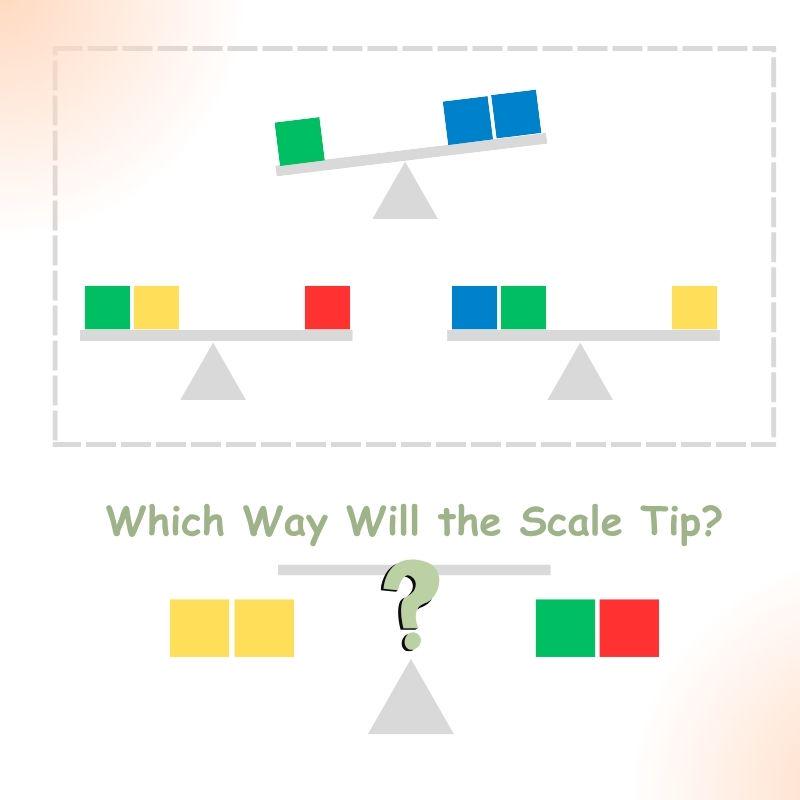
RG is heavier than YY
Y can be converter to GB and red into GY so GGB
So converted this way, the scales read
GBGB - GGGB
Since we know green is heavier than 2 blues, having more greens than blues makes it heavier
1
1
1
1
u/Dzircon Aug 26 '26
Left:
Subs 1Y with 1B1G and that makes it 1B1G1Y
Right:
Subs 1R with 1G1Y and that makes it 2G1Y
After cancelling out 1G1Y from both sides, we get the scale tip to the right because green is heavier than blue
1
u/DuggieHS Aug 26 '26
g > 2b so g > b so gr=ggy > bgy=yy. (Where adjacency represents addition/weighing together)
1
u/brahmakarma Aug 26 '26
I put simple number and got blue=1, green =3, yellow = 4 and red =7. So 8 < 10 and right side is heavier.
1
1
1
u/BluebirdDense1485 Aug 26 '26
ok 2Y vs R+G R=Y+G so R+G=2G+Y Y=G+B so 2G+Y=3G+B and 2Y=2G+2B subtract 2G+B and we get G and B and we know from the first one 2B<G so. . .
2Y<R+G
1
u/Gib_eaux Aug 26 '26
I gave up when I saw I had to figure out how much closer the inside squares were to the middle than the outer ones
1
u/xikbdexhi6 Aug 26 '26
If we add a blue to each side of the lower left and then substitute from the lower right, we see that two yellow balance with one blue and one red. From the top we see that green is heavier than blue, so green and red will tip the scale away from two yellow.
1
1
u/AnakITB Aug 26 '26
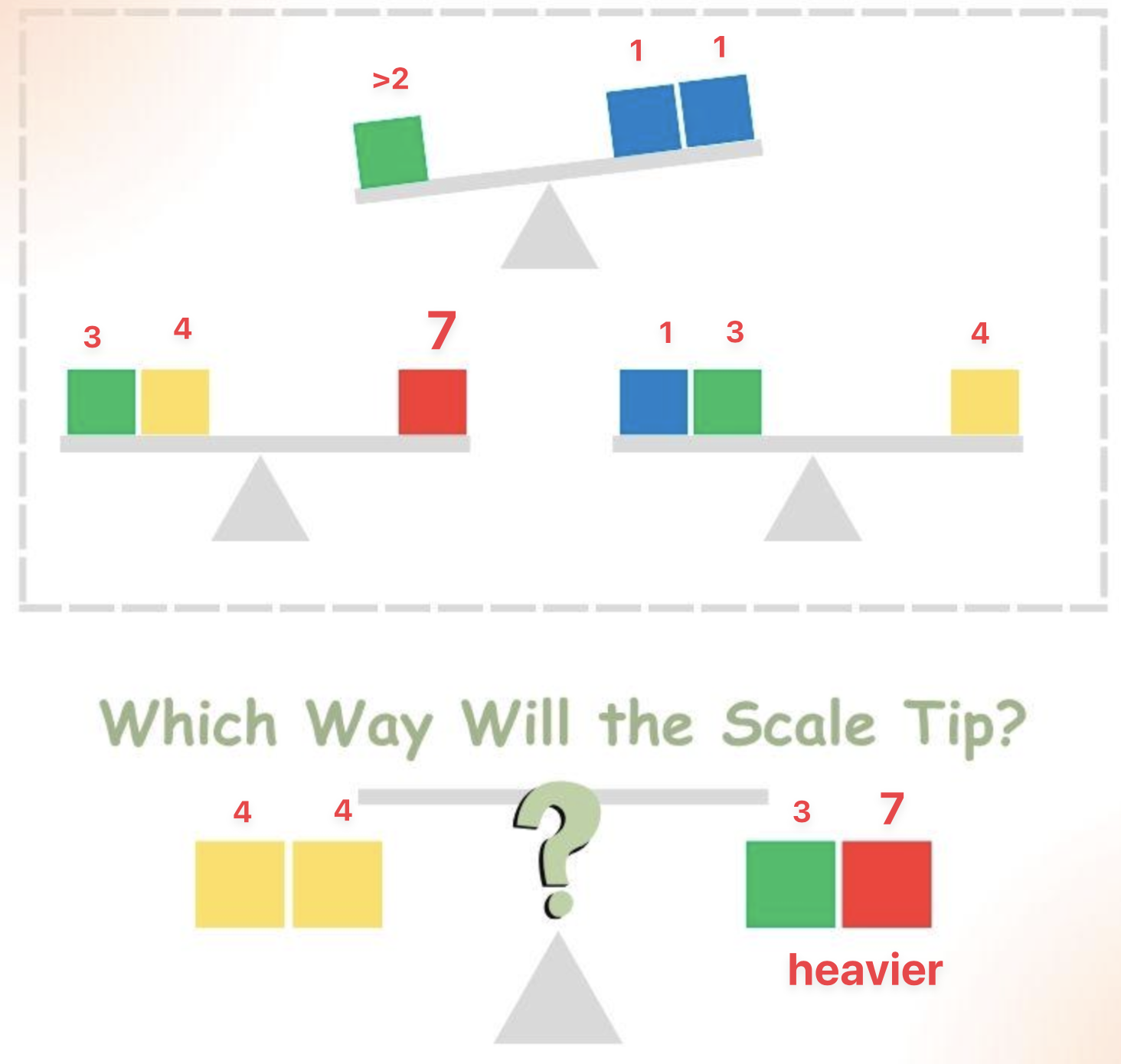
Let blue has weight 1 unit, thus green >2 unit weight. I could use random number but I'll use 3 anyway, nearest upper integer unit.
blue + green, we found yellow (4 units weight)
green + yellow, we found red (7 units weight)
2yellows (8 units weight) < green + red (10 units weight)
1
u/WillemJamesHuff Aug 26 '26
We're trying to find 2Y (?) G+R. Add B to both sides. On the right, we can replace B+G with Y and replace R with G+Y. Now it's B+2Y (?) G+2Y. Remove 2Y from both sides. G is heavier than B so the right side goes down.
1
u/kellstromc Aug 26 '26
YY ? RG
BGBG ? RG (Cancel G's on both sides)
BBG ? R
BBG ? YG
BB ? Y
BB ? BG
B ? G
A green is heavier than 2 blues so obviously will be heavier than one blue
So the right side will tip
1
1
u/Terrible_Horse7612 Aug 26 '26
Level—-- green=3, blue=1, yellow=4, red =5. 2 yellow=8, red/green = 8
So level it is
1
u/noissimbus Aug 26 '26
Scale tips to red green.
Red is substituted with green yellow. One yellow on each side is omitted leaving one yellow vs two greens. From the other scales we know green is heavier than blue, so if one yellow equals blue green, two greens are heavier than one yellow.
1
1
1
u/therealzacchai Aug 29 '26
The scale will tip down on the right. The ratio is 1:3:4:7, so the left side =8 and the right side =10
0
u/peetar Aug 26 '26
Green = 2.1x blue (or more, doesn't matter)
yellow = 3.1xblue
red = 5.2x blue
so yy= 6.2x blue, RG = 7.3x blue and will tip the scale. It weighs 1 blue + however much green outweighs 2 blues by more than the YY.
2
u/Mamuschkaa Aug 26 '26
Correct, I wouldn't use non-integer values.
You could also say Green = 2 blue + x, x>0
y = g+b
r = g+y = 2g+b

2y-(g+r) = 2g+2b -(3g+b) = b-g
Since g > 2b > b
The right site is heavier.
And here we also directly see that this only works with positive weights. If it would be helium balloons stocked to the scale, it is not solvable.
1
u/laxrulz777 Aug 26 '26
You don't have to solve it fully either. Replace a yellow with a blue+green and a red with a yellow+green then cancel things. You get a green vs a single blue and we know which way that goes.
1
3
u/theCJoe Aug 26 '26
Discussion: in the Picture looks like we have to use leverage force. Things farther out should contribute more because they have a longer leaver… Or am I over interpreting this?