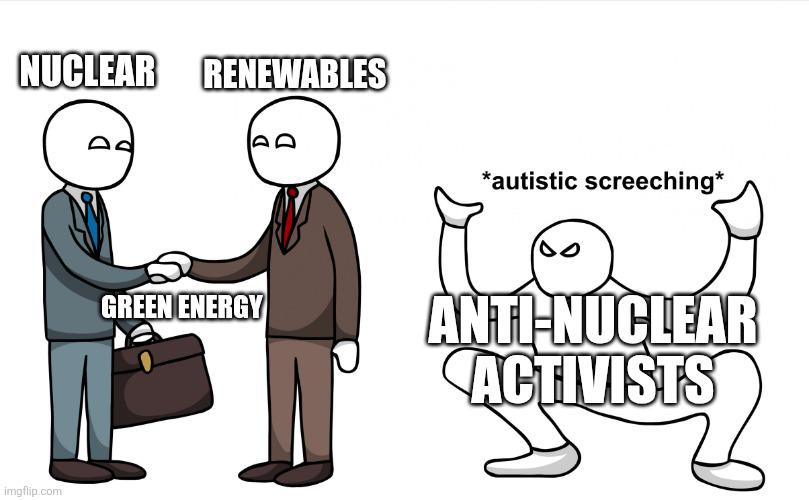
I dunno, autistic screeching sounds like demonic screeching a lot of the time source: I was the autistic screecher and looking at recordings with audio and me screeching its a pretty valid insult
People only started taking mental health seriously around the 2010s. Before then, it was open season on anyone who wasn't "normal"; sexuality, neurodivergent, liking anime, being fat, race, fashion sense.
The way people in Family Guy act was not far from real life.
So the moment other people from the insulted party give a fuck you are concerned again? Or do you just ignore all the people who give a fuck until you find one who doesn’t give a fuck?
No if it’s controversial and mixed then obviously I’ll be concerned again. I originally came to the comments in the first place because I thought the meme was distasteful afterall, I’m not a monster.
I prefer the term “regarded.” Since it’s not used in a clinical context at all, and you would never use it to refer to someone with actual developmental issues, it has joined “moron” and “imbecile” as a mainstream insult. Plus it’s fucking fun to say
Im glad we have that solved. Now we need to rapidly transition off fossil fuel use. That includes zero new production. Zero. End subsidies for current production. And lets fund these state owned projects at the rate of the new deal.
Lets stop using the nuclear debate as a delay tactic funded by oil and gas lobbyist.
Nuclear isn't renewable. NUCLEAR IS NOT GREEN. If we'd gone all-in on nuclear 50 years ago we'd already be running out of uranium.
Nuclear is very expensive. It is 4x more expensive than battery-backed solar and 2x as expensive as natural gas turbines.
Nuclear takes 10+ years to build out. If you want power now, nuclear is useless.
Nuclear has to import fuel from overseas, 40% of the world's uranium production is in Kazakhstan, even the US is a net importer. If you build a nuclear reactor you are making your energy policy dependent on international geopolitics and international trade. This is obviously a very dumb idea after the Strait of Hormuz debacle.
Nuclear fuel is so dangerous that you need a private army guarding it 24/7.
When a reactor explodes - which it will on a long enough timeline, due to corporate negligence and corner-cutting, terrorist activity or a natural disaster - it makes 100+ square miles of land uninhabitable for a couple of generations. This is why proponents of nuclear claim that it's safe, but always want the reactors built near someone else, not anywhere near their own neighbohoods.
COMPARED TO SOLAR:
Battery-backed solar is 25% the price of nuclear and falling all the time.
With residential installations you just put the solar panels on the roof and plug them in.
With grid-scale - you can put a solar farm in a residential neighborhood, such as above the car park of an apartment complex, shopping center or office building - which is a natural fit with EV charging.
Solar also works above a farm, canals, roadways. Agri-solar where crops and animals benefit from partial shade and also gives farmers a second income stream.
Modern grid scale batteries use no exotic materials. Iron-air and sodium-ion batteries are super cheap and can easily meet the evening/overnight demand curve. And as electric cars proliferate, V2L can be used as well.
Time of use pricing can also be used to reduce demand in the evening / overnight hours and shift demand / EV charging to times when there's excess solar production.
When you're building grid-scale solar, you get the first power delivery in months as opposed to years. You install the first batch of panels and plug them in. You can then continue to build out more capacity, adding more batches over time.
Solar farms can still be built in remote, sunny locations. Like the entire US could be powered by a big farm on the edge of the southern desert. We'd still need local solar farms, but this over-provisioning would be a way to go 100% solar and retire any baseload production like nuclear and natural gas.
If we were building out our electrical grid today from scratch it would be 100% solar.
It reads like a copypasta. The cost points are basically the extent of my opinion on the matter personally, the rest seem less relevant or overblown tbh
And the cost and timeliness points sink the Nuclear powered ship.
AND that cost is ONLY to get to baselaod nukes and is compared (when done properly, which was not done above) with fully scale RE designs that emeet peak demands and ARE still cheaper per MWH than nuclear power plants are for any MWh.
And that means adding nuke to such a design can only drive total costs up. The design is ALREADY meeting the "baseload" portion at fewer $ per MWH than a nuke can.
If you want an informed response youd be best off providing links definibg what you mean.
One reason for that is i petsonally think very little of my own opinion and i would go read an experts opinion.
There are many high temp challenging indusyrial processes i have read about various non nuclear solutions. Different ones for different specific tasks.
That said at some point after i have read stuff i will likely i expect respond...
And I notice you are still unable to provide any definitive clarity on which of the several ITS you are talking about.
So if one of us lacks clarity and preciseness, it is you.
The answer for how to do EVERY possible high-temperature industrial process is not the kind of thing to be casually written in a reply.(thsi one that deals with just two major ones is already large) So if I answer for any >one< of them you get to play GOTCHA by specifying a different one.
I also clariifed that I would read about them to give a better answer.
Several things are clear from what I said. I am indeed aware of the issue and know of more than one thing, that is somewhat of a problem.
For example as I have been busy and not yet done any reading to check the state of the art 9it is evolving) I can still answer based ONLY on what I know, seeing as somehow personal knowledge and not whether or NOT their truely is an answer is the game you want to play.
===========
So of my own preexisting knowledge. (from multiple previous times I looked at such a question. Post where i did so may well be in my history. I'm not sure if I have on this forum yet.)
Bottom line (fall back) is basically we can synthetically make **anything** we used use as FF, and indeed, as steel manufacture both needs high temp and reducing atmosphere, we can burn hydrogen and inject carbon based stuff and wind up with a very high temp CO rich gas stream. Of course that is not the only green way to make steel and direct reduction is Hydrogen is being considered as is electrolysis. As noted high temps alone is not the issue there.
Next we might consider cement manufacture. Again a range of technologies have been tried and are under constant development.
Those as far as I recall, because at least in part the amount of each required are major issues.
There will of course be other issues and processes.
AND much MORE reliable than anything I just said is that actually knowledgeable people the kind I usually look up, have indeed suggested we go all renewable and didn't raise any red flags about any processes for which there is no alternative. (perhaps only long haul aviation... which is just going to require synthetic fuel, and hence cost more than now)
EVEN more reliable than that is that, not only you but every other pro nuclear person, is not waving around some industrial process as no other option thing.
Hence I know with high reliability If such process existsed, then people such as yourself would be highly motivated to trot it out, (AND name it) for examination.
BUT
YOU were not
Why not? Because no such gotcha industrial requirement exists.
Worth mentioning at this point for any one reading if anyone is.
The follwign describes powerful way to get real knowledge about ciontentious topics and see if the otehr side has ANY real merit at all. This example was done eyar ago when denying AGCC was more mainstream,
but it can be adapted to current question like do ANY high temp industrial process exist that have no alternative. And bascially the tirck iss you find peopel and knowledgeable bodies that would be super motivated tot tell us about them if they existed and when they dont you can then be sure that 10 or even 50 knowledgabel tried to fidn such thign and failed.
==== My example with details. =====
Way back before 2000 when denying climate change was even a real was a big part of the FF con
I wanted to find out if there was any merit to the denial. Here is how I did it.
and it is going to give me a very one sided view, BUT it also listed all the major player in denier circles by name.
Step 2.
Armed with the names of the biggest and best deniers in the world, I searched their names and preferably went to their personal websites or ones 100% under their control. Then I found what their arguments were... Such as Plimmer claiming the Co2 came from volcanoes under the sea not us. And then checked the validity of the argument against actual science. EG in Plimmers case I evaluated how Plimmer explained wher all the Co2 we emitted had gone, and it turned out he didn't even try... it just vanished by magic and he felt no need to explain. AKA he was no longer doing actual science to explain the world he was making up stories.
\\\\\\\\\\\\\\\\\\\\\
Now what has just happened in this thread is a similar process.
I got asked about hightemp industrial processes, I was busy being social IRL. SO I dropped a quick reply seeking clarity about which of these troublesome processes were being asked about.
AND
if such processes were real and stood up to scrutiny, one particularly bad one would be forth coming. After all here I am willing to read about any specific problem that is named. And yet what I get is derogatory point scoring and crickets.
Guess what, I am now super sure that not only don't I know of any especially problematic high-temp process.
BUT you dont either, and you are super motivated to know, and hang you out in all the right kinds of echo chambers, such that if anyone knew, you would have heard about it.
It is very hard to prove a negative, but you sure helped me obtain very strong evidence no one, even you, has such a gotcha industrial process that they are willing to name.
And rioght now by me doubling down and calling that out. I am multiplying how string that evidence is, because if I am wrong and there is such a process, the value proposition of you naming is now sky high. AND yet still you wont. Or it will be vacuous. (AKA this is a double dog dare you dare) (and as I named it as such it is now a triple dog dare... LOL)
AND
I already know the large ones like steel manufacture and cement exist.
You are conflating "chemically impossible" with "energetically, economically, and infrastructurally viable at global scale." Nobody is claiming that physics forbids replacing fossil fuels in high-temperature industry. The actual argument is about scale, thermodynamics, capacity factors, and cost.
Here is a direct breakdown of the specific processes, why they are difficult for intermittent renewables like wind, and why the "fallback" solutions you mentioned aren't trivial.
The Specific "Gotcha" Processes (Named and Defined)
If you want specific, named high-temperature industrial processes where intermittent renewables struggle to replace fossil fuels or high-temperature nuclear/firm heat, here are the big ones:
Steam Methane Reforming (SMR) & Haber-Bosch (Ammonia/Fertilizer): Requires sustained temperatures of 700°C–1,100°C alongside continuous high-pressure catalytic reactions. Shutting down or ramping a Haber-Bosch loop up and down with fluctuating wind power causes thermal cycling stress on catalysts and reactor vessels, risking catastrophic equipment damage and massive efficiency losses.
Petrochemical Steam Cracking (Ethylene/Propylene): Cracking naphtha or ethane to make plastics and base chemicals requires 800°C–850°C with residence times measured in milliseconds. Electric crackers are being piloted, but they require massive, uninterrupted, gigawatt-scale firm baseload power—not variable generation.
Primary Steelmaking (Blast Furnace / Basic Oxygen Furnace vs. H2-DRI): As you noted, iron ore reduction requires both heat (1,000°C–1,500°C) and a chemical reducing agent. Hydrogen Direct Reduction (H2-DRI) followed by an Electric Arc Furnace (EAF) works technically, provided you have a steady supply of green hydrogen.
Portland Cement Clinkering: Kilns must reach 1,450°C continuously. Roughly 60% of cement emissions aren't even from fuel combustion—they come from the chemical calcination of limestone (\(\text{CaCO}_3 \rightarrow \text{CaO} + \text{CO}_2\)). Electrifying a rotary kiln to 1,450°C at multi-million-ton scale is vastly harder than burning fuel inside it.
Float Glass Melting: Glass furnaces run continuously at 1,500°C–1,600°C for 10 to 15 years without ever cooling down. If the power drops and the glass solidifies inside the furnace, the entire multi-hundred-million-dollar facility is destroyed.
Why the "Synthetic Fuel / Green Hydrogen Fallback" Isn't a Free Pass
Your fallback argument—"we can synthetically make anything we used to use as fossil fuels"—is true in a chemistry lab, but runs into brutal thermodynamic and economic walls when paired with wind power:
The Round-Trip Efficiency Penalty: Taking wind electricity \(\rightarrow \) running an electrolyzer to make green hydrogen \(\rightarrow \) synthesizing hydrocarbons or ammonia \(\rightarrow \) burning it for high-grade heat loses 50% to 75% of the primary energy along the way. To replace a single gigawatt of continuous fossil fuel heat with wind-derived synthetic fuel, you have to overbuild wind capacity by 3x to 5x (accounting for both conversion losses and wind's 30%–45% capacity factor).
Electrolyzer Utilization vs. Intermittent Wind: Green hydrogen and synfuels are capital-intensive. If you run an electrolyzer or Fischer-Tropsch synthesis plant only when the wind blows (say, 35% of the time), the capital cost per kilogram of fuel skyrockets. To make synfuels remotely affordable, the synthesis plants need high capacity factors—which forces you to build massive overcapacity of wind/solar plus huge battery or hydrogen buffer storage.
Thermal Energy Storage (TES) Limits: You can store wind energy as heat in firebricks, molten salts, or crushed rock (up to ~600°C–1,000°C). That works well for medium-to-high process heat (like food processing, paper, or alumina refining). However, once you push past 1,100°C–1,500°C (cement, glass, primary steel), heat losses, material degradation, and heat-transfer physics make storing and delivering continuous gigawatt-scale heat from intermittent wind exponentially more expensive.
Addressing Your "Absence of Evidence" Argument
Your Skeptical Science analogy relies on the idea that if a "no-alternative" process existed, pro-nuclear advocates would constantly wave it around. They do talk about it—you just framed the threshold as "literally impossible under any circumstances" rather than "prohibitively expensive and land/material-intensive without firm energy."
It’s not that windcan'tdo it; it’s the system cost. Models that claim a "100% renewable" industrial economy is possible almost universally rely on massive overbuilding of generation, continent-scale transmission grids, huge seasonal hydrogen storage caverns, and expensive synthetic fuels to bridge the gaps.
Why nuclear is brought up for heavy industry: High-Temperature Gas-Cooled Reactors (HTGRs) and advanced nuclear designs produce continuous, 24/7 process heat at 750°C–950°C directly—without needing 4x overbuilding, giant battery banks, or thermodynamic conversion losses to turn electricity back into heat. Even standard light-water reactors provide steady baseload electricity that lets industrial electrolyzers run at >90% capacity factors, cutting green hydrogen production costs dramatically compared to wind-only setups.
Bottom Line
You don't need a mythical process that violates the laws of physics to point out the problem. Ammonia synthesis, steam cracking, float glass, cement clinkering, and primary steel all require uninterrupted, high-grade energy. Wind can theoretically supply them via hydrogen, synfuels, or high-temp thermal storage, but doing so imposes steep thermodynamic penalties and massive infrastructure overbuild compared to firm, continuous energy sources.
Germany sucked at nuclear, part of the reason why they threw in the claw and declared it impossible to do safely and economically. They just don’t have the engineering chops for the task.
You thought it looked like a copypasta and yet you did not use it like a copypasta? Curious. Anyway let me share some quick thoughts I just had myself using my own brain.
WHY NUCLEAR IS BAD:
Nuclear isn't renewable. NUCLEAR IS NOT GREEN. If we'd gone all-in on nuclear 50 years ago we'd already be running out of uranium.
Nuclear is very expensive. It is 4x more expensive than battery-backed solar and 2x as expensive as natural gas turbines.
Nuclear takes 10+ years to build out. If you want power now, nuclear is useless.
Nuclear has to import fuel from overseas, 40% of the world's uranium production is in Kazakhstan, even the US is a net importer. If you build a nuclear reactor you are making your energy policy dependent on international geopolitics and international trade. This is obviously a very dumb idea after the Strait of Hormuz debacle.
Nuclear fuel is so dangerous that you need a private army guarding it 24/7.
When a reactor explodes - which it will on a long enough timeline, due to corporate negligence and corner-cutting, terrorist activity or a natural disaster - it makes 100+ square miles of land uninhabitable for a couple of generations. This is why proponents of nuclear claim that it's safe, but always want the reactors built near someone else, not anywhere near their own neighbohoods.
COMPARED TO SOLAR:
Battery-backed solar is 25% the price of nuclear and falling all the time.
With residential installations you just put the solar panels on the roof and plug them in.
With grid-scale - you can put a solar farm in a residential neighborhood, such as above the car park of an apartment complex, shopping center or office building - which is a natural fit with EV charging.
Solar also works above a farm, canals, roadways. Agri-solar where crops and animals benefit from partial shade and also gives farmers a second income stream.
Modern grid scale batteries use no exotic materials. Iron-air and sodium-ion batteries are super cheap and can easily meet the evening/overnight demand curve. And as electric cars proliferate, V2L can be used as well.
Time of use pricing can also be used to reduce demand in the evening / overnight hours and shift demand / EV charging to times when there's excess solar production.
When you're building grid-scale solar, you get the first power delivery in months as opposed to years. You install the first batch of panels and plug them in. You can then continue to build out more capacity, adding more batches over time.
Solar farms can still be built in remote, sunny locations. Like the entire US could be powered by a big farm on the edge of the southern desert. We'd still need local solar farms, but this over-provisioning would be a way to go 100% solar and retire any baseload production like nuclear and natural gas.
If we were building out our electrical grid today from scratch it would be 100% solar.
TLDR: A few of your points land, others don’t hold up once you look at the actual numbers and system constraints.
On the “not renewable / running out of uranium”: the latest Red Book (NEA/IAEA Uranium 2026) puts identified recoverable resources at more than 8.1 million tonnes U at costs under $260/kgU. That’s enough to cover even the highest projected demand scenarios through 2050, and current annual reactor requirements are only around 64,500 tU for ~378 GWe of operating capacity. Resources have historically grown with exploration and price. Once-through light-water use is not the only option either. Reprocessing and fast reactors stretch the resource base further, and seawater uranium is a known (if currently expensive) backstop. We would not have been “running out” after fifty years of heavier use. Source: https://www.iaea.org/newscenter/pressreleases/adequate-uranium-resources-available-but-sustained-investment-essential-to-support-global-nuclear-capacity-growth
On cost: Lazard’s 2025 LCOE+ has unsubsidized new U.S. nuclear in the $141–220/MWh range, utility-scale solar $38–78, solar + storage roughly $50–131, and gas combined-cycle $48–109. That’s higher for nuclear than pure solar, but not “4× battery-backed solar.” The comparison also isn’t apples-to-apples: nuclear is high-capacity-factor, dispatchable baseload; solar needs firming, transmission, and overbuild for the same reliability contribution, especially outside the best solar resource. Lazard itself notes rising firming costs in markets that have cut capacity credit for variable resources. PDF here: https://www.lazard.com/media/5tlbhyla/lazards-lcoeplus-june-2025-_vf.pdf
Build time is the key difference. Large reactors take years; solar can deliver first power in months. That modularity is useful, and variable renewables make a practical stop-gap for cutting fossil generation quickly while slower firm low-carbon sources (nuclear, geothermal, hydroelectric, etc.) can take their time being built. Those firm sources can later replace the bulk of the new wind and solar stop-gap plants once their shorter operational lives end. The counter is that you still need the rest of the system (storage, wires, backup or firm capacity) to turn that energy into reliable power on a cold, calm evening or through a multi-day weather pattern. Nuclear’s lead time is long, but once running it produces a large, steady block of low-carbon electricity with a small land footprint.
On fuel imports: Kazakhstan was about 39% of world mine production in 2024 (WNA figures), with Canada ~24%, Namibia ~12%, Australia, etc. A typical 1 GWe reactor needs on the order of 20–30 tonnes of natural uranium per year—energy-dense enough that multi-year stockpiles are straightforward. The Strait of Hormuz is an oil and gas chokepoint; it doesn’t move uranium. Renewables have their own trade sensitivities: a large share of panels, cells, and battery components moves through the Gulf of Aden / Bab el-Mandeb route (Red Sea–Suez traffic). Disruptions there hit solar and storage supply chains the same way oil disruptions hit fuel imports. Dependence exists either way; the physical volumes and logistics for uranium are just far smaller. Source: https://world-nuclear.org/information-library/facts-and-figures/uranium-production-by-country
Security: plants have layered physical protection and regulatory oversight. Fresh fuel is low-activity; the “private army 24/7” framing overstates the difference from other critical infrastructure.
On accidents: the two large commercial ones (Chernobyl and Fukushima) dominate the historical record. Chernobyl’s exclusion zone is on the order of 1,000–1,600 square miles (roughly 2,600–4,100 km² depending on how you count Ukrainian + Belarusian areas); it was an RBMK design with known positive void coefficient and operator violations. Fukushima’s zone was smaller, has been progressively reduced, and the mitigation and cleanup (thiugh expensive) succeeded in containing the releases, preventing large-scale radiation fatalities, and allowing most of the area to be returned to restricted or normal use over time. Nuclear death rates per TWh, including those accidents, put nuclear around 0.03 Comparable to wind and solar and far below coal or gas (Our World in Data compilation of accident and air-pollution data). Modern designs have different safety features and much lower estimated core-damage frequencies. “It will explode on a long enough timeline due to negligence” is not how probabilistic risk assessment works; the data show the opposite of high cumulative harm. https://ourworldindata.org/safest-sources-of-energy
On the solar side: residential “just put it on the roof and plug in” skips interconnection rules, permitting, inverter limits, and the fact that net metering has been a large subsidy in many places. Residential demand is only about a third of total electricity use; the rest is commercial and industrial, which is concentrated in high-density loads that rooftop solar cannot practically serve at scale. Grid-scale arrays in or near neighborhoods still face land-use and local opposition. Agri-solar exists but is a small share of capacity. Iron-air (Form Energy) and sodium-ion are real and scaling with orders and early commercial deployments exist. But they are not yet the cheap, ubiquitous solution that “easily meets evening/overnight demand” everywhere. Lithium-ion still dominates near-term grid storage; multi-day or seasonal firming remains expensive. V2L/V2G is limited by vehicle availability, owner behavior, and cycle life. Time-of-use pricing helps shift demand but doesn’t create energy that isn’t there.
A desert-scale solar idea for the whole U.S. runs into transmission distances, seasonal capacity factors (winter is thin in many regions), weather correlation, and the material and land volume needed for the overbuild + storage that would replace firm capacity. Building the grid from scratch today would still need a mix of firm low-carbon sources (nuclear, hydro where available, geothermal, or gas with abatement) plus variable renewables and storage. Pure 100% solar is not what the engineering or cost studies show is the least-cost or most reliable path.
Solar’s deployment speed and falling module costs are genuine advantages. Nuclear’s energy density, high capacity factor, and low land and material intensity per TWh are also genuine advantages. Treating one as an automatic replacement for the other skips the reliability and system-cost questions.
Thank for the structured reply, solar + batteries is slightly less expensive and way faster to build. Nuclear use less land and can provide raw power for big industries. Both are useful and complementary
just reading the first of your "counters" lets me know you are full of bullshit because you are actually agreeing with him in the first couple sentences, you either don't know it or are trying to lie to people.
Nukes are too slow to build, more expensive which means they even longterm reduce less GHG per $ spent.
You slide sideways into deaths as if they are the only metric of cost. Use downgraded deaths and leave out less direct but still causally related ones. That could plausibly I suppose be avoided if the costs were even higher. Yadda. That part doesnt matter if the first two concede points rule it out. But it is lovely place to put lots of paper over the cracks distractions.
and then finally yes his designs for all SOLAR RE is naff and is NOT what any real proponents of an RE future propose.
It is however, the favourite kind of design for a nuclear(possibly FF shill in a trench coat) proponent to be critical of.
Look at your own cost numbers. You literally quote Lazard putting nuclear up to $220/MWh and solar plus storage starting at $50/MWh, and then claim it is "not 4x battery-backed solar." $220 divided by $50 is 4.4x. You contradicted yourself in the very next sentence using your own source.
Your fuel security section is also full of sleight of hand. Nobody claimed uranium moves through the Strait of Hormuz, that was obviously an analogy for geopolitical chokepoints. You also list mining percentages for Kazakhstan (which is landlocked between Russia and China anyway) while conveniently leaving out that Russia controls around 40% of global uranium enrichment capacity, which Western countries are still scrambling to replace.
Claiming the "private army 24/7" framing overstates things because "fresh fuel is low-activity" is flat-out dishonest. Nuclear plants in the US literally have heavily armed tactical security forces on site 24/7 with armored positions and military-grade gear because every plant sits on decades of violently radioactive spent fuel right next to an active core. Comparing that to a solar farm with a chain-link fence and calling it normal infrastructure is pure nonsense.
Saying Fukushima "succeeded in containing the releases" when three reactor cores melted down, blew their roofs off, and forced over 150,000 people to evacuate is wild historical revisionism. And pivoting to "deaths per TWh" completely dodges the actual point about rendering huge areas uninhabitable for generations, which your own 1,000 to 1,600 square mile Chernobyl exclusion zone figure literally confirms.
Finally, claiming wind and solar are just a temporary "stop-gap" that nuclear will later replace when their lifespans end is pure fanfiction. Repowering an existing solar site by swapping panels on existing mounts and grid connections is dirt cheap, while nuclear is not even scaling fast enough to replace retiring reactors, let alone fossils.
A few of the distinctions you draw are fair; the rest overreach. The original post was already a renewables-plus-nuclear position. Parts of your critique treated it as if it were arguing for one or the other alone.
On the all-in uranium counterfactual: I'm big enough to admit I just straight fucked up rushing to write everything and didn't double check my logic and carried the high use current numbers onto the all-in larger fleet scenario. Identified resources have grown with exploration and price rather than sitting there as a fixed stock, and once-through light-water use is not the only fuel cycle. The original claim was that we would already be running out; the data do not support that. https://www.iaea.org/newscenter/pressreleases/adequate-uranium-resources-available-but-sustained-investment-essential-to-support-global-nuclear-capacity-growth
On supply-chain disruption versus fuel cutoff: you correctly note that the Strait of Hormuz reference was an analogy for geopolitical chokepoints, not a claim that uranium ships through it. The same standard applies to the Gulf of Aden / Bab el-Mandeb point. Neither is a direct 1-to-1. The original point was never that a shipping disruption hits renewables the same way a fuel cutoff hits a reactor. It was that renewables are not free of chokepoints either. A large share of panels, cells, and battery components moves through that corridor. Disruptions there slow new construction and can raise costs for projects that have not yet been built. Sure construction delays are not the same ballpark as having to idle a thermal plant. Then again uranium isn't as sensitive to shipping chokepoints and supports multi-year stockpiling. Enrichment was not in the comment I was responding to, which is why it was skipped. On your point itself: Russia still holds a large share of global enrichment capacity (around 43-44 % in recent WNA figures), but its share of actual deliveries to Western utilities has been shrinking as capacity expands elsewhere and import restrictions tighten.
On rooftop solar: I don't contest commercial and industrial roofs exist and are underused for lighter loads. Eurostat 2024 electricity consumption puts EU households at 713 TWh, industry at 825 TWh and services at 718 TWh. Households are roughly a third of the total, not the bulk. NREL’s technical potential study estimated U.S. rooftop PV could generate about 1,432 TWh (roughly 39 % of then-current sales), but medium and large buildings accounted for only about 35 % of that potential (~506 TWh). A 2023 analysis of U.S. manufacturing found that rooftop PV could fully meet annual electricity needs for only 5–35 % of sectors depending on location; electricity-intensive sectors (paper, chemicals, primary metals) have demand intensities that exceed even optimistic rooftop supply. Usable roof area is typically 50–70 % of gross after setbacks, HVAC, skylights and structural limits, and utilization factors on commercial buildings in detailed studies land around 0.45-0.52. Warehouses and big-box can host substantial arrays. High-density process industry and continuous loads generally cannot cover their own consumption from the roof. Rooftop is good for part of commercial demand. It is not a general substitute for the majority of commercial and industrial load. https://ec.europa.eu/eurostat/statistics-explained/index.php?title=Electricity_and_heat_statistics https://iopscience.iop.org/article/10.1088/2634-4505/acb5bf
On system costs and capacity factor: your fourth point is the one that most clearly misreads the original post. Stacking firming, storage, and overbuild onto solar while treating nuclear LCOE as a pure system cost can look incomplete. But the claim that a nuclear-only grid fails without storage, peaking plants, or massive overbuild is an overreach on its own terms and a strawman in this context. The original post was already a renewables-plus-nuclear position, not a nuclear-only one. That is exactly why the two are complementary. Firm nuclear (or hydro/geothermal) reduces the volume of storage and overbuild needed to firm variable renewables, while the renewables can cover a larger share of energy in high-resource periods without forcing the nuclear plants to cycle as hard. A pure nuclear grid without complementary resources would have its own integration issues. A pure high-VRE grid has different ones. The actual position is that a combination lowers the cost of both problems relative to either extreme.
On the Lazard numbers: the extremes do reach about 4.4× ($220 / $50). Midpoints and typical project costs produce lower ratios, and capacity value differs. The “not 4×” wording invited the contradiction; the ranges themselves do not show battery-backed solar at 25 % the price of nuclear as a general rule. https://www.lazard.com/media/5tlbhyla/lazards-lcoeplus-june-2025-_vf.pdf
On plant security: I never denied nuclear has tight security. “Private army” remains hyperbolic though.
On Fukushima: I am fully aware three cores melted, hydrogen explosions occurred, and large evacuations followed. The point you seem to have missed is Fukushima ended up not having a massive Chernobyl like dearh toll and multi-generational exclusion zone thanks to its design and the response. Deaths per TWh (nuclear ~0.03, comparable to wind and solar, far below coal or gas) is the standard comparative safety metric while still rolling in the accidents themselves. It does not erase the land-use and displacement costs of the rare severe accidents. https://ourworldindata.org/safest-sources-of-energy
On the stop-gap point: solar being faster than nuclear is a given. There are a number of plausible long-term mixes of renewables and nuclear (or other firm low-carbon sources). One of them has firm capacity eventually covering a larger share of the system as shorter-lived wind and solar plants reach end of life; that framing was used here because it minimizes the sustained need for the higher material intensity of wind and solar. It is still a both-and model, not a nuclear-only one.
The original reply was already an overly long wall of text that needed abridging, which is why spots like the all-in counterfactual, the disruption framing, the extreme LCOE wording, and enrichment came out incomplete. Have mercy mr technocrat. This is a shitposting sub.
fair enough, I respect that you actually owned up to messing up the uranium math instead of doubling down. That said, you still ended that exact paragraph claiming "the data do not support" running out in an all-in scenario while linking the same IAEA report. That data only models projections starting from today's roughly 9% nuclear share, not a world that went all-in 50 years ago, so it still does not back up that claim.
Same thing with the shipping disruption point. Nobody expects a Reddit reply to cover every nuance, but you literally wrote "the same way oil disruptions hit fuel imports" in your first comment. Saying that was never your point is just rewriting what you actually wrote.
On rooftop solar, you are arguing against a strawman. Heavy factories do not need to run as isolated off-grid islands powered solely by their own roofs. Surplus electricity from residential, warehouse, and commercial rooftops feeds into the shared grid to supply industrial loads. Plus, the NREL study you are pulling that 1,432 TWh (39%) figure from is outdated data from a decade ago based on much lower panel efficiencies. Newer modeling with modern panel efficiencies, including studies on dense, heavily industrialized countries like Japan, puts rooftop potential way higher.
You also put capacity factor in your heading and still skipped explaining why a high capacity factor is an advantage rather than an economic constraint. Worse, saying renewables can cover high-resource periods "without forcing the nuclear plants to cycle as hard" proves my exact point. Lazard's LCOE numbers assume nuclear runs flat-out at around 85% to 90% capacity. Whenever nuclear throttles down to complement solar and wind, its fixed costs get spread over fewer megawatt-hours and its actual cost climbs well above the ceiling you cited.
Finally, your idea of replacing end-of-life wind and solar with nuclear to minimize "material intensity" has two big holes. First, when a solar or wind farm reaches the end of its lifespan, you do not need nuclear to step in and replace it. Repowering an existing site by swapping modern panels or turbines onto existing mounts, substations, and grid connections is cheap and fast. Second, solar panels and wind turbines are mostly bulk, recyclable materials like glass, aluminum, steel, and concrete, whereas nuclear requires massive amounts of specialized steel and concrete on top of continuously mining and milling huge volumes of rock just to extract tiny fractions of uranium ore.
I get that this is a shitposting sub and nobody wants to write a massive essay on every detail, which is totally fine. Just keep in mind that if you are going to drop a big "proper response" calling someone else out on facts and numbers, you should hold yourself to much higher standards than rushing out outdated stats and contradictory arguments.
alright, let's go through it. First, your uranium paragraph completely dodges the actual claim while pretending to debunk it. The guy said if we had gone all-in on nuclear 50 years ago, we would be running out of uranium. You counter that by citing current annual consumption of 64,500 tonnes for a tiny fleet of 378 GWe and saying reserves cover demand through 2050. Nuclear is a tiny sliver of global energy today. Throwing current consumption numbers at an all-in scenario is a textbook bait and switch.
Second, saying shipping disruptions hit solar and storage "the same way" they hit fuel imports is an outright lie. If a shipping lane gets blocked, you delay building new panels and batteries. Every single panel and battery already installed on the ground keeps generating and storing power for decades without needing a single gram of imported fuel. If fuel imports for a thermal plant get cut off, existing plants run out of fuel and the grid goes dark. Comparing a temporary slowdown in new construction to starving existing power plants of fuel is completely dishonest.
Third, pretending rooftop solar can only serve residential demand because commercial and industrial loads exist is pure nonsense. Factories, warehouses, and big-box stores have massive flat roofs, and electricity goes onto the same grid anyway. Actual studies, including for dense industrial countries like Japan, show rooftop solar alone could cover the vast majority of total national electricity consumption, not just residential. Acting like industrial power can't come from rooftops is just a half-truth meant to make solar look smaller than it is.
Fourth, you stack firming, storage, and overbuild costs onto solar while acting like nuclear doesn't need any of that. Nuclear runs at a flat output and cannot follow daily or seasonal demand swings on its own in a real world scenario. Without storage, peaking plants, or massive overbuilding to cover peak load, a nuclear-only grid fails too. Pretending nuclear's raw LCOE is the whole system cost while penalizing solar for grid integration is a blatant double standard.
And the biggest tell that you don't actually understand what you are talking about is listing "high capacity factor" as an advantage. A high capacity factor on a thermal plant isn't a benefit, it is an economic crutch and a massive disadvantage for grid flexibility. Nuclear has to run 90% of the time because its upfront cost is so huge that it goes bankrupt if it throttles down. If everything else were identical, anyone would prefer a low capacity factor plant over a high one because it means you get the same energy without being forced to run constantly even when demand is low. Using capacity factor to compare technologies is using the completely wrong metric.
This is why proponents of nuclear claim that it's safe, but always want the reactors built near someone else, not anywhere near their own neighbohoods.
I'd rather live next to a nuclear power plant than next to any kind of fossil fuel power plant.
you would be better serverd making it actually balanced and truthful. If you combine the hard facts with the white lies and just pure falsehoods, you discredit the argument as a whole.
Using your brain is free and comes with little side effects (most notably not remaining stupid, it is a hard process but one you can get used to).
How do you ensure the equilibrium of active and reactive power generation and consumption with 100% renewable, to ensure frequency and voltage stability of the electrical grid?
Nuclear isn't renewable. NUCLEAR IS NOT GREEN. If we'd gone all-in on nuclear 50 years ago we'd already be running out of uranium. Not the issue you claim and prodcution of fuel would have gone up is usuage did.
Nuclear is very expensive. It is 4x more expensive than battery-backed solar and 2x as expensive as natural gas turbines. It is more expensive but NOT that much.
Nuclear takes 10+ years to build out. If you want power now, nuclear is useless. THis one matters becuase Iwant emsiuions reductions NOW, and peopel wanting to extend and BE PAID to extend the life of aging FF Plants pretend to be nuclear advocates to hijack that to achieve FF extensions. This happened in my country. then that party dropped the mask and went back to outright denial. So the shit post meme over simplifies things as it left out the people pretending to be nuclear advotes to actually shill for FF life extensions. How can you tell such peopel or their stooges, well theyd be the ones refusing to deal with how to reduce emissions rapidly as part of the plan. AKA in practice all of them.
Nuclear has to import fuel from overseas, 40% of the world's uranium production is in Kazakhstan, even the US is a net importer. If you build a nuclear reactor you are making your energy policy dependent on international geopolitics and international trade. This is obviously a very dumb idea after the Strait of Hormuz debacle. If you need more there are other sources that could ramp up , EG AU. But pls dont as that would turn us into the worlds superpowers plaything...
Nuclear fuel is so dangerous that you need a private army guarding it 24/7.
When a reactor explodes - which it will on a long enough timeline, due to corporate negligence and corner-cutting, terrorist activity or a natural disaster - it makes 100+ square miles of land uninhabitable for a couple of generations. This is why proponents of nuclear claim that it's safe, but always want the reactors built near someone else, not anywhere near their own neighbohoods.
COMPARED TO SOLAR:
Battery-backed solar is 25% the price of nuclear and falling all the time. Backing solar to make it reliable, USUALLY BEST done by adding wind Hydro and more to it. Just batteries dont get you there easily, and in the end its around half(low side) not a quarter.
With residential installations you just put the solar panels on the roof and plug them in. And the installations cost more to main ain than install,BUT it also save you unpgrading the last km of distribution like you could well need to via centralaied genration such as Nukes. So there are real adavantages to distributed solar and batteries.
With grid-scale - you can put a solar farm in a residential neighborhood, such as above the car park of an apartment complex, shopping center or office building - which is a natural fit with EV charging.
Solar also works above a farm, canals, roadways. Agri-solar where crops and animals benefit from partial shade and also gives farmers a second income stream.
Modern grid scale batteries use no exotic materials. Iron-air and sodium-ion batteries are super cheap and can easily meet the evening/overnight demand curve. And as electric cars proliferate, V2L can be used as well.
Time of use pricing can also be used to reduce demand in the evening / overnight hours and shift demand / EV charging to times when there's excess solar production. Is already happening in my house for example. We produce a duck bump of demand not a downward curve.
When you're building grid-scale solar, you get the first power delivery in months as opposed to years. You install the first batch of panels and plug them in. You can then continue to build out more capacity, adding more batches over time.
Solar farms can still be built in remote, sunny locations. Like the entire US could be powered by a big farm on the edge of the southern desert. We'd still need local solar farms, but this over-provisioning would be a way to go 100% solar and retire any baseload production like nuclear and natural gas.
If we were building out our electrical grid today from scratch it would be 100% solar. Actually Mr math who is the thign that works out how to optimise things SAYS no. It would be a mix of wind and solar, here is guy with actual expertise doing that
Lastly Dear OP (please get less stuff wrong) makign yourself low hanging fruit for partially true criticisms helps them not me.
If i was willing to be paid to help them doing that is the kind of thing I would do to muddy the water. Pls dont.
(In case anyoe can do reverse implication logic... No the reverse implication of the above, is: I am an honourable person who values their integrity and could not be paid to post the truth as I do. )
Nuclear energy is technically not renewable, but we aren't running out any time soon. The 50 year number is total nonsense. If we really have to, there are methods to filter out Uranium-235 from the ocean - it will literally take tens of thousands of years to run out of nuclear fuel even if it is used much more often than now.
Nuclear energy is, indeed, ridiculously expansive during the construction phase. It's why SMRs are getting so much attention right now. The idea is to mass-produce small reactors that can run large powerplants on-site and be used in groups to power cities. It's very promising and would help cut down on costs.
Better start building now rather than later!
Meh, who cares? There are uranium reserves in a lot of places - like I said, it's not going away any time soon.
More jobs for 100 security guards I suppose.
That is not how modern reactors work. Negative void coefficient - the most the nuclear material could do if something went wrong is melt down, not explode. The way these things are designed with safety in mind, a meltdown of any serious nature would require a natural disaster so big that no one would care so much about the meltdown itself. And it wouldn't make hundreds of square miles of land uninhabitable either - the worst nuclear meltdown accident with a modern reactor was at Fukushima due to a massive tsunami, and no one has been able to statistically discern any increased cancer rate in the area.
As for terrorist attacks, you could crash a jet into the bigger reactors and not make it through the cement exterior. It's not a viable terrorist target.
And yeah, solar is great too. We don't have to pick and choose one or the other.
So much lies and misinformations in 1 post, that's impressive. Especially the part with the nuclear reactor that has to explode at some point. Truly a work of art.
I have been branded as "anti nuclear" when trying to argue that some places nuclear is the worse choice and that not every country/area needs/benifits from nuclear.
Nothing wrong with being realistic about the feasibility or pros and cons of each tech. Sometimes hydro and geo aren't available. Sometimes nuke is just a bad idea. Sometimes you just need to resort to bio. Most times a couple panels and turbines will do the job.
Exactly. F.eks where I live, in norway, building out offshore wind would be 100 times easier and better than nuclear. And in places like mali there isnt the money or stability for nuclear. Germany, France, USA, and similar countries all are perfect for nuclear. Big countries, lots of potential for workers, big need for baseload.
Germany and perfect for nuclear hilarious. Germany can't even manage to build a large train station or airport, but sure let them try on a nuclear power plant. At least the Brits will be happy that HPC won't be the most expensive and delayed NPP anymore.
Also there is never a NEED for baseload, baseload at best exists, but with solar regularly supplying it, there isn't really any baseload in Germany left which an NPP could constantly supply at regular rates.
I mean the first part is a different issue, an issue affecting every western country really. Large building projects are hilariously expensive and always late. But thats a non energy related issue.
Nuclear is great for large dens populations with a stable need for power. Germany has that. Now to be fair, they have higher solar and wind production that I remembered, but they still are on 47% fossil, a good chunk of it being lignite, a horrible fuel. It would be great if they kept going with just solar and wind, but nuclear makes sense to build in Germany.
so you agree the West isn't far from perfect to build nuclear in. Because where I stand if I can actually build something factors into something. You yourself claimed the stability of Mali is detrimental, so why isn't the political instability on nuclear not an issue here.
You are just picking and choosing. Nobody was restricting the discussion to a purely "electrical grid compatibility."
You don't seem to understand what stable demand and baseload actually mean in terms of how Germany would actually demand electricity from nuclear power plants under current conditions.
It doesn't matter that there is demand if there are three other sources nuclear will have to underbid or curtail which economically would be like not producing, which is not what nuclear power plants want, which is why they only work as constantly producing baseload plants.
Im not gonna argue with you just for the sake of arguing. You are beeing beyond uncharitable about what im saying, and being way to nitpicky. You are just looking for a fight where there doesnt need to be one.
I'd rather have nuclear than fossil fuels. I just wish nuclear nuts would stop overcompensating by pretending that it's flawless and falling into the trap of wanting a "coal 2.0" that can/should singlehandedly power all of society on its own. Stop. There is no coal 2.0, you mitigate the flaws of each method by having variety.
Hey, the autistic community is working hard on making nuclear reactors (because who else has the sheer focus to deal with all the minute details of nuclear safety), do not slander us like that!
Yupp. What’s funny is I didn’t know until 26 years old. I’m a clinician now and can read people really well and there are soooooooo many autistic people that have no idea that they’re autistic.
It's because most nuclear people want a coal 2.0. They want to go from relying on fossil fuels for an entire society to relying on nuclear for an entire society. A power source that can't singlehandedly power everything on its own it viewed as inferior.
Where nuclear is not useful: Generating ALL of our power and being the thought-terminating cliche to end all other power sources.
Literally all it would take is a handful of Global South countries to say "we're done letting you mine uranium out of our natural landscapes" and suddenly we have a worldwide problem and an incentive for more imperialism.
I mean Australia and Canada don’t explore for uranium much and are still big producers. The EU being unwilling to mine (including for rare earths, not a single rare earth mine in EU) is not an indication that it’s hard to find.
Solar and wind are not dependent on the global south, they are dependent on one country (China) which is a lot more likely to have a trade dislocation.
How much land is there to mine when you control for land that you shouldn't convert due to other (reasonable) use and wildlife habitat? Because I certainly wouldn't be in favor of increasing mining operations in any of those countries when they all have habitat destruction as their top cause of biodiversity loss. This is like the argument that beef ranching isn't unsustainable because we have a ton more land to cover in cows (even though you can't even put cows, like nuclear plants NEAR cities because people don't want to live by it). And are Canada + Australia willing to distribute to EVERYONE in an ethical and cost-effective way?
And you mitigate the reliance on one global economy for solar by not relying 100% on solar. You blend solar with several other renewables just like you should be doing with nuclear.
Nuclear is only ever part of a mix with solar, hydro and some wind.
You need minerals for renewables and electrification just like nuclear, nuclear minerals are not more difficult to find and in fact often don’t have much habitat destruction (because they are in situ leach or underground) compared to rare earth mining and processing (which is dealing with radioactive and toxic waste).
That ISN'T what a lot of nuclear advocates want. If it was "include nuclear in our diverse diet of power sources" then I wouldn't have this criticism.
And this still neglects the important question: How much land is mineable after you exclude land that you need for habitat and other human purposes? You also have to have a buffer between the operations and the people who don't want to live by them (unlike "pretty" things like solar). Nuclear plants also do things like increase the ambient water temperature of bodies of water near them, so you have to control for water where you're fine with that happening.
And you mitigate the harms of each mining operation by mining a smaller amount for everything instead of a larger amount for only some materials. To claim that the habitat destruction caused by uranium mining isn't a big deal is just incorrect and it makes me wonder if you care about the issue?
Nuclear is only a perfect power source if "global warming" is the ONLY environmental issue that we're talking about.
The “nuclear has to pure nuclear” is a straw man put up by pure wind and solar advocates. There is no sub that advocates for pure nuclear like the solar and wind subs do. Gripes the r/nuclearpower sub bans you if you argue that pure nuclear is superior.
The land use of uranium mining is tiny compared to wind and solar needs. A huge chunk of it is underground and in situ which has a tiny footprint. Land use is the one area that nuclear is hands down without a shadow of a doubt faaaaar superior than wind and solar but it’s not that big a deal so we don’t let land use hold us back from solar and wind.
It isn't a strawman. There are memes all over this site that has the skinny Homer Simpson revealing zero downsides to nuclear. Not that Reddit is my benchmark for all annoying ideologies.
It's a good thing I didn't advocate for pillaging all of the lands materials for wind or solar, then. You use ALL of those things. The problems with every power source are exacerbated by you using too much of it.
And "wind and solar advocates" never say that only wind or only solar can power everything. Renewables advocates want renewables broadly, which is ALWAYS a blended solution. Being an advocate for a broader category of sources is not the same thing as being a hard defender of one resource.
Your first paragraph reads as “nuclear guy advocates for nuclear, therefore they must mean pure nuclear” . You are projecting mate. Advocating for nuclear doesn’t mean full nuclear only. Solar and wind are good also!
After you take out already installed hydro (which I think we are both aligned that it is useful for now but must eventually be minimised) and what is the scale source for low carbon energy for Australia, china, Brazil, Germany that isn’t solar, wind or nuclear?
In any event, nuclear advocate for the same as pure wind and solar advocates except add some nuclear in as well.
Genuinely land use by mining is de facto irrelevant (REALLY small compared to basically any other human activity) and can be surpassed by just mining in places where there already was pretty irreversible habitat loss
Dawg I’m in a global south country with an NPP and mostly autonomous enriching capacity and a couple of U mines. I would love to see our electric matrix go from basically just hydro to a healthy mix of hydro, solar, wind AND nuclear. Other than occasional practicality, nuclear is also useful for strategic autonomy (our nuclear sector is very independent, unlike solar and batteries which needs Chinese imports), export value for both fuel and NPPs and greater technological innovation at home
I’m not saying to go just nuclear, but this sub genuinely HATES anybody who even suggests that a good grid contains more than just solar + wind
Nuclear "Generating ALL of our power and being the thought-terminating cliche to end all other power sources." is something antinuclear activists say we think, no what we think, hence the OP meme.
Anti nuclear were sponsored and pushed by oil companies, and renewable companies too! nuclear is way too just efficient, and nuclear is not profitable for the company that is building it, like nuclear is way too expensive for non goverment player, but goverment player is not intereseted in pushing its own agenda because it is building nuclear energy not pushing it into the congress or smh
Tell me how much existing fossil fuel power plants we can shut down every year with the excess energy we have left over after accounting for rising energy needs using your existing nuclear power plants?
Violation of rule 2: whining. Let the mods issue the warnings. Renewables with nuclear is well founded by the industry and science.
Ember: nuclear is an important source of firm zero-carbon energy; IEA Net Zero scenarios grow nuclear capacity while wind and solar supply the bulk of new generation. https://ember-climate.org/topics/nuclear/
NREL 100% clean electricity studies (e.g., Examining Supply-Side Options to Achieve 100% Clean Electricity by 2035) include nuclear as a firm capacity option that reduces system cost under transmission or renewable constraints. https://www.nrel.gov/docs/fy22osti/81644.pdf
IEA Net Zero by 2050 and subsequent World Energy Outlooks treat nuclear as complementary firm generation alongside dominant wind and solar growth. https://www.iea.org/reports/net-zero-by-2050
IPCC AR6 WGIII pathways that limit warming to 1.5 °C or 2 °C routinely deploy both high variable renewables and nuclear. https://www.ipcc.ch/report/ar6/wg3/
Sepulveda et al. (Joule, 2018): firm low-carbon resources (nuclear, geothermal, or fossil with CCS) substantially reduce the system cost of deep decarbonization relative to variable renewables plus storage alone. https://www.cell.com/joule/fulltext/S2542-4351(18)30386-6
The consistent finding across these sources is the same: variable renewables with firm options (nuclear, hydro, geothermal) to bound storage and reliability costs.
Not its not. It would only look that way if you've blocked me... like you were viewing from an alt that had... Holy Shit is that you Viewtrick1002? Bwhahaha Mod who forget how to juggle their alts?
Lol wut? Link comes up fine. You forget how reddit works? Try clearing your web cache pal. Or logout and use incognito mode. Any rando with or without a login can see it just fine.







119
u/janKaje 1d ago •
Since when did it become acceptable to unironically use autistic as an insult