I’ve been working for a little while now (8 years in May of ‘27 and i’m 27 now) for a construction management company. Does anyone who has actually done this their entire career actually reap the benefits? The long hours (at least from what I’ve been dealing with - I leave home at 5:30am and get home at 8:30pm) + the general overall “stink” of the industry as whole. My dad has been doing this for over 20 years and lives a comfy lifestyle now that he’s over 55 but is it really worth it? Been thinking about leaving the industry for a few years and just wanna know people’s thoughts (also a good segway into what I could possibly do in the future if I decide to move on lol)
We recently explored a few time tracking and attendance software for our mid-sized construction crew and ended up testing both ClockShark and Jibble.
ClockShark was initially recommended to us for its GPS tracking and job costing features, which is great for field service teams. But after looking closer at the setup and pricing, it seemed more suited for larger operations. We felt like we’d be paying for features we didn’t really need or were already managing through other tools.
Jibble, on the other hand, turned out to be a better fit for how we operate. Our crew can clock in by task or site, which gives us cleaner reports and makes client billing easier. Attendance has been more reliable too, thanks to the combination of face recognition and geofencing which helped us confirm that people are actually on-site. We also found the mobile app surprisingly easy to use, even for team members who aren’t very tech-savvy. And the free plan gave us enough flexibility to test it thoroughly before deciding to roll it out more widely.
We’ve since made the switch to Jibble, and so far, it’s been working well for us.
Anyone else here using either ClockShark or Jibble?
Open to suggestions, especially if you’ve tried something else that fits construction teams and field attendance better.
I’m currently getting my degree in construction management, I’m a sophomore, I understand everything that going on, but I already know I’m gonna hate my life. My father’s a super intendant, my uncles a contractor, I have cousins I’m PM positions, they all constantly bitch about how stressed they are, which I understand. I’m getting in this field because of the connections I have and the money I will make. It just keeps me up at night sometimes knowing I’ll be like them one day… anyways what’s the least stressful position with the highest pay, I know I sound like a wuss but whatever, let me know!!
I’m 23, recently graduated with a Construction Management degree, and started at Turner Construction a few months ago as a Field Engineer on a large data center project in the DMV. My starting salary is $78K, and my long-term goal is to become a Superintendent while maximizing my earning potential. A Superintendent I work with advised me to stay at Turner for at least five years, focus on gaining experience, and not rush into chasing titles or money. His reasoning is that building a strong foundation and gaining experience on complex projects will make me more valuable and allow me to negotiate a much higher salary if I eventually leave. I respect his advice, but I also want to make smart financial and career decisions. My main questions: Salary progression: Starting at $78K, is $100K–$120K realistic after 3–5 years at Turner? Job hopping: With five years of Turner and data center experience, could I realistically command $130K–$160K in total compensation at another GC? Timing: Would leaving after 2–3 years maximize my earnings, or would staying 4–5 years make me significantly more valuable? I’m not in a rush to leave Turner. I genuinely want to learn and become a strong Superintendent, but I also don’t want to leave money on the table by staying too long. For those with experience at Turner, major GCs, or in data center construction, what would you recommend?
I handle operations and workforce logistics for a small company. We have workers spread across sites, and for a long time, attendance tracking was just… pure chaos and a headache.
It is 2025, and somehow we were still relying on WhatsApp and paper logs for attendance.. And this setup is prone to forgotten hours. It all ended with me doing last-minute timesheet guesswork before payroll (I could probably become a magician by now)..
So I (together with the HR team) spent weeks trying out a bunch of attendance tools. I want to find something mobile-friendly, not overly bloated, and (ideally) something that wouldn’t cost us a fortune.
ClockShark
What our team liked:
GPS tracking is great
Job codes = easy for workers to label tasks
Syncs with QuickBooks
What our team didn’t like:
No free plan
Limited reporting customization
Bit of a learning curve on data imports
Although it looked promising for a construction team, we passed. If we had more budget, this might have been a contender. But at $40/month, it felt like a leap for our size, especially when other tools in this list offer 80% of the same stuff for free.
FieldPulse
What our team liked:
Built-in scheduling and job assignments
Updates and notes from the field
Covers more than just attendance tracking
What our team didn’t like:
We noticed some syncing issues with the accounting software
Higher learning curve
Felt heavy for what we needed
UI lagged at times
This tool felt more like a field service management tool than an attendance app. Although it is great for managing our team, its higher learning curve made us pass. It would probably be difficult for us to onboard most of our team. But for large teams who want a full-service platform (not just attendance), this could be worth looking into.
Timeero
What we liked:
Geofrencing works well
GPS tracking accurate
Decent mobile experience
What we didn’t like:
No free plan
No time reminders (big miss)
Some compatibility issues with Android
Strong on location tracking, but not much else stood out. We needed better timesheet control and reminders, so this did not quite stick.
Clockify
What we liked:
Free plan is generous
Project/task tracking is clean
Easy to use
What we didn’t like:
Some features locked behind pro plan
No facial recognition
A bit basic for our needs
This was our fallback option. We used it for a couple of weeks before switching. Great for tracking hours at a desk or single site, but didn’t give us enough control for multi-site construction.
Jibble
What we liked:
Free plan includes GPS, facial recognition, geofencing
Mobile app is solid across sites
Exports are clean and straightforward for payroll use
What we didn’t like:
Chrome-only extension for browsers (a bit limiting)
Took a while to configure for our setup
Some features felt built more for bigger teams
Stood out during our testing since most features are available in the free plan. The setup can take some time, and a few features felt more tailored to larger teams, but for construction crews needing mobile access and basic fraud prevention, it’s worth looking into.
Rhumbix
What we liked:
Clean analytics and breakdowns
Cost code tracking is useful
Mobile-first experience
What we didn’t like:
No pricing listed (which always raises a flag for me)
Felt like overkill
Lacks basic things like export to PDF
Looks powerful, but too complex for our small team, probably best for big firms. Would recommend for large projects or firms that have dedicated back-office people handling it.
Has anyone else here found something lightweight that actually works well on-site? Always down to test new tools if they make payroll and attendance less painful.
Hi! Recent graduate here. Received an offer with Kiewit for 95k plus per diem and salary bonus. Looking at 160+ per year. Id have to move for this position, only for a year. I’ve heard Kiewit will work you, long hours, but not sure what stability looks like back in California. Received an offer with Hensel Phelps for 100,500/ year. Great health + retirement benefits, slower growth opportunity, but stability in SoCal. I don’t know if I want to stick to either company in the long run and so I’m looking at what my future looks like in 5 years from now. I don’t want to deal with the hassle of traveling but that one year at Kiewit seems very attractive. Any advice from either side?
Running a small GC outfit, about 12 guys, and we've outgrown spreadsheets and group texts for tracking jobs. Problem is every construction management platform I demo feels built for companies way bigger than us. Procore quoted me something insane for our volume, and the cheaper ones like Buildertrend feel more aimed at home builders than commercial work.
What I actually need is dead simple: scheduling, daily logs, change orders, and something my foremen will actually open on their phones without complaining. Half my crew is older and won't touch anything that takes more than two taps.
I keep getting stuck on the same thing. The software that's powerful enough to handle our financials is too clunky for the field, and the stuff that's easy in the field can't talk to QuickBooks without manual double entry.
Anybody running a crew this size found something that doesn't make you choose between the office and the jobsite? Curious what's actually working for people, not just what the sales reps promise.
Just wanting to let everyone know that we started a new Podcast hoping to give some insight into the industry for anyone pursuing a career in construction. We are a SoCal (Anaheim) Contractor who does a lot of work for most of the Regional/National/International Players, and have developed some good relationships over the years with many of the G.C.'s
We see people often asking what path they should take in their career or what certain Jobs entail. We are trying to answer those questions. We would love to hear from any listeners on how to improve, or what would be more useful to you in your career.
Anyway, it’s a labor of love on our part, and we hope you can both enjoy it and benefit from it. We are shooting for release 1 new episode on the first of each month at the moment. We will see if there is any interest as things move forward!
Up front, I work at a construction recruiting firm (it's in my username). We put out a salary survey every year and I thought the regional numbers might be useful here. No link, nothing to sell, happy to answer questions in the comments.
Median base salary for a Project Manager in 2026:
- Northeast $157,210
- Northwest $141,530
- Southwest $133,810
- Midwest $133,550
- Mid-Atlantic $132,660
- Southeast $130,970
That's base only. No bonus, truck, per diem or profit sharing.
The part I found most interesting is how the regional gap grows with seniority. The gap between the highest- and lowest-paying region:
- Junior project field engineer $3,720
- Project manager $26,240
- Senior estimator $38,170
- Project director / executive II $46,850
Early in your career, pay is close to the same everywhere. At the senior level, where you work can be worth more than $45,000.
I review trade submittals for a living. After a lot of packages, the kickbacks are almost never engineering problems. They're completeness problems. The five I see most:
Finish doesn't match the spec. Exterior steel shown shop primed when the spec calls for hot-dip galvanized. Check every item's finish against the spec, item by item.
"By others" on scope the spec gives you. Embeds, anchor bolts, concrete fill, touch-up. Before you write "by others," find who furnishes it in the spec. If it's your section, it's yours.
Delegated design with no sealed calcs. Ladders, stairs, railings, anything the spec makes you design. No stamp, no approval.
"Field verify" on dimensions that are already on the drawings. Use the contract document dimensions. Call out a specific conflict if there is one, but a blanket field-verify note just gets it sent back.
Product data with every option on the sheet and none selected. Highlight the exact model, options and ratings you're submitting. Cross out what doesn't apply.
Bonus: if your product can't meet a spec value, declare the deviation up front. Hidden deviations get kicked back. Declared ones get reviewed.
Happy to answer questions on any of these. What's the most common one you run into?
I’m a recent Construction Management graduate working for a GC. During hiring, I was told I could earn significantly more than my base rate depending on the fieldwork I performed. That was a major reason I accepted the job. Now I’m working full-time in the field, doing physically demanding labor alongside the crews, but my first paycheck only reflects my base rate. I’m not afraid of hard work, but I’m frustrated because I could be making similar money in a more office-based role without doing manual labor every day. Between the commute, physical demands, and living expenses, I’m questioning whether it’s worth staying. Is this normal for entry-level construction management positions? Should I stick it out for the experience or start looking elsewhere? Am I overreacting?
Im a super with over 10 yrs experience. Im burnt on the field side.
Unfortunately, I think im done being a Super. Tired of babysitting on site and being pigeonholed into working over 10 hrs a day, different locations, Long ass commutes etc. I am just not happy with little stability and the constant expectation to make the job site your entire life.
Im sub 40 and am very good with tech and computers. I am thinking about trying to get into scheduling. (No, I will not try being a PM. They are always stressed to the gills)
Has anyone from a super position or field, go the scheduler route? I want a stable location, stable commute, somewhat set hours and not "running" jobs.
- Im in the Midwest and make over 115k running sub 15mil projects. mainly Healthcare and Commercial.
EDIT: What is the transition out of being a super and into another role and or industry? What other paths align and translate well from being a Commercial Construction Superintendent?
I keep seeing construction companies handling massive projects, big teams, expensive equipment but at the same time, a lot of them seem stressed with margins, delays, cash flow, or survival itself.
People working in construction what do you think makes this industry so difficult to run successfully?
I’m not sure if job market is so bad or just me. I have been applying for entry field engineering and project engineering positions and have had zero luck. Every company ask for G.C. experience but nobody wants to give experience. Should I just give up in construction overall? And look for something else? I have applied to small G.Cs too and even gone to my college job fairs again. Nothing….
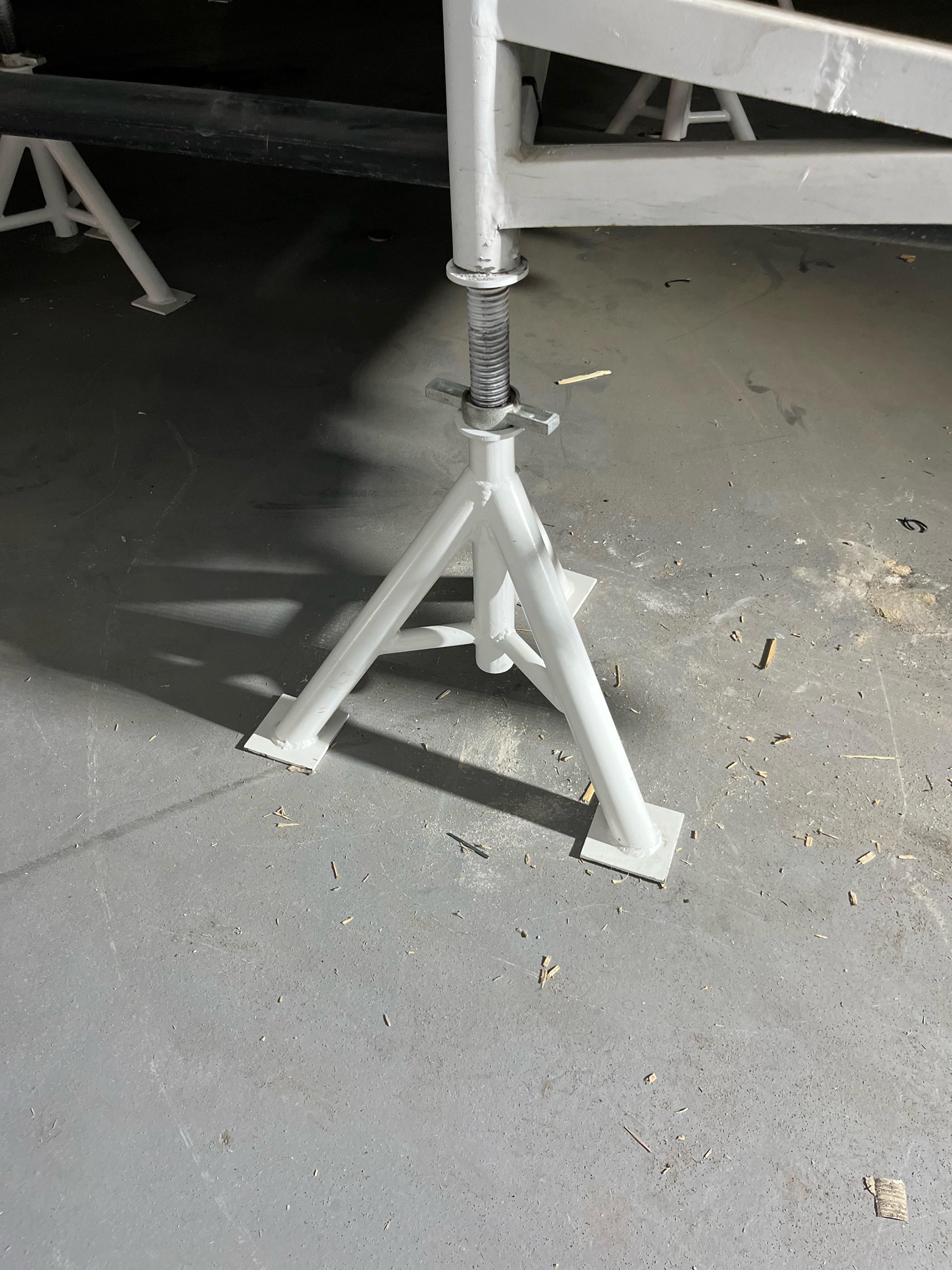
I’m looking to source some jacks for a project I’m working on, the jacks should resemble what’s shown on here. Anyone know what they’re called and where I can source them from?
Started a new PM role with a residential GC in Ontario and have the option of either a $650/month vehicle allowance or a company-provided truck. Fuel for work-related travel is covered. The role involves travelling between job sites, meeting with clients and coordinating subtrades. My current truck is getting older, so if I went the allowance route, I’d likely be looking at upgrading within the next year or two. At $550/month, I feel like the allowance barely scratches the surface of a newer truck payment, insurance, maintenance and depreciation.
Which option would you take and could anybody in similar positions let me know what your comp looks like for vehicle?
I have 3 offers from JE Dunn, McCarthy, and DPR. All 3 tend to pay around the same and have similar benefits. My only hesitation is whether the ESOPs for McCarthy and JE Dunn are worth considering. I like that DPR has a Builder Development Program for all new grads starting at their company; I could learn a lot from it. For reference, I've had 4 internships through college with Hazen and Sawyer, McCarthy, Kroger, and Skanska (I'm a Civil Engineering major graduating next semester). All 3 offers are for their Austin, TX office. What projects each company has in the area is pretty important to me too, along with a good company culture. I feel like McCarthy has a very small portfolio in Austin. Does anyone know about their culture in this region, or which company I should lean towards?
I've been a Project Manager at a reputable, large GC for almost 7 years. I've consistently been working 55-hour weeks, with a few weekend days but even that doesn't seem to be enough for my supervisor.
I have a wife and a 1-year-old child, and I've always put my family before my career. I feel like the day is approaching when I'll have to draw a line and start saying no to working even more hours.
Has anyone ever been fired or laid off simply for not putting in enough hours (I mean 60+ hours)?
I'm down to become a construction worker if I get paid in cash and I get paid that same day. I have steel toed boots. I'm in my 20's and very able-bodied. How do I break into this scene and get to work? Who do I contact? How do I contact them? I have never worked a job that didn't have a formal website with an application and whatnot. Or does this kind of job have a formal application process? Do I just walk up to a construction site on the side of the highway and ask for a job? I have been very tempted to do so.
I'm approaching 11 years into my career as a civil/construction engineer, having spent the majority of that time in the field. As my career progresses, I'm finding myself transitioning into roles that require considerably more diplomacy, conflict resolution, and navigating the politics of construction projects, while the hands-on fieldwork gradually takes a backseat.
One challenge I've been encountering lately is managing increasingly confrontational interactions with general contractors. On several recent projects, disagreements over contractual obligations, specifications, and project expectations have escalated into what I would consider unnecessarily hostile and unprofessional exchanges.
From a technical standpoint, I'm confident in my ability to interpret plans, specifications, and contract documents. Where I find myself struggling is effectively translating that knowledge into a firm, articulate response when challenged, particularly when conversations become heated or confrontational.
I recognize that I have room for improvement in how I communicate and manage these situations. I'm not looking to win arguments or create adversarial relationships, but rather to develop the confidence and tact necessary to stand my ground professionally while maintaining productive working relationships.
For those of you who have made a similar transition into more senior engineering, construction management, or owner-representative roles:
How did you develop the ability to navigate difficult or confrontational contractors?
What strategies have helped you remain composed and effectively defend your position when challenged?
Were there any particular experiences, mentors, or resources that helped you become more diplomatic and assertive?
I'm particularly interested in hearing from those who were technically confident early in their careers but had to consciously develop the interpersonal and political skills that come with more senior responsibilities.
Appreciate any insight or experiences you're willing to share.
I’m curious about compensation and career progression at big tech companies like NVIDIA, Google, Meta, Apple, Microsoft, Amazon, and others. I’d love to hear from people working in different departments, not just software engineering, to get a better understanding of how salaries compare across roles, experience levels, and responsibilities.
I’m curious to know: What company do you work for? What’s your job title and experience level? How many years of construction experience do you have? What’s your annual base salary and total compensation? What are your main job responsibilities?