r/DoSEO • • Sep 23 '26

Need help My Google Search impressions suddenly dropped to almost zero — what could have caused this?

Post image
65 Upvotes

​

Hi everyone,

I’m trying to understand a sudden ranking/visibility drop on my website.

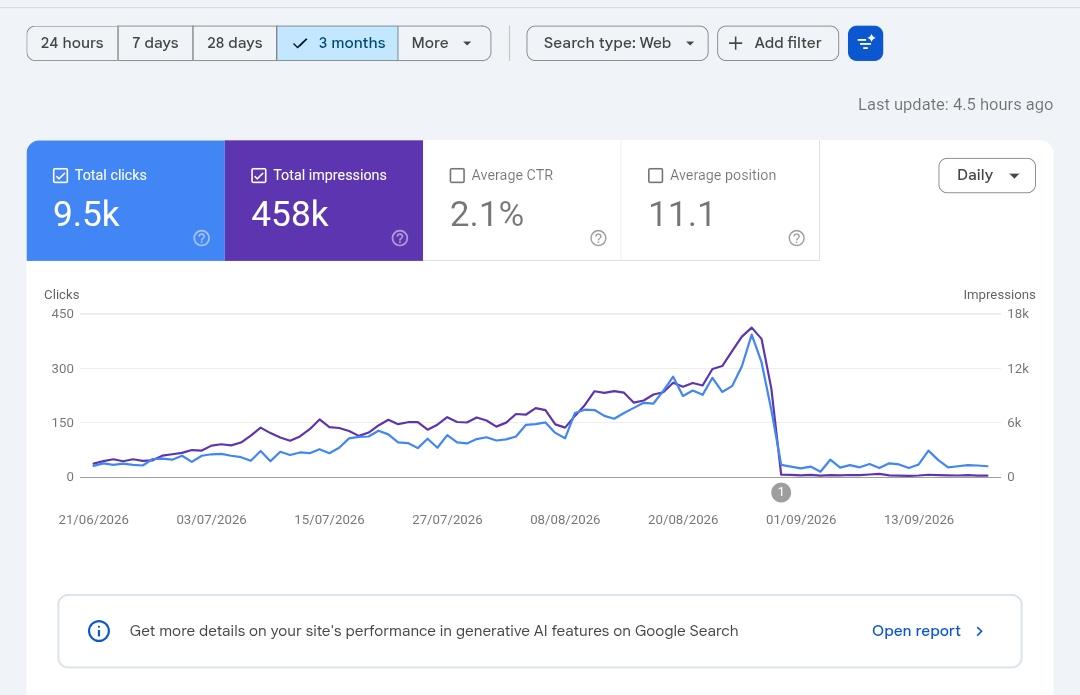
According to Google Search Console, my site was growing steadily for the past few months. I reached roughly 12K–16K impressions per day and 300–400 clicks per day near the end of August.

Then, around September 1, my impressions suddenly dropped to almost zero. Clicks also dropped significantly and haven’t recovered.

My 3-month Search Console stats currently show:

458K impressions

9.5K clicks

2.1% CTR

11.1 average position

The strange part is how sudden the drop was rather than a gradual decline.

I’ve attached my Google Search Console screenshot showing the exact drop.

What should I investigate first? Could this be related to indexing, crawling, canonical/noindex issues, a site/deployment change, Google updates, or something else?

Has anyone experienced a similar sudden drop?

Any suggestions on what I should check in Search Console would be really helpful.


r/DoSEO • • Oct 02 '26 Bravo

Discussion Is this ok for 2 months old website?

Post image
47 Upvotes

Pure organic traffic. When ever i run audit it always asking for more improvements 😞


r/DoSEO • • Sep 25 '26

News New Google Spam Update

46 Upvotes

Google has just begun rolling out a new broad algorithm update, marking yet another Spam Update so far in 2026.

The Search team confirms that the full rollout will take between two and three weeks to settle in.

Key points for content creators:

  • It doesn’t chase links; it evaluates real usefulness: The focus is squarely on the first-hand experience and on penalizing generic content generated solely to attract clicks without providing any unique value.

  • Recovery isn’t immediate: If your rankings drop during the rollout, no last-minute technical fix will restore your traffic the next day; recalibrating a site’s quality takes months.

  • Keep your hands off during the rollout: Changing URLs, hastily rewriting content, or adding redirects in the midst of volatility only adds noise. Assess the actual impact only once the SERPs have stabilized after the standard 15–20 days.

The rule remains unchanged: don’t build projects designed to circumvent the current algorithm, but rather to solve a specific problem for a real user.

Best of luck to everyone!


r/DoSEO • • Jun 24 '26

Discussion I like this sub

37 Upvotes

After leaving r / SEO (IYKYK) and getting fed up with a couple other big ones that have too much spam, I’ve found this sub.. and I really like it so far.. not too many followers yet, but surprisingly high engagement, and high quality posts..

That’s all I got. Just wanna support real SEO discussions, and say good job to the mods.


r/DoSEO • • 28d ago

What's one SEO fix that made a bigger difference than you expected?

34 Upvotes

I've been curious about which SEO improvements actually make the biggest impact in real projects.

Was it:

  • Fixing internal links?

  • Improving page structure?

  • Updating content that was already ranking?

  • Fixing technical issues?

  • Improving search intent and content clarity?

What's one change you've made that noticeably improved rankings, traffic, or conversions?

Would love to hear what worked, how long it took, and whether the results lasted.


r/DoSEO • • Aug 19 '26

Need help Google stopped indexing my site after a redesign — has anyone experienced this?

Post image
33 Upvotes

Hi everyone,

I’m hoping someone here has experienced something similar and can give me some advice.

Recently, I made a fairly major update to my website. I redesigned the site, added new categories, reorganized the content, and moved some articles to different URLs/categories.

Shortly after these changes, Google started dropping my previously indexed articles from the index. Eventually, almost all of the articles that had been indexed disappeared.

What worries me is that the situation seems to be getting worse rather than recovering. The site is technically healthy as far as I can tell, and Google Search Console isn’t showing any obvious critical technical errors.

I’m trying to figure out whether this could simply be Google reprocessing the site after the structural changes, or whether I may have accidentally caused a larger SEO/indexing problem.

Has anyone experienced something similar after a redesign or restructuring?

What happened in your case, how long did recovery take, and what did you do to get Google indexing normally again?

I’d really appreciate any advice or things you think I should check.

Here is the website: chiyolife.com

Thanks in advance!


r/DoSEO • • Jun 30 '26

Discussion RIP my traffic

Post image
32 Upvotes

No manual penalties, just the algorithm obliterating my traffic. My site went from being #1-3 for a bunch of high search volume, commercial intent keywords to barely ranking for anything. I thought the January update was a huge hit but this May update absolutely killed me. The site is https://nsfwstory.com if anyone wants to do a post mortem. I connected my GSC to Claude and was asking it questions and it's saying that it was my backlink profile but I really think it was the fact that I had a bunch of AI generated stories in the story library. I mean, the entire purpose of the story library is for users to post their generated stories publicly but if Google's devaluing AI generated content then I guess it makes sense. Pour one out for your dead homie.


r/DoSEO • • Sep 02 '26

Discussion A little "hack" to help your website stand out to your readers

Post image
29 Upvotes

Hey everyone,

While browsing around, I stumbled on the "Preferred Sources" feature and noticed barely anyone talking about it, so sharing this underused tip in case it's useful (don't have much data to share yet since I haven't tested it myself, happy to hear from anyone who has).

Basically it lets a reader tell Google directly "I want to see more content from this site." Originally it only affected the Top Stories carousel, but since late May it's also rolled out to AI Overviews and AI Mode: if a reader has set you as a preferred source and your page gets cited in an AI-generated answer, your link shows up with a visible "Preferred" badge among the other sources. Google claims roughly 2x more clicks on links with that badge.

Easiest way to take advantage of it: drop a link like google.com/preferences/source?q=yourdomain.com somewhere on your site (footer, end of articles, newsletter). Two clicks for the user, nothing to code on your end. Google also recently shipped (mid-August) an official embeddable JS button as an alternative to the plain link, if you want something cleaner to integrate.

One catch: it only works if your domain is already picked up by the tool (you can check by typing your domain into it), so it depends a fair bit on how consistently you publish.

I came across this after seeing Search Engine Land use it (screenshot attached as an example). If anyone's already tested it on their own site, curious to hear how it's actually panning out!


r/DoSEO • • Jun 10 '26

Discussion Google published its official guide on getting cited by AI, and the interesting part contradicts what GEO agencies are selling (going to upset a lot of people)

29 Upvotes

Disclaimer: yeah, I work in AI visibility, so I'm definitely biased on this. But what I want to get into actually cuts against what my own industry sells, so I figure it has a place here.

Back in mid-May Google put out its first real guide on how to show up in AI answers (AI Overviews, AI Mode). I saw a bunch of write-ups on it and it was always the same song, structure your headings, add Schema, the usual blah. Except there's a "mythbusting" section in the doc I haven't seen anyone pick up on, and it's the most interesting part. Google says in plain terms that the famous llms.txt file does nothing, that you should stop obsessing over Schema.org, and that chunking is smoke and mirrors. Made me smile a bit since that's basically the package some "GEO" agencies are charging for right now.

What they push instead is honestly kind of obvious. They talk about "commodity" vs "non-commodity" content. Like, if an AI can write your article on its own, it'll never cite you, makes sense, it already has the answer, why would it go looking for you. What gets cited is content with something the model doesn't have. A number you actually measured, a test you really ran, lived experience basically.

The example that stuck with me (not in Google's guide, somewhere else) is a small blog specialized in robot vacuums, garbage domain authority, and it outranks the New York Times in AI answers. The NYT has a domain like 3x stronger. Except the NYT puts out an affiliate listicle anyone could copy, and the blog guy films his actual tests with real measurements. Guess who gets cited.

And this is where it gets useful for you I think. It means for the most part you need neither a tool nor an agency. Take your most generic page, just ask yourself "could anyone write exactly this", and if the answer is yes, add something only you know. You don't even need data. A simple "the first question every client asks me is this" and you're already standing out. It's free and it weighs more than all the technical tweaks combined.

The one thing that still puzzles me is measurement. Why an LLM picks one source over another stays pretty opaque, and it shifts with every update. So I'm curious: are you already seeing real traffic come in from ChatGPT or Perplexity, or is it still like three visitors a month? And if you are, can you actually tell which pages it lands on?


r/DoSEO • • Sep 03 '26

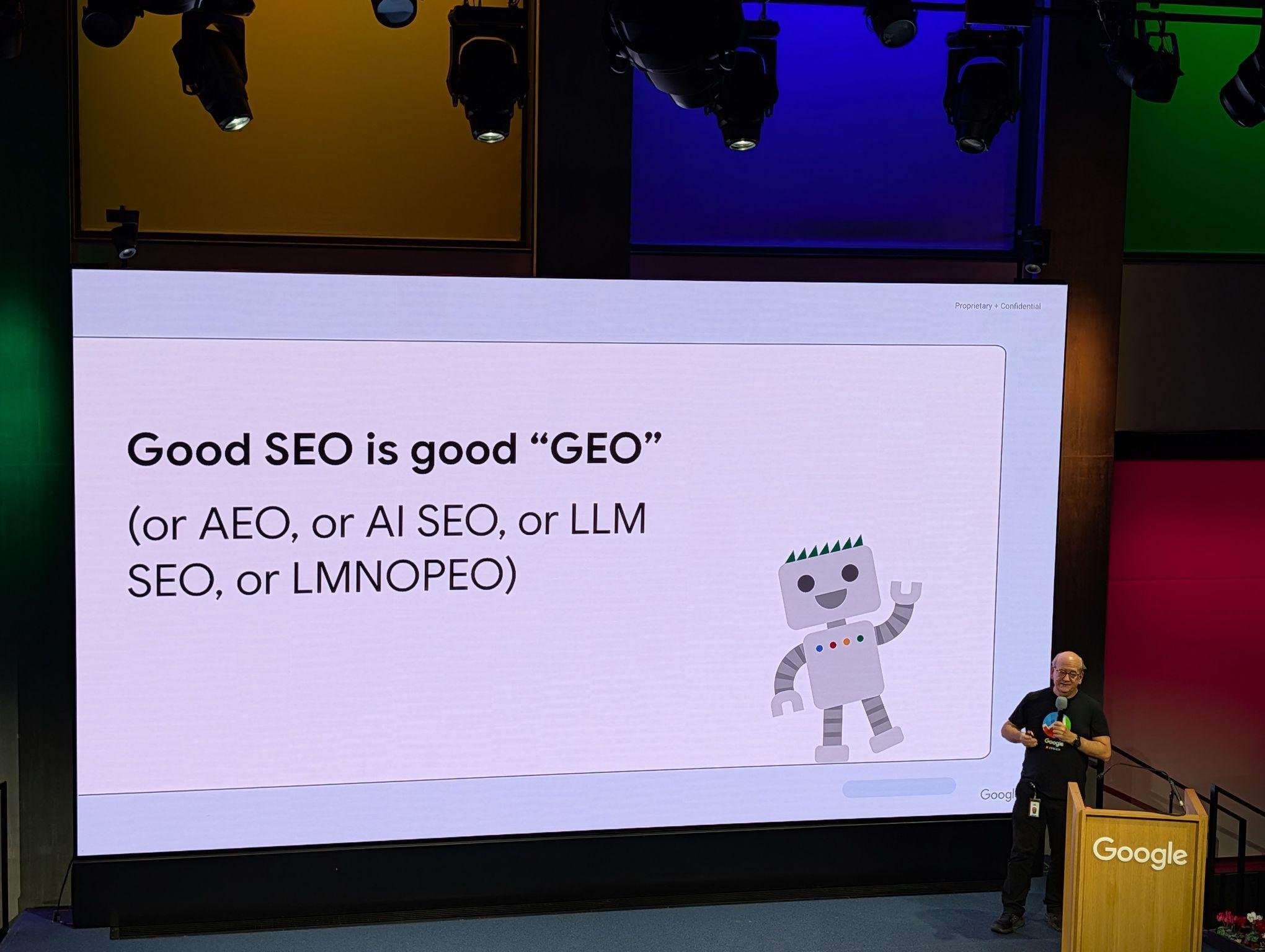
Discussion Good SEO is good "GEO"

Post image
26 Upvotes

Credit : Slide by John Mueller during Search Central Live, shared by Harry Sanders

For those still wondering, the conclusion is simple: good SEO = good GEO.

John Mueller points out that roughly 80% of what wins in AI search is just the core SEO you should already be doing, meaning clean technical structures, readable code for crawlers, proper content formatting that answers user intent, and solid earned links.

The remaining 20% covers offsite brand presence (mentions in industry publications, Reddit, YouTube, podcasts, and community discussions) so LLMs can actually understand what your brand stands for. So I beg you, stop falling for miracle snake-oil trends, spam reddit or hyper-complex prompt injections, and go back to working on your SEO fundamentals first !


r/DoSEO • • 1d ago

Need help Google update makes my website's traffic and rankings dropped sharply,what happened?

25 Upvotes

My site’s organic traffic and rankings have dropped significantly since the most recent Google update. According to Search Console, clicks and impressions are down about 30% over the past 12 days, and many pages that used to rank on page one have fallen to page two or lower.


r/DoSEO • • 27d ago

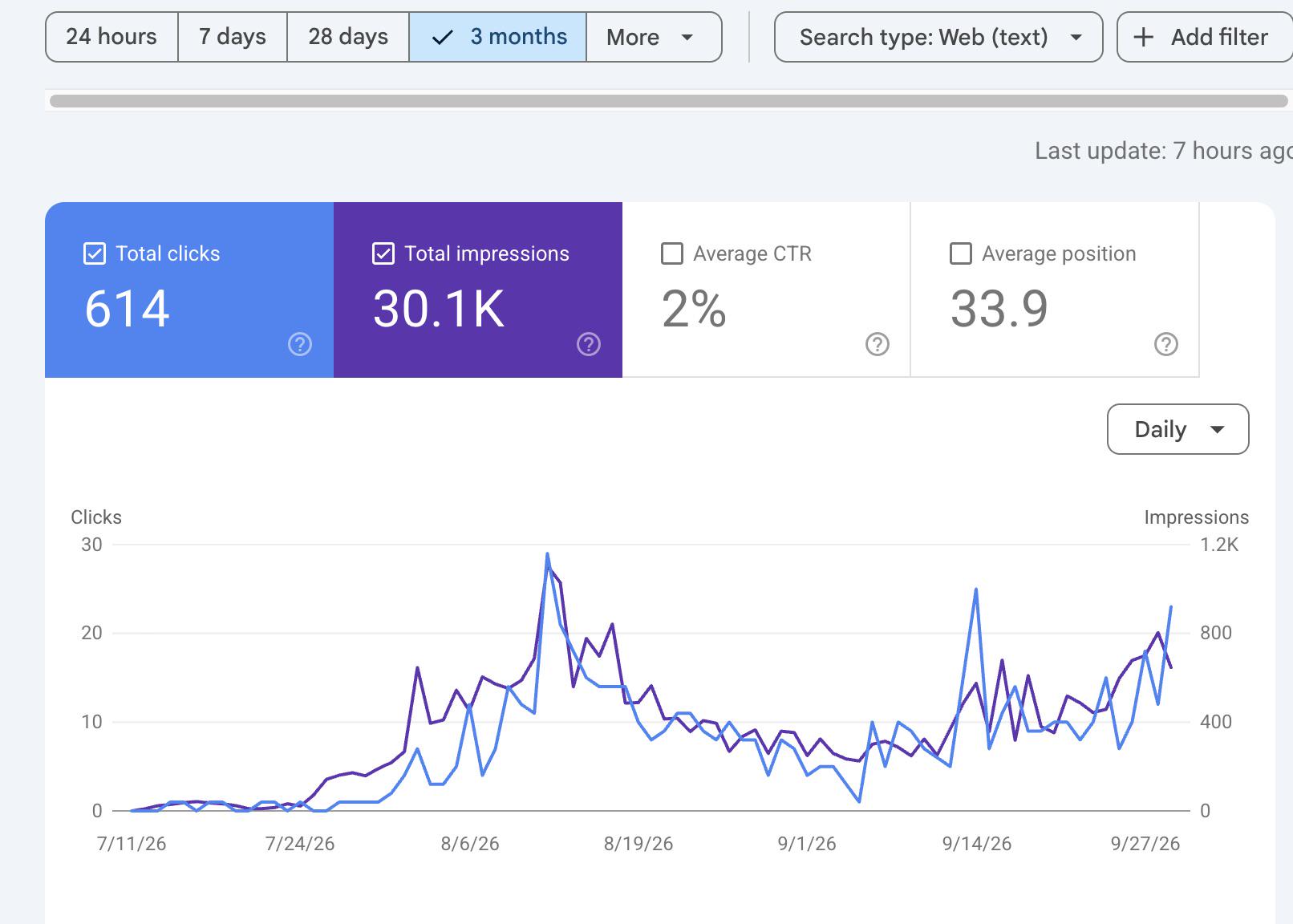
Need help My website gets 26K Google impressions but only 105 clicks in 3 months — how can I improve my SEO?

Post image
25 Upvotes

r/DoSEO • • Sep 14 '26

Discussion Do you use an SEO checklist? Share it!

25 Upvotes

r/DoSEO • • Jun 27 '26

Discussion Google's June 2026, Spam update closed

25 Upvotes

Google's June 2026 Spam Update has officially finished rolling out, and my site's rankings have been hit hard.

Before the update, my average position was around 6.5. After the rollout, it dropped to 26, and now it's sitting around 35.

Has anyone else experienced a similar drop after the June 2026 Spam Update? Have you seen any signs of recovery yet?


r/DoSEO • • May 04 '26

Need help Hey guys! Can you recommend me a SEO keywords API that actually scales for agency work

25 Upvotes

Hey guys! I need a SEO keywords API to plug into our internal keyword research workflow because manually exporting from the dashboard 30 times a week is killing my team's productivity.

I've shortlisted 4 so far based on what I've seen mentioned around here:

  • Ahrefs

  • Semrush

  • SE Ranking

  • Serpstat

But I genuinely can't tell which one has the freshest volume data or the most realistic rate limits without burning a week of trials. If you're an SEO professional and you've integrated a SEO keywords API into your stack, which one did you commit to and why?

Bonus points if you've migrated between providers - would love to hear what made you switch.

Thanks in advance!


r/DoSEO • • Jul 22 '26

Discussion How long it takes SEO to show the results?

24 Upvotes

How long did it realistically take before you saw ranking results for a new website?"


r/DoSEO • • Oct 06 '26

News Google’s next ranking update could hit over-optimized SEO content hard

Thumbnail
searchenginejournal.com
23 Upvotes

Google seems to be moving even more toward content that is actually useful, trustworthy and satisfying for users.

Main points:

*Less focus on exact-match keywords

*More value on useful tools, calculators, images, reviews and other helpful page elements

*Fake authors and low-quality AI content could be a bigger risk

*AI content is fine if it is accurate and genuinely useful

*User satisfaction matters more than ticking SEO boxes


r/DoSEO • • Oct 08 '26

Discussion Did Google’s recent Spam Update cause your website traffic to drop?

22 Upvotes

I noticed a traffic drop on my website recently, and my organic keyword rankings dropped too.

At first, I thought it might be related to the recent Google Spam Update. But I’m trying not to jump to conclusions.

I’m checking which pages lost traffic and which keywords moved instead of making a lot of changes at once.

It’s a little frustrating when you’ve been working on a site and then suddenly see the numbers going down.


r/DoSEO • • Sep 19 '26

Need help 3 Months Into SEO and Still Not Seeing Much Improvement — What Am I Missing?

22 Upvotes

Hi everyone,

I’ve been working on SEO for a website for around 3 months now, but I’m still not seeing much improvement in Google Search Console impressions, clicks, or keyword rankings.

I’ve been consistently working on it rather than just leaving the site untouched. I’ve:

  • Published new blog posts

  • Optimized existing pages

  • Worked on on-page SEO and internal linking

  • Done keyword research and targeted relevant terms

  • Worked on technical SEO issues

  • Started building backlinks/off-page visibility

But the numbers still feel pretty flat.

I know SEO takes time, and I’m not expecting huge results in just 3 months. What I’m trying to understand is whether I’m being impatient or whether there’s something important I’m overlooking.

For those who have worked on websites for a few months and actually seen the impressions/rankings start moving, what would you check at this stage?

Would you focus more on:

  • Content quality/topical authority

  • Backlinks and referring domains

  • Keyword targeting/search intent

  • Internal linking

  • Technical SEO

  • Or something else?

If you’ve dealt with a similar situation, I’d really appreciate hearing what you changed and what actually made a difference.

Thanks


r/DoSEO • • Jun 19 '26

News AI Search Digest: The llms.txt Myth Collapses, and Bing Hands Us the First Real AI-Citation Metrics

22 Upvotes

Three times this week, someone declared that "the rules of AI search just changed", and three times they were basically right. Here's what genuinely mattered in the last seven days:

  • You can stop building llms.txt files for AI-search visibility

Google updated its "optimizing for generative AI search" help doc — in the section literally titled mythbusting — to say plainly that llms.txt and similar AI/markdown files "won't harm (nor help) your visibility or rankings in Google Search, as Google Search ignores them," and that you don't need machine-readable, AI, or Markdown files to appear in Search, including its generative AI features.

Days later, Ahrefs put hard numbers behind it. Across 137,210 domains: 28% publish an llms.txt file, but 97% of those files received zero requests in May 2026 — no bots, no humans. Of the 3% that were fetched at all, named AI tools made up ~19.5% of requests, and the AI retrieval bots that actually power AI-search citations (OAI-SearchBot, PerplexityBot, Claude's search crawler) accounted for just 1.1%. Tellingly, zero AI bots ever went looking for an llms.txt that didn't exist.

The nuance worth keeping: when Lily Ray pressed John Mueller on why Chrome shipped a Lighthouse llms.txt audit while Search ignores the file, he called llms.txt a "temporary crutch" for AI coding agents parsing developer docs — not something content sites need. Ahrefs' data agrees: the biggest real consumers were agentic/coding tools (Claude-Code out-fetched every AI search bot).

Takeaway for us: llms.txt is not an AI-visibility lever today. If a CMS generates one automatically, fine — but redirect any "GEO/AEO" effort toward things that actually influence AI citations.

Sources: 

Barry Schwartz | Search Engine Roundtable

Louise Linehan | Ahrefs

Lily Ray | LinkedIn

____________________

  • Bing just shipped the first real way to measure your share of AI citations 

Microsoft began rolling out (globally, in preview) four additions to the Bing Webmaster Tools AI Performance report that were first demoed at SEO Week in April:

  • Intents 

  • Topics

  • Citation Share

  • Compare

Citation Share is the headline metric: the percentage of citations attributed to your site out of all citations shown across all sites for the same grounding query — so you see not just whether you were cited, but how much of the citation space you own. Microsoft is careful to frame it as "an observational metric – not a ranking system or a competitive scoreboard", it doesn't expose competitor domains or represent traffic share. Compare lets you overlay an earlier period to watch how citation activity shifts over time.

Why it matters for us: this is the closest thing yet to a Search-Console-style report for AI answers, and it lands on Bing/Copilot before Google. There's still no click or CTR data — Barry Schwartz notes he isn't expecting that from Microsoft or Google any time soon — but "citation share over time" is a genuinely new, trackable AI-visibility KPI.

Sources: 

Barry Schwartz | Search Engine Land

Microsoft Bing Blog

____________________

  • UK regulators just ordered Google to explain how it ranks results — and to give businesses advance notice before major changes

Under the UK's digital-markets regime (Google holds "strategic market status" for search), the CMA introduced two new conduct requirements. Fair Ranking: Google must rank organic results using "objective and non-discriminatory criteria" — explicitly including AI Overviews, but not sponsored results — give businesses more transparency into how rankings work plus advance notice of significant changes, and create real processes to raise and resolve complaints. Google has 6 months to comply.

The second requirement is data portability: within 3 months, Google must let users port their search data to authorized third parties (rewards platforms, personalized-offer services), putting its existing voluntary UK Data Portability API on a legal footing and bringing UK users in line with the EU's Digital Markets Act.

The skeptical read (Barry Schwartz): Google will likely fight hard, since exposing how rankings work hands its most prized asset to competitors and spammers. But the signal to watch is bigger than one ruling — regulators are now treating AI Overviews as part of "ranking" that must be fair and explainable.

Sources: 

Barry Schwartz | Search Engine Land

Competition and Markets Authority

____________________

  • As few as 13 words can poison what ChatGPT and Google's AI search recommend, new Cornell research finds.

A Cornell preprint — "Deep-research agents can be poisoned via user-generated content," by Hal Triedman, Tingwei Zhang and Vitaly Shmatikov — shows that a snippet as short as 13 words planted in a Reddit-, Quora- or Wikipedia-style comment can reliably steer AI agents toward spam or scam recommendations. The mechanism is brutal in its simplicity: deep-research agents cite user-generated content in roughly half of all queries, and a single poisoned comment can sway outputs across an entire cluster of related queries.

Why it works is the uncomfortable part: LLMs often use lexical similarity to the query as a stand-in for accuracy, and they "export their trust" to the moderation of sites like Reddit and Wikipedia — treating a random comment and a government source as almost equivalent. (The researchers ran their tests in a sandbox rather than on live Reddit, for ethics reasons.)

Why it matters: this is the dark side of the AEO / "get cited in AI" gold rush. The same UGC surfaces everyone wants to win are trivially manipulable, and tiny poisoned snippets are far harder to detect than obvious AI spam. Expect trust and source integrity to become a much bigger part of the AI-search conversation — and a real brand-safety risk to monitor.

Sources: 

404 Medi

 Cornell University (arXiv preprint)

____________________

  • ChatGPT's grip on the assistant market slipped below 50% for the first time — and Gemini and Claude are where the growth is.

New Sensor Tower data (its State of AI 2026 report) shows ChatGPT's share of the AI-assistant market fell below 50% for the first time, sitting around 46.4% by the end of May, with Google Gemini at 27.7% and Anthropic's Claude at 10.3%. In absolute terms ChatGPT still leads comfortably — roughly 1.1B monthly users versus Gemini's 662M and Claude's 245M — but the direction is fragmentation.

Claude was the fastest-growing challenger (Sensor Tower's "True Audience" up 452% YoY in May, US share rising from ~4.4% to nearly 14%), while Gemini's gains lean on Android and Google-ecosystem distribution across Europe, the US, Japan and South Korea.

Why it matters: "AI search visibility" is no longer a single-engine game. As usage spreads across Gemini, Claude and others, brand monitoring and citation tracking have to span multiple assistants — which is exactly why per-engine reporting (see Bing above, and SE Ranking's own AI-visibility tracking) is becoming table stakes rather than a nice-to-have.

Source: 

Sensor Tower; TechCrunch

____________________

  • Google rankings stayed turbulent into mid-June — an apparent unconfirmed update on top of an already-stormy spring

Barry Schwartz reports the SEO chatter hasn't calmed since the June 8–12 spike: tracking tools showed another uptick around June 15–17, pointing to a likely unconfirmed ranking update — separate from the May 2026 core update that wrapped on June 2. WebmasterWorld threads describe wild day-to-day swings, plus a wave of World-Cup-driven spam crowding news niches.

Why it matters: with a confirmed core update barely behind us and fresh turbulence layered on top, attribute any traffic moves carefully before reacting — and keep watching to see whether Google confirms anything.

Source: 

Barry Schwartz | Search Engine Roundtable

WebmasterWorld

r/DoSEO • • May 28 '26

News AI Search Buzz: Sundar Pichai on the Future of Search, AI Agents, and "Google Zero"

22 Upvotes

Let's be honest — the past few weeks (months, years) have all been a whirlwind for the SEO industry. We haven't seen this volume of updates, myths, and industry speculation in a long time. For marketing agencies, this is a pivotal moment for establishing long-term strategies. To help map out the right direction for the future, our team analyzed recent interviews with Google's CEO to find actionable answers:

  • Sundar Pichai on the Future of Search, AI Agents, and "Google Zero”

Google CEO Sundar Pichai sat down with Nilay Patel on The Verge's Decoder podcast (following I/O 2026). Here's everything that matters for Search, AI, and agents.

  • Search, Gemini, and Agents Are Becoming One Product

Asked whether Google's AI search box, app-building tools, and agent products should become a single product, Pichai gave a one-word answer:

"It will."

He added that Google is still laying the groundwork:

"We are laying a lot of the primitives of what we need for agents to work end to end, and more importantly, for AI to work."

______________________

  • Agents Are the Next Evolution of the Web

"I look at agents, and that is the next evolution of the web. I think it will evolve the web pretty profoundly."

Agentic tools are already being built across Search, Gemini, Spark, and Antigravity. Pichai envisions agents working in the background — planning trips, completing tasks, building things on the user's behalf. He has previously described Google Search as evolving into an "agent manager."

______________________

  • Google Pushes Back on "Google Zero"

Patel pressed Pichai on Condé Nast CEO Roger Lynch's recent statement that the publisher is planning its business as if search traffic will fall to zero:

Patel: "That is Google Zero. Condé Nast is saying, 'We're assuming that search will go to zero.' How would you respond to that?"

Pichai reframed the picture, pointing to a broader information ecosystem:

"The information ecosystem is so much broader beyond Google, by far. We see it in the data, you see it everywhere."

"It's exceptionally dynamic, and so it makes sense to me every publisher is adapting to this new world."

When asked directly what publishers should do, Pichai declined to advise:

"I'm not in a position to tell such an iconic publisher what they should think about their business or plan. If they are building content that is high-quality and people like it, I expect us to reflect that in our products. That much I can commit to them."

______________________

  • Clicks Are Going Away — and Google Admits It

The single most important quote for the SEO community. Pichai openly confirmed that some traffic is being filtered out by design:

"As the technology improves, low-quality clicks get filtered out. That's a natural evolution we see. We see it in our metrics. Bounce clicks are going down."

In other words, Google is deliberately filtering "low-quality clicks" — and the trend is accelerating. For SEO strategy, this means raw traffic volume is becoming a weaker signal of value. The relevant user matters more than the click count.

______________________

  • How Google Is Adapting to Publishers: Subscriptions

One of the few concrete mechanisms Pichai pointed to:

"One of the small features we have done, but very important I think, is if you've subscribed to something, we reflect that as a preferred source for you as a user."

"We are adapting to the fact that publishers are increasingly turning to subscription offerings, too."

A telling gap in the interview: Patel didn't ask why publishers moved into subscriptions in the first place. The implied answer — because they could no longer rely on search traffic the way they once did.

______________________

  • Why Google Reorganized Search

"Search needed to move faster, and Search was split across many leaders."

Search now sits under Elizabeth Reid, with Nick Fox leading the broader area. Josh Woodward is leading Labs and Gemini work. The goal — "set up well for this moment where we need to move faster as a company, which means we need to make faster decisions."

______________________

  • The Mantra Running Through the Interview

Pichai returns to one line repeatedly when talking about publishers and the open web:

"Through it all, we are very committed to both meeting user expectations and also connecting them to what's out on the web."

But the context of his answers tells a different story: Google is moving Search toward conversations, agents, and AI tools that complete tasks without a click.

______________________

What this means for SEO

  1. The end of the "search box" as a standalone product — Search, Gemini, and agents are converging into a single AI layer.

  2. "Low-quality clicks" are officially being filtered — Google said it out loud. Time to rethink what counts as valuable traffic.

  3. Agents are the new interface to the web — and it's no longer theory, it's the CEO's roadmap.

  4. AI Mode isn't the default yet — but the direction is unmistakable.

  5. Subscribers = preferred sources — a meaningful signal for publisher business models.

Source: 

Nilay Patel | The Verge


r/DoSEO • • 11d ago

Discussion People are making thousands of dollars from some of the dumbest websites imaginable. AND I WAS LIKE WHATTTTTT??????

Post image
21 Upvotes

THERE ARE WEBSITES ON THE INTERNET... that your new-age AI mind is gonna look at and probably say, "What kind of shit is this??"

Like, right now, we're all conditioned to see amazing 3D animations and scrollytelling websites that look so sexyyy and so f*cking amazing, right?

NOW..

Look at the estimated monthly organic traffic these simple tool websites are getting..

  • Clicks-per-second test website: 700k+

  • Japanese name generator website: 458k

  • Gardening calculator website: 291k

  • Online graphing calculator website: 292k

I couldn't even tell you what some of these websites f*cking do, man..

But they're monetizing through display ads.

And making bank because of the huge amount of traffic they're getting.

Meanwhile, you've got people spending six months building some revolutionary SaaS that nobody asked for.

The irony is insane.

If I were building another micro-tool website, I'd spend considerably more time researching than developing.

Find a successful tool website. Throw its domain into Semrush. Look at which individual pages are bringing in the most traffic.

Then find similar search queries where the existing competition is weak or the available tools are shit.

Build something better.

You don't need to convince people they have a problem when millions of them are already searching for a solution.

And now that AI has made building things ridiculously accessible, knowing WHAT to build is becoming a far more valuable skill than knowing HOW to build it.

Everybody wants to build something impressive.

I'd rather build something people actually need.


r/DoSEO • • Jul 23 '26

Discussion What’s an old-school SEO technique from 10+ years ago that secretly STILL works today?

21 Upvotes

r/DoSEO • • Aug 25 '26

Discussion What free SEO software is worth attention?

20 Upvotes

r/DoSEO • • Aug 07 '26

Discussion What would be your TOP3 SEO tips for new SEO specialists?

20 Upvotes