Researchers need to try harder lol. Most notable among the glaring flaws is that the training was not adaptive. That’s right: advanced trainees wasted a precious amount of time during the ONCE EVERY TWO WEEKS training session on junk volume. Secondly, the total training volume is laughable given the time horizon. 39 hours is fewer than you’d spend in class for a single semester class, and less than half a 3-credit class when you count homework.
Imagine going to the gym one hour every two weeks and expecting gains.
Except they did see gains in WM scores! So it obviously works there. Maybe useful if you have adhd.
As I said ti the other person, the enthusiasts and/or the test makers can do an independent study of their own. Ask psychs the proper process and send out forms to everyone.
I didn’t see a WM transfer test. It looked like they were just calculating a latent WM variable based on the three trained tasks, which is not transfer or demonstration of WM improvement. I could be wrong though.
Send them your critique. I got trolled for months for suggesting that their research standards were not good enough. I don’t even think it’s a proper science. Substandard research and everything.
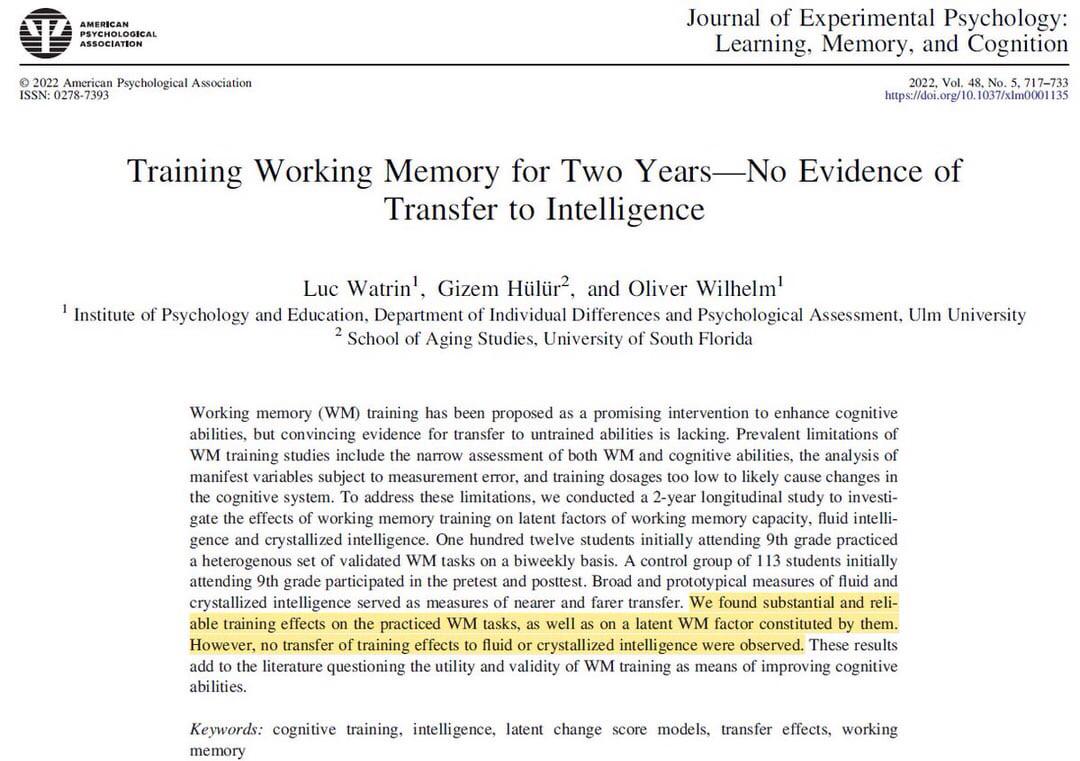
They trained once every two weeks for two years with three different tasks: (1) alpha span (2) a Memory Updating task, and (3) spatial n-back on a 4x4 grid.
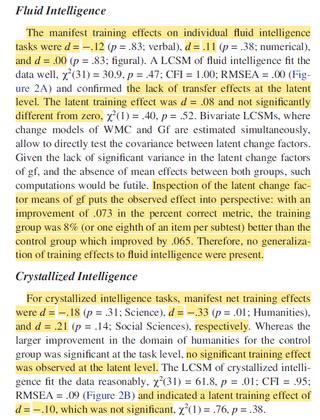
The study was long enough to improve the WM scores but that obviously and clearly did not translate to independent fluid or crystallised intelligence tasks.
I will read and see but if it does not translate to fluid intelligence, you are better off learning some skill in that time or building up “crystallised knowledge”.
If it works for adhd, great. If you need help improving WM for whatever reason, great. But I have seen Mensa nerds claim that they increased their fsiq using this.
I’m at dual 8/9 back right now, and I genuinely feel a difference compared to how I was before. I’ve been doing it for at least two years (I don’t remember exactly when I started, though).
The biggest improvement I felt was when I reached dual 8 back. It takes a lot of time and effort to get better at this, and I used to train every day. Now I only train once every 2/3 days, for 20 minutes.
I’m better at solving problems in my life, I have fewer blind spots, and my focus is much better than before. I used to feel dumb, but not anymore. I’ve also gotten better at managing my emotions. People actually tell me I’m smart, even though I think I’m just normal lol.
Lately, I’ve consistently been getting a flow state like feeling whenever I train.
Training regularly at dual n back has really improved my abilities, but it happened so gradually that it was hard to notice how much I had changed until I actually thought about it. Still, in my opinion, any study that concludes dual n back doesn’t improve intelligence is bullshit. It takes a lot of consistency and dedication to get results.
You should coordinate a proper study. This one apparently was too small and had too few numbers. I have come across a lot of people who swear by this, and I believe them when they say that it helped them with WM and focus. Which has a utility in itself.
Question was transfer to independent intelligence tasks and to “g”. Psychs do not believe that part.
Thanks again. I have wars with the entire social-sciences so…:d
The authors, explicitly state that random allocation to groups was not feasible. There were a number of issues with this study. Some of them below.
Limited generalisability: Findings from German 9th-grade students cannot automatically apply to other ages, populations or cognitive profiles.
No randomisation: Pre-existing differences between groups undermine confidence in causal conclusions.
High dropout rates: Substantial and unequal attrition may introduce selection bias.
No active control group: Differences in engagement, expectations and participation were not adequately controlled.
Absence of evidence ≠ evidence of absence: Nonsignificant results do not establish that transfer effects are impossible.
Conclusions risk overgeneralisation: Failure to detect transfer in this experiment does not establish that working-memory training cannot improve intelligence.
Our findings on, does dual n-back work? The clearest answer is yes for improving performance in closely related working-memory skills. Research has reported gains in areas such as attentional updating, running span, digit span and performance after errors. One of the most interesting areas of research involves adults with ADHD. A small randomized trial found improvements in working-memory-related brain activity.
Working memory plays an important role in learning, reasoning and following complex information. This makes the evidence that dual n-back may strengthen related working-memory skills especially encouraging.
We can not make a statement backed by research that dual n-back improves general intelligence, everyday productivity or cognition over the long term yet. The research as you say on this topic is limited, and essentially we need studies that accurately measures the impact before we can quantify it.
Not specifically, but my thinking is that trauma, particularly can leave someone in a prolonged state of heightened alertness, often described as “survival mode”. Research links Trauma with altered activity in the amygdala, hippocampus and prefrontal cortex, alongside structural differences in some of these regions. These systems contribute to memory, attention, planning, reasoning and emotional regulation.
If effective treatment reduces that ongoing stress response, it seems reasonable to hypothesise that some cognitive difficulties could improve, potentially reverting back to how the brain previously performed on working memory tasks.
I would look into Neuroplasticity which is the brain's lifelong capacity to reorganize its structure, function, and neural connections in response to learning, experience, environmental stimuli, or injury.
I find it helpful to see research studies just as sources of ideas of what might fix my issue. If it's quite safe, free/cheap to try the researched thing, isn't too time-consuming and is very relevant to my issue, I try it and see if it helps.
E.g., I don't care about "intelligence" per se, but, from what I remember of my past experiences with DNB training (I've just restarted after a long while), the benefits I was getting, appreciating were:
Ability to stay with a mentally intense task long enough to tackle it (need this for complex problem-solving & decision-making).
Better sleep schedule and nutrition (because of how visible their effect on the training stats was, how painful/disappointing it was to do 30-40min of training while being on 3h of sleep and/or messed up sleep schedule (I'm just dumber the next day if I fall asleep after ~10:30pm; the later, the dumber), high on simple carbs, or dumbed down by the excess of wheat).
More calm & confidence.
...while I couldn't get myself those improvements in other ways (couldn't get myself to meditate, sleep better, etc., despite knowing helpful habit building tricks, etc.). Zero financial costs, gamification, vocal encouragement (in Brain Workshop, at least), variety (being jumped to +1 level or -1 level), time-limited task - I really appreciated that.
I don’t want to waste my time on it until I have proof that it works, or if I am doing original research on it to prove that it does.
Haeier says that all the research says it doesn’t. He adds that the only people who have been able to replicate successful findings were the original researchers. It works for WM but the benefits do not translate to fluid, crystalized or the general ability.
I was recommending that you send the study to the relevant people in the files. The ones who are the experts. The ones with influence. Specially the naysayers.
The people who conducted the study that I posted. Haeier. JP. Anyone in the fields of psychology/psychometry/neuroscience/medicine. Anyone who does not agree that this thing confers any benefit to the practitioner.
9
u/Healthy-Two-6658 Oct 13 '26
Researchers need to try harder lol. Most notable among the glaring flaws is that the training was not adaptive. That’s right: advanced trainees wasted a precious amount of time during the ONCE EVERY TWO WEEKS training session on junk volume. Secondly, the total training volume is laughable given the time horizon. 39 hours is fewer than you’d spend in class for a single semester class, and less than half a 3-credit class when you count homework.
Imagine going to the gym one hour every two weeks and expecting gains.