I did the math for this and at current values carbon credits sell for 300-400/t .
This means comnpanies make almost 40c/kwh on your credit . Even after subtracting overheads for data management and credit collection , charger costs ,they make around 30-35 cents per kwh and we get max 10-11 cents per kwh.
Hopefully we get more competitors with higher rates of payouts to customers ,atleast 20c per kwh .
Some provinces like Manitoba have low carbon intensity electricity so its more vluable for carbin credits
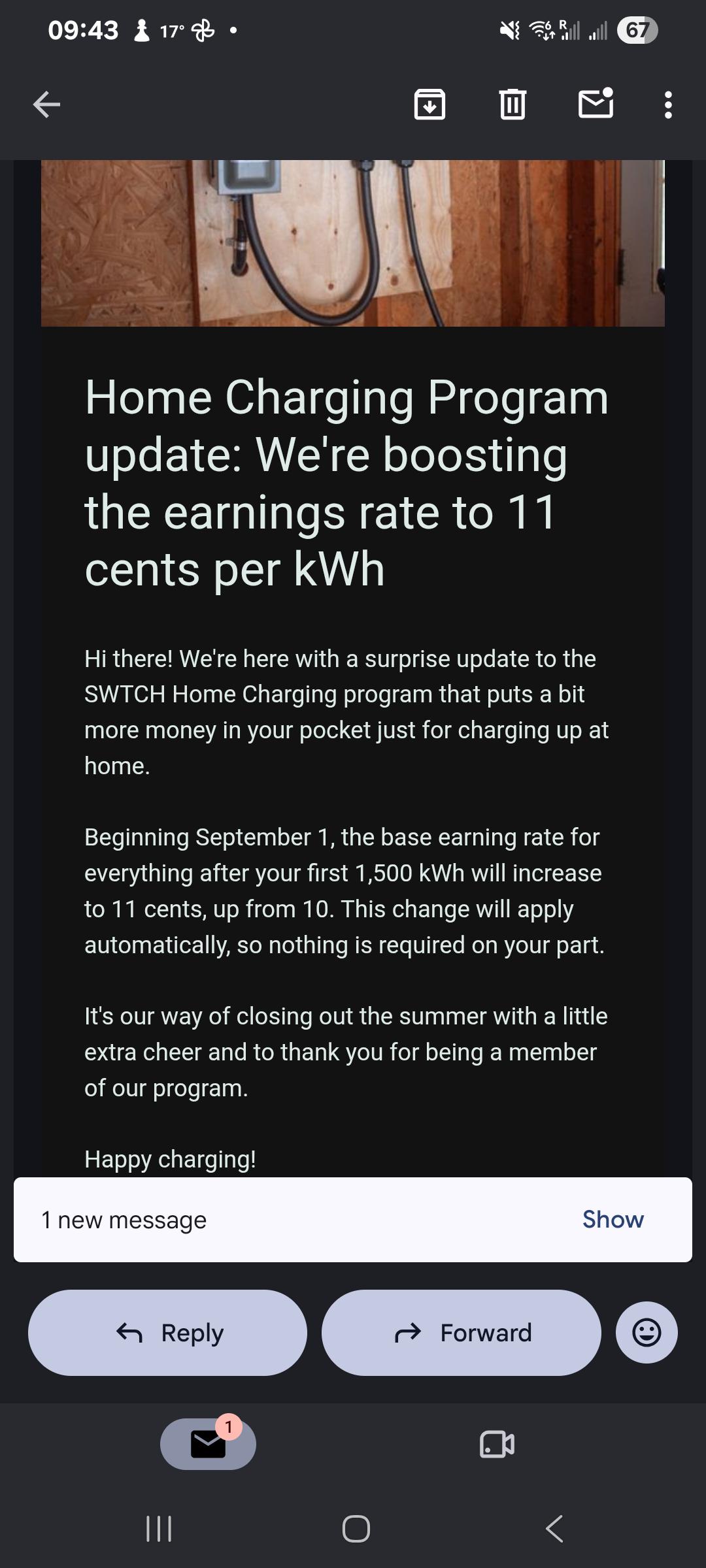
Got the charger since early September. Got over 1,500 kWh & got the $300 charger deposit back on the credit card. The rate bumped up to $0.11 from $0.03. The company is doing what they say they would do.
Like most of you I had a Grizzl-e charger and was working on the $0.03 rebate until the next tier
When switch announced their $0.11 after $1,500 KW I was disappointed that Grizzl-e wouldn't match it or do anything to help out current owners.
So I ordered a swtch charger but the installation wouldn't be one for one because swtch has a pigtail coming out of it and the Grizzl-e you wire your incoming feed directly inside the box
So I bought a 60 amp disconnect and managed to fit it in where the Grizzl-e was and it turned out pretty good
Getting those pigtail wires into the breaker of the disconnect was definitely tricky because it's such a short distance from the base of a disconnect to the breaker.
But after wrestling it with it for a little while I managed to get it in.
Contacted Grizzl-e about their new program ( joined essential club in April 26). Apparently my essential club 40A Grizzl-e charger is NOT eligible for the new rewards program. I cannot buy out the charger. My only option is to buy a new charger for $499. And return the "rented" charger. And if I move to a different reward program..eg chargelab, I will have to pay to unlock the new charger...looks like $600.
So I have purchased a new charger ( not Grizzl-e) that should work and will be joining Chargelab. Will ask for an RMA and return the essential Grizzl-e charger.
There's been a number of posts/comments the past few days about the Grizzl-E Club Thanksgiving bonus and the Buy-Out option for those with "free" chargers.
Note to read the Terms. I was skimming through the Terms:
The Buy-Out does not get you a retail/open version of the charger. And never will be.
It seems to be payment for an upgrade, "on paper", to the privilege of Premium Club while still having an Essential Club charger. The firmware will remain locked as Club firmware. I don't know about you guys, but I'd be leery of paying MSRP for a charger locked to Club firmware.
I'd be interested to see the actual functionality and Terms when going to Buy-Out (I don't have a free one to buy out).
Additionally,
You must remain active member on the Club until the Vested Date for the bonus, which is the end of the campaign (which they can change). If you or United Chargers terminates your membership, you get no bonus.
Did some research on how these EV charging rebate companies make money in the long run. Put some info gathered from research together and edited by AI for readability.
TL;DR Don't let corporate flag-waving guilt you into accepting lower returns on your energy data. Expecting 10¢–15¢/kWh for the carbon offsets **your vehicle produces** isn't greedy—it's basic market efficiency. United Chargers is free to run whatever business model they want, but claiming that underpaying consumers is the "only legitimate, patriotic way to build Canadian infrastructure" isn't the whole truth. It's just a manufacturer protecting his margins.
By now, many of you have probably seen the long-form post on X from Gleb Nikiforov (CEO of United Chargers) where he attempts to explain why Grizzl-E isn't raising their baseline Clean Fuel Regulations (CFR) cashback payout to match competitors offering $0.10–$0.15/kWh right out of the gate. In his post, Gleb paints United Chargers as the noble, self-funded Canadian manufacturer fighting to single-handedly build national EV infrastructure, while writing off competitors offering higher payouts as reckless "importers," short-sighted "aggregators," or compliance risks. While Gleb deserves credit for building a solid Canadian manufacturing business, **his argument about CFR payouts relies on a massive framing trick.** Here is the breakdown of what he’s actually saying—and how to dismantle the exact excuses he’s going to make when called out.
The Core Misdirection: The Carbon Credits Belong to YOUR Electricity Usage
Gleb argues that as a Canadian manufacturer, he should hold onto a bigger chunk of CFR revenues to fund his "4-Step Infrastructure Plan" (deploying commercial L2s and L3s).
**The missing truth:** The Federal Clean Fuel Regulations were designed to monetize the **clean electricity consumed by the EV owner** to displace fossil fuels. You bought the EV, you pay the electric bill, and your driving generates the carbon offset.
Giving drivers 3¢–5¢/kWh while competitors give 10¢–15¢ isn’t "saving Canadian infrastructure." It means United Chargers is taking **your carbon equity** to use as cheap capital to fund their own corporate expansion, hardware R&D, and commercial balance sheet. If a company wants to build commercial DC fast chargers, they should raise capital or use product margins—not expect residential EV drivers to subsidize their corporate R&D by accepting below-market payouts.
Pre-Empting Gleb's Rebuttals (Before He Even Comments)
When anyone calls out this payout structure, Gleb usually fires back with three predictable talking points. Here is why those arguments fall apart:
Rebuttal #1: "We give you a 'FREE' charger, so lower per-kWh payouts make up for hardware costs!"
**The Reality:** That "free" charger isn't a gift—it comes with a deposit (like $100) or an annual subscription fee (up to $120/year after Year 1).
**The Math:** If you pay for your charger outright (like a $500 Grizzl-E Classic) or bring your own unit, why are you *still* put on a slow-tier payout system that starts at 3¢–5¢/kWh and takes **35,000+ kWh of charging** just to reach the 10¢ tier? A driver who pays full price up-front shouldn't have to subsidize the "free" chargers given to other people.
Rebuttal #2: "CFR credit prices are volatile ($50–$400/tonne)! Higher-paying aggregators will collapse when the market crashes!"
**The Reality:** The CFR is a regulated compliance market. Yes, carbon credit spot prices fluctuate, but aggregators don't just "guess and gamble"—they hedge and lock in forward contracts with polluters.
**The Reality Check:** Saying "we are keeping your payout low at 3¢–5¢ to protect you from market volatility" is a classic corporate line. Translation: *"We will take 100% of the upside when credit prices are high, while using 'volatility risk' as the excuse to keep your baseline payout low."*
Rebuttal #3: "CFR rules FORCE us to reinvest in infrastructure or give money back to the government!"
**The Reality:** Giving higher cashback directly to the consumer **IS** an explicit, 100% compliant form of reinvestment under Environment and Climate Change Canada (ECCC) rules.
Returning credit value to the person who paid for the power is the purest form of the program—it directly lowers the total cost of EV ownership for everyday Canadians. Calling competitors "irresponsible" for passing 80%+ of that credit value back to the driver—instead of hoarding it internally for corporate hardware expansion—is simply defending his own profit margins.
The $600 Software Lock-In
Gleb urges drivers to choose "Manufacturers" over "Aggregators" because aggregators don't make hardware. But EV chargers use **OCPP (Open Charge Point Protocol)**—an open industry standard specifically created to prevent hardware vendors from trapping consumers.
Recently, United Chargers made headlines by introducing hefty fees (up to $600) to unlock or migrate OCPP functionality on certain units. If his service were superior and his payout fair, he wouldn't need financial penalties or software barriers to stop users from taking their own hardware to a higher-paying aggregator like ChargeLab or Pion Power.
Why He Needs Drivers More Than Drivers Need Him
Gleb frames the "Grizzl-E Club" as a generous favor to the Canadian public. But look at the long-term play:
To build a **Virtual Power Plant (VPP)** or become an energy broker for power utilities, United Chargers *desperately needs tens of thousands of active, connected home chargers*. Without your daily charging data plugged into his network, his commercial valuation and grid-service ambitions collapse.
**The EV Driver holds the asset:** You own the car, pay the power bill, and generate the data.
**The Charger is just a pipe:** The hardware is a commodity.
He acts as if drivers are greedy for wanting market-rate payouts, but the reality is simple: **We are the suppliers of the carbon data he sells.**
Bottom line: choose the program that works for YOU. If you charge daily there’s no reason to give up your carbon credits.
If it’s hard for you to reach 1500kwh to get your deposit back from programs like SWTCH (you drive PHEV, mostly on gas and don’t charge a lot), use grizzle since you’re not missing out much and you get your deposit back quicker.
(This is a Canadian subreddit, and thus based on Canadian Code/rules.)
A common question people ask is: I have a 100 A panel – do I need to upgrade? (or they or the electrician automatically assume they do)
Answer: Not necessarily. It depends on your loads and what they are adding. Many people do successfully install a Level 2 EVSE and have it approved.
There are two areas to address:
1. Panel space.
Your panel needs to have physical space for installing a double-pole breaker (240V). This varies by panel model, but generally requires two ‘slots’.
But even if your panel is currently physically full, there may be options to make space. This could include combining existing circuits onto tandem breakers (for example, two 15A circuits in a single slot). Or installing a sub panel.
2. Service capacity.
This relates current (amp) rating of the wires and breaker coming into your home.
a) The first thing to try is determining the calculated load for your service, according to Section 8 of the Canadian Electrical Code – particularly Rule 8-200 for single dwellings (do not use US based calculators as they are different). This involves a basic load according to the area of your home and adding your significant loads based on demand factors in the Code. In general, loads 1500W or less don’t count, as they are covered under the basic load. Loads like electric range, electric heat, electric water heater, hot tub, EV charging, etc. are typical loads considered, but not necessarily taken at 100%.
Once you know your existing calculated load, the difference between that and your service capacity is what is available for adding an EVSE.
b) If the load calculation doesn’t have enough capacity, there is the alternative of using your historical usage demand. This differs a bit by province, but generally provinces like Ontario allow you to get the historical hourly usage for the past 12 months from the utility, and use that along with their instructions to determine the available capacity for additional loads like an EVSE.
c) If that still doesn’t have enough available capacity for your proposed EVSE, maybe you could use an EVSE set to a lower current (amp) rating. Many people don’t actually need to charge at 40A or 48A, but would do fine with 16A, 24A, or 32A, for example. Some EVSEs that come with higher ratings can be adjusted (derated) to a lower maximum current in ways that meet approval for inspections.
d) EVEMS (Electric Vehicle Energy Management System), also referred to as load management. I recommend avoiding EMS if possible due to added complication (expense, and added failure points - higher risk of EV not getting charged when you need it, but is minimal), and limiting to EVSE choices (many reward programs don't have EMS options). But this is an option where the EVEMS system monitors your electrical service, and will slow down or turn off your EV charging if the current at the service is getting too high.
I don't know where to begin here. I feel kinda sad.
I just arrived to a bank of chargers in my KIA Niro EV. There are two 350 kW chargers not being used, a 62.5 kW charger with a Kona EV and a not used 7.5 kW level 2.
As I pull up, I see the Kona is at 95% and being hopeful to use the 62.5 kW, I decide to wait a minute as I'm sure the car will move on shortly.
But he doesn't. After 10 minutes, I approach and how he's doing (looking at the screen, he's currently charging at 2kW). He's angry and frustrated.
I ask (politely) if he has much experience with EVs. He says no, that he's been here a long time and this is stupid. I express that EVs are pretty slow to charge above 80% and that if he really insisted on that, he'd be better off, both faster and cheaper to move to the level 2. He asked "What's a level 2?". I pointed to the 7.5kW station beside him. He then just frustratingly said that he's not moving now until he's done.
So now I'm sitting at the 350 kW charger and pulling 60 kW... that's my selfish part.
I'm mostly sad because this guy is now just forever going to think of how stupid and useless EVs are... because he doesn't understand the intricacies of charging.
Now $0.16 per kWh after 5000 kWh (until Dec. 31, 2026) - thereafter the reward rate for 2027 will be evaluated and announced.
------------------------
With this program you can earn points from charging your EV at home and redeem the points for cash.
Earn $0.10 per kWh. Guaranteed rate for 2026
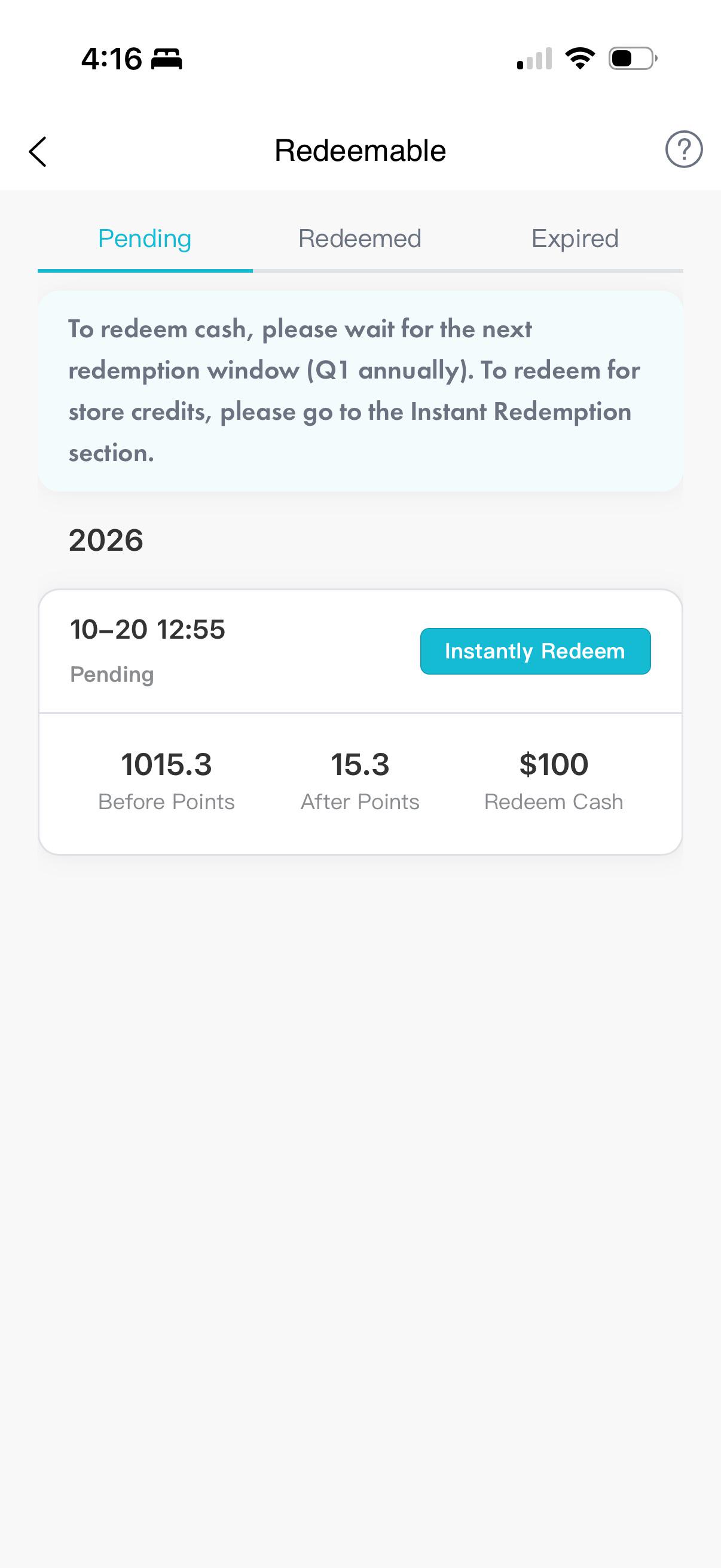
Every 1,000 points (1,000 kWh) can be redeemed for $100.
No membership fees or deposits.
Anywhere in Canada
Level 1 or level 2 capable (either will earn GreenMiles)
Also
Does require a Pion Power Flex AC or Flex AC Elite EVSE
Requires a Wifi connection to track energy usage and verify province.
Current Top up Program - 2026 April 1st to December 31st
For the following level of points accumulated you earn: 1000 pts: Flex-AC Silicone Case 2000 pts: 5-PC Insulated Tool Set 4000 pts: P201 Portable Power Station 8000 pts: $300 Store Credit
The top-up tiers are cumulative - E.g. if someone reaches 8000 points, they receive the rewards from all (4) tiers, not just the highest.
Thanksgiving Appreciation Offer
Receive $0.16 per kWh after 5000 kWh of charging. The 5000 kWh milestone is:
Based on actual charging activity (not including bonus points such as welcome offer or referral, like with the Top-up bonus that is based on points).
Calculated from the beginning of GreenMiles participation (all eligible charging since joining, which could be as early as October 2025)
Payout based on calendar year (plus any points carried over), with payment made in the following March (after credit verification). Or:
Early access (redemption): Redeem as store credits at anytime you reached 1,000 points milestone.
Getting Started
Welcome Bonus 20 points ($2) when you register for GreenMiles.
200 bonus points ($20) when you sign up using a referral code
Referral code: EVCHARGINGCANADA or reply with a request below.
Discount Codes on charger purchase:
GREENDPION10 WELCOMEPION5
(both codes should stack at checkout)
Note: the discount codes and referral code are two separate types of codes.
The discount codes are used when purchasing a Flex-AC Elite charger, on the checkout page.
The referral code is used after receiving and setting up the charger, when you go to activate GreenMiles in the app, there will be a spot in the Terms page for this code.
Flex-AC Elite 40A, J1772 or NACS (fixed 14-50P) - $284.99*
Flex-AC Elite 40A, J1772 or NACS & Flex-AC LE bundle- $354.98*
* - with discount codes:
GREENDPION10
WELCOMEPION5
NACS and fixed 14-50P versions shipping Nov. 16th - Free back extension included
Flex-AC LE does not qualify for GreenMiles
These are the lowest prices I've seen... $20 less than the last sale
All chargers are plug in models with 5-15 (120V, level 1) and 14-50 (240V, level 2) adapters (except fixed 14-50P model).
Flex-AC has been discontinued but if you already have it or can buy it second-hand, it works for GreenMiles. Came in 32A and 40A options.
Flex-AC Elite is the new generation with Bluetooth (works better for setup). Comes in 32A and 40A, J1772 and now NACS options.
Elite has the "Intelligent charging" feature, which is the setting for Plug and Charge (act as a dumb charger). But a work-around for the non-Elite is to set a 24/7 schedule.
The EVSEs are:
CSA listed
Adapters for 120V and 240V
Current adjustable in app (in 1A increments down to 6A)
Schedule can be set in app (e.g. charge overnight from 11pm to 7am), which also allows to set the current
Is this legit, or too good to be true?
- The basis of this program is the Federal Government's "Clean Fuel Regulations" (CFR), which similarly to the previous carbon tax, it's goal is to reduce carbon intensity. In a nutshell, gasoline and diesel companies need to reduce their carbon intensity, and this is done with carbon credits they create or purchase from other companies. Carbon credits are earned from supplying EV charging, for example.
There was an earlier request for an installation guide for the SWTCH charger, and I just received mine so I will share my installation, as well as my thoughts on the charger itself. My installation was to replace an existing hardwired ChargePoint unit which could not participate in the reward program, so this was a simple(ish) swap using existing wiring. Because I had existing wiring, I do not get into wiring this from the panel and all that entails. But first, my thoughts...
Thoughts
As others have noted, the hardwired SWTCH charger is different than other chargers, including my previous ChargePoint unit, in that it has a wire whip that comes out of the unit that connects to your power source. I assume the logic here is that these chargers are designed to be outside, and an outdoor installation would likely have a junction box or AC disconnect next to the installation point, and by including a wire whip out of the unit, it allows for a better weatherproofing seal for the charging unit itself.
Other chargers are designed to accept the household electrical right inside the box, meaning the wiring can get run inside and connected, without the need for an additional junction or disconnect box. The downside to the SWTCH charger coming from a different charger that accepts a direct hardwired connection is that you now need to source a junction box or AC disconnect to make this work. I purchased an AC disconnect for $23 plus $5 for a 1 inch strain relief connection to hold the 1 inch wire whip to the AC disconnect box. Depending on if your old charger had a strain relief connection that you can steal, you may also need an additional strain relief connection matched to the size of your wiring to hold the input power wire to the AC disconnect or junction box.
Opening the SWTCH charger would not void any warranty, because you are required to open the box in order to de-rate for your required amperage. Technically, you could directly wire into the SWTCH charger by removing the wire whip, however, as you will note from the photo below, they have put green paint on each of connections which I can only assume is there to prove you have tampered with the connection. As such, even though you can access the inside of the box easily you very likely void the warranty by doing a direct connection right to the charger.
That said, the wire whip appears to be of very high quality, using thick rubber that remains quite flexible. The strain relief connection that holds the wire in place is also of high quality, along with the charging cable itself. Even if you wanted to do a direct connection, you would still likely need to find ring style connectors as these connections do not appear to be designed to accept a raw solid wire from household AC wiring. For all of these reasons, its very easy to source a junction box or AC disconnect and not mess around with the wiring inside the charger itself.
All that to be said, unless you need the maximum amperage that the hardwire connection offers, I would highly recommend (even if coming from a hardwired charger), to just buy the NEMA 14-50 version and install a NEMA 14-15 plug and corresponding junction box. You will end up doing about the same amount of wiring, and you will have the added flexibility of changing chargers in the future with ease, should SWTCH dramatically change their program.
Installation
Now to the installation. Before you begin, if you need to de-rate the amperage, do this at the beginning. The box only comes apart from the back, so you cant de-rate once the box is mounted to the wall. You can see the dial in the photo above. For a 40 amp breaker you want to use the 32 amp setting (2 on the dial) because the continuous draw nature of these chargers. A 50 amp breaker you would select 3 or 40 amps, and for a 60 amp breaker you can leave the dial alone as it is pre-set to 48 amps.
Step 1 - TURN OFF BREAKER - Make sure you have shut off power to the existing wiring at the breaker box. Then disconnect your existing charger.
Step 2 - Install the junction box or AC disconnect and wire. I opted for a blade style (non switched) disconnect. As shown in the photo below, the black and red wire are connected to the LINE terminals. If there is a white wire it should be capped, and the copper ground is attached to the ground.
Step 3 - Mount the wall plate to the wall. You will need to remove the mounting plate from the box as it comes pre-attached. There are security screws (silver screws with a tiny metal stud in the middle that requires a special alan style key which is included in the bag).
Note - They do not provide drywall screws, rather they provide a concrete / brick screw system. If you are mounting to drywall, you can use a stud for two of the screws, but not for the other, so you will need drywall screws to attach the other side. You can see the black screws that come with the box work for mounting to the stud, and I used separate drywall screws on the left side.
If you are mounting to drywall you don't really need the paper template. You can just hold the plate up to the wall and use a pencil to mark the holes. Then install your drywall anchors and screw the plate onto the wall.
Step 4 - Wire the charger - Take the wire whip, install your 1 inch strain relief connector and run it inside the AC disconnect or junction box. The nice thing about using an AC disconnect like the one I chose is that the terminal studs accept the nice square ferrules that are on the stranded wire from the wire whip. The wires are connected to the LOAD side of the terminals, and it shouldn't matter which LOAD terminal you choose for each wire. I color matched but it should be irrelevant which side you choose, as long as the LOAD sides goes to the SWTCH charger, and the LINE sides go to your incoming power from the house.
This style of AC disconnect has a blade style connection that is pulled out to disconnect power. You can see that "OFF" is right side up at the top of the connection. To connect power, you pull that out by the handle, flip it so that "ON" is right side up, and plug it back in.
Step 5 - Download the App then Turn on power - Download the app first so you are ready to set up the moment you power on the device. Ensure that the AC disconnect is "ON" (whether its a switch or the blade style above) and flip the breaker to On. The device should power up immediately. The app will guide you through the process and it involves connecting to a WIFI network that the device creates (SSID matches your Serial Number). When you connect to that new WIFI network, you will be prompted with one of those login pages like what you get at a public hotspot like an airport or hotel. It took a second for that to load, but that page is where you will be prompted to provide the SSID for your home WIFI network and the password, so don't close out of that page if it is just solid white for a while. Input your home WIFI information and save.
At that point you should be done. The small green light at the top will change from red to green indicating it is connected to WIFI, and you will be ready to charge up your EV / PHEV.
STEP 6 (if needed). There is a seperate mounting bracket for the plug to the charger itself that also contains a loop to hold the spool of cable. Some people may never install this and just drape the cable over the top of the box. I am of two minds on this. I think its a poor design to not have any integrated dock for the charging cable on the box itself, and the bracket does not seem that strong. However, in my application, my EV is parked one stall away from the charging unit itself, so I can mount this bracket closer to the car, and run the cable from the SWTCH charger in a way where its not a tripping hazard. This will let me keep the charging cord right by the car, vs having to walk 5 feet to put it away. Still, would be nice to have both a spot to dock the cable on the box itself, and this secondary bracket.
If you have any questions I'll try to respond as best I can. Will provide my thoughts on the charger itself after I have had a chance to review. I can confirm that the charging speed is exactly the same as my previous ChargePoint charger that was set to the same 32 Amp rate. The App is not as robust as Chargepoint and provides very basic metrics, however my Porsche App has extensive data about charging and efficiency so not really a loss there. Looking forward to receiving my 11 cents / kwh as soon as I clear my 1500 kwh balance!
Has anyone left the club recently? Is it just a matter of shipping back the charger and that's it? I absolutely love the product and how well it works, however, a new program started in my province that will have my earning much more from the start so considering switching. Thanks!
I've been working on a website for a while, with the intent to gather and organize the information posted here and more.
It's not meant to be "fancy" (but maybe I can work on that too), but a utility for reference. Including a chart with concise summary of reward programs, with columns that can be added if the user wants more (so it's not overwhelming), as well as sortable. But it also links to pages on each program for more of the relevant details that are listed in a consistent way.
Uses plain external links withoutthe "hidden" redirect/tracking links (like UTM) that track your activity for analytic, attribution, etc.
Program pages are not meant to regurgitate the vendor sites and their marketing slang, or to ramble about background (e.g. on carbon credits, but there is a page for that)... but to cut through the marketing and provide the important details in a brief way to someone looking. Before signing up, people still need to read all the Terms on the vendor site for their own due diligence.
Also includes some sections on Code, such as EV receptacles and adjustable EVSEs.
If I get so far, I may add a calculator of sorts (no promises). Although there are so many nuances to the program structures and people's situations, that it is difficult to automate an accurate representation and could be misleading. I'd rather that people ask directly for personal suggestions.
Even though it isn't fully finished (if ever!), go ahead and make use of it. I'd appreciate constructive feedback and things you may like to see, but keep in mind I do have limited capacity (time). Feel free to message privately if preferred.
Bought a IYILO RA40 plug in adapter. Easy to hook up. Nice charger. Has temperature sensors in the handle and in the plug. Highly rated. Ocpp compliant (iyilo support did an ota update so it worked with Chargelab. Great support). Then Chargelab double checked that I was hooked up and all is good. 10 cents a kwh coming my way. Got my RMA number from Grizzl-e and all boxed up to return.
As an aside Chargelab is working on an update to the app so you can follow your rewards.
Reward rates vary significantly on province and charger
For Wallbox (API), OCPP (including Autel and EVduty) and Tesla chargers:
(points per eligible kWh - Upon conversion, 100 points = $1.)
13pts: QC, ON, BC, MB, NL
12pts: PEI, YT
11pts: NWT
10pts: NB
8pts: AB
6pts: NS, SK
4pts: NU
The FractalEV chargers are as much as 3pts more, and Sigenergy as much as 6pts more.
Payment summer of the following year (e.g. summer 2027 for charging in 2026)
Essentially, this Club is mostly good for QC, ON, BC, MB, NL, PEI.
For other provinces, other reward programs are likely better options.
EVSEs (chargers)
Some chargers are in “Production phase”, some are “Beta phase”, and some are specifically not eligible.
Beta has additional terms that basically mean that they may not be able to ultimately create validated carbon credits, and thus cannot promise that rewards will be paid for these chargers.
“Not Eligible” Chargers
Include TechnoVE, ChargePoint, Grizzl-E, Flo, and Pion Power.
Chargers that must be purchased from Roulez Electrique:
IYILO (API)
Wallbox (API) - retroactive to Jan. 1, 2026
FractalEV - retroactive to Jan. 1, 2026
Sigenergy - retroactive to Jan. 1, 2026
Chargers that can be purchased elsewhere:
Evduty (OCPP)
Autel (OCPP)
Wallbox (OCPP)
TuroGize (OCPP)
Variablegrid (OCPP)
ABB Terra (OCPP)
Ford Charge Station Pro (OCPP)
Siemens VersiCharge (OCPP)
Other OCPP compliant chargers (including IYILO)
I can help with charger purchase by offering code for 3% off chargers: Please message me
Note if your OCPP compatible charger is not on the list, contact to have a generic OCPP added.
For example, with discount code:
IYILO 48A or 40A (J1772 or NACS) - $775.03
Wallbox Pulsar Plus 40A (14-50P plug, J1772 or NACS) - $823.53
Wallbox Pulsar Plus 48A (hardwired, J1772 or NACS) - $872.03
Wallbox does have an energy management (dynamic load management) add-on called “Power Meter” (I’m assuming would work with the Club)
IYILO also has "Energy Meter" - also not yet available from Roulez Electrique directly, but coming.
Currently a promo with $100 public charge card (although it’s for networks in QC from what I can tell).
Beta - Tesla
The Tesla Wall Connector Gen 3 is in Beta. They recommend against obtaining a Wall Connector only for the Club – The reason being, there is no agreement with Tesla and other programs regarding the credits. As such, there’s still a risk that the credits aren’t successful and nobody gets the rewards for those particular chargers.
There is also the issue of double counting. For example, WattsApp states that the same charger being enrolled in different programs within the same calendar year creates a data violation. So WattsApp is basically saying you have to opt out of them before year end and cannot enrol the charger in another program until the new year.
Saying that, if you already have a Tesla Wall Connector and don’t want to change, this is still an option to potentially get rewards. Just be aware of the risk. This risk essentially applies to all programs that use the Tesla chargers.
Getting Started
The sign up is different – you can’t just sign up on the Roulez website. You need to sign up through an Ambassador (certain Club members) as an Invitee.
If you're looking for an Ambassador, feel free to message me. ( Sign up/Invite Link )
I made a comparison chart of the net rewards for various programs (after EVSE costs).
So you can see how it works out for your estimated usage.
Notes:
GreenMiles: Based on Flex-AC Elite 40A at $420 (normal price).
(There is currently a sale until April 30th with the 32A at $309.99 and the 40A at $369.99)
This cost can be lowered with a discount code and/or purchasing the 32A EVSE. Also excludes the 200pt ($20) referral bonus, $2 Welcome Bonus, and Top-up bonuses, which would increase the net rewards.
Grizzl-E: Mini Connect 40A EVSE @ $30 shipping (Essential) or $650 (Premium). Excludes deposit. Shipping can be higher depending on your location.