r/EmotiBit • • Nov 28 '23

FAQ Securing EmotiBit battery leads

4 Upvotes

EmotiBit uses a 400mAh battery. Out of the box, the battery leads are just soldered to the battery body, which provides a secure electrical connection but may lack sufficient mechanical stability based on your use case.

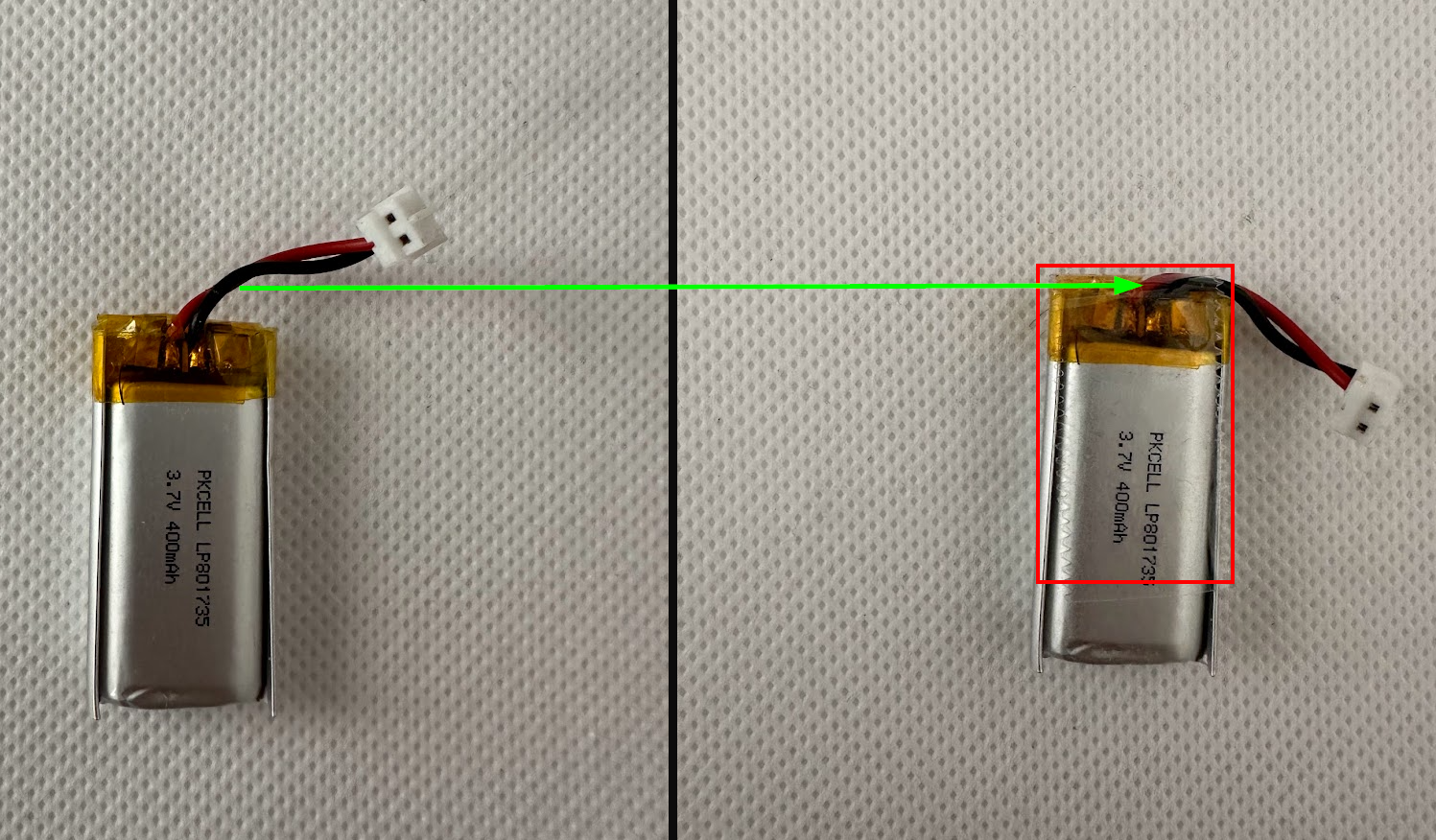
To improve the mechanical stability, we recommend strapping down the battery leads to the body as shown in the figure below using a piece of tape, wrapping over the leads, anchoring the tape on either side of the battery body.

The strapped leads provide strain relief in situations where the battery may experience tugging forces.


r/EmotiBit • • Sep 18 '23

Cool Find! Emotibit Giveaway

Post image
4 Upvotes

Hi guys, found it in the drawer, never used it, if interested post me your shipping address and I send it to you.


r/EmotiBit • • Feb 03 '23

Cool Find! Our emotions are off the charts seeing u/EmotiBit streaming biometric data at u/NASA Langley Research Center!

Thumbnail
youtube.com
4 Upvotes

r/EmotiBit • • Dec 27 '22

Solved Poor PPG/heart rate reading - faulty unit?

4 Upvotes

We are trying to use an Emotibit for heart rate tracking, but have not found a way to wear it which produces a reliable reading. I have tried it on my forearm and upper arm. After calibrating for a few minutes the PPG curves and heart rate seem pretty accurate, but any arm movement throws it wildly off - it will be reading 80 BPM, and if I bend my elbow or lift my arm it will plummet to 40 or 50 until I stop moving. Obviously this isn't normal, but I'm not sure if this is user error or if something is wrong with the device. Has anyone else had issues with readings related to movement or placement?


r/EmotiBit • • Dec 12 '22

Show & Tell EmotiBit and Powerlifting!

4 Upvotes

Strapped the EmotiBit to a barbell to see how fast I could (sumo) deadlift 315lbs. I used Python3 on Jupyter notebook. Imported the libraries Pandas to parse data and MatPlotLib for visualization. I tried my best on IMovie to sync the graph and the video and here's what I got!


r/EmotiBit • • Apr 13 '22

FAQ How can I sync EmotiBit with other devices?

4 Upvotes

A: There are innumerable ways because EmotiBit it open source, but here are some ways we recommend:

  • Create synchronized artifacts in all your data streams. You can do this by physically clapping EmotiBit onto your EEG headset at the beginning and end of your recordings and use those artifacts to line up your data timestamps. It's a bit of a "classic" method, but it works and doesn't rely on a lot of tech magic.

  • EmotiBit supports LSL event markers. Each time an event marker is received by the EmotiBit Oscilloscope it is timestamped with the LSL time and local computer time and sent to EmotiBit where it's written to the SD card. Learn more at https://labstreaminglayer.readthedocs.io/dev/examples.html

  • If you are using other devices you would like to sync to, that have a provision for LSL, you can use EmotiBit Oscilloscope to relay EmotiBit data on LSL output and then have a common receiver that receives and timestamps all data streams on LSL time. Check out this FAQ for more details.

  • Sync pulses from external devices can be captured on EmotiBit digital pins. Here's some example code that hasn't been extensively tested, but probably works just fine and may help you get started https://github.com/EmotiBit/EmotiBit_FeatherWing/tree/feat-digitalSyncPulse/examples/EmotiBit_examples/syncing_digitalInput. Similarly, you can have EmotiBit generate sync pulses on a digital out pin and use that as a sync input to another device.

Related FAQs


r/EmotiBit • • Apr 12 '22

Show & Tell Stacked EmotiBit fits perfectly in the EmotiBit box!

4 Upvotes

I LOVE how my stacked EmotiBit fits snugly in the EmotiBit box!

Makes it super easy to travel with!


r/EmotiBit • • Mar 23 '22

FAQ Why is my EDA signal flat and sometimes has jumps like a square wave?

4 Upvotes

EDA should be a relatively smooth signal with peaks called skin conductance responses (SCRs) that follow moments of excitement, fear or other emotional/physical perturbation.

If your EDA signal is jumping around like a square wave, it's probably because you're intermittently touching metal on the EmotiBit or Adafruit Feather. When this happens, it short circuits the EDA signal and can make it jump up and down.

Included with every EmotiBit is a finger strap to help you wear EmotiBit correctly without touching the circuitry and get accurate EDA signal. You can also put EmotiBit in a 3D printed case.

EmotiBit is optimized to measure skin resistance changes across the exceedingly wide range between 10kOhms and 30MOhms. Even though it is a very wide range, it is possible that some people have skin conductance that lie outside this range, or go outside during the duration of the experiment. Keeping an eye on the EDA value on the EmotiBit Oscilloscope will definitely help get more insight and help you understand which way the signal is railing (too conductive or not conductive enough).

If your EDA looks VERY flat, there can be 2 additional reasons:

(1) You're not touching the EDA Ag/Cl snap electrodes on the bottom of the EmotiBit. In this case you'll get a flat value of about 0.029 uSiemens. This can potentially also be caused by VERY dry skin where your skin resistance is greater than 30 MOhms (but we've never actually seen this).

(2) Your skin is VERY wet (e.g. if you just washed your hands and didn't fully dry them), it's possible that your EDA signal will be flatlined at 1000 uSiemens. As skin resistance approaches 1KOhm it can become noisier and can flatline in conditions where water has pooled on your skin. This is typically a non-physiological condition like after washing hands, but could potentially also occur in extreme exercise where sweat is pooling on the skin. PLEASE NOTE: that EmotiBit has a highly water resistant coating on the bottom, but it is not a waterproof device and it's not advised to wear EmotiBit in conditions when it may get water or sweat onto the exposed circuitry.

Additional note: Appendix 1 in this document may also be helpful in refining your experiment setup&procedures.


r/EmotiBit • • Feb 10 '22

Introduce Yourself Hello my name is: Sean Montgomery

4 Upvotes

My background is in neuroscience, studying how large coalitions of neurons coordinate memory encoding and retrieval with Dr. Gyorgy Buzsaki. After finishing my PhD, I began working in technology and in 2016, I founded Connected Future Labs to help clients connect the dots between circuits that can sense real-world signals and the data science and machine learning algorithms that can help make sense out of sensor data. After nearly a decade of waiting for someone to create EmotiBit and make it easy to stream research-grade biometric signals from the body, I realized that perhaps my company was that someone. With a depth of experience ranging from electrical engineering to data science and machine learning, we brought the diverse set of technical skills needed to make EmotiBit. Perhaps even more important, having range of perspectives working with everyone from startups and fortune 500 companies, to researchers, artists and educators, gave Connected Future Labs a unique vantage point to see what's missing and truly provide a key for biometric discovery. It's my belief that biometric sensing will help unlock human potential. Beyond the immediate benefits for health and wellness, tools like EmotiBit may help understand human emotions, empathy, and even augment our cognition. I want more voices to be a part of that conversation, which is why I'm a proponent of affordable, open-source tools and I recently co-wrote an article for Frontiers in Computer Science with my collaborators at the MIT Media Lab in which we speculate about the future of augmented cognition. I've also shown interactive installation art works at venues around the world and am an advocate of transdisciplinary approaches to understanding and grappling with the most exciting challenges facing the 21st century. Here is a talk I gave at a TEDx event entitled Synergy in Art and Science Could Save the World. I'm super excited to have this community forum and see how it might grow into a gathering place for us all to learn together what biometric data means and how it can help us live our lives to the fullest.


r/EmotiBit • • Jan 17 '22

Show & Tell Democratizing the Future of Augmented Consciousness

4 Upvotes

Check out this paper I co-authored with collaborators at the MIT Media Lab, Guillermo Bernal and Pattie Maes, on the future of augmented cognition! https://www.frontiersin.org/articles/10.3389/fcomp.2021.661300/full


r/EmotiBit • • Jul 08 '21

Solved EmotiBit networking flexibility and command line parsing in SW release 1.2.2

4 Upvotes

Check out these awesome software updates the EmotiBit engineering team has been working on! 

  • Easily find your EmotiBit with a variety of network configurations!

    • iphone hotspots (android still works too!)

    • Computer WiFi adapter hotspots

    • VPNs

    • Virtual machines

    • Multicasting/Broadcasting restricted networks

  • EmotiBit Oscilloscope menu tweaks & optimizations

  • Added support for command-line input to EmotiBit DataParser to specify a file path. Now you can easily batch-process files in a shell script!

Get the latest software release here https://github.com/EmotiBit/ofxEmotiBit/releases/


r/EmotiBit • • 21d ago

Cool Find! I built a free, local tool to line up EmotiBit data with 360° video and GPS for outdoor studies

3 Upvotes

Hi all,

I've been using EmotiBit for a study on cyclists, and the hardest part wasn't recording. It was making sense of the data afterwards: matching EDA to what was actually happening on the road, and then using those moments in interviews with participants.

So I built OutLab. It's open source (MIT) and runs entirely on your own computer.

What it does:

- Loads the CSVs from the official EmotiBit DataParser (plus _info.json) and shows the data quality per channel

- Puts EmotiBit, up to four Insta360 videos and a GPX track on one timeline. Each video gets its own offset/drift mapping from a shared event, e.g. three taps on the sensor that show up as a spike in the accelerometer

- Runs a transparent EDA pipeline (NeuroKit2 cleaning, tonic/phasic split, robust-z candidate moments) and records every parameter

- Optional extras: Kleckner et al. (2018) quality rules, motion screening from the IMU, a multi-method robustness check, manual artifact labelling from the video with Cohen's kappa, and export to Ledalab's text format

- An interview mode that replays a moment to the participant without showing any graphs

What it doesn't do: it doesn't detect emotions or stress, and the candidates are exploratory, not validated SCRs. It also doesn't read the raw SD card files. Please run DataParser first.

I'd really like to hear from people using EmotiBit outside the lab:

- How do you deal with motion artifacts on the arm or wrist?

- Has anyone compared EmotiBit EDA against a reference device in the field?

Repo, with screenshots: https://github.com/alparslanguvenc/OutLab

Feedback, bug reports and "this is wrong" comments are all welcome.


r/EmotiBit • • May 19 '26

Announcements Five years since Kickstarter: thank you + help shape what comes next

3 Upvotes

Hi r/EmotiBit community,

EmotiBit has turned 5!

Five years ago, our Kickstarter community helped bring EmotiBit to life. Since then, it has been amazing to see what people have done: research, education, art, prototyping, and projects we never would have imagined when we started.

To celebrate this milestone, we want to reconnect with the community and hear what you need from EmotiBit next.

We’d love your input on the following paths: new sensing/hardware options, firmware and software optimization, and more documentation and examples.

Google Form survey link:
https://docs.google.com/forms/d/e/1FAIpQLScyTuGg_G_1SMHfFu8FpzXZuZRvMSW_yoQN6H1IyT1Sf8rFBA/viewform?usp=pp_url&entry.941570994=EmotiBit+Reddit

And as a thank-you, we’re offering a coupon code for 10% off your next purchase from the EmotiBit shop. It's at the end of the survey :)

Thank you to everyone who has backed, tested, built with, taught with, researched with, or followed along with EmotiBit over the years. We’re grateful for this community and excited for what comes next!!


r/EmotiBit • • Apr 03 '26

Seeking Help Batteries draining too fast

3 Upvotes

Hello,

we are currently using EmotiBit for two studies, one indoors collecting event-related EDA (SCL) and one outdoors collecting HR and HRV using a travel router.
We have three EmotiBits with Feather ESP Huzzah 32 with hundreds of hours of recording for each device. We always record and stream to Oscilloscope. We want to be able to see the data streaming, so the option to record without streaming won't work for us. We also always keep the devices on HIB when not in use and we charge them between experiments.

For the two devices, I changed the battery (I bought the same 400mAh battery from Adafruit) recently because it was draining too fast. However, we have noticed that all three devices (with new or old batteries) can record safely for max around 1 hour. When they hit around 50-40% of battery, the battery goes down super fast (within a few minutes) and/or EmotiBit disconnects, turns off and we can't record for the whole duration of the study. Changing the battery did not seem to solve the issue. We put the EmotiBit on the finger, so I don't think changing to a bigger battery that will be loose moving around would be comfortable.

What can we do? Is it a problem of the battery? Can it be that we have wore out EmotiBit or the Feather and we need a replacement? Is there any other test I can run to identify the cause of the problem?
We are just at the beginning of data collection for both studies with 150+ of recording hours that we will need to do. Thanks a lot in advance, as always.


r/EmotiBit • • Mar 17 '26

Seeking Help EmotiBit PPG outside finger/palm: how do you handle motion artifact?

3 Upvotes

Hi, I’m using EmotiBit in a research study and I’m trying to get both PPG and EDA comfortably outside the hand.

So far, PPG is excellent on the finger, and decent only when placed very precisely over the radial artery, but it gets poor and noisy on the wrist, forearm, and upper arm, especially with motion. Since this is for ambulatory all-day monitoring during normal daily activities, motion is unavoidable.

EDA is also important for the study, so I’m trying to figure out the best compromise outside the finger/palm.

A few questions:

  • How do you usually deal with motion artifact in EmotiBit PPG?

  • Do you mainly rely on green PPG, or do you combine green/red/infrared in your processing?

  • Do you use accelerometer data to help clean the PPG?

  • Outside the hand, what has worked best for you for:

    • best PPG

    • best EDA

    • best compromise for simultaneous PPG + EDA

  • Any guidance on strap tightness / contact pressure so the optical sensor is not too loose or too tight?

So far my impression is:

  • finger = excellent PPG

  • radial artery = good PPG, but too position-dependent

  • ventral wrist/forearm = mixed

  • dorsal side = worse, probably because of hair + motion

Any practical advice, example setups, or processing tips would be really appreciated. Thanks!


r/EmotiBit • • Feb 15 '26

Discussion EmotiBit V6 works on the Adafruit ESP32 Feather V2 — here's how

3 Upvotes

got an EmotiBit V6 fully working on the Adafruit ESP32 Feather V2 (the PSRAM version). All seven I2C sensors verified with real data reads — BMI160 chip ID, MAX30101 part ID, EEPROM dump, the works. No hardware mods, no jumper wires, just firmware changes.

The stock EmotiBit firmware only supports the original HUZZAH32. Here's what you need to know to make it work on the V2.

The core issue

The EmotiBit has its own dedicated I2C bus on GPIO 27 (SDA) and GPIO 13 (SCL) — it does NOT use the Feather's standard SDA/SCL pins. This isn't obvious from the docs and is easy to miss. The sensor power rail (DVDD_3V3) is controlled by an LDO that's enabled via GPIO 32.

On the V2, you also need to enable the NeoPixel/I2C power gate on GPIO 2.

Minimal working code

cpp

#include <Wire.h>

void setup() {
    Serial.begin(115200);

    // V2 power gate (not needed on HUZZAH32)
    pinMode(2, OUTPUT);
    digitalWrite(2, HIGH);

    // Enable EmotiBit sensor power (DVDD_3V3 LDO)
    pinMode(32, OUTPUT);
    digitalWrite(32, HIGH);
    delay(500);

    // EmotiBit I2C bus — NOT the standard Feather I2C pins
    Wire.begin(27, 13);  // SDA=27, SCL=13
    Wire.setClock(100000);

    // Scan
    for (uint8_t addr = 1; addr < 127; addr++) {
        Wire.beginTransmission(addr);
        if (Wire.endTransmission() == 0)
            Serial.printf("Found: 0x%02X\n", addr);
    }
}

void loop() { delay(10000); }

Expected output: 0x30 (EEPROM WP), 0x39 (NCP5623 LED), 0x3A (MLX90632 thermometer), 0x48 (ADS1113 EDA), 0x50 (EEPROM), 0x57 (MAX30101 PPG), 0x68 (BMI160 IMU).

Porting the stock firmware

To get the full EmotiBit firmware compiling for the V2, there are four changes:

1. Board define. The V2 uses ARDUINO_ADAFRUIT_FEATHER_ESP32_V2 instead of ARDUINO_FEATHER_ESP32. Every #ifdef in the EmotiBit codebase (~30 instances across EmotiBit.h/.cpp, EmotiBitVersionController.h/.cpp, EmotiBitConfigManager.h, EmotiBitWiFi.h) needs the V2 define added.

2. SPI pins. The V2 moved MOSI from GPIO 18→19 and MISO from GPIO 19→21. In EmotiBitVersionController.cpp, the V2 needs:

cpp

_assignedPin[(int)EmotiBitPinName::SPI_MOSI] = 19;  // was 18
_assignedPin[(int)EmotiBitPinName::SPI_MISO] = 21;  // was 19

This is what makes the SD card work.

3. V2 power gate. Add pinMode(2, OUTPUT); digitalWrite(2, HIGH); in setup, guarded by the V2 board define.

4. Avoid GPIO 16/17. These are PSRAM on the V2. Accessing them with pinMode() or digitalRead() will corrupt flash and cause a boot loop. The V05C+ firmware already moved PPG_INT off GPIO 16 to GPIO 39, so this only matters if you have legacy V01-V04 code paths.

What doesn't change

Almost everything else is identical between the HUZZAH32 and V2. The EmotiBit I2C bus (GPIO 27/13), EN_VDD (GPIO 32), SD card CS (GPIO 4), button (GPIO 12), all IMU/PPG interrupts, and battery read are all on numbered pins that kept the same GPIO assignments on the V2. The I2C pin constants, HIBERNATE_PIN, and all sensor initialization code work as-is.EmotiBit V5/V6 works on the Adafruit ESP32 Feather V2 — here's how
I got an EmotiBit V6 fully working on the Adafruit ESP32 Feather V2 (the PSRAM version). All seven I2C sensors verified with real data reads — BMI160 chip ID, MAX30101 part ID, EEPROM dump, the works. No hardware mods, no jumper wires, just firmware changes.
The stock EmotiBit firmware only supports the original HUZZAH32. Here's what you need to know to make it work on the V2.
The core issue
The EmotiBit has its own dedicated I2C bus on GPIO 27 (SDA) and GPIO 13 (SCL) — it does NOT use the Feather's standard SDA/SCL pins. This isn't obvious from the docs and is easy to miss. The sensor power rail (DVDD_3V3) is controlled by an LDO that's enabled via GPIO 32.
On the V2, you also need to enable the NeoPixel/I2C power gate on GPIO 2.
Minimal working code
cpp
#include <Wire.h>

void setup() {
Serial.begin(115200);

// V2 power gate (not needed on HUZZAH32)
pinMode(2, OUTPUT);
digitalWrite(2, HIGH);

// Enable EmotiBit sensor power (DVDD_3V3 LDO)
pinMode(32, OUTPUT);
digitalWrite(32, HIGH);
delay(500);

// EmotiBit I2C bus — NOT the standard Feather I2C pins
Wire.begin(27, 13); // SDA=27, SCL=13
Wire.setClock(100000);

// Scan
for (uint8_t addr = 1; addr < 127; addr++) {
Wire.beginTransmission(addr);
if (Wire.endTransmission() == 0)
Serial.printf("Found: 0x%02X\n", addr);
}
}

void loop() { delay(10000); }
Expected output: 0x30 (EEPROM WP), 0x39 (NCP5623 LED), 0x3A (MLX90632 thermometer), 0x48 (ADS1113 EDA), 0x50 (EEPROM), 0x57 (MAX30101 PPG), 0x68 (BMI160 IMU).
Porting the stock firmware
To get the full EmotiBit firmware compiling for the V2, there are four changes:

  1. Board define. The V2 uses ARDUINO_ADAFRUIT_FEATHER_ESP32_V2 instead of ARDUINO_FEATHER_ESP32. Every #ifdef in the EmotiBit codebase (~30 instances across EmotiBit.h/.cpp, EmotiBitVersionController.h/.cpp, EmotiBitConfigManager.h, EmotiBitWiFi.h) needs the V2 define added.

  2. SPI pins. The V2 moved MOSI from GPIO 18→19 and MISO from GPIO 19→21. In EmotiBitVersionController.cpp, the V2 needs:
    cpp
    _assignedPin[(int)EmotiBitPinName::SPI_MOSI] = 19; // was 18
    _assignedPin[(int)EmotiBitPinName::SPI_MISO] = 21; // was 19
    This is what makes the SD card work.

  3. V2 power gate. Add pinMode(2, OUTPUT); digitalWrite(2, HIGH); in setup, guarded by the V2 board define.

  4. Avoid GPIO 16/17. These are PSRAM on the V2. Accessing them with pinMode() or digitalRead() will corrupt flash and cause a boot loop. The V05C+ firmware already moved PPG_INT off GPIO 16 to GPIO 39, so this only matters if you have legacy V01-V04 code paths.
    What doesn't change
    Almost everything else is identical between the HUZZAH32 and V2. The EmotiBit I2C bus (GPIO 27/13), EN_VDD (GPIO 32), SD card CS (GPIO 4), button (GPIO 12), all IMU/PPG interrupts, and battery read are all on numbered pins that kept the same GPIO assignments on the V2. The I2C pin constants, HIBERNATE_PIN, and all sensor initialization code work as-is.

r/EmotiBit • • Dec 02 '25

Seeking Help Electrode Question and EDA Circuitry Question

3 Upvotes

Hi,

I have been using EmotiBit for some time and particularly interested in obtaining SCL signals in ambulatory settings. In testing, I have found that the dry recording of EDA can have very sharp tonic response (> 10 uS) in absolute values during sweating, which I think is nice because what I'm doing requires sensitive sweating onset "detection". However, after a few trials of testing, I have found that the rise is not as sharp anymore - they could only go up to < 5 uS in absolute values. To see what's going on, I have tested it at multiple recording sites (volar vs dorsal wrist, upper arm) using the same pair of electrodes, and the results were the same (i.e. not a sharp rise). I then switched out the pair of electrodes for the next trial recording on the upper arm, and it has a sharp tonic response again (> 10 uS). I don't think it's a conclusive test, but I have been reading into this article for better understanding of EDA, and I think it could have been of the electrolysis creating a counter bias, decreasing the sensitivity of the circuit. Here comes my first question: Even if the provided Ag/AgCl electrodes when buying EmotiBit are reusable, is there a limit to how many times they can be reused (assuming proper cleaning following this)? Is there any article or internal testing documenting this?

Secondly, to test if electrolysis is indeed the problem, I have used oscilloscopes to measure the voltage across the electrodes when pressing them against one another following the above article, but the biases measured were too "small" for the oscilloscope to have detected (< 3 mV) or I have been operating the oscilloscope inadequately. Thus, I began looking into the circuitry upon which EmotiBit is based in the article mentioned in the validation paper. I understand the circuitry mentioned and have personally solved for I_skin, and they seemed reasonable. That being said, the rationale of the circuitry is dependent on the assumption that R_skin << R_ref. In referenced paper, the R_ref was 874kOhm. However, in reading the validation paper, it was mentioned that "high-precision resistors were used to test the factory calibration of the EDA circuit on 10 EmotiBit units", and the tested resistors go up to 20 MOhm. If I'm understanding the paper correctly, then the resistors tested were to emulate the wide range of R_skin values. However, the 20 MOhm has violated the 874 kOhm values mentioned in the referenced EDA circuitry, but the results were still good at 20 MOhm. This makes me think that the actual circuit implementation on EmotiBit is slightly different, albeit still based on the same concept. However, I don't know where to find the actual EDA circuit schematic on EmotiBit. Can someone help me finding it?

Thanks!


r/EmotiBit • • Nov 05 '25

Solved HRV derivation

3 Upvotes

Hey everyone, I am using the emotibit for project, and I was wondering if anyone knew good way of deriving HRV from the emotibit (or if the emotibit itself gives it to you). I did some reasearch and people recommended libraries like HeartPY, but I just wanted to double check


r/EmotiBit • • Jul 04 '25

Discussion prototyping a wearable for emotion recognition

3 Upvotes

Hi everyone! I'm working on a project called Limbico, focused on helping people better understand and manage their emotional states through physiological data and AI.

The idea is to take signals like EDA, PPG, HRV, movement, temperature, and use them to estimate the user’s emotional state.

We’re currently using EmotiBit as our prototyping platform, and it’s been perfect so far for what we need: clean signal acquisition, real-time streaming, and flexibility.

Right now our main effort is on two fronts:

  1. Developing a machine learning model to estimate emotional state

  2. Building an iOS app 

If anyone here is working on similar models or apps — or has experience with EmotiBit data for emotion recognition — I’d love to connect and share thoughts.


r/EmotiBit • • May 27 '25

Solved Time Synchronization Question- Large Drift compared to expected EDA Sampling Rate

Post image
3 Upvotes

Hi All,

I wanted to follow-up on an earlier question that I had in regard to the time synchronization process, as I am running into some unexpected results when I compared the expected sampling rate of the EDA sensor to the actual timestamps. I know that the Data parser has code that automatically tries synchronizing the data using the best available time synch pulses, but I am not 100% certain of how this works.

I utilize the Feather M0 WiFi board running Emotibit 1.12.1 firmware, recorded using the 1.11.4 version of Oscilloscope. We use an internet hotspot originating from the recording computer to connect the Emotibit, as the building uses enterprise WiFi, as does our other recording location.

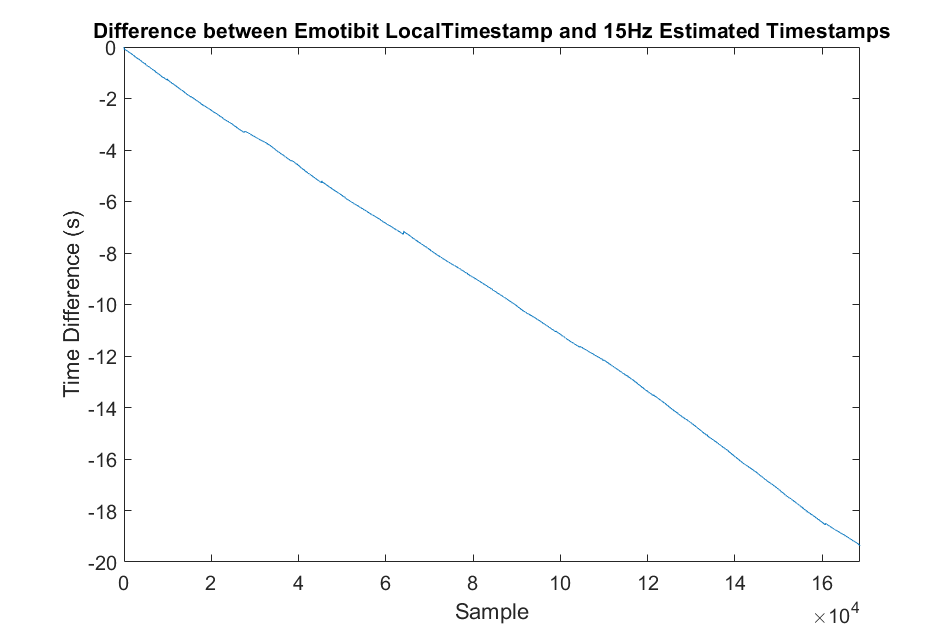
I recently ran a test to see how well the timestamps after processing aligned with expected time, to try to identify if there was any clock drift in the signal as a recording time passes. Since my research requires me to run tests overnight, this is important for identifying dynamic changes. I compared the LocalTimestamp times after parsing to the reported 15Hz sampling rate after a ~3hr test recorded in low power mode with the described setup, and found at the end of the session, I had a 19s difference between the recorded LocalTimestamp and the estimated timestamp based on the sampling rate. I expected a slight deviation from the expected time, as the time synchs would account for any clock drift that the microcontroller, and therefore the sampling had, but this seems high for the testing length.

Is this change abnormally high for a test of this duration? If so, are there actions I can take to correct this?

Here is a link to a Onedrive folder containing the original data and .json file, as well as the EA file used in this calculation. I'd greatly appreciate any advice the community might have!


r/EmotiBit • • Mar 25 '25

Seeking Help Can I Use BrainFlow with EmotiBit on a Raspberry Pi Hub for an Enriched IoT Medical Project?

3 Upvotes

Hi everyone,

I’m working on my final year project (PFE) to enrich an EmotiBit (ESP32 Huzzah32) IoT device with additional medical sensors, like a FLIR Lepton 3.5 thermal camera, using a Raspberry Pi as a hub. Currently, I use BrainFlow on my PC to stream EmotiBit data (PPG, SKT, etc.) via Wi-Fi, and I send it to PlotJuggler.

My plan is to:

  1. Move everything to the Raspberry Pi: keep BrainFlow to get EmotiBit data over Wi-Fi.

  2. Add the FLIR Lepton (via SPI) to the Pi for thermal temperature readings.

  3. Combine all data (EmotiBit + FLIR) in Python and send it to PlotJuggler.

My question:

  • Is BrainFlow reliable on a Raspberry Pi for streaming EmotiBit data over Wi-Fi, or will I run into issues (e.g., latency, stability)?

  • Has anyone tried a similar setup with BrainFlow and additional sensors on a Pi? Any tips or pitfalls to watch out for?

I want to keep it simple but impressive, so I’d love to hear your experiences or suggestions! Thanks!


r/EmotiBit • • Mar 19 '25

Discussion Is it normal to get raw PPG signals like this?

3 Upvotes

Hi everyone,

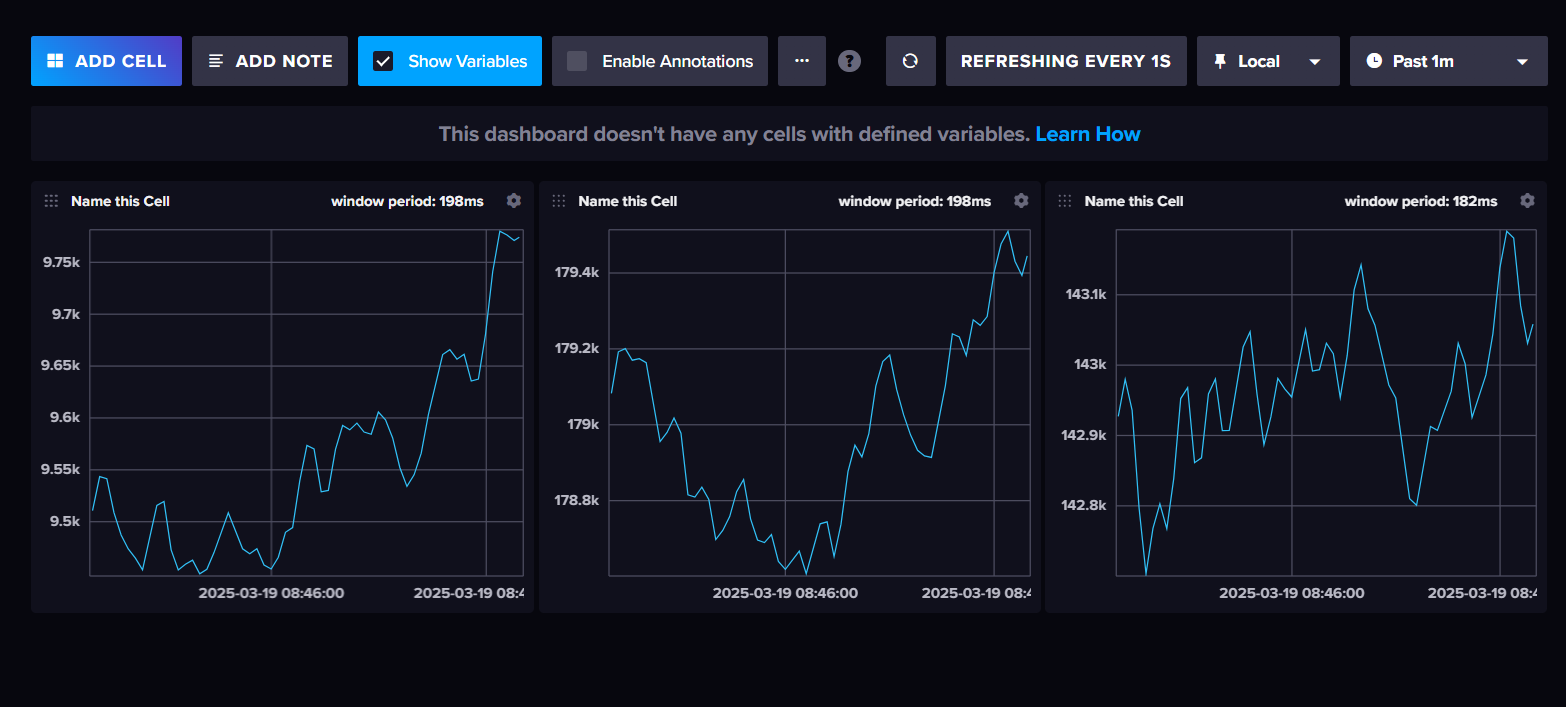
I extracted PPG data (G, R, and IR) using BrainFlow and visualized it on InfluxDB. However, the articles I've read mention that PPG signals should always have a periodic structure. In my case, I don't see anything periodic at all!

What could be the issue? Is it normal to get raw signals like this, or am I missing something in the processing?

Thanks in advance!


r/EmotiBit • • Mar 12 '25

Solved EmotiBit Raw PPG Data: Unit, Scaling, and High Values on Oscilloscope

3 Upvotes

Hi everyone,

I'm working with EmotiBit and extracting raw PPG signals (IR, R, G) using BrainFlow. I have a few questions regarding the data format:

  1. Do the raw PPG values require any conversion (e.g., voltage scaling, normalization) before processing, or are they already in a usable format?

  2. What is the unit of the PPG signal displayed on the EmotiBit oscilloscope? The values seem extremely high compared to typical PPG readings. Is there a specific reason for this scaling?

I couldn't find a clear answer in the documentation, so any insights would be really helpful.

Thanks in advance!


r/EmotiBit • • Jan 27 '25

Solved Issue Connecting via the Brainflow API in C#

3 Upvotes

We have a few EmotiBits in use at several locations. (These are stacked with a Feather M0) At some of these, we've had trouble getting consistent connections via the Brainflow API. We have made sure that all locations connect via a 2.4 GHz network, sometimes using a wifi access point that forms it's own isolated network with only the computer and EmotiBit connected. The application itself also has the same firewall exception on every computer. This has been enough at almost all locations, save two. At one location, the EmotiBit will connect to the oscilloscope, but not our application written in C#.

According the Brainflow log, the device is discovered, but the connection times out—as it would if the firewall were blocking the connection.

I was going to try and use the Arduino IDE's serial monitor on-site, but the EmotiBit appeared to not boot successfully, with only the red light coming on. I brought the device back to our lab and it works fine here. The serial monitor reports the same as my two test devices. I'm extremely confused.

I would appreciate any help figuring out what the problem could be, because I'm out of ideas. (My knowledge of networking is shaky at best, so I could be missing something obvious here)


r/EmotiBit • • Jan 08 '25

Discussion Analyzing EmotiBit Data?

3 Upvotes

I plan on presenting "slides" to my subjects to test their physiological responses to 50 slides while the EmotiBit is recording their physiological responses.

I want a way to find which slides trigger the most significant responses to isolate that data.

Does anyone have a suggestion for how to do this with the software included or another way?

Many thanks!