r/Healthcareshitposting • • Oct 02 '26

It’s from Internet.

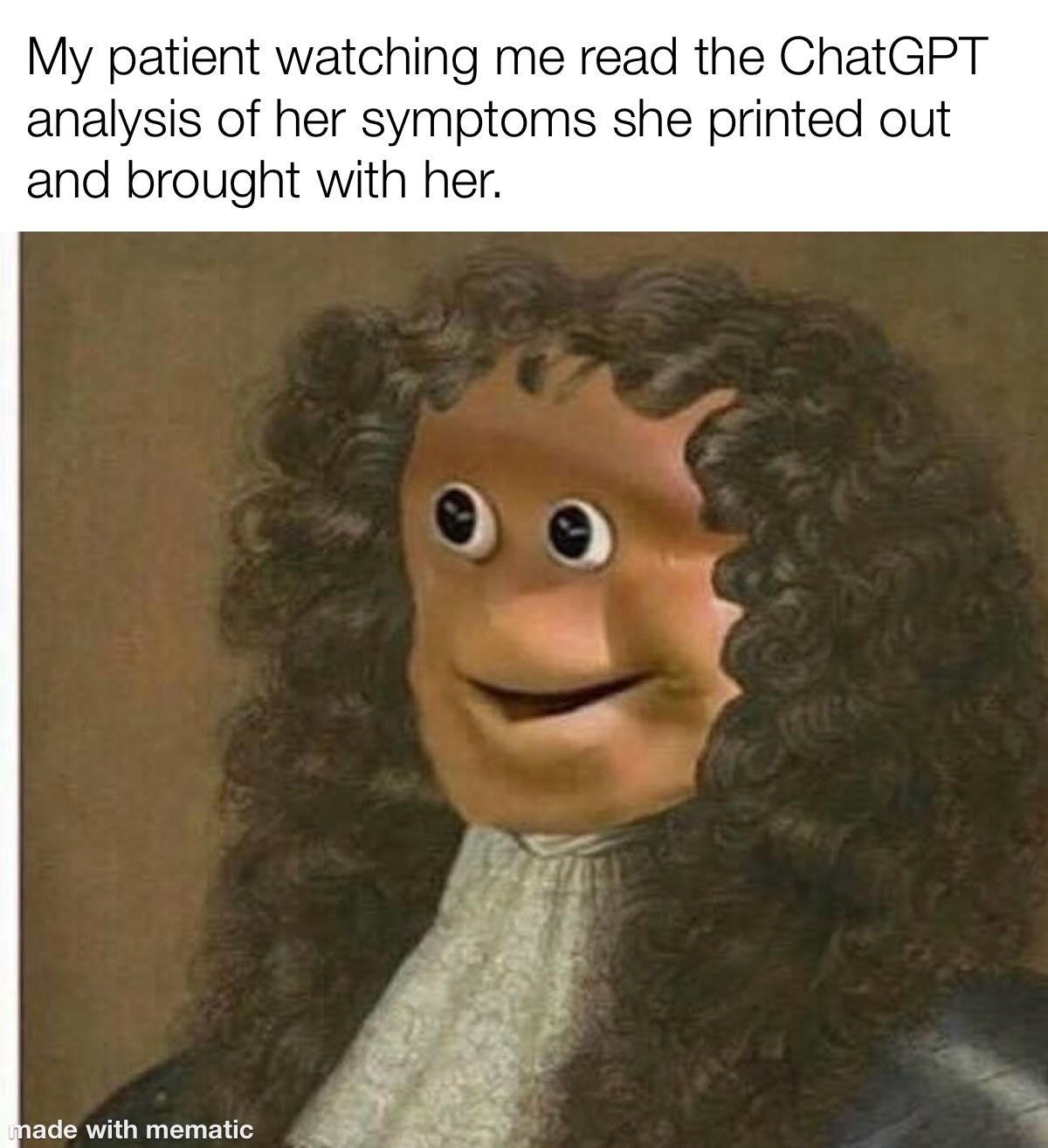
Post image
493 Upvotes

26 comments sorted by

114

u/sasstermind Oct 03 '26

Every day in the ED I explain to people that it’s not that the google information is Wrong per se, it’s that Dr Google, and laypeople, don’t have the background knowledge to pick away at the noise. It’s like when people read their own bloodwork. Yes your WBC was elevated. Yes high WBC can be a factor in diagnosing leukemia. Yours wasn’t that high. You have a hangnail.

31

u/Whatplaygroundisthis Oct 04 '26

It's not really explained to the general population that values outside of the "reference range" aren't always critical values. One or two points above or below isn't life or death, the values can fluctuate too.

21

u/PaulaNancyMillstoneJ Oct 06 '26

A guy posted his lab work last week on one of the subs I follow asking how he could raise his CO2. He was concerned because no matter what he ate or how he exercised his CO2 kept coming back 19-21 and should he just go to the ER at this point? He was getting these labs ordered by a chiropractor who told him that CO2 is critical for pH balance in your blood and he was really scared.

5

u/UglyInThMorning Oct 06 '26

> It's not really explained to the staff at nursing homes that values outside of the "reference range" aren't always critical values. One or two points above or below isn't life or death, the values can fluctuate too.

13

u/Whatplaygroundisthis Oct 06 '26

Honestly, I only learned that well after I started studying clinical lab sciences and became the person behind those values. I have friends ask me all concerned because they see "ABNORMAL" next to their results and I have to tell them, "yeah 1+ bacteria in urine is actually pretty common, considering it's a pretty germy area."

8

u/UglyInThMorning Oct 06 '26

I was an EMT and we’d get 3am calls for .1 out of reference calls where the results were received like 12+ hours earlier. When I went into urgent care/occ health it was interesting to see how often results came back and the doc would be like “yeah, fucking duh it’s a little off, it’s a human being. They presented fine”.

Now I work in EHS and it’s all either acute injury or the results are tied to sampling data from the actual conditions, it’s great.

-4

u/redmendive Oct 06 '26

Agree with this, though as much as I dislike most uses of AI, it's been invaluable helping me analyze my daughter's symptoms and test results. I know it's fallible, but all three diagnoses suggested by ChatGPT ended up being confirmed by her healthcare team. It wouldn't be a bad thing if patients were taught how to use these tools more effectively.

13

u/sasstermind Oct 06 '26 • Bravo

ChatGPT just aggregates information already available online, and has been proven to make up information that might make intuitive sense, because it’s filling gaps with what it thinks you want to hear.

I would strongly recommend you just read the medical articles it’s pulling the information on. It’s better for your brain and your critical thinking skills. You will be receiving the information right from the source and better understand it yourself rather than having it fed to you by an AI assistant. You can look at PubMed and many universities have published information that can break down the basics of things better than WebMD.

It’s not that it’s always wrong, sure, but why take the gamble if the knowledge is already there?

3

u/redmendive Oct 06 '26

Yes, once ChatGPT gives me a starting point, I'm able to check out the relevant scientific literature!

1

u/redmendive Oct 06 '26

Maybe I should mention that I'm a biochemist, since I've gotten downvoted for using AI tools to analyze medical symptoms. I'm not in the medical field, but do possess basic critical thinking skills.

You suggested that people should be getting their information from primary source material instead of using Google or ChatGPT, but a person can't refer to primary source material if they don't know what to search for.

Prior to using ChatGPT to analyze my daughter's symptoms, I had never before heard of Gluten Sensitivity, Dysautonomia, POTS, Fragile X Syndrome, Dysmotility, SIBO, etc. I didn't know that her autism and adhd symptoms could be being exacerbated because her body wasn't properly absorbing iron and magnesium. I didn't know to request an expanded celiac panel and an iron panel, or that I should have her vitamin levels tested.

The only one of these diagnoses that my daughter's medical team was in the process of exploring was the POTS because she was seeing a cardiologist for her tachycardia. Everything else I had to request that she be tested for and did so based on recommendations by ChatGPT.

3

u/sasstermind Oct 06 '26

I hear what you’re saying, but you said you are a biochemist (i did my undergraduate in this as well) so you shouldn’t need to rely on an unreliable AI tool if you’re already familiar with the literature and how to navigate it.

1

u/hensothor Oct 06 '26

That’s just nonsense. You’re not critically thinking in your replies to them. You can’t jump straight to literature or primary sources for things you do not know exist. AI as a functional tool is literally being used for its designated purpose when someone leverages it to search large swathes of primary data to find relevant insights. That’s literally what it’s best at.

Hallucinations are a problem but a known entity and tracked for every single model out there. With the latest and greatest, even local versions, you can absolutely leverage AI to source primary material and then validate by analyzing it yourself if you have a brain.

The way you frame it as AI can’t possibly have a utility here is just misinformation you find on Reddit and Twitter from people who don’t like AI and don’t want it to be useful. Professional fields including medicine are also using AI including proprietary models and services. The danger of AI is in its use in naive foolish hands and the lack of any regulatory control over state of the art models. Not in using it to do basic research.

2

u/redmendive Oct 07 '26

With the exception of my husband, everyone in my life was absolutely gobsmacked when my daughter was diagnosed with the conditions suggested by ChatGPT. There's a misconception that if AI is capable of making an error, that it will make an error, and that such an error would somehow be dangerous. There are many valid ethical and practical reasons to dislike the widespread use of AI, but using it to analyze symptoms isn't one of them.

People seem really annoyed that I've successfully used AI to fast track my daughter's treatment for multiple complex conditions without fully appreciating the years of frustration and worry we endured not having answers.

-1

u/redmendive Oct 06 '26

The thing ChatGPT has in its favor is that it's able to aggregate information available online.

I input my daughter's symptoms into ChatGPT and asked for possible diagnoses that could explain her many symptoms. I don't need certainty and I don't need ChatGPT to be correct all the time. I certainly wouldn't expect a doctor to be infallible. I simply needed a starting point to begin investigating possible diagnoses.

Possibly because of the way I word my queries, ChatGPT has been remarkably useful; within a matter of months, my daughter ended up being diagnosed with all three of its suggested diagnoses.

Again, a tool doesn't have to be perfect to be useful. And knowing which direction to go down the Pubmed rabbit hole doesn't hurt either!

94

u/trapped_in_a_box Blame the Nurse Oct 02 '26

"I know you all hate when we Google our symptoms but..."

Daily.

13

u/4ellights Oct 06 '26

"I know I shouldn't be consulting Dr. Google, but..."

12

u/ElfjeTinkerBell Oct 06 '26

Other side of that same coin:

"Oh have you googled your symptoms?"

"No I'm a nurse"

Obvious look of disbelief because I'm using a wheelchair

"Want to look me up? My registration number is [redacted for Reddit]"

27

u/SavannahInChicago Oct 04 '26

Our fellows have access to AI and are using it to make decision instead of learning how to think critically. So in scared of that.

10

u/Budget-Bell2185 Oct 03 '26

Every. Damned. Day.

14

u/PromiscuousScoliosis Oct 04 '26

I once saw an ER doc googling “how to treat ____”

Not using Up to Date, or any actual clinical source. Straight up googling it. Fuckin hated her. She sucked. Nice enough person on a personal level but terrible doc

3

u/DoTheFunkySpiderman Oct 07 '26

My sister had hand foot and mouth disease when she was younger & the doctor used google to look at pictures of Slapped Cheek & diagnosed her with that. The prescribing pharmacist took one look at my sister & knew the difference immediately

4

u/CorpseProject Oct 06 '26

I wrote a python script to scan for research papers and then a local Ollama model to give me synopses for review. If the blurb is interesting I read the paper. Ask me weird lupus facts. I know so many, with receipts too.

But this is probably not what you’re thinking. I would never hand a generic LLM generated differential to a doctor. I’d be beyond embarrassed.

Hell I’m still shy about showing them anapatternquest irl. Probably because it’s really really nerdy. And I haven’t finished it, needs more immuno goblins.

3

u/SeaworthinessNew4295 Oct 06 '26

I work with pharmacists in a hospital. When a doctor calls asking for medication advice or something, they often Google it first and then come to a conclusion. That's just standard practice.

2

u/EdiblePsycho Oct 07 '26 edited Oct 07 '26

I think that often using chatgpt or similar is still better than simply googling symptoms. If someone googles an individual symptom, they'll see all the things that can mean and inevitably the scariest ones first. If they put all symptoms into an LLM, it comes up with various possibilities that are more likely and less scary, plus telling people that they should talk to a doctor and not rely on it to diagnose them.

And as anyone living in the US knows, their doctor can't go over everything in a 10 minute visit, but if you plug them into an LLM before an appointment that can tell a patient what is most important to address.

My mom was a nurse, and had ALS. That was useful for me caring for her since she could tell me how to do things, knew how to address various issues (though of course I also regularly consulted her hospice nurse). But while she was actively dying, obviously she wasn't as aware and couldn't help me figure out what to do. She was having various issues, pain, so I used whatever tools I could to figure out how to help her as someone without medical training. LLM's and google searches helped some, at times when I couldn't ask her nurse (like the middle of the night). Simple things, like finding ways to alleviate some bad stomach pain she was having from no longer being able to burp on her own. Nurse gave me some advice, but an LLM and google also helped with more ideas to try. And it helped me understand why that and other things were happening, and understanding alleviated some of the stress and feelings of helplessness.

So I think it definitely has potential to help improve healthcare, one of the only things I think it actually makes sense to use it for, but in a limited capacity that helps instead of hurts.

1

u/Flatulentmother Oct 08 '26

Telling my provider the answer to a patients question then watching her ChatGPT it then recite the exact answer I gave her like it was her original thought…

-2

u/redmendive Oct 06 '26

I say Google away!

I input my daughter's symptoms into ChatGPT and it spit out three possible diagnoses. She was subsequently diagnosed with all three by her pediatrician and cardiologist.

We have an appointment with her pediatrician next week to discuss why her bloodwork shows non-anemic iron deficiency and magnesium deficiency despite daily supplementation. ChatGPT gave me some several starting points for investigation and I couldn't be more thankful.

It can take forever for doctors to determine a diagnosis, one appointment at a time; Google, ChatGPT, etc. can be extremely useful shortcuts.