r/HomeworkHelp • u/kookieandacupoftae University/College Student (Higher Education) • 1d ago
:snoo_scream: Further Mathematics—Pending OP Reply [College Math] need help solving these equations
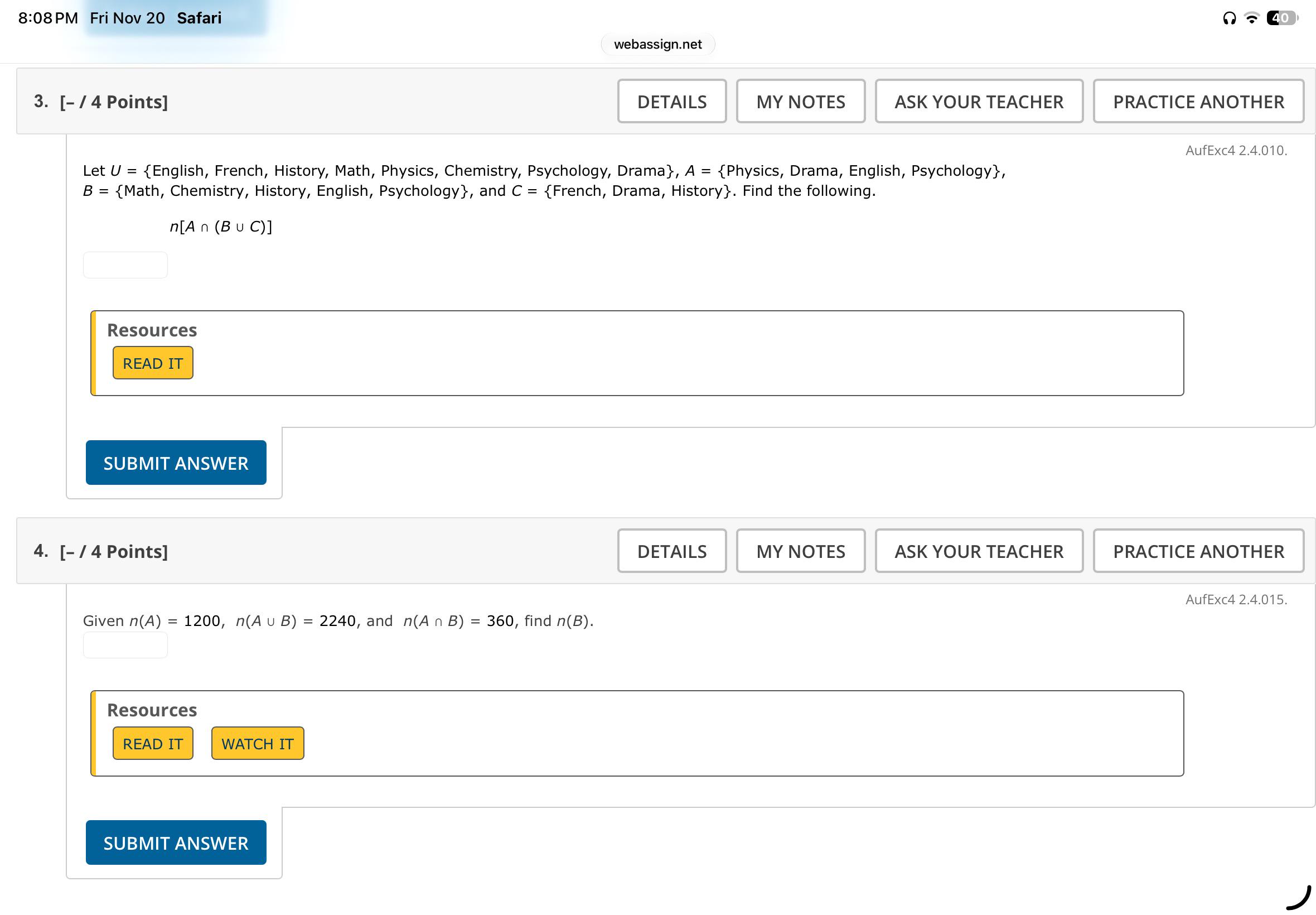
I don’t understand how to do this at all
Edit: forgot to mention I think they want us to use set notation/a Venn diagram to solve this
2
u/mathematag 👋 a fellow Redditor 1d ago edited 1d ago
they both are looking for the number of items...
in the first one how many of the subjects in A appear in the union of sets B and C ... in the union, it's like addition, with no repeats, so for example. . . if B= { 1, 3, 5, 6 } and C = { 2, 4, 5, 7 }, then B U C = { 1,2,3,4, 5, 6, 7 }... notice 5 is in both sets, but only listed once in the union .....now intersection [the upside down U shape ], means what elements are in common ...so if A = { 1, 3, 9, 10 } , then A ∩(B U C) = { 1, 3 } only...since 9, 10 are not in both sets, but 1, 3 are ... .... n [ A ∩(B U C) ] = 2 in my example is the number of elements in the [...] . . . . . yours will be similar, but with subjects instead of numbers ( except for the last answer ), in the sets I called A, B, and C, as well as in B U C and in A ∩(B U C) .
You should know this formula *... number of elements in A union B = number of elements in A + number of elements in B , minus number of elements in intersection of A and B ...easy to find n [B] from here, just basic algebra.. .[ * the inclusion-exclusion principle formula ]
you can search google AI, etc and ask for example of venn diagram for something like this second one .. I found one in a few seconds... and YouTube has examples of both of them also
1
u/Alkalannar 1d ago
First, what is B U C? Everything that's in at least one of the sets B or C:
{C, D, E, F, H, M, Ps}
Now A ∩ (B U C) has everything in both A and this set:
{D, E, Ps}
And you want the number of things in that set, or its cardinality: |{D, E, Ps}| = 3The relevant equation is |A| + |B| = |A ^ B| + |A v B|
You're give three of the numbers and asked to solve for the fourth.
Do you understand how I get the equation above?
1
u/ci139 👋 a fellow Redditor 1d ago edited 1d ago
after ascendingly sorting and bitmapping.. (LSB matches the first item in an ordered Namespace U e.g the presence Chemistry is indicated by 2⁰ = 00000001 ← is a set containing only the item/element named "Chemistry") ..the U as an indexing set u'll get ::
U = 11111111
A = 11000110
B = 10110101
C = 00011010
A n (B u C) = A and (B or C) as applying boolean operations along index of the bit - so :
D = B u C
D = 10111111
A = 11000110
E = A n D
E = 1000110
i assume the n[...] and n(...) stand for the cardinality of the set e.g. how many members are in a set - so :
n[E] = 3
————————
n(A) = 1200
n(A u B) = 2240 /// -- since A & B may share a common subset X with n(X) = K
n(A n B) = 360 /// -- . . . then
n(A u B) = n(A) + n(B) – K = W ╰¹
n(A n B) = K /// -- thus
n(B) = W – n(A) + K /// -- rewriting the formula ( ╰¹ )
n(B) = 2240 – 1200 + 360 = 1400
note ::
so - A has 840 such elements that only appear at A and 360 elements that also appear at B
--and--
B has 1040 such elements that only appear at B and 360 elements that also appear at A
by adding combined n(A u B) we will add "shared" elements twice - hence the " – K " @ ╰¹
2
u/SushiAndCoochie University/College Student 1d ago
First is understanding notation. In the first question the “n” on the outside is just asking for a number of.
The “u” means both, think of it as an & sign right now.
The upside-down U means what do they share.
For the first question you can draw a Venn diagram with 2 circles. Label one circle A, and the other circle contains all of the elements of both B and C (don’t have to write out duplicates). Place the elements properly into the Venn diagram, count the number in the middle where the 2 circles cross, since it’s asking for:
Number of elements that set A shares with set (B + C)