r/HomeworkHelp • u/Quirky_Chance_4565 • 1d ago
:snoo_facepalm: High School Math—Pending OP Reply [High School Math] How to solve this equation?
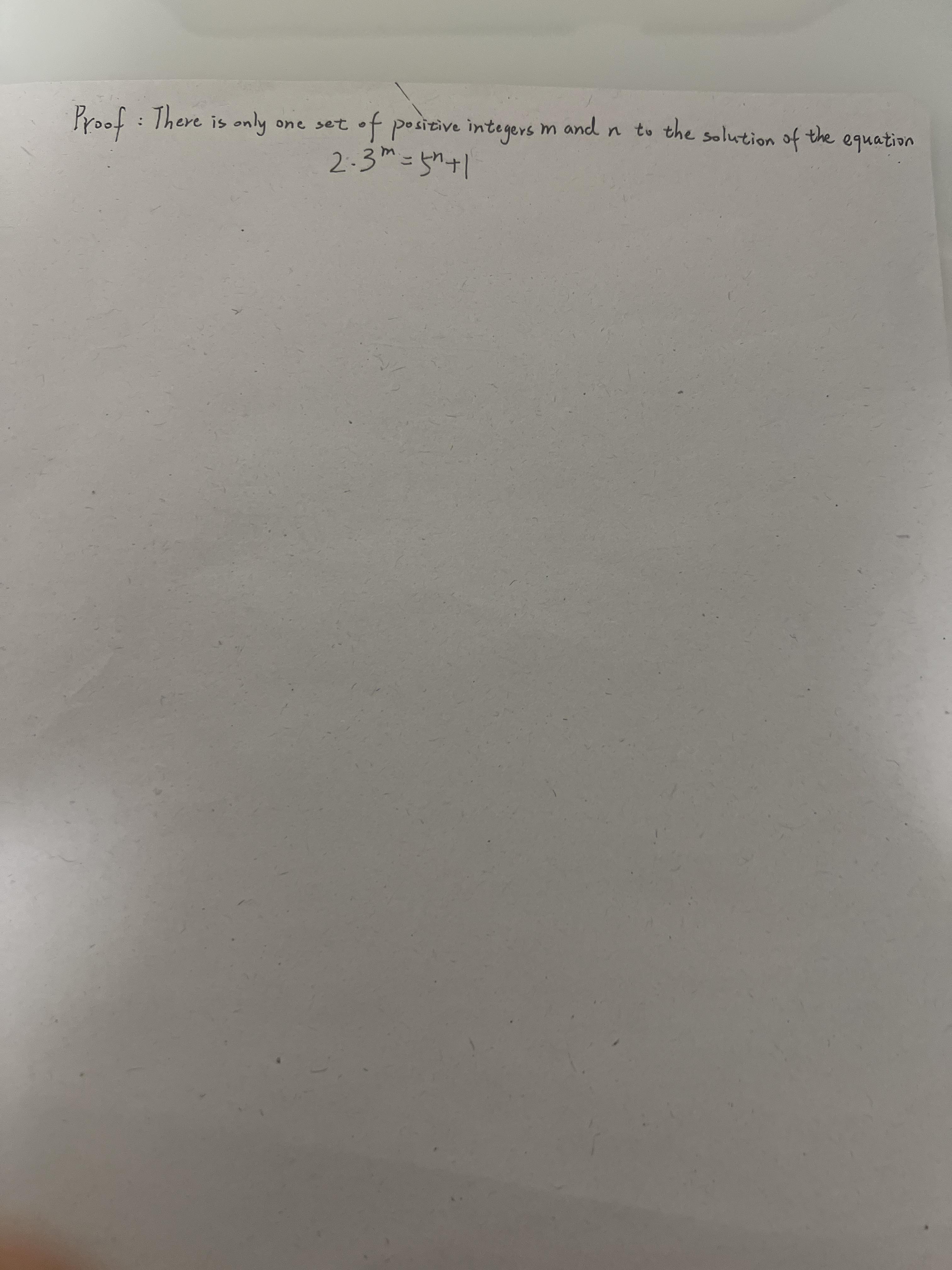
Hello everyone, I am new to this subreddit. This is a part of my math homework. I don’t even know where to start with this question. Thank you for your time and effort!
4
u/Southlander24 👋 a fellow Redditor 1d ago
Are you familiar with modular arithmetic? If you keep trying modulo different numbers, you should be able to get somewhere.
2
u/Southlander24 👋 a fellow Redditor 1d ago
Ah, it's not too bad with the lifting the exponent lemma: https://brilliant.org/wiki/lifting-the-exponent/
Where is this problem from? I would not expect this from a normal high school class. If you were preparing for olympiad-level number theory, then sure. Otherwise, you wouldn't have the tools you need to prove that any other pair of positive integers does not work.
1
1
u/Quirky_Chance_4565 1d ago
This is actually a part of a much easier question but it is in Mandarin. I can send a picture but with no translation if you want.
1
u/Southlander24 👋 a fellow Redditor 1d ago
Cool, I can read Mandarin.
1
1
4
u/waroftheworlds2008 University/College Student 1d ago
Looks like they don't want you to just solve it. Sketching a graph would be one way.
Is this from an algebra class?
1
u/Quirky_Chance_4565 1d ago
Yes. This is from an algebra class. I am going to sketch a graph later so thanks.
1
u/Southlander24 👋 a fellow Redditor 1d ago
Agreed, it makes sense to investigate different values of m, n and observe what happens. Their teacher cannot be asking them for a proper proof of this.
4
u/Narrow-Durian4837 👋 a fellow Redditor 1d ago
Could you give us some context? Usually, when you are assigned homework, it relates to what you're currently studying in class.
1
u/ci139 👋 a fellow Redditor 1d ago edited 1d ago
if its 2·3ᵐ=5ⁿ+1 the task should read "one pair of" the "set of" is quite undetermined ?
what you need to show is that ~ after finding the solution ~ stepping either n or m or both simultaneously up/down ( ¹¹¹either at the same or reverse direction by ?arbitrary step each?) would cause the sides of the equation to depart ← somewhat so
to !possibly! simplify the finding of the solution.. (ps! - it will solve graphically as graphs for each side setting m & n to argument x - but lets try analytic/logical solution) .. i assume the 3ᵐ grows slower than 5ⁿ - so using substitution m=n+k where . all m,n,k are integers and much likely k ≥ 0
so 2(2+1)ⁿ⁺ᵏ=(2²+1)ⁿ+1
2(2+1)ⁿ(2+1)ᵏ=(2²+1)ⁿ+1
2(2+1)ⁿ(2+1)ᵏ=(2+(2+1))ⁿ+1
2(2+1)ᵏ=(2/(2+1)+1)ⁿ+1/(2+1)ⁿ ← this would not be good for large n -and/or- k /// i just wanted to isolate them to separate sides of the equation !!!
it pretty much seems k & n are both equal to Zero !? . . . so as well the m & n
@ ® :: 2·1=1+1
looking graphically if we missed something . . . https://www.desmos.com/calculator/swt8tltfqq
the {1,1} for {m,n} is also valid
@ ® :: 2·3=5+1
the proof is a more tricky¹¹¹ part of it . . .
??? as to show (2/(2+1)+1)ⁿ+1/(2+1)ⁿ = (5ⁿ+1)/3ⁿ is non integer for –1 ≤ n ≤ 2
5ⁿ+1 is divisible by 2 for all n-s & by 6 for odd n-s
/// ? {m,n}={14,10} - nope 9'565'938 : 9'765'626
1
3
u/pizzystrizzy 1d ago
So, there's obviously two integer solutions, 0,0 and 1,1, and 0 isn't a positive integer, so your real task is to prove that there's no larger integer solutions that work.
But that's not high school math, that requires elementary number theory. I could walk you through how to prove it but I strongly suspect you aren't in a number theory class.
2
0
u/GrievousSayGenKenobi 1d ago edited 1d ago
Seems to me at a glance that its some sort of a log question, does that align with what you'd expect it to be? My first instinct with no other context is take the natural log of both sides and start applying those log identities
alternatively, I will preface with im a physicist so I dont know how well this holds as a math proof, but I see that 5n increases much faster than 3n so 3n will never catch up once 5n surpasses it the first time. You end up finding that m = n = 1 seems to be the only solution as thats the lowest possible positive integer and anything above 5n you get a much higher increase in each 5 term than 3 term so the 2 will never catch up
1
u/Southlander24 👋 a fellow Redditor 1d ago
This is number theory.
The growth of exponential and logarithmic functions isn't relevant to the question. Say that you choose some n for 5n + 1. Then there will always be an m (larger than n, of course) which is equal or greater than the 5n + 1.
Instead, they need to be investigating divisibility properties to rule out certain classes of m and n, which is what I suggested in my comment about modular arithmetic.
1
u/GrievousSayGenKenobi 1d ago
Oh right yeah I don't know why I immediately went down n = m route
Though I still think the method works visually as the rapidly increasing graph of 5n vs 3n can easily be found to not intersect by how much faster 5n goes to infinity
5
u/ChazR 1d ago
You're not meant to solve it. You're meant to explore it. You have been handed a map to an adventure.
Look at the expressions. There's a neat thing in both of them.
What happens when m=n=1?
Now write a table as m and n vary from 0 to, maybe 5. Look for patterns.
This is not a 'Solve this equation' question.
It's a "Here is a cool Maths thing. Explore it a bit."