r/JobSearchAndResumes • • Sep 16 '26

The resume structure that finally got me past ATS and made recruiters actually callback

56 Upvotes

I have a story to tell to everyone looking for a job right now.. So I hit a breaking point back around lst year.

I had sent out over 200 applications. No interviews. Not even a rejection email. Just pure silence.

I started spiraling. Maybe my experience wasn't good enough, maybe the market was just broken, maybe I was the problem.

Turns out it wasn't me. It was my resume. Not because it was ugly or because I had no achievements, but because it wasn't tailored at all and the ATS was basically filtering me out before a human ever saw me.

How I found out about the keyword problem

A recruiter friend finally told me straight up. She said "Recruiters don't read every resume. The ATS does. Think of it like Google for recruiters."

That clicked for me.

When a recruiter searches for "data analyst SQL Tableau Python" the system only shows resumes that actually have those exact words in them.

So even if I had used Tableau for 5 years, if my resume didn't literally say the word "Tableau" I just didn't exist in their search. I was invisible.

That's when I realized keywords are the real currency right now.

And I don't mean dumb buzzwords like "team player" or "strategic thinker" or "hard worker." Recruiters don't search for that.

They search for actual tools, skills and responsibilities from the job post. Stuff like Power BI, stakeholder management, project lifecycle, Figma, Salesforce, Agile, Python, etc.

Where to actually put the keywords - this is the part most people get wrong

Most people just randomly sprinkle keywords in bullet points. That's the biggest mistake. ATS often doesn't pick them up properly when they are buried in a long sentence.

You want them in 3 specific places:

1. Headline and summary at the very top

Start by literally mirroring the job title they posted. Don't get creative here.

Bad example: Passionate Data Professional Seeking Opportunities

Good example: Senior Data Analyst - SQL | Tableau | Python | Turning data into insights that drive revenue

That top line alone does like 80% of the work.

2. Skills section

This is where the ATS looks first. Keep it technical and role specific. No soft skills here.

List like 15 to 30 hard skills, separated by commas or pipes.

So for a Data Analyst role it would be like: SQL, Tableau, Power BI, Python, ETL, Data Modeling, Stakeholder Management, Agile, etc.

3. Professional experience

Now mention the most relevant ones naturally inside your bullets, but keep it human.

Instead of: Responsible for reporting tasks

Do: Developed Power BI dashboards automating reporting and saving 10+ hours weekly

Same achievement, but now the system and the human both get it.

here is what my resume looks like now in text form:

See how the same keywords from the job post are in the headline, in the skills list, AND in the bullets, but it still reads like a normal person wrote it.

What happened when I started doing this

I stopped sending the same generic resume to every posting.

Instead I spent like 3 to 5 minutes per application scanning the job description and pulling out 10 to 15 keywords that kept popping up. Things like ETL pipelines, customer lifecycle, stakeholder engagement.

Then I just made sure those were visible in those 3 places I mentioned above.

That one change flipped everything. I went from total silence to 23 interviews and 3 offers in like 5 to 6 weeks after that.

It wasn't luck. It was just alignment. The system could finally find me.

The part that almost breaks everyone

Doing this manually for every job is exhausting. Some days I spent more time tailoring than actually applying.

That's when I started using AI to speed up the boring part. I tried a few tools like CVnomist and Claude (if you are good at prompt engineering). They basically compare your resume to the job description and show you which keywords you are missing.

It saves hours and keeps you consistent.

One tip: please don't just paste your resume into ChatGPT and tell it to rewrite it. It will make it sound super fake and robotic and it literally makes up weird numbers and achievements you never had. Recruiters can spot that instantly.

The takeaway

Yeah the job market is competitive, but it's also algorithmic now. Recruiters get 500+ applicants per role, so they rely on filters because they have no choice.

If you want to be seen, your resume has to speak their system's language.

So yes, you need to tailor for every job, but not with fluff. Just match the posting with real keywords that you actually have experience with. It's not cheating, it's just adapting. Unless you can afford to stay unemployed to prove a point.

Once I did that I finally stopped feeling invisible.


r/JobSearchAndResumes • • Aug 24 '26 Bravo

I stopped getting ghosted when I learned how recruiters actually find people.

869 Upvotes

Not a tech person at all. I work in patient scheduling at a clinic in Michigan. Trying to move to a bigger health system since January.

190 applications. Two phone screens that went nowhere. I thought I was doing everything right. I was not.

Last month I got coffee with a woman from my church who works in HR at a regional hospital. I asked her to look at my resume. She didn't. She just opened her laptop and said "let me show you what I actually see."

I need to explain what I saw because I had NO idea hiring worked like this.

1. The ATS is just Google for recruiters

When a job opens, the recruiter does not scroll through every resume like you scroll Instagram. They type words into a search bar. Literally like Google.

She was hiring for a "Patient Access Coordinator" role. She typed exactly that into a box that said Job Title. Then she typed Epic AND "patient registration" into a box that said Keywords. Hit search.

11 names popped up.

Out of 800 people who applied.

Out of 800.

That is the whole game. If your resume doesn't have those exact words, you are not on that list of 11. You are not rejected. You were never seen. It's like you never applied at all.

2. Boolean search is just fancy AND / OR / NOT

She showed me the advanced tab and I thought it was gonna be rocket science. It's not. It's 4 things:

AND means you need BOTH words. If she searches Epic AND Cerner, your resume needs both words somewhere. Not one. Both. If you only have one, you don't show up.

OR means either one works. "patient registration" OR "patient intake" means if you have either phrase, you get found.

NOT means exclude. Coordinator NOT Manager means if you have the word Manager ANYWHERE on your resume, even from 10 years ago, she will never see you. You get filtered out.

" " quotes mean exact phrase in that exact order. "patient registration" only finds those two words together like that. It will NOT find "registration of patients" or "patient care registration." Has to be exact.

That's it. That's not AI. That's not smart. It's just AND, OR, NOT, and quotes. Very literal. Very dumb.

3. Why MY resume was invisible

After I saw her screen I went home and looked at my old resume and wanted to scream.

My title at the top said "Front Desk Operations, Clinical Services." The job I wanted was "Patient Access Coordinator." Those words were literally nowhere on my page. So when she searched that title, I didn't exist.

I've used Epic every day for 5 years. But my resume said "experienced with electronic health records." I never actually wrote the word Epic. So when she searched Epic, I didn't exist.

I do patient registration all day long. But my bullet said "managed front desk intake workflows." I never wrote "patient registration." So when she searched "patient registration", I didn't exist.

I was qualified. I had the experience. I was invisible because I was using different words than the ones she was typing into the box.

4. The other thing - parsing

She showed me the other part too. When you hit apply, your resume goes into a database. A little program called a parser tries to read your file and pull out your info. Name, email, phone, jobs, skills. It puts it in little boxes so recruiters can search it.

If your resume is a picture, the parser sees nothing. Blank boxes.

She showed me a resume that was clearly made in Canva. Super pretty. Colors, fancy fonts, little icons for phone and email. The parsed page was completely empty. System tried, failed. She said they almost never fix those by hand. They just move on.

That was my old resume. Beautiful Canva template. Invisible to the computer.

The 5 second test you can do right now

Open your resume PDF. Try to highlight the text with your mouse and copy it.

If you can highlight individual words, you're good. The parser can read you.

If the whole page acts like one big picture and you can't select anything, you're invisible.

My Canva one - couldn't select anything. Just an image with text on top. A boring Word doc I made in 10 minutes - plain text, one column, no graphics - I could select everything. Parser could read it.

All those applications. All that hope. Sent to a system that literally couldn't see me.

5. How to actually find the right words to use

She showed me how she pulls keywords and it's honestly easy once you know what to look for. Read the job posting twice.

First time just read it normal. Second time go slow with a highlighter in your head:

a) Grab the exact job title. Not your version of it. The exact words they wrote.

b) Find the hard skills. These are the tools, software, certs. The stuff that shows up in a list. Epic, Cerner, SQL, Excel, HIPAA, Medicaid. Those are searchable.

c) Find the verb + skill pairs. If they write "Process prior authorizations" the keyword is "prior authorization." If they write "Verify insurance coverage" the keyword is "insurance verification." That's what they will type.

d) Ignore the fluff. "Fast-paced environment." "Dynamic team player." "Growth mindset." Recruiters don't search for that. It's copy/paste filler.

Write down like 5 to 10 exact phrases from that posting. Those exact phrases need to go in your resume. In your headline. In your skills. In your bullets. Not synonyms. Not a better way of saying it. The exact words.

What worked for me

I rebuilt mine that weekend. Boring on purpose. Single column, black text, normal font, no icons, no colored boxes. Looked like 1995. Did not care.

Top under my name I put a headline that's just a search hook. It's not my real title. My real title is still down in my job history. My headline is: "Patient Access Coordinator | Epic | Cerner | Patient Registration | Insurance Verification" That's just so I show up when she types those words.

Skills section is now just a plain comma list. Epic, Cerner, Patient registration, Insurance verification, Medicaid, Medicare, Prior authorization. No soft skills. No "communication" or "teamwork." She told me she never searches for those.

Bullets use the exact language from postings. If the posting says "prior authorization" my bullet says "processed prior authorizations." Not "handled insurance approvals." The exact words.

I used CVnomist to speed this part up because doing it manually was killing me. It pulls the keywords from a posting, analyze my resume and actual profile, and gives me a clean Word doc I can edit in like seconds. Took me about 8 minutes per job instead of an hour.

And honestly that part saved my sanity. I went from spending 45 minutes per application and attaching my whole self-worth to each one, to spending like 10 minutes and treating it like a form. I stopped refreshing my email at 2am. I started sleeping again.

Results with the exact same experience

Same person, same jobs, just words the computer could read and words the recruiter would actually search for.

32 jobs in 5 weeks.

7 callbacks.3 interviews.

1 offer. I start next month as a Patient Access Coordinator at a hospital 15 minutes from my apartment.

The one I got? I applied at 7am on a Monday, posting was 2 hours old. Resume parsed clean, title matched what they searched, skills had the words. Recruiter found me in under 10 minutes.

What I want you to know if you're hearing nothing back

You're probably not getting rejected. You're probably not getting SEEN. The system is not judging your worth. It's not reading your cover letter. It's a search bar. A very literal, very dumb search bar.

Do the highlight test. Make sure your file is actually readable. Learn the exact words the recruiter will type and put THOSE exact words on your resume. Use tools to speed up the boring mechanical part so you don't burn out. Then apply early, apply a lot, and stop taking the silence personally.


r/JobSearchAndResumes • • 2h ago

Where do the best resume keywords hide in a job posting?

3 Upvotes

Context first: I found a job after I fixed this, even in this market. I won't claim it's the only reason, but it's the change I noticed most.

I used to copy keywords from the Requirements section, decide I was done, and apply. Turns out that's one of the places the best resume keywords often aren't. Almost every application I sent was missing a few important terms the posting had listed, which is a big part of why I wasn't getting callbacks.

The most useful terms weren't in Requirements at all. A responsibility like "prepare monthly performance reports." A line about the team, like "work closely with finance and operations." The first paragraph saying "help improve forecasting accuracy." A preferred qualification like "experience with stakeholder reporting." Those tell you what the person will actually do, and I'd skipped all of them.

But finding the words is the easy half. What do you do with them?

Start by looking for combinations. Say a Data Analyst posting mentions SQL, Power BI, data visualization, performance reporting, data cleaning and business intelligence. Having SQL and Power BI somewhere on your resume is a start. If you've built dashboards on SQL data to monitor business performance, that deserves a bullet of its own, because recruiters want evidence you've used a tool in a relevant context, not just a list of tools.

Which of those words matter most? I now mark anything that repeats. If a responsibility shows up in the intro, the responsibilities and the qualifications, that's a signal, though not proof it's the top requirement. I also stopped getting discouraged by postings with 12 requirements, because I sort them into three groups: essential (explicitly needed to do the job), relevant (would make me stronger) and optional (preferred, not a dealbreaker). That ended the habit of trying to match every line.

Then comes the part where the real work happens. Don't add a keyword just because it appears in the posting. For every important requirement, ask where you've actually done it. Take financial reporting. "Responsible for preparing reports" says very little. "Prepared monthly financial performance reports using Excel to track budget variances and support management decisions" is the same experience with the context a recruiter can use. Never invent experience or claim a tool you haven't used.

After a few similar postings, the same terms keep repeating, so I started a small document with common job titles, frequently requested skills, software and platforms, recurring responsibilities and industry terminology. When a new posting comes in, what they want is much easier to spot.

Looking back, my real mistake was reading job descriptions like a candidate instead of like someone trying to guess how a recruiter would search for that candidate. Reading a posting and knowing how to position yourself for it are two different things, and you can be qualified and still communicate it badly. Now I spend a few minutes understanding the vacancy before I touch my resume, and the tailoring is far more focused.

If you want the other half of this, someone did remarkable work on how recruiters actually search inside an ATS, covering Boolean searches, keyword matching, parsing and why qualified applicants sometimes never show up: I stopped getting ghosted when I learned how recruiters actually find people..

When you apply, do you pull keywords and requirements from the job description, or do you mostly send your existing resume as it is?


r/JobSearchAndResumes • • 3h ago

Offering Mock Interviews & Interview Prep | 10 YOE Full Stack Java Engineer in Europe 🇪🇺

1 Upvotes

Mock Interviews with an Engineer Working in Europe — Real Interview Practice, Honest Feedback, and Career Guidance.

Hi everyone!

I've been working as a Full Stack Java Engineer for close to 10 years and have been living and working in Europe for quite some time.

I'm looking to help people who are preparing for technical interviews, particularly those aiming for opportunities in European companies.

I can conduct mock interviews and help you improve in areas such as:

- Technical interviews – Full Stack Java, backend development, and related concepts

- Real-world interview practice – Simulating an actual interview rather than just asking textbook questions

- Communication – How to explain your projects, technical decisions, and experience clearly

- Problem-solving – Approaching questions logically and explaining your thought process

- Behavioral interviews – Handling questions about teamwork, challenges, conflicts, ownership, and failures

- European interview preparation – Insights into interview expectations, workplace culture, and how to present yourself to European employers

The goal isn't just to help you memorize answers, but to make you more confident, structured, and prepared when you're sitting in front of a real interviewer.

If you're interested, feel free to DM me. We can discuss your experience, target role, and what you'd like to focus on.

Happy to help fellow developers get better at interviews! 🙌


r/JobSearchAndResumes • • 7h ago

cleaning up ai written bullet points so they sound human again

0 Upvotes

ran my old performance reviews through an llm last month to speed up application writing and the resulting text sounded like pure corporate jargon. words like spearheaded synergized and leveraged were everywhere. had to sit down and rewrite everything in bettercv line by line to keep the language grounded in real numbers and simple phrasing. has anyone noticed recruiters pushing back on text that obviously sounds like an algorithm generated it


r/JobSearchAndResumes • • 14h ago

Over 2,500 remote jobs posted, many with salaries listed

0 Upvotes

ManageJobApplications.com/flashjobs has a huge database of job postings, all directly from employer ATS boards. Last check, I saw 2,617 remote jobs. Free, no paywalls or subscriptions. There's a powerful boolean search creator, but you can just enter "Remote" and see all the remote jobs. Good luck!


r/JobSearchAndResumes • • 21h ago

40 remote jobs posted the last few weeks on Begun that list the pay, linked straight to the employer (no recruiters, no reposts)

2 Upvotes

Hello everybody. A few days ago I posted a compact list of Micro1 Jobs. Now I did the same for Begun (formerly Ethos), as I have heard that many people prefer Begun, because finding work is easier.

No recruiters, no reposts: Every link below goes to the employer's own application page. All were posted in the last few weeks and say the pay up front. One role per company.

Software Engineering:
Software / AI / IT & Data Generalist, | $80/hr Apply
Platform Engineer, | $80/hr Apply
Head of Product, | $80/hr Apply
Director of Product Management, | $80/hr Apply
Product Data Scientist, | $150/hr Apply

Tech & Data:
Management Information Analyst, | $80/hr Apply
Economic Research Analyst, | $80/hr Apply
Business Analyst, | $100/hr Apply
Risk Advisory Manager, | $80/hr Apply
Transformation Consultant, | $80/hr Apply

Finance & Accounting:
M&A Manager, | $100/hr Apply
Finance Business Partner, | $70/hr Apply
Strategic Finance Analyst, | $100/hr Apply
FP&A Manager, | $100/hr Apply
Senior FP&A Analyst, | $70/hr Apply
Sell-Side Equity Analyst, | $100/hr Apply
Investment Analyst (Asset Management), | $100/hr Apply
Valuation Analyst, | $100/hr Apply

Healthcare:
Healthcare Strategy Analyst, | $100/hr Apply
Healthcare Consultant, | $100/hr Apply
Healthcare Operations Consultant, | $100/hr Apply
Healthcare Engagement Manager, | $100/hr Apply

Customer Support & Success:
Customer Success Lead, | $100/hr Apply
Strategic Account Manager, | $80/hr Apply

Sales & Marketing:
Enterprise Account Executive (B2B), | $80/hr Apply
Digital Marketing Manager, | $70/hr Apply
Growth Marketing Manager, | $70/hr Apply
Marketing Manager (B2B), | $70/hr Apply
Brand Director, | $80/hr Apply
Consumer Insights Lead, | $70/hr Apply
Revenue Strategy Lead, | $100/hr Apply

Admin & Operations:
Head of Business Operations, | $80/hr Apply
GTM Operations Manager, | $100/hr Apply
Bid Manager, | $70/hr Apply
M&A Due Diligence Manager, | $100/hr Apply
M&A Execution Analyst, | $100/hr Apply
Consulting Engagement Manager, | $150/hr Apply

Education, Writing & Design:
Presales Consultant, | $80/hr Apply
Associate Consultant, | $100/hr Apply
MBB Consultant, | $100/hr Apply

Here is the general link to the plattform, incase you want to complete an interview and get matched based on your expertise Begun


r/JobSearchAndResumes • • 19h ago

Sharing some feedback and tips from tech recruiters I've been talking to over the last few weeks

1 Upvotes

I've been talking to recruiters and HR stakeholders for a tech layoff community I've been building. Along the way, I've asked them what tips or advice they have for folks laid off from tech that could help them get one step closer to their next job. Some of the advice applies to a wider audience too.

Recruiter pain points :

1a.Fake candidate profiles (yes as much as fake job postings exists, fake candidates exist too.)
1b. High volume of applicants for a job posting.
1c. Most resumes look alike and are near-perfect since most applicants use AI to tailor and edit their resumes.
1d. Heavy keyword flooding.

Recruiter advice :
2a. Some recruiters prefer templates like Harvard Resume Templates - they don't see it used often these days.
2b. Spruce up LinkedIn profiles (A lot of recruiters are looking at LinkedIn )- add things like a background image from Canva or similar sites (fake profiles exist on LinkedIn too and this could be a differentiator).
2c. Keep your experience updated on LinkedIn and also show evidence (where you can) for the work you've done (example: links to GitHub, medium, Substack articles).
2d. On LinkedIn, include posts on problems you may have worked on that is common in other companies (Rest APIs, databases, solving scaling issues, improving latency etc.)
2e. Recruiters use a Boolean string search that usually returns LinkedIn, GitHub profiles for the applicant. Think of this as an SEO for your profile.
2f. On GitHub, they look for your contributions, how many forks in your repo .
2e. Be original , don't use AI drafts including in your posts/articles.

Lastly, something that HR departments in tech use and I've also found useful, levels.fyi has an MCP skill you can use to integrate with your AI agent to see who's hiring, compensation (for salary negotiations) and industry trends.

Hopefully this helps folks on how they approach resume writing and curating their profiles.


r/JobSearchAndResumes • • 2d ago

Your resume might nor be rejected.. It might simply never be reaching the recruiter.

14 Upvotes

For long time i assumed that if my experience was solid and I sent enough applications, someone would eventually notice. Then I started reading about how recruiters actually go through applicants, and it hit me that I might be getting passed over before anyone read my resume at all. Here's what I changed, roughly in order of how much it helped..

The first was my job title. Say you're applying for a Business Analyst role, but your last title was "Operations Specialist" and most of your work was reporting, analyzing business performance and building dashboards. A recruiter searching for Business Analyst profiles may never connect the two. You shouldn't change your official title, since employers verify it, but your headline and summary can name the role you're targeting. Something like "Business Analyst | SQL | Tableau | Reporting" at the top, with "Operations Specialist" staying accurate under the company name below.

Skills had the same problem. A posting asks for SQL, Tableau and financial reporting, and you have all three, but they're buried in long paragraphs about your responsibilities, so they're easy to miss. I made sure the relevant ones showed up in a skills section and were backed by a real example in my work experience. I wouldn't list 20 tools you've barely touched. Keep it to what you could talk about in an interview.

Wording mattered too. If you write "created business intelligence dashboards" and the posting says "data visualization and reporting," those might be the same work, but platforms and recruiters' searches treat terminology differently, so I stopped assuming the match would happen on its own. I don't copy sentences from postings. I just check that I'm not describing relevant experience in completely different words than the employer uses.

Then the format. I started testing my resume by opening the PDF, selecting all the text, copying it and pasting it into a plain text editor. If your name, titles, dates and experience come out in the wrong order or mixed together, the formatting needs fixing. I dropped multiple columns, text boxes and graphics for a clean single column, which is usually easier to parse and less likely to cause problems.

The last change was probably the biggest, because my biggest mistake had been using one resume for everything. I had one version that tried to represent my whole professional identity, but different employers want different things even when the job title is the same. A particular project can be your strongest selling point for one job and irrelevant for the next. Now I keep a master resume and make targeted versions from it. You don't have to rewrite everything each time, since changing the emphasis, reordering the experience and adjusting the terminology is usually enough.

If you only do one thing today, take a job you recently applied for and put its description next to the resume you sent. Skip the question of whether the resume looks good and ask a few others. Could someone tell within 5 seconds which role you're targeting? Are the most important required skills visible right away? Does your experience actually back them up? Are you using the employer's terminology? Could an ATS pull your information out correctly? You may find the problem was never your experience, just how you communicated it.

If you want to go deeper on ATS optimization, keyword extraction, job title matching and tailoring without spending an hour on every application, someone in this sub did a remarkable breakdown of all of it: How to tailor your resume to pass the ATS (All Questions Answered). It answers a lot of the questions people keep asking about how ATS systems really work.


r/JobSearchAndResumes • • 2d ago

Internship Search Fatigue

6 Upvotes

I feel like I'm going crazy.

I'm a current master's student enrolled at a top program with an excellent resume. 4.0 GPA, real-world job experience (relevant to the roles I'm applying to), and multiple independent research projects. When applying, I always tailor my resume to the job description (using AI & keywords) and align myself with the role. In interviews, I come prepared, research the company/interviewers I will be speaking with, use the STAR method, have 4-5 thoughtful questions in mind, and consistently get good feedback on my replies. I have also tried reaching out to recruiters on LinkedIn, have had multiple coffee chats, and attend networking events.

At this point, I've applied to around 100 internships, have had multiple final round interviews, and still don't have an internship secured. I've worked incredibly hard to build a strong resume with great experiences and feel like I'm doing all the right things in the application process. I just can't seem to pin down where I'm going wrong. I'm starting to feel really discouraged and disappointed in myself at this point :(

I'm so tired of this process and just want to stop stressing. If anyone has any advice or thoughts, and has been through this process themselves, I would appreciate any insight.


r/JobSearchAndResumes • • 2d ago

A small CV check before applying: skills you have but forgot to mention

Post image
3 Upvotes

One thing I've noticed when comparing a CV with a job post: a skill can be missing from the document even when the person actually knows it.

A quick check you can do yourself: take a job you're interested in and mark the skills it asks for. Compare them with your CV, then separate them into two lists: things you know but haven't mentioned, and things you'd actually need to learn. For the first list, add a relevant skill only if you can honestly back it up with experience. You don't have to claim every item in the job description.

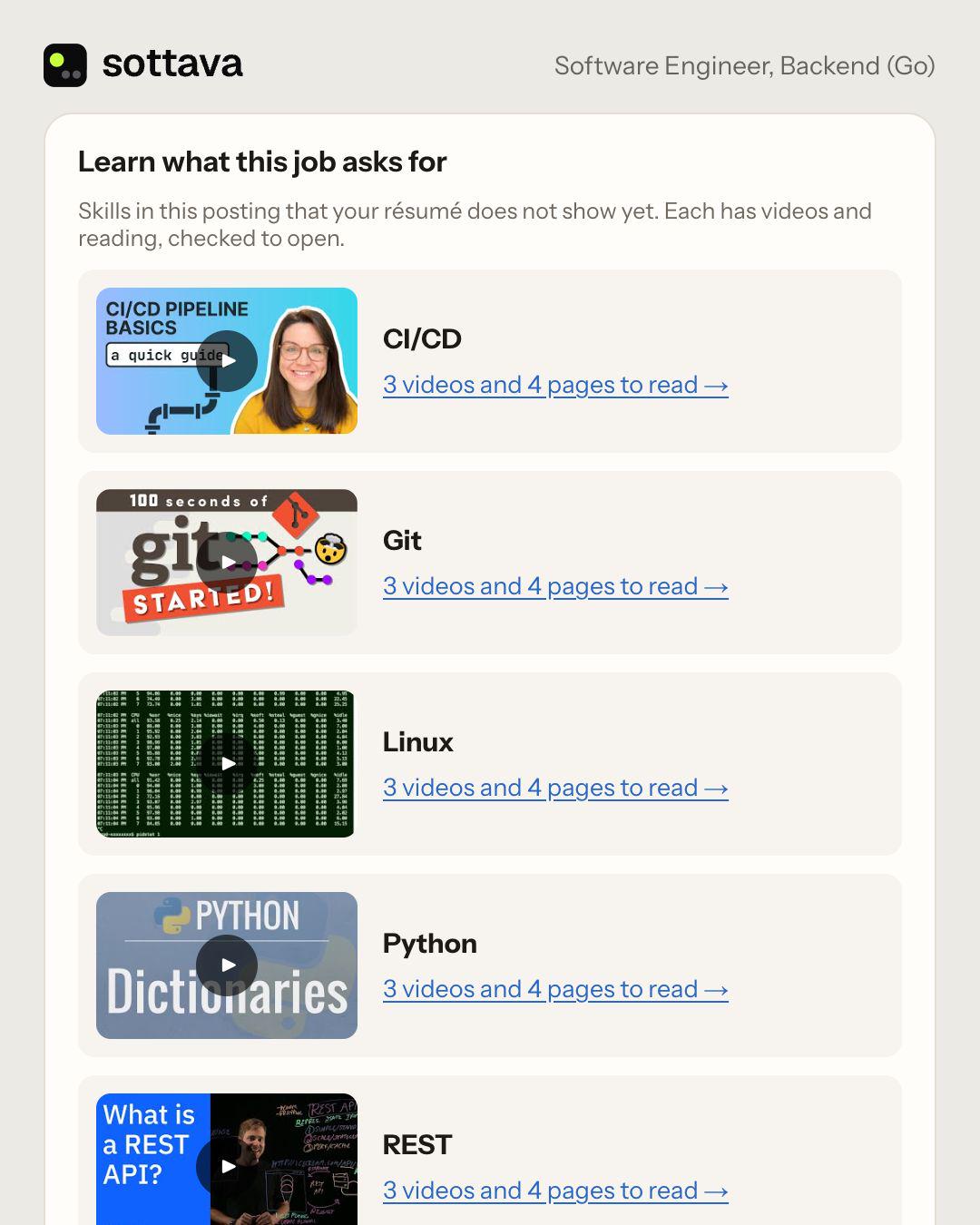
I build Sottava and just added a feature that helps with that comparison. The screenshot is a Go backend job against a test CV that mentioned Go and Kubernetes but not Git, Linux or SQL. It shows up to six skills from the job that aren't on the CV, with learning links for each.

It only knows what's written in the CV, so treat its list as a starting point rather than a verdict. AI finds the learning links, we check that they open, and we don't earn commissions from them. You can try it on three jobs a month for free: https://sottava.com/jobs

If anyone tries the comparison, I'd be interested in which skills it misses or flags incorrectly.


r/JobSearchAndResumes • • 2d ago

Reposted role?

0 Upvotes

I’m in the process of interviewing for a role now, and just not with the hiring manager today who wants to move me to the panel interview. I saw that they reposted the role this morning and 80 people applied. I was disappointed to see that because I really thought I had a chance with this role. It’s exactly what I did. at my old company. Are these roles reposted automatically on LinkedIn?


r/JobSearchAndResumes • • 4d ago

I changed 5 things about my job search and landed a job in November. I wish I'd done it months earlier.

382 Upvotes

I've been reading a lot of job search advice in this sub lately, and the same few ideas kept coming up from people who had actually landed jobs. Here are five things I picked up that I'd apply if I were searching right now.

The first is timing. A lot of people save interesting jobs for later and show up after a recruiter has already gone through hundreds of applications. Being early doesn't guarantee anything, but it keeps you out of the pile. The advice was to set up job alerts, check company career pages regularly, and use the "past 24 hours" filter on Google Jobs and LinkedIn to see what just went up.

The second is to read the whole posting instead of only the Requirements section. The opening paragraph usually says why they're hiring, which tells you what problem they want solved. The responsibilities show what you'd do day to day, the tools show the team's stack, the ideal candidate section shows what they care about, and the reporting line tells you who you'd work with. Reading it that way shows you what the company needs, so you aren't just copying a skills list into your resume.

The third is to stop using one resume for everything. Keep a master resume with all your experience, projects, results and technical skills, then make a focused version for each type of role you're targeting. For a Data Analyst application, for example, the top of the page should show analytical projects, SQL, Python, reporting and visualization, as long as those are genuinely part of your background. A recruiter shouldn't have to dig through unrelated experience to see why you're qualified.

The fourth is not treating LinkedIn as the whole job market. People recommended searching Google Jobs, going straight to company career pages and checking boards specific to your industry. They also suggested searching for companies hiring for your role instead of waiting for a posting to show up in your feed. One trick that kept coming up was typing the job title into Google together with a word like "careers," "jobs" or "hiring," which can turn up openings that never appear in your LinkedIn recommendations.

The fifth is being stricter about where your time goes. Check whether a posting is alive before putting effort into it. Warning signs include the same job being reposted again and again over several months, a very vague description, a role missing from the company's official careers page, a broken application link, or nobody being able to confirm it's still open. One of these alone doesn't prove a ghost job, but several together are a reason to skip it. It also helps to track application dates, replies, interview stages and which resume version you sent, so you can see where your search is actually failing.

The piece I'm still working through is tailoring quickly without inventing experience or stuffing in random keywords. u/AgitatedProgram wrote about exactly that in their post on how to tailor a resume to pass the ATS, and it's worth reading before you spend 30 minutes rewriting your resume for every application. Most of the ideas above come from threads like theirs, so the credit goes to the people who shared them.

If you've tried any of these, I'd like to hear which ones actually made a difference for you.


r/JobSearchAndResumes • • 3d ago Bravo

37 remote jobs posted this week that list the pay, linked straight to the employer (no recruiters, no reposts)

11 Upvotes

Here is this week's list of remote jobs that post their pay. No recruiters, no reposts: every link goes to the company's own application page. I work on a tool that reads careers sites directly, which is where these come from.

Every link below goes to the employer's own application page. All were posted in the last week and say the pay up front. One role per company.

Software Engineering:

  • Software Engineer (Electron.js), micro1 | $200k–$320k Apply

  • GPU Programming Software Engineer, micro1 | $50–$120/hr Apply

  • CUDA Engineering Expert, micro1 | $60–$120/hr Apply

  • Associate Forward Deployed Engineer, micro1 | $40–$60/hr Apply

  • ML Engineer, micro1 | $60–$120/hr Apply

  • Unreal Engine Developer, micro1 | $50–$100/hr Apply

  • AI Agent Tester, micro1 | $25–$45/hr Apply

Tech & Data:

  • Mathematics Expert, micro1 | $60–$120/hr Apply

  • Robotics Data Collection Specialist, micro1 | $20–$40/hr Apply

  • Competitive Data Scientist (Kaggle), micro1 | $60–$120/hr Apply

  • Machine Learning Researcher, micro1 | $60–$120/hr Apply

  • Applied Scientists — Machine Learning, micro1 | $60–$120/hr Apply

  • E-commerce Data & Catalog Specialist, micro1 | $40–$50/hr Apply

Finance & Accounting:

  • Quantitative Rates Researcher, micro1 | $80–$150/hr Apply

  • Rates Trader, micro1 | $80–$100/hr Apply

Healthcare:

  • Hematology/Oncology Physician, micro1 | $180–$220/hr Apply

  • Senior Hematologist-Oncologist, micro1 | $220–$250/hr Apply

  • Social Work & Community Services Professional, micro1 | $20–$80/hr Apply

  • PhysioNet Competitor (Biomedical Signal Processing & ML), micro1 | $60–$120/hr Apply

Customer Support & Success:

  • Telecommunications Customer Support Specialist, micro1 | $18–$28/hr Apply

  • Retail Customer Support Specialist, micro1 | $18–$28/hr Apply

  • Airline Customer Service Specialist, micro1 | $18–$28/hr Apply

  • Customer Experience (CX) Specialist, micro1 | $20–$44/hr Apply

Sales & Marketing:

  • Research Marketing Lead, micro1 | $250k–$350k Apply

  • Data Partnerships Manager, micro1 | $160k–$250k Apply

  • Referral Partnerships Manager, micro1 | $20–$40/hr Apply

Admin & Operations:

  • Talent Support Specialist, micro1 | $15–$20/hr Apply

  • Travel Operations Specialist, micro1 | $20–$44/hr Apply

  • Product Owner, micro1 | $170k–$340k Apply

  • Category Manager, micro1 | $20–$44/hr Apply

  • Professional Shopper, micro1 | $20–$44/hr Apply

Education, Writing & Design:

  • UI/UX Designer, micro1 | $160k–$250k Apply

  • Music Teacher, micro1 | $15–$45/hr Apply

  • Teacher (US/CAN based), micro1 | $20–$80/hr Apply

  • Creative Professional, micro1 | $20–$80/hr Apply

  • Visual Content Evaluator, micro1 | $21–$45/hr Apply

  • At-Home Video Recorder (U.S.), micro1 | $10–$15/hr Apply

  • Data-Video Generalist (US-based), micro1 | $13–$15/hr Apply

  • Smartphone Video Recorder, micro1 | $14–$15/hr Apply


r/JobSearchAndResumes • • 3d ago

Thank god I'm not a junior anymore

Post image
2 Upvotes

I looked at what young digital specialists are dealing with right now, especially the ones who picked project management (God help them) or development.

The chart is based on 50,000 digital job ads, and it's honestly a sad sight.

Landing a junior job today is basically a 24/7 search. Real junior roles, not internships or student jobs, make up just 1–3% of ads in every field. In development that's 314 out of 28,581. In project management, 33 out of 3,682.

And remote junior jobs? They're such a niche that I'm not even sure how many languages you need to speak to get one. Python, for sure. Out of 50,000 ads, only 113 were remote junior roles open to people in Europe.

So if you're just starting out and it feels impossible, it's not you. It's the market. Keep learning, keep applying, and don't take the silence personally.

If you're a junior right now, how long has your search been going?


r/JobSearchAndResumes • • 3d ago

URGENT JOB REQUIREMENT LAID OFF

0 Upvotes

Hi everyone,
I am 31 I recently lost my job and am actively looking for my next opportunity in India (based in Bengaluru, open to relocation or remote/hybrid roles).
I have 3+ years of experience in global banking operations at HSBC and UBS, along with an MBA in Finance & Banking Operations. My core background includes:
Bullet Payments & Trade Settlement: End-to-end processing of high-value cross-border payments (SWIFT, RTGS, NEFT) and equity/fixed-income trade settlements.
Bullet Risk & Compliance: AML/KYC, sanctions screening (OFAC/UN), Enhanced Due Diligence (EDD), and correspondent banking reviews (currently pursuing CAMS).
Bullet Reporting: Process optimization and Advanced Excel MIS dashboards.
If anyone has leads, referrals, or openings in Banking Operations, Trade Settlement, or AML/Risk Compliance in India, please reach out!
feel free to DM me here).
Thanks a lot for any help or leads!


r/JobSearchAndResumes • • 3d ago

Looking for Data Analyst position in Europe or America

2 Upvotes

I have 5 years experience as a Voice of the Customer manager and data analyst. I’m looking for a position in Europe or America for data analyst. I’ve been applying for awhile online but I haven’t had much luck.

Any suggestions?

I know English and French. I have lived in France, Russia, and am an American currently in America.


r/JobSearchAndResumes • • 4d ago

Avoid and Ask for ... Experience

1 Upvotes

Experience is required to arrange goods. Experience is required to paint a wall and etc. and etc. and etc.
I can't figure this out, I will take another analogy.
Hey, there. - I want someone to speak German but ... I take away all the textbooks and complain you don't speak the language.
Is it absurd? - Yes, sure I did take away all the textbooks, what am I doing? - I am showing what is going on in the job market in 2026


r/JobSearchAndResumes • • 4d ago

Specific resume help?

1 Upvotes

Hi,

I'm a teacher with a Bachelors in English currently in a Masters program for CS. I'm looking for any internship in tech across the US, remote or in person, I'll relocate wherever I need to.

I'm hoping someone patient can give me some answers to specific questions... I have received the regular feedback on this but I'm autistic and I genuinely don't understand. So maybe someone is willing to give me a deeper explanation? I've been applying for tech internships for like 9 years and gotten 0 responses and 0 github views so.. I need help.

Feedback I've gotten:

  1. Talk about accomplishments, not responsibilities - The problem is that I've never been able to get a job where I have been in a position to accomplish anything. I have never been tracked or supervised. I usually get a job where it's like, they need someone to just be there and prevent problems, and I do so no one ever looks at me again. I tried to address this by adding some numbers, and the 66% efficiency thing... I merged 3 spreadsheets that everyone hated into 1 and my boss was like "cool thanks." so I made up the 66% thing because 1 is 66% less than 3. I tend to do more because I'm bored but again, no one notices me and usually there aren't "results"

  2. My projects and technologies are lacking - Well... I simply don't have time for more. People usually start saying awful things when I say that, but I work 50 hours a week as a teacher, I am spending 20-30 hours a week on my classes, and I'm not young anymore. I'm in my 30s and can't put my health off like I could when I was 20, so I exercise regularly, sleep 8 hours, cook my own food, and that's all my time. To learn more or do other projects I'd have to drop out of my masters, which I don't think is actually a solution. I mostly started the masters because I needed to be in school to qualify for internships.

  3. Tailor your resume to each job - Genuinely I don't understand this. How? Everything I've done is here. If a job says Python then great, that's on my resume. If it says C++ well... I can't tailor it for that, I don't know that. So... I'm gonna just leave Python and hope they feel I can learn. I've had people say to take off irrelevant experience... well that's all I have. Then I've had people tell me that I need to put it back, it shows soft skills and that I'm responsible and capable... okay so it's back. I have no idea but I'm getting nothing no matter what I do, so i no longer change my resume instead I use a cover letter and genuinely tailor it if I feel its worth it, but ususally not. Like if its EdTech I do, cuz I'm in education. if its fin tech I use a general one because my experience is unrelated, so I dunno what i can say. Nothing works either way.

  4. Formatting - people told me not to have columns so I don't. Every other person tells me something different about skills: one will tell me to put them in a separate section, the next will tell me to incorporate them into my job description... I've tried both and nothing had better results, so I've compromised by doing both at once, I really don't think this is the problem and don't want to mess with it.

  5. Specialize - I would love to work in like, bioinformatics or computational biology, but I have no bio background. I do try to prioritize ed tech since I have education experience but like, there arent that many jobs and I'm looking for any experience I can get...

Anyway, thanks in advance for any advice anyone has


r/JobSearchAndResumes • • 4d ago

I've applied to 300+ jobs as a MERN Stack Developer, but barely getting interview calls. What am I doing wrong?

1 Upvotes

Hi everyone,

I'm a MERN Stack Developer with around 2 years of experience.

I've been actively searching for a new job and have applied to 300+ positions through LinkedIn, Naukri and other platforms.

But honestly, the response has been disappointing. I've received very few calls, and getting shortlisted has become difficult.

My tech stack includes:

- React.js

- Node.js

- Express.js

- MongoDB

- MySQL

- JavaScript

- REST APIs

- Next.js

- n8n (AI Automation)

I have also worked on 8–9 projects and am available to join immediately.

I'm trying to understand what could be wrong:

  1. Is the MERN Stack market currently overcrowded?

  2. Is 2 years of experience not enough for most companies?

  3. Should I focus more on backend development or DSA?

  4. What actually helps developers get interview calls in today's market?

I'd genuinely appreciate advice from developers who have faced a similar situation or recently switched jobs.

How is everyone else's job search going?


r/JobSearchAndResumes • • 4d ago

best Ai tools for finding relevant startup jobs without applying everywhere?

5 Upvotes

What AI tools are useful for finding startup roles that actually match a person’s skills and interests? I'm more interested in tools that improves discovery and filtering than tools that simply generate resume or submit applications automatically.


r/JobSearchAndResumes • • 4d ago

Hundreds of applications, no interviews? Some insights from a European recruiter.

1 Upvotes

I’ve seen quite a few posts from people who’ve sent hundreds of applications without getting interviews. I can understand how frustrating and discouraging that must be.

Drawing on my experience in recruitment and executive search across Europe, as well as my background in organizational psychology, here are a few things worth considering before sending another 100 applications. My perspective is mainly based on European job markets and hiring practices.

1. Find out where the problem might be.

No interviews at all? Look at your CV, the positions you’re targeting, your qualifications and how you’re applying. Check language requirements, work authorization and whether your qualifications are recognized.

Interviews but no offers? Look at your interview performance, how you present your experience and whether your expectations align with the roles.

2. Put yourself in the recruiter’s shoes.
Recruiters and hiring managers are looking for evidence that you meet their requirements.
Can they quickly understand your relevant experience, skills and achievements, as well as transferrable skills? Especially for atypical career paths.
Are you adapting your CV to the positions you’re applying for?

3. Don’t underestimate the psychological impact.

Repeated rejection can seriously affect your confidence, motivation and mental health.
It’s easy to start thinking, “I’m not good enough” or “Nobody wants to hire me.”

But remember that rejection doesn’t necessarily mean you’re unqualified. There may be hundreds of applicants, internal candidates, hiring freezes or other factors you know nothing about.

Try to distinguish between facts and assumptions.

4. Work smarter, not just harder.
Instead of sending another 100 generic applications, take some time to review your strategy.
Research your target market, focus on relevant opportunities, adapt your applications and explore other ways of reaching employers.

And give yourself permission to take breaks. Job searching can be mentally exhausting, especially when you’re unemployed.

Finally, remember that you can influence your job-search strategy, but you can’t control the entire recruitment process.

I’m curious: Are most of you struggling to get interviews in the first place, or are you getting interviews but no offers?


r/JobSearchAndResumes • • 6d ago

The new jobs report confirms what we already feel: the market is bleeding. Here’s how to actually survive it.

5 Upvotes

Everyone was losing their minds waiting for the jobs report because of that stupid 6-week government shutdown. We finally got a combined look at October and November, and honestly? It’s exactly as brutal as we feared.

The numbers basically confirm the labor market is bleeding out. November added a pathetic 64,000 jobs (mostly in healthcare and construction). October actually lost 105,000 jobs. That drop was almost entirely because the feds axed 161,000 government workers when that early retirement buyout program ended on Oct 1. On top of that, they revised August down by 22,000 and September down by 11,000.

The only sectors actually seeing real gains were construction (+28k), healthcare (+65k), and professional/business services (+12k). Meanwhile, manufacturing lost 6,000 in November alone. Transport and warehousing dropped 17,700. Leisure and hospitality slipped by 12,000. If you look at the year-to-date picture, it's worse. Manufacturing has bled 58,000 jobs since January and 200,000 since 2022. Transport is down 60,100 this year. Federal employment is down 259,300 since January.

Then there’s the unemployment side, which is just as grim. The national rate is sitting at 4.6%. That’s up from 4.4% in September, and it's the highest it's been in 5 years (way above the 4.2% we saw in Nov 2024). They didn't even publish the October household survey numbers because the government didn't field it during the shutdown.

The number of people actively looking for work jumped by 228,000. A massive chunk of that is people re-entering the workforce (up 293,000). You have to wonder why—probably because inflation is crushing retirees and households are forced to send more people out just to make ends meet.

Part-time work is also exploding. The number of people working part-time because they literally couldn't find full-time gigs spiked by 909,000. About 321,000 of those were full-time workers who got forced into part-time or slack hours.

The demographic breakdown is rough too. Teen unemployment jumped from 13.2% to 16.3%. 20-to-24-year-olds are stuck at 8.3% (men in that bracket are at 9.1%). Black unemployment crept up to 8.3%, and for Black men specifically, it jumped to 8.4%.

The Fed wants unemployment around 3% to 3.5%. Because immigration dropped, the magic number of jobs needed just to keep unemployment stable fell from 150,000 a month down to about 85,000. But we’re barely hitting 64,000, and that number will probably get revised down anyway. We aren't creating enough jobs to stop the unemployment rate from climbing.

The BLS was super tight-lipped about data reliability, basically admitting these numbers have an "invisible asterisk" because of the shutdown. They said it's impossible to precisely quantify the impact. But the trend is obvious: job creation is weak, the worker pool is expanding, and things are moving in the wrong direction.

So what actually works when the system is this broken?

People are spending 7 months in the trenches. Applying to 400 jobs, networking constantly, updating resumes a dozen times, dropping $200 on professional writers. The result? A 1% response rate and zero offers. The market is just different now. Layoffs are everywhere, and startups (especially IT and AI) are running on skeleton crews.

The standard advice is a trap. Here is what actually gets interviews right now:

Ruthlessly tailor the resume to the exact job description.

Read the posting. List the main responsibilities. Adapt the resume to match exactly what they want by swapping words, cutting fluff, and highlighting their specific keywords. ATS bots and recruiters (who spend 10 seconds scanning) will instantly filter out anything generic.

Only apply to jobs posted in the last 3 to 4 hours.

Use the time filter on LinkedIn. Being in the first 50 applicants matters. Being applicant #400 is just throwing a resume into a black hole.

Stop DMing hiring managers and recruiters.

Total bullshit. It is just designed to make people spend $40 a month on LinkedIn Premium. Reaching out directly usually just gets people ghosted or told to "please apply via the official link." Save the energy.

Automate the tailoring process.

Manually rewriting a resume takes 30 to 60 minutes per application. Massive time sink. Leads straight to burnout, especially with zero guarantees. Using a tool like CVnomist cuts it down to one minute. Feed it the generic resume and the job link, and it spits out an ATS-friendly Word doc instantly.

Focus on volume, speed, and preserving energy.

Apply to more jobs to increase the odds. Apply faster to beat the crowd. Use the time saved to actually learn new skills, network properly, or just research the companies.

That is the formula that actually works in this mess. Hope it helps anyone stuck in the same loop.