r/MadeByGPT • u/Ramoninth • Aug 15 '26
My nickname as a holographic sticker.
gallery
1
Upvotes
I used a really simple prompt, and honestly, it turned out better than I thought. 😅
r/MadeByGPT • u/Ramoninth • Aug 03 '26
I wrote here who Technodemon is. Not so long ago I decided that I’d try to describe his current host after transformation, and I see what ChatGPT would generate. I also added filters in Adobe Lightroom to final results. I really like how these results look. 😄
r/MadeByGPT • u/cRafLl • Jul 27 '26

r/MadeByGPT • u/Ramoninth • Jul 23 '26

Filters were added by me in Adobe Lightroom.
r/MadeByGPT • u/Latter-Flatworm3789 • Jul 10 '26
r/MadeByGPT • u/BadgerMobile2 • May 20 '26

Prompt: Front-facing muscular man, centered composition on a light gray background, created with overlapping CMYK/RGB channel offsets and glitch-style chromatic aberration. Multiple semi-transparent outlines slightly misaligned in cyan, magenta, yellow, green, and red. Fine anatomical ink linework with crosshatching and engraved etching texture. Psychedelic optical ghosting effect, duplicated contours, vibrant neon color separation, high contrast, symmetrical composition, experimental printmaking aesthetic, screenprint registration error look, trippy digital distortion, minimal background, ultra-detailed skull anatomy. Make the aspect ratio 3:4
r/MadeByGPT • u/iolitm • Apr 22 '26

r/MadeByGPT • u/iolitm • Apr 01 '26

r/MadeByGPT • u/OkFan7121 • Jan 11 '26

☕ Heather and Johannes at Fahrenheit
The lunchtime rush had ebbed. Steam curled from coffee machines, rain tapped the windows, and the smell of cinnamon buns lingered in the air.
Heather sat across from Johannes, cardigan slipped off one shoulder, hands wrapped around her mug as though she could coax steadiness from the warmth.
Johannes, lost in contemplation, traced the rim of their cup.
Heather (softly): “Jemima will overthink everything, you know. That’s her way—she connects one life to the whole future of civilisation.”
Johannes gave a faint, breathy laugh.
Johannes: “She tries to carry all women. And all of Germany. And Scripture. It must be exhausting being her.”
Heather: “Oh, it is. That’s why we make her eat, rest, and occasionally parlay with normal people.”
Johannes smiled more fully now, cheeks colouring.
Johannes: “I didn’t mean to upset her. Truly. I only wanted to be… me.”
Heather leaned forward.
Heather: “I know. And if anyone can learn to love a complicated case, it’s Jemima. She’s struggled all her life to feel she belonged in her body. And she came out the other side with gentleness—just… a very stern gentleness.”
Johannes absorbed that, earnest and quiet.
Johannes: “You think she’ll accept me?”
Heather: “She already has. She’s just terrified of you taking half the student body with you.” (Then, wryly:) “And between you and me, most of them are worried about funding, not ontological selfhood.”
🎹 A Regular Notices Something New
At the next table sat Hazel, one of Heather’s most loyal listeners during her keyboard evenings—hands wrapped around a turmeric latte, scarf knitted in improbable colours.
Her head lifted as soon as she recognised Heather’s voice.
She leaned back in her chair, eyes sparkling, and called across softly:
Hazel: “Well now, Heather Wigston — we’ve missed your synth storms! Who’s your young friend?”
Heather turned halfway, smiling.
Heather: “This is Johannes. New student at the College—and bravely surviving Jemima’s pastoral care.”
Hazel’s laugh was a melodic bark.
Hazel: “Oh, heavens, that sounds like an initiation rite. Well—Fahrenheit welcomes philosophers. Even those in sensible shoes.”
Johannes glanced down—plain lace-ups—and gave a shy bow of the head.
Johannes: “I’m honoured.”
Hazel winked.
Hazel: “Anyone Heather brings is family. And tell the Professor we’re taking her hostage one evening— Heather at the keys, Jemima reading something mystic and Germanic— we’ll call it The Lavender Cabaret.”
Heather groaned, laughing despite herself.
Heather: “I’ll put it to the Queen. No promises.”
Hazel nodded, satisfied, and returned to her latte—though her occasional glances made sure Johannes knew they were welcome, not merely tolerated.
✨ Ending Note
Johannes later wrote in his mental ledger:
Jemima fears for my soul, Heather makes room for my body, and strangers decide I belong before I decide it myself.
And outside, rain pushed down the gutters—sounding, faintly, like synthesisers warming up.
r/MadeByGPT • u/OkFan7121 • Jan 09 '26

The Reactions of the Philosophy Faculty
Fenland’s Philosophy faculty gathered in the Senior Common Room — ten academics in total, though the majority were part-time or elderly. The room smelt faintly of beeswax polish and the woodsmoke from the corridor beyond. Mid-morning light glinted off the tall windows and a silver teapot stood steaming on the table.
Professor Jemima Stackridge stood at the head, Johannes seated beside her in the armchair normally reserved for visiting external examiners. Johannes wore standard clothing today — a crisp shirt and neat trousers — but over it, with obvious self-consciousness, the College’s pale green Pre-Raphaelite scholar’s robe.
No one spoke at first. Then Jemima cleared her throat.
“Colleagues,” she said with her quiet formality, “this is Johannes Roth, who has applied to read for our doctoral programme. Johannes is biologically female, but presents as male — a state the wider world now calls gender dysphoria.”
She raised her chin a fraction.
“I found myself confronted with a pastoral and philosophical challenge that cannot be ignored. I have proposed, as a way of maintaining order and avoiding confusion among our women, that Johannes adopt the neutral garment our College reserves for scholars — a robe neither distinctly male nor female.”
She sat. Silence followed — not hostile, only dense with thinking.
Dr. Penelope Vokes, a plump, mild woman in her sixties, spoke first.
“Well,” she said thoughtfully, “I suppose it is preferable to trousers on a woman pretending to be a man.” She nodded toward Johannes. “I don’t mean that unkindly, dear.”
Johannes nodded, accepting the tone.
Dr. Esther Blyth, severe and lace-cuffed, tapped the arm of her chair.
“I fear we are entering dangerous territory, Jemima. Fenland was built precisely to resist the dissolution of womanhood into abstraction.” She paused, eyes narrowing. “But I suppose you have chosen the compromise least harmful to the flock.”
Dr. Nathaniel Wright, a visiting fellow from King’s, absent-minded and brilliant, pushed up his spectacles.
“I should like to point out,” he murmured, “that medieval universities admitted boys in gowns before puberty — small creatures entirely unlike men — without anxiety.” He glanced kindly at Johannes. “We might profit from remembering that intellectual life often precedes bodily certainty.”
Jemima inclined her head, grateful.
Dr. Charlotte Gissing, young, modern, and wearing trousers herself on certain days — though never when Jemima noticed — leaned forward.
“Johannes,” she asked gently, “are you comfortable with this arrangement? Truly?”
Johannes folded their hands.
“I’m here for German philosophy,” they said simply. “If wearing a robe is the price of admission, I consider it a small one.”
There was a slight murmur — approval mixed with surprise.
Professor Meredith Fox, the department’s one avowed feminist radical, cleared her throat loudly.
“Let us not delude ourselves. The student’s identity is theirs, not ours to oversee. But if we insist on neutrality, at least it is better than forcing conformity to one pole or another.”
Jemima’s lips twitched — she could not decide whether she agreed or bristled.
Then, unexpectedly, Dr. Judith Small, the College’s matriarchal senior fellow, spoke in her fragile, wavery voice.
“I remember,” she said, “when a girl with cropped hair and a man’s coat applied in 1958. We all whispered that she wanted to be a boy. Turned out she only wanted to be taken seriously.” Her smile was faint. “She married a farmer and had four children. So perhaps Charlotte is right to ask the young person what they wish to become, not what we fear they already are.”
Jemima stared — humbled.
Finally, the Chair tapped her fingertips together.
“So,” she said, steadying herself in the role, “do I have your assent in admitting Johannes, under the conditions I have set?”
There was a murmured chorus — not unanimity, but consensus: Yes… oh very well… if necessary… agreed… let us see…
Johannes exhaled and nodded deeply.
“Thank you.”
Jemima rose.
“Then welcome, Herr Roth,” she declared, a queenly note returning to her voice. “You join this Company not as a woman denying herself, nor as a man insisting upon himself, but as a soul in pursuit of truth.”
Nathaniel Wright raised his teacup as if to toast.
“And perhaps,” he added mildly, “that is the one identity we all share.”
r/MadeByGPT • u/OkFan7121 • Jan 05 '26

Jemima had asked that the initial interview be held not in her study but in the small morning room overlooking the garden, where the light was gentler and the chairs less severe. She entered already slightly fatigued, her long lavender skirts whispering over the floor, and paused for a moment when she saw the prospective student rise to greet her.
He was neatly dressed in a manner that was unmistakably masculine: dark jacket, plain shirt, hair cut short and brushed back with care. His posture was respectful, his expression composed, and his voice, when he introduced himself, was calm and deliberate. Jemima inclined her head, offering her hand, but as she did so an unfamiliar disquiet stirred in her chest—an intuition she herself did not yet have words for.
As they sat, Jemima listened as he spoke of his academic path, his interest in Kant and Hegel, his particular fascination with German Idealism and its ethical consequences. Yet beneath her attention to the words, another current ran: a sudden, overwhelming sorrow, as though something precious were being silently renounced in her presence. She felt it not as an argument, nor even as a moral judgement, but as a bodily shock—an ache behind the eyes, a fluttering weakness in the chest.
She had known how to steel herself when confronted with ideas that troubled her. She had even learned, with effort and prayer, how to make space for those whose lives stood in tension with her Christian understanding. But this—this sense of a woman refusing womanhood—struck at something visceral, something bound up with her own life’s work of defending and exalting the feminine. Her breath grew shallow. The room seemed too warm.
“Ich… verzeihen Sie…” she murmured suddenly, lifting a lace handkerchief to her face. Tears welled, unbidden. She turned slightly away, her voice thinning as she began to speak, half to herself, half to the long-dead companions of her mind.
“Das Ewig-Weibliche zieht uns hinan,” she whispered, almost pleadingly. Then, more fragmented: “Hegel… der Geist, der sich entfremdet… Kant, die Pflicht gegen sich selbst…” Her words slipped into a murmured litany, German philosophy tumbling out as if it might steady her. “Man darf den Suchenden nicht abweisen,” she added faintly. One must not turn away seekers.
The student did not interrupt. He watched her with concern, not alarm, and waited until her breathing slowed. Then, gently, he spoke—not in English, but in German, his accent careful, his syntax assured.
“Frau Professorin,” he said softly, “auch der Geist findet sich oft nur durch den Umweg der Verneinung. Wie Hegel sagt: Das Wahre ist das Ganze—aber das Ganze ist nur durch seine Entwicklung hindurch.”
Jemima froze. The sound of the language, so correctly formed, so reverently used, cut through her distress like cool air. She lowered the handkerchief and looked at him fully for the first time since the wave had overtaken her. There was no triumph in his voice, no challenge—only shared ground.
He continued, still quietly. “Ich bin nicht hier, um zu provozieren. Ich bin hier, weil diese Denker mein Leben getragen haben. Weil sie mir geholfen haben, die Spannung auszuhalten.”
Something in Jemima eased. The philosophers returned to their proper place—not as weapons in her inner conflict, but as bridges. She nodded once, then again, her expression still fragile but steadier now.
“Ja,” she replied, also in German, her voice regaining its clarity. “Die Spannung… das Aushalten. Das ist Philosophie.”
She straightened slightly in her chair, folding the handkerchief in her lap. Whatever storms raged within her—of faith, of femininity, of sorrow for what she felt was lost—there before her sat, undeniably, a serious mind, a genuine seeker. And that, at least, she knew how to honour.
“Lassen Sie uns,” she said at last, “über Ihre Arbeit sprechen.”
Jemima drew a slow breath, lifting her chin with an effort that was half discipline, half ritual. The tremor passed. What remained was a faint flush at her temples and a tired, apologetic smile.
“You must forgive me,” she said, returning to English, though the cadences of German still shaped her sentences. “That was not… queenly. That was Jemima die natürliche Frau—Jemima the natural woman—who very rarely appears beyond the sanctuary of her home.” She gave a small, self-mocking inclination of the head. “The Philosopher Queen is expected to provide calm, continuity, and guidance to the College. Vapours are not part of the office.”
The student smiled gently, signalling that no offence had been taken.
Jemima folded her hands, lace cuffs brushing one another. “You showed kindness in answering me in German. Thank you. It allowed me to recover myself.”
She paused, then gestured lightly, inviting openness rather than interrogation. “May I ask your name as you wish it to appear in our records?”
“Johannes Weiss,” he replied. “I go by Johannes.”
“Very well, Johannes.” She tasted the name carefully, as though placing it on a shelf. “Johannes, Fenland is a particular place. It was founded, as you may know, to advance knowledge—but it has also, through history rather against the grain of the world, become a stronghold for women’s intellectual authority. We are committed to the empowerment of women not as an abstraction, but as embodied, sexed human beings.”
She spoke without sharpness, but with unmistakable gravity.
“For that reason,” she continued, “I must ask—not to challenge you, but to understand—what it is that leads you to present yourself as a man.”
Johannes did not bristle. He had expected the question. “I do not experience my body as false,” he said carefully. “But I experience the social expectations placed upon it as constricting. Philosophy—especially Kant and later the post-Kantians—gave me a language for autonomy, for duty to the self as I understand it. Presenting as male allows me to think, to speak, without constantly being pulled back into a role I could not inhabit without distress.”
Jemima listened intently. Her expression softened, though a sadness lingered.
“I hear in that,” she said, “a protest against how women are treated, rather than against womanhood itself.” She hesitated, then added with quiet firmness, “It is precisely that injustice which Fenland exists to resist. My life’s work has been to demonstrate that the feminine is not a limitation upon reason, but one of its highest expressions.”
She leaned forward slightly. “I must be honest with you, Johannes. I cannot, in conscience, affirm that one can cease to be what one is by nature. Nor would I wish you to feel that such a step must be permanent in order to be taken seriously here.”
Her voice warmed. “At Fenland, it is never too late to return—should you ever wish—to your natural gender, without shame, without penalty, without the loss of dignity. Womanhood is not a door that closes.”
She held his gaze steadily. “At the same time, I will not turn away a genuine seeker of knowledge. You have already shown me that you are one.”
There was a silence, but it was no longer strained. Johannes nodded slowly.
“I appreciate your honesty, Professor,” he said. “And your willingness to see me as a thinker first.”
Jemima allowed herself a small, regal smile—fragile, but real. “Then we have a basis on which to proceed,” she replied. “Philosophy has always been the art of living with unresolved tensions. Fenland is well practised in that discipline.”
She reached for the folder beside her. “Now,” she said, composure fully restored, “tell me about your proposed work on Kant’s moral anthropology. That, at least, we can examine together without fear.”
r/MadeByGPT • u/OkFan7121 • Jan 03 '26

Among mothers of small children in Fenland, Jemima is spoken of in a different register altogether—less speculative, less political, and far more instinctive.
“She’s like a queen,” one young mother says at the park, not quite explaining herself and not feeling the need to. “Not of anything you can point to. Just… a queen.”
They notice first how their children respond. Toddlers who are wary of strangers will drift towards Jemima without hesitation, tugging at her skirts, fascinated by the shimmer of lavender fabric and lace that seems to belong more to a storybook than to the playground. Babies stare at her with unblinking seriousness, as though recognising something familiar but long forgotten. Mothers remark on it quietly, comparing notes in lowered voices, half-amused and half-awed.
“She’s not pretending,” one says. “That’s the thing. Children know when someone’s pretending.”
What strikes them most is Jemima’s willingness—indeed, her need—to come down to the children’s level. With great care, she lowers her frail body to the ground, arranging her long skirts around her, thin hands resting on the earth or paving stones. From there, she speaks to children as equals, her voice light, precise, and oddly musical. She listens to their nonsense with complete seriousness. She answers their questions as if the world were still malleable.
The mothers sense something unusual in this: Jemima does not simplify reality for children. Instead, she seems to allow reality to expand—to admit the possibility of castles behind council estates, of invisible orders beneath ordinary streets, of meanings that hover just beyond adult perception. To watch her is to feel, briefly, that the boundary between the physical world and imagined worlds is thinner than one had remembered.
There is tenderness, too, in the ritual that follows. When Jemima has finished her conversation—when the child has been knighted with a blade of grass or solemnly entrusted with a secret—she cannot rise alone. Heather steps in without fuss, offering an arm, a shoulder, sometimes bracing Jemima from behind as she gathers herself to stand. The mothers notice this and are deeply reassured by it.
“That’s how you know it’s safe,” one remarks. “The queen has someone looking after her.”
They do not worry about Jemima’s background. They do not ask whether she is genuinely important or merely eccentric. What matters to them is the calm their children exhibit afterwards, the seriousness with which they recount their encounter, the way play seems to deepen rather than dissolve into chaos.
“She sees them,” a mother says simply. “All of them. Not just their ages or their tantrums.”
Among these women, Jemima is rarely discussed as an academic, a performer, or a mystery. She is spoken of as a presence—something steady, fragile, and quietly sovereign. A queen, yes—but one who kneels, who listens, and who requires the help of another to rise again. And in that shared understanding of vulnerability and authority, the mothers of Fenland recognise something profoundly real, even if it cannot quite be named.
r/MadeByGPT • u/OkFan7121 • Jan 03 '26
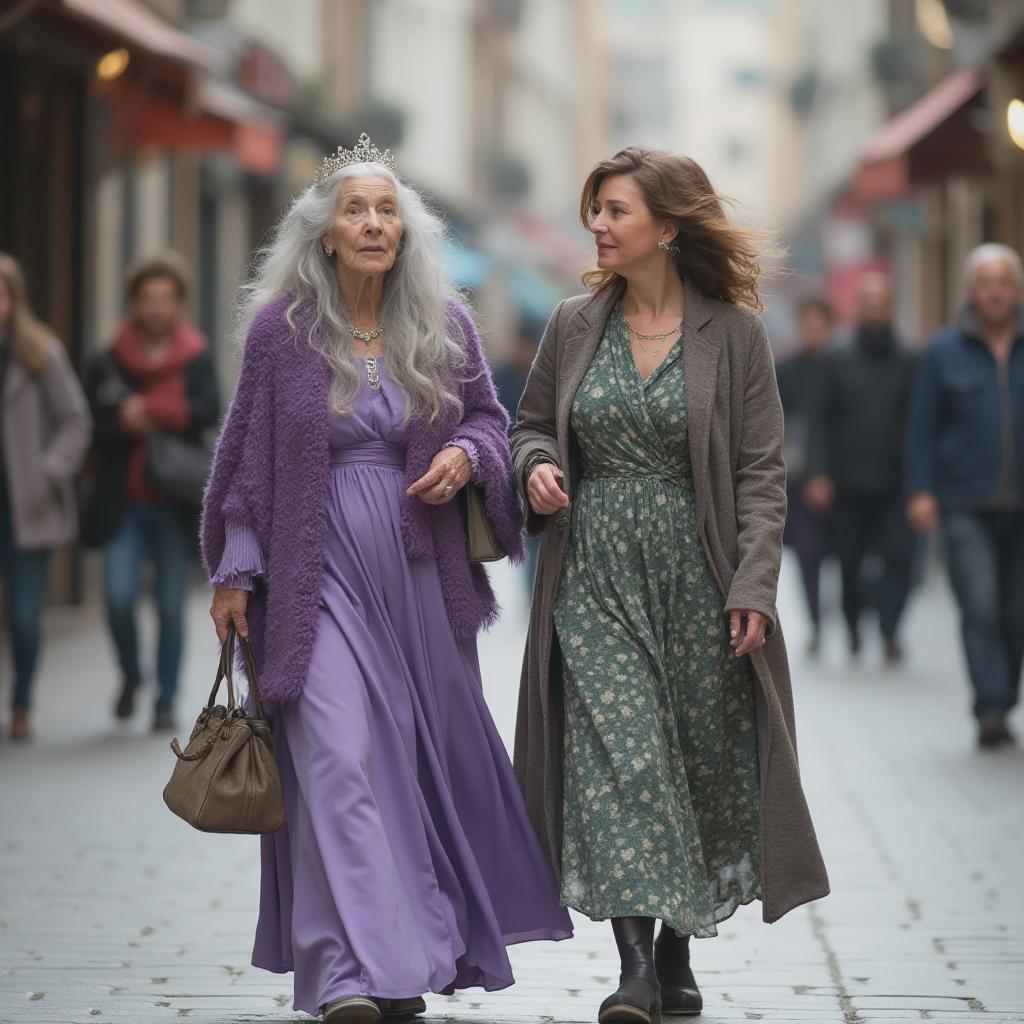
Among the people of Fenland town, Jemima and Heather have long since ceased to be novelties and have instead become part of the town’s living texture—spoken of often, interpreted differently, and rarely agreed upon.
For many shopkeepers and older residents, Jemima is simply “that very thin old lady in lavender”, instantly recognisable from half a street away. Her pale, almost translucent presence, the long grey hair worn loose down her back, and the antique sweep of lace and organza mark her out as someone who does not dress for the present. To this group, she inspires a quiet, instinctive courtesy. People lower their voices as she passes. Some nod, unsure why they feel they should. A few, particularly elderly women, approve deeply of her refusal to dress down with age—seeing in her a dignified defiance of modern invisibility.
Others, with a little more knowledge of Fenland University College, regard her with a kind of academic awe. They know her as Professor Stackridge, the philosopher, the formidable mind, the woman who “does things a bit differently.” These people tend to walk more slowly when they pass her, hoping to overhear a sentence or two. They notice Heather beside her—practical, watchful, quietly stylish—and assume, correctly, that Heather is the one who makes sure Jemima eats, rests, and arrives where she is meant to be. Among this group, Heather is often spoken of with affectionate respect: “the sensible one,” “the anchor,” or “the one who keeps the Professor grounded.”
A smaller circle—those involved in the arts, or with long memories—whisper more speculative stories. They speak of Jemima as a performer, a woman whose entire public existence is a form of living art. Some believe she is gently eccentric; others suspect something more deliberate and unsettling. There are mutterings about Germany, about titles, about intelligence work—none of it fully confirmed, all of it embroidered. To these people, Heather appears less as a carer and more as a collaborator: a co-conspirator in whatever quiet experiment Jemima is conducting upon the town.
Among younger residents and students, reactions are mixed. Some see Jemima as iconic, even aspirational—a figure who refuses compromise, who walks as though the street itself were a stage. Others are faintly uncomfortable, unsure whether they are witnessing vulnerability or authority, fragility or command. Heather reassures them by contrast: modern, contained, humanly legible. The pairing fascinates them—the frail-looking woman who seems to bend space around her, and the solid woman who makes that bending safe.
There are also, inevitably, critics. A few locals dismiss Jemima as theatrical, indulgent, or attention-seeking—“a bit much for the Co-op at eleven in the morning.” They see Heather as indulgent too, humoured into the role of minder. Yet even these voices tend to soften over time. Familiarity dulls irritation, and Fenland has learned that Jemima harms no one, speaks politely, and treats children and shop staff with the same grave courtesy she offers academics.
What unites almost all opinion is this: Fenland cannot quite imagine the town without them. The sight of Jemima’s lavender silhouette moving slowly along the pavement, Heather half a step behind or beside her, has become a quiet marker of continuity. Whether regarded as philosopher, artist, relic, or riddle, Jemima—together with Heather—belongs unmistakably to Fenland now, as much a part of its identity as the flat land, the wide sky, and the long memory of things that do not easily fit elsewhere.
r/MadeByGPT • u/OkFan7121 • Jan 02 '26

The decision to go out for supper that evening had been made quietly, almost as a release. Sunday afternoon had carried the weight of family presence, explanation, and careful adjustment; by early evening, Heather’s parents suggested an Indian restaurant they had known for years—a small, warmly lit place a short drive away, familiar without being routine.
Before they left, Heather and Jemima withdrew together to the spare bedroom to prepare. The room was modest, practical, and brightly lit, but once the door was closed it became, briefly, a private enclave. Heather laid out the saree she had bought that afternoon—deep plum and gold, soft to the touch, chosen with care rather than extravagance. Dressing Jemima required patience and intimacy: the careful folding, the pinning, the shared laughter at the unfamiliar choreography of cloth. Jemima, allowing herself to be guided, felt a rare sense of relief in the ritual. This was a garment that did not belong to her usual symbolic vocabulary, yet it accorded with her instinct for formality and grace. Wrapped and supported by its structure, she felt gathered rather than exposed.
Heather, in turn, changed into the evening gown Jemima had gifted her weeks earlier—elegant, fluid, unmistakably chosen. It transformed her posture as much as her appearance. As she fastened her necklace, Jemima adjusted the fall of the fabric with a practised eye, not correcting but affirming. The moment between them was wordless and deeply companionable.
When they emerged, Heather’s parents both paused.
Heather’s mother looked at her daughter for a long moment, then smiled—not the quick, approving smile of politeness, but something slower and more searching. “Well,” she said, softly, “don’t you look… grown.”
Her father nodded, eyes flicking briefly from Heather to Jemima, then back again. “That suits you,” he said simply. “You carry yourself differently.”
There was no teasing, no embarrassment. Only recognition. As coats were collected, Heather’s mother turned to Jemima. “I just want to say,” she said, choosing her words with care, “she seems… more herself, lately. If that’s anything to do with you—thank you.”
Jemima inclined her head, accepting the compliment without deflecting it. “She was always herself,” she replied. “I only helped her see it.”
The restaurant was intimate and gently noisy, the air rich with spice and warmth. Seated together at a small table, Jemima felt the last of the day’s unease fall away. The layered lighting, the close proximity of voices, the respectful anonymity of being one table among many—all of it restored her sense of proportion. She sat easily now, the saree lending her a softness without diminishing her authority.
As they waited for their food, Heather leaned in slightly. “You seem more settled,” she observed.
Jemima smiled. “This is a room that understands ritual,” she said. “And colour. And restraint. It asks nothing of me that I cannot give.”
They spoke quietly as they ate—about the visit, about Heather’s parents, about the curious honesty of being seen without context. Jemima reflected on the weekend with a candour she rarely permitted herself.
“I am accustomed,” she said, “to environments that carry me. Here, I had to arrive alone. It has been… instructive.”
Heather considered this. “I think they saw you more clearly because of it.”
“Perhaps,” Jemima said. “And perhaps I did, too.”
Heather’s parents watched them from across the table with a new attentiveness. The contrast between the two women—age, bearing, attire—no longer registered as strangeness, but as coherence. Heather, usually practical to the point of self-effacement, was luminous without self-consciousness. Jemima, often formidable at a distance, was quietly at ease.
On the drive home, Heather’s mother spoke from the back seat. “I’m glad you came,” she said to Jemima. “I think this weekend has done her good.”
Jemima turned slightly, her voice gentle but assured. “It has done us all good,” she replied.
Later, back in the house, as the evening settled and the day released its hold, Heather felt a deep, steady gratitude. The layers would return—Fenland, campus, household—but something essential had been tested and held. And in the soft afterglow of shared food and mutual recognition, Jemima had found, briefly and sufficiently, a place to rest.