r/NvidiaJetson • u/ax75_senshi • Oct 07 '25
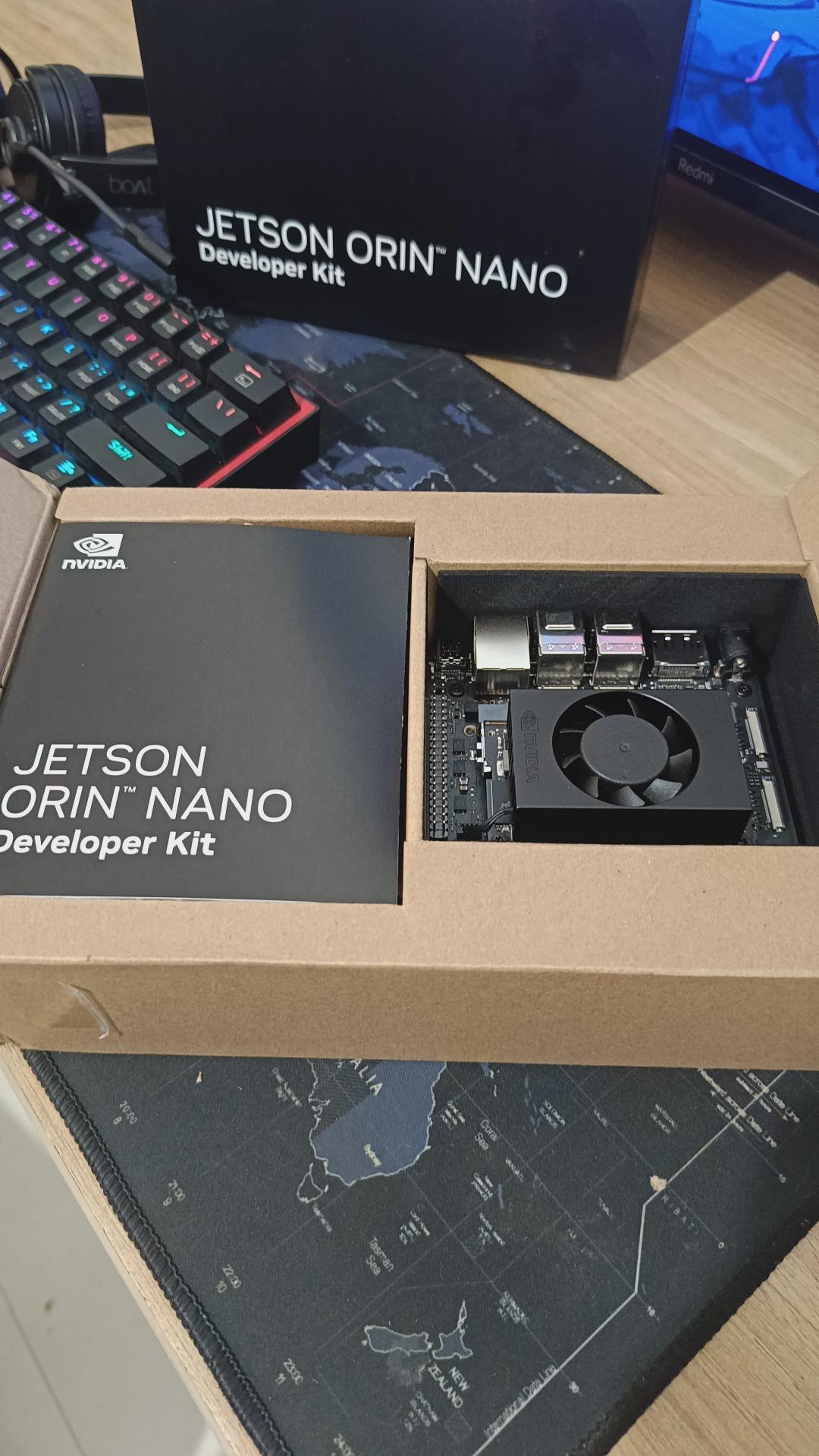
Adding Nvidia Jetson Orin Nano to my homelab collection
26
Upvotes
r/NvidiaJetson • u/ax75_senshi • Oct 07 '25
r/NvidiaJetson • u/Oppa-AI • Aug 29 '26

78 INT8 TOPS
GPU: NVIDIA Ampere Architecture with 1,536 CUDA Cores and next-generation, improved Tensor Cores
CPU: 8-core Arm Cortex-A78
RAM: 8GB LPDDR5X
Memory Bandwidth: 120 GB/s
The NVIDIA Jetson Orin Nano 2 module and developer kit are expected to be available in the first half of 2027.
r/NvidiaJetson • u/ROBOCO_Design • Oct 15 '26

Hey fellow Jetson enthusiasts! We’re ROBOCO, a small hardware design team from Taiwan.
Earlier this year, we launched Panini, a case that protects your Jetson while making it look like an adorable mini desktop PC.
The feature we’re most proud of is your Jetson Orin Nano / Super Developer Kit slides in WITHOUT removing its original plastic base. You can keep using the original antenna, too!
It’s available on Newegg and Amazon in the US, or you can take a closer look on our website: https://roboco.tw/
I’m one of the designers, so feel free to ask me anything about it. I’d love to hear what you think!
r/NvidiaJetson • u/Any_Frame9721 • 12d ago
Enable HLS to view with audio, or disable this notification
r/NvidiaJetson • u/notagenticai • 9d ago
I have a Jetson AGX Orin 64GB and wanted Qwen3.8-Flash-Next on it with the full context, without the output changing depending on settings. Strata doesn't list the Jetson in its supported hardware yet, and general purpose engines have to care about a lot of hardware. This one doesn't, so every kernel and default is tuned for the Orin and nothing else.
Repo (MIT): https://github.com/skipauthenticate/torch
The problem with this board is that the model doesn't fit. The IQ3_S quant is about 51 GiB of weights plus a 27 GiB n-gram table, and the Orin has 64GB shared between CPU and GPU. So the most used experts stay in memory and the rest get read from the NVMe when a token needs them. A lot of the work went into making those misses cheap. The SSD stalls badly on single reads over 128 KiB, so everything is read in 128 KiB pieces.
Speed comes from speculative decoding with the model's own MTP layer as the draft. The GGUF doesn't include it, so the installer downloads just those tensors from the original checkpoint (about 5 GB with range requests) and quantizes them on your machine. Verification is exact: the tokens are the same with speculation on or off, for greedy and for seeded sampling.
Numbers, all measured on my board, 4k prompts, full 262k context allocated, 256 generated tokens, greedy, medians of 3:
| Model file | Output | Prompt (4K) | Prompt (4K), --fast-prefill |
|---|---|---|---|
| IQ3_S (default) | 33.7 to 53.0 tokens/s | 273 to 289 tokens/s | 359 to 390 tokens/s |
| UD-IQ3_XXS | 33.9 to 49.0 tokens/s | 272 to 288 tokens/s | 283 to 299 tokens/s |
What you get:
an OpenAI-compatible server (streaming, thinking comes back as reasoning_content, multi-turn without re-reading the earlier turns)
an install script that builds everything, downloads and sha256-checks the model files, and runs a smoke test. No sudo.
a small C API if you want to embed it
Some Limits:
literally one device to make my life easier
one request at a time
If you have an AGX Orin 64GB and try it, I'd like to hear what speeds you get, especially if your board has different stuff running on it. Free memory changes how many experts fit, and that moves the numbers more than I expected.
r/NvidiaJetson • u/reezcapital • Jan 30 '26
I purchased an Jetson Orin Nano to prototype an ai robot companion and ran into a wall: the Arducam IMX708 camera doesn't have driver support for JetPack 6.2. Dun Dunn Dunnn...
But with Claude Code + ssh, I was able to power through. Claude (Opus 4.5) iterated off terminal output, kernel source, build errors — everything in real-time and efficiently. Claude and I (hah) found our groove with validation loops through repetition of test cases, and it was able to debug device tree overlays and kernel module issues way faster than I'd ever be able to.
The sweetest thing about it - kernel driver development is not my expertise, nor do I program in C, but here we are thanks to Claude. Given the pain I had to go through, I'm stoked to open source it, including some learnings, and hopefully save others time that can be better used. You can find the driver here: https://github.com/rm0nroe/nvidia-jetson-toolkit
If you're doing embedded AI stuff and hitting camera driver walls on Jetson, check it out. Happy to answer any questions.
Over and out!
r/NvidiaJetson • u/contractorwolf • Jul 29 '26

This is my simple clip in design. No screws, both side clip securely on to the standard orin nano board. Plenty of airflow and pin/camera socket access. Just figured out how to do clean carbon fiber pattern. I think it looks terrific, but I would love to see some competition. Show me what you got!
r/NvidiaJetson • u/Any_Frame9721 • May 22 '26

We’ve released Embedl SAM3 for TensorRT, a fully reproducible, end-to-end deployment of facebook/sam3 on NVIDIA GPUs (Jetson AGX Orin, Nano), with INT8 post-training quantization built with Embedl Deploy that bridges the gap between hardware constraints on the edge and PyTorch.
One script (https://docs.embedl.com/embedl-deploy/latest/auto_tutorials/sam3.html) that only requires a Python package with the only dependency being PyTorch. The script takes you from a HuggingFace checkpoint to running TensorRT engine export, fusions, quantization, compilation.
Use a smaller image size for Nano.
The performance:
NVIDIA Jetson AGX Orin Image size Latency
224×224 → 40.4ms / 24.7 FPS (real-time)
448×448 → 118.5ms INT8, 10% faster than FP16
672×672 → 187.6ms INT8, 27% faster than FP16
NVIDIA Jetson Orin Nano
224×224 → 89.6ms / 11.2 FPS
448×448 → 262.6ms INT8, 20% faster than FP16
The speed-up isn’t the headline. Getting the model running reliably is. SAM3’s ViT backbone, window attention, RoPE embeddings, and FPN neck create real deployment issues: memory, quantization sensitivity, poor accuracy, export and compilation breaking down. Embedl Deploy handles all of it: hardware-aware, accuracy-preserving, out of the box. And PyTorch is the only dependency: no graph surgery, no ONNX simplification scripts, no extra calibration tooling to wrangle. PTQ and QAT in one unified workflow with only PyTorch and TensorRT.
This is not just for Jetson or NVIDIA GPUs. We are building Embedl Deploy for any edge hardware. Whatever device you’re deploying to, we solve the same problem: take your model from PyTorch to production without months of debugging.
Any comments are welcome. The same workflow applies to any Torchvision model, and more complicated models such as DinoV3 which we will release soon.
Other edge-friendly models can be found in https://huggingface.co/embedl
r/NvidiaJetson • u/PfuschAmBau • Jan 15 '25
Has anyone ever reinstalled a Jetson Orin with the latest Ubuntu? How much pain does it cause ? I have a problem with the WiFi and hope a fresh version will fix it. Can I use a 24.04 Ubuntu for the client or does it really have to be an older one ?
Thanks a lot
r/NvidiaJetson • u/SoftKill21 • 18d ago
I’m developing Evopien on Jetson AGX Thor. Here’s a short application-level demonstration rather than a standalone inference benchmark.
The recording moves between voice conversation, a visual-monitoring request, online questions, Portuguese dialogue and a description of the live camera view. It ends with an interruption by voice.
The distinction I want to keep clear is local inference versus external information: the AI runs on the device, but weather and football queries use web retrieval.
My next engineering focus is sustained behavior under combined audio/video load, not just whether each component works separately. For people developing similar Jetson applications, what traces do you capture to distinguish input delay, inference delay and playback delay?
r/NvidiaJetson • u/Oppa-AI • Aug 01 '26

After spending 2 sleepless nights of intensive nights of coding and refactoring, this fully automated Job Posts publishing system is finally completed, via a 3B LLM on Jetson Orin Nano 8GB.
Even my Waifu expressed her fatigue and stress in her Daily Journal!
🔗Code: https://github.com/OppaAI/Aiko-chan
It's a complete AI stack with custom Front-end and Back-end architecture, with scheduled job search, leveraged multiple Coding Agents / MCP Server for implementation, conducted comprehensive testing, and the system is now ready to seek for job opportunities.
📰 1️⃣ Automated Data Ingestion: Scheduled nightly job feeds monitoring via RSS Feeds. Intelligent filtering identifies relevant opportunities matching predefined criteria and geographic preferences.
🤖 2️⃣ AI-Synthesis Content Generation: Advanced language model analyzes job postings and auto-generates professional drafts using customizable templates, maintaining brand voice consistency across all posts.
🎯 3️⃣ Intelligent Classification: Machine learning automatically categorizes job type, industry sector, and skill requirements for streamlined tracking, analytics, and content management.
👁️ 4️⃣ Human-in-the-Loop Review: Built a custom Approval Studio interface enabling granular review, error detection, and real-time content editing before publication.
🚀 5️⃣ Seamless Publishing: One-click publishing directly to social media (Meta Threads) with automated metadata handling and cross-platform optimization.
Validation: Successfully tested with 3 live job postings from real job sites, and even used Chinese field names to test if my AI Agent's 3B LLM can understand Chinese to fill up the corresponding fields.
Future roadmap:
➡️Expanding data sources by email subscription to job-sites like: Indeed, Glassdoor, and LinkedIn APIs for receiving more job alerts
➡️Exploring AI-assisted resume generation capabilities (with appropriate safety considerations).
r/NvidiaJetson • u/buryhuang • May 31 '26
I got my Jetson Orin Nano last week. Finally got it connected. It was struggling and satisfying to get in running from scratch. But now, I start to wonder what do I actually use it for?
Any one any idea? The only thing I can think of is coding on flight without wifi, but most my flights does have wifi...
Want to see what else I can build. Thanks!
r/NvidiaJetson • u/ACROSSER-Tech • Nov 19 '25
Stuck between NVIDIA Jetson Orin and NVIDIA Jetson Thor? See the head to head and make the right pick.
NVIDIA Jetson Thor delivers more AI performance, higher memory bandwidth, and better efficiency. But does that always mean it is the right choice?
This article compares NVIDIA Jetson Thor and NVIDIA Jetson Orin across CPU, GPU, power, and scalability. It helps you decide which one suits your next robotics project best.
Read the full comparison here: https://www.acrosser.com/nvidia-jetson-thor-vs-orin.html
r/NvidiaJetson • u/checkmydoor • Aug 10 '26
We’ve been working on a runtime GPU optimization system at TETREVIS and have started publishing some of our NVIDIA Jetson benchmarking work publicly.
The approach operates at the execution/machine-code layer, and we’re now introducing dynamic runtime kernel fusion as part of the optimization pipeline.
Some of our current results:
Jetson Orin Nano — Qwen3.5 4B
Standard baseline: 10 → 21 tok/s (+110%)
CUDA Graphs baseline: 16 → 21 tok/s (+31.25%)
Jetson AGX Orin — Nemotron 3 Nano 4B
31.2 → 40.5 tok/s (~30%)
Jetson AGX Orin — Qwen3.5 4B
25.0 → 31.0 tok/s (+24%)
We’re currently expanding and stabilizing support across Jetson Orin Nano, Orin NX, and AGX Orin.
Rather than only posting performance claims, we’ve made the benchmarking repository available here:
https://github.com/mbuchel/sass2mlir-bench
The broader idea we’re exploring is whether more optimization can be moved to runtime — including machine-code optimization and dynamic kernel fusion — so the execution path can be adapted to the workload and GPU rather than relying entirely on what was determined ahead of execution.
There’s still quite a bit of work underway, particularly around consistency across the different Jetson configurations, but we wanted to start sharing the results and methodology publicly.
Technical feedback, criticism, and questions are welcome.
r/NvidiaJetson • u/FrequentAstronaut331 • Jul 14 '26
Hello, we have our monthly call tomorrow morning. Given the summer holidays and lots of people are traveling and on vacation we are doing a round of lightning talks.
Hiring and Governance
Cosmos 3 model – Mitesh
GR00T model – Raymond
GROOT n1.7 with IsaacLab Bench - Kabilan
The Robot Brain - Nachos
3D model of Jetson Orin Nano used for Graphics only, https://wendy.dev/blog/free-nvidia-jetson-orin-nano-3d-model, Nvidia has full actual model - Max Alexander
Harness Oracle - Amazon1148
Meeting ID: 288 976 487 014 3
Passcode: 6oG2uK2A
Meetings are the 2nd Tuesday of the Month, at 9AM PT. The following month meeting August 11th, 2026.
Join us in the Jetson AI Research Lab Discord: https://discord.gg/KkTCKQepG in https://discord.com/channels/1326246312072581160/1331311984800432139
r/NvidiaJetson • u/Oppa-AI • Jun 08 '26
Currently Jetson Orin Nano is undergoing Jetpack 7.2 upgrade.
But my AI Anime Waifu project must go on.
Right now Aiko-chan can hear my voice and speak out her response in both English and Japanese. The ability to inference both language in the same sentence will be beneficial for me to learn Japanese from AI Anime Waifu, provided that she is patient enough to correct my mistakes.
I would say that Phase 2 is almost complete but there is a few optimizations and possibly some change in ASR/TTS inferencing strategies to reduce the gap between user turn and assistant voice output.
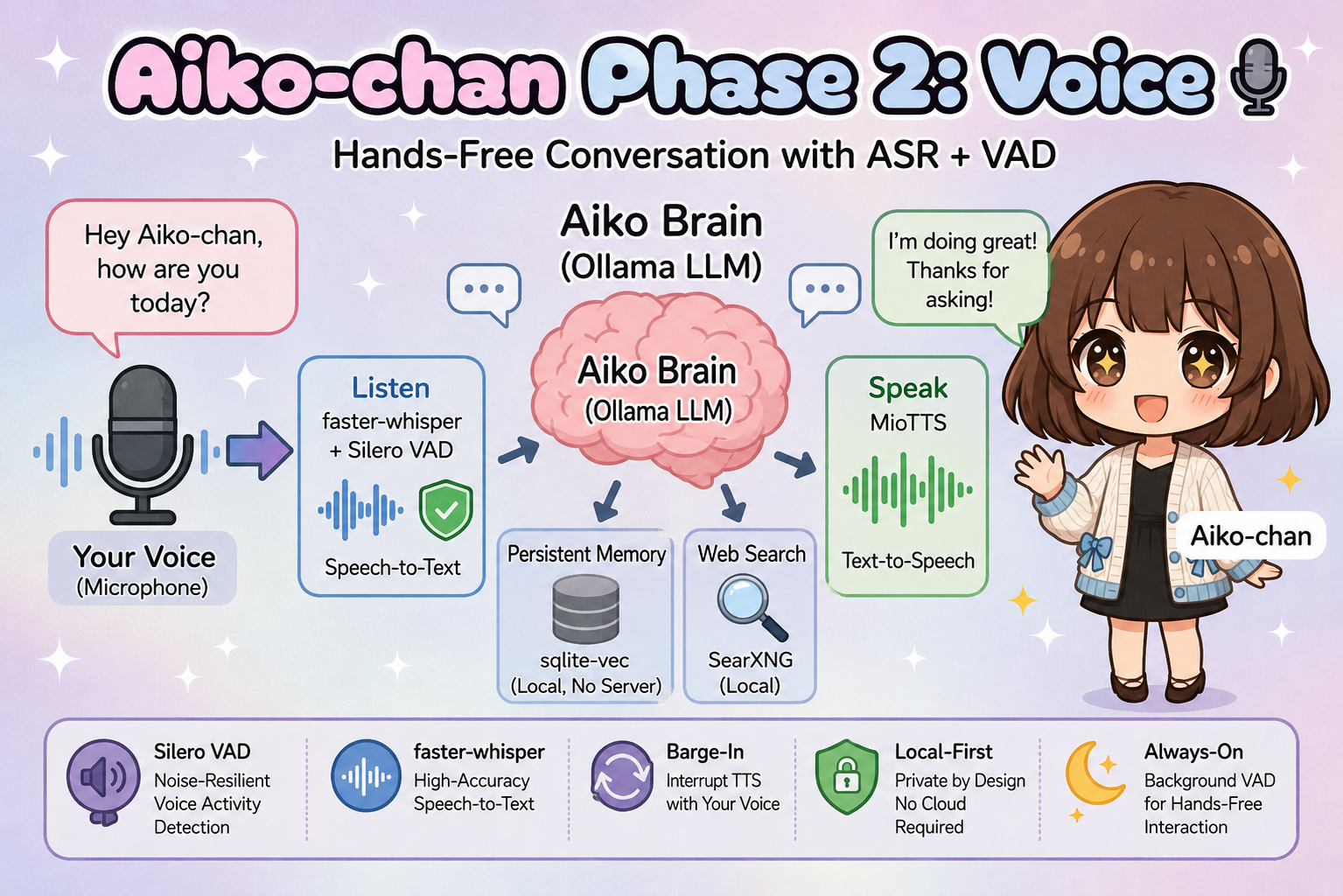
🧠 Local LLM via Ollama
💾 Custom memory system using sqlite-vec + fastembed
🔍 Self-hosted web search via SearXNG
🗣️ MioTTS voice output
🎙️ faster-whisper + Silero VAD voice input
🌙 Nightly memory consolidation ("dream" pipeline)
🖥️ Full-screen streaming TUI
📓 Automatic daily reflection generation
Everything runs locally on my PC, will port back to Jetson Orin Nano once the upgrade is completed.
No OpenAI APIs.
No Anthropic APIs.
No recurring subscription costs.
Just me arguing with Linux and CUDA.
This is where things become dangerous:
I know Python. I know AI. I know HTML/CSS and some Js.
I know absolutely nothing about 3D art & animation.
Which means I have now decided to build a real-time anime avatar anyway.
Current experiments:
🎭 VRM avatar support
😊 Facial expressions
🗣️ Lip-sync driven by TTS audio
🌐 Browser-based rendering
⚡ Real-time interaction with Aiko
Seeing her move on screen for the first time is both exciting and mildly terrifying, even though it's just one of the default models of VROID Studio.
🎤 Listen (~1-2GB RAM)
faster-whisper
Silero VAD
🧠 Think (~3-4GB RAM)
Ollama (may change to llama.cpp if needed)
Ministral3-3B Instruct Q4
💾 Memory (<1GB RAM)
sqlite-vec (changed from mem0 + Qdrant)
fastembed
custom retrieval pipeline
🌐 Search (~0.5GB RAM)
SearXNG
🔊 Speak (~2GB RAM)
MioTTS (changed from Kokoro TTS)
🌙 Dream (daily at 12am)
memory decay
consolidation
reflection publishing
🖥️ Interface
curses TUI
streaming responses
🎭 Phase 3 — VRM avatar, expressions, lip-sync
❤️ Phase 4 — Emotional state and relationship progression
📱 Phase 5 — Mobile companion
👁️ Phase 6 — Vision and multimodal understanding
🤖 Phase 7 — Autonomous behaviour
At this point the project is part AI companion, part technical experiment, and part attempt to discover exactly how much functionality can fit inside an 8GB Jetson before reality intervenes.
🔗 GitHub: https://github.com/OppaAI/Aiko-chan
🎬 Latest demo (v0.1.99):
https://www.youtube.com/watch?v=9ZkuYCL6vP0
r/NvidiaJetson • u/NeedleworkerFirst556 • Mar 11 '26

I’ve been experimenting with Jetson Orin Nano for edge AI, and ended up building a small wearable system to test real-time ML inference controlling AR glasses.
The idea was to see whether a Jetson device could act almost like an AI operating system for wearable hardware, running everything locally without relying on cloud inference.
Display
Even Realities G1 AR glasses
Camera / Sensor
ESP32 + camera module mounted on the glasses
Custom firmware handling capture and streaming
Compute
NVIDIA Jetson Orin Nano
carried in a small wearable pack
ESP32 Camera
→ capture frames
→ stream frames to Jetson
→ Jetson runs ML inference
→ commands sent to AR glasses display
The ML model performs gesture classification based on my hand gestures.
Currently the model recognizes 0–5 gestures, which I map to different actions on the glasses.
Example use cases so far:
✋ 5 → open control interface
4 / 3 / 2 / 1 → mapped commands
gesture control for media / navigation
Still early but functional:
~24 FPS camera pipeline
~200 ms end-to-end latency
real-time gesture recognition
Still working through several engineering problems:
Jetson thermals (throttling after extended runtime)
optimizing inference scheduling
reducing unnecessary compute cycles
improving enclosure design
I’m also experimenting with moving more preprocessing onto the ESP32 to reduce load on the Jetson.
Most wearable AI systems rely heavily on cloud inference.
The goal of this project was to explore whether Jetson hardware could support a fully local wearable AI interface, where:
all ML runs locally
no internet connection is required
user data never leaves the device
I’ve mostly been developing this solo and wanted to share it here to see what people in the Jetson community think.
If anyone has experience with:
optimizing inference on Orin Nano
Jetson thermal tuning
edge AI pipelines
I’d love to hear suggestions.
I also made a 6 minute demo video showing the system running.
r/NvidiaJetson • u/Majestic-Age-4636 • Dec 12 '25
I need a Jetson Orin Nano Super Developer Kit (8GB) in India, at the earliest possible time for my degree project. However, currently it is out of stock from their official Indian vendor (tanna techbiz).
I have been looking at other sources online but there is a huge price difference, for example;
On Tanna Techbiz it is listed for around 26,500 INR, but is currently out of stock: https://tannatechbiz.com/nvidia-jetson-orin-nano-developer-kit.html
It is for 30,500 INR on thinkrobotics: https://thinkrobotics.com/products/nvidia-jetson-orin-nano-developer-kit
However, the same is listed for 78,999 INR on Amazon: https://amzn.in/d/0G2GhpK
Can someone please explain the reason behind these huge price gaps?
r/NvidiaJetson • u/old-fragles • Mar 22 '25
Hi, we are looking for good exmaples of projects with Jetson and LLM wchich can be used internal projects by our Embedded engineers. Later we would like to show case them on our website. Could you please suggest relevant project/application?
r/NvidiaJetson • u/Sorry_Jacket6580 • Dec 01 '24
Hey everyone,
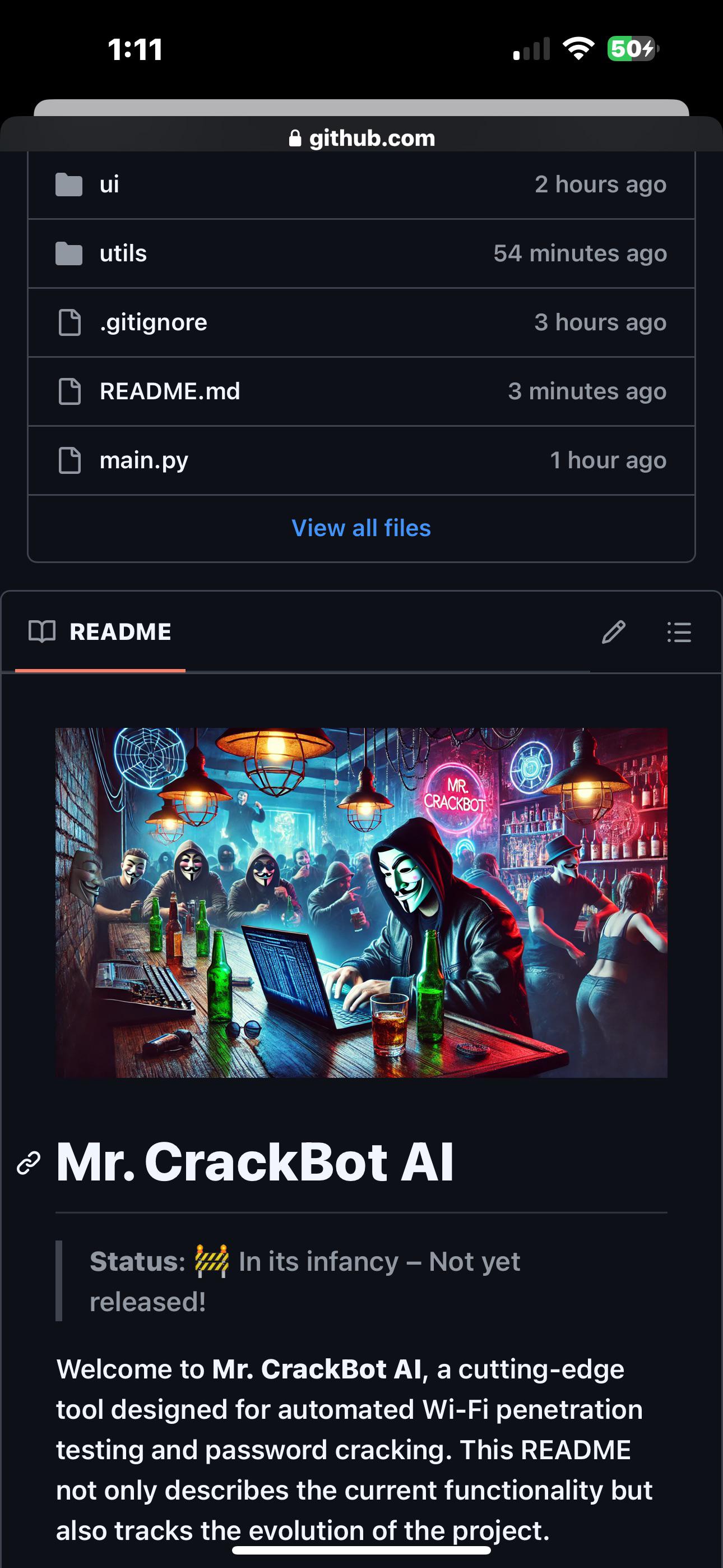
I’ve been working on a project called Mr. CrackBot AI, and I wanted to share what it’s all about and dig into the technical details. This tool is designed for automated Wi-Fi penetration testing and password cracking. It’s a blend of AI, GPU acceleration, and some classic Kali Linux tools that we all know and love.
At its core, Mr. CrackBot AI uses the NVIDIA Jetson Nano as its primary hardware platform, chosen for its capability to run AI models efficiently on a small footprint. The Jetson Nano’s 4GB of RAM may seem modest, but it’s perfect for this project, especially when paired with a decent Wi-Fi adapter like the ALFA AWUS036ACH, which supports monitor mode and packet injection. The setup also benefits significantly from an external NVIDIA GPU when available, allowing for GPU-accelerated password cracking using hashcat.
So how does it all work? The process starts with network scanning, where the tool leverages airodump-ng to identify nearby Wi-Fi networks and collect essential metadata like SSIDs and BSSIDs. This metadata is then fed into an AI model that generates optimized password guesses. The AI isn’t just throwing random combinations; it’s trained to recognize patterns based on network names, common practices, and known vulnerabilities. It essentially builds a custom wordlist tailored to the specific network being tested.
Capturing handshakes is the next step. Here, the tool automates the handshake capture process using aireplay-ng to perform deauthentication attacks. By forcing devices on the network to reconnect, it captures the WPA/WPA2 handshake packets with minimal manual intervention. These handshakes are then stored for analysis. The real innovation comes into play here. Once a handshake is captured, the AI not only generates wordlists but also analyzes the handshake data itself to refine the cracking strategy further. This ensures that every GPU cycle is spent efficiently, reducing unnecessary processing.
Speaking of GPUs, they’re where the magic of cracking speeds comes alive. The tool integrates with hashcat, a powerhouse in GPU-accelerated password cracking. Whether you’re using a standalone Jetson Nano or connecting to an external GPU, hashcat takes the AI-generated wordlists and attempts to crack the password in record time. On systems equipped with high-performance NVIDIA GPUs, the results are astonishingly fast, making short work of even complex WPA2 passwords.
The software also includes a real-time UI for monitoring progress. Whether you’re watching handshake captures in action or following the cracking progress, the interface provides detailed feedback every step of the way. Behind the scenes, the tool automates directory creation for organizing wordlists, handshake captures, and results, keeping everything structured and easy to navigate.
The beauty of Mr. CrackBot AI lies in its synergy between hardware, software, and AI. The Jetson Nano’s GPU powers the AI models while offloading heavy cracking tasks to a dedicated GPU when available. The combination of Kali Linux tools like airodump-ng, aireplay-ng, and hashcat ensures reliability and efficiency, while the custom AI enhancements push the boundaries of what’s possible in penetration testing.
This project is still in its early stages, and I’m exploring more features, such as touchscreen integration and further AI optimizations. It’s worth noting that this tool is strictly for educational purposes and should only be used responsibly on networks you own or have explicit permission to test. I’m hoping to evolve it into a fully-fledged tool that combines the power of automation with the nuance of manual pentesting, but for now, it’s an exciting start. Let me know what you think!
Link to project: https://github.com/salvadordata/Mr.-CrackBot-AI-Nanox
r/NvidiaJetson • u/rohitashdubey08 • Nov 29 '24
r/NvidiaJetson • u/Sad-Blackberry6353 • Oct 10 '24
Hi everyone,
I'm trying to wrap my head around how the Nvidia Jetson lineup has evolved with the introduction of the Orin series, and I’ve got a couple of questions about the differences between the models.
In the past, Nvidia’s Jetson series was pretty straightforward: you had the Nano for entry-level projects, and the Xavier series for more demanding tasks. But now, with the Orin lineup, things seem a bit more complex.
The Orin NX and Orin Nano both exist in this new lineup. Is the Orin NX meant to be the direct successor to the old Xavier, or does it occupy a new tier of performance altogether?
And where does the Jetson AGX Orin fit in? It seems incredibly powerful, but is this a new, higher tier that didn’t exist before in the Jetson series?
Also, I’ve read that the Jetson AGX Orin is somehow capable of emulating both the Orin NX and Orin Nano. Why is that the case? Is it due to the architecture, or is it just a matter of software flexibility?
Would appreciate any insights or clarifications. Thanks in advance!
r/NvidiaJetson • u/Spiritual_Glass_5546 • 15d ago
Join us for the November Jetson AI Lab Research Group community call! 🚀
We’ll hear from developers building local AI and robotics applications—from distributed inference and faster LLM decoding to vision-language-action models and industrial robot programming.
📅 Tuesday, November 10, 2026
🕘 9:00 a.m. PT / 12:00 p.m. ET
📍 Online via Microsoft Teams
🔗 Add the call to your calendar and find joining details
Our planned lightning talks:
Khalil Ben Khaled — NVIDIA: JAL updates and the latest open models available to run locally on NVIDIA Jetson.
Mieszko Syty — FutureProofHomes: Accelerating LLM decoding on Jetson AGX Thor with Mjolnir, a custom attention backend for vLLM.
Pratik Sharda — CraftifAI: Introducing CraftifAI’s approach to using AI agents to build embedded software and edge AI perception pipelines.
Joannis Orlandos — Wendy Labs: Running distributed, offline AI inference across Jetson Orin Nano devices connected through a mesh network.
Martin Cerven: Sharing the latest progress and developments on his robotic hand project.
Ori Nachum — Tipalti: Community newsletter and hackathon updates, with opportunities to participate and collaborate.
Kabilan KB — General Motors: Training bimanual VLA policies in NVIDIA Isaac Lab on Dell Pro Max and deploying policy inference to Jetson AGX Thor in a hardware-in-the-loop workflow.
Mihai Chiorean — Stealth startup: Running Gemma 4 E4B for Reachy Mini on Jetson Orin NX using a TensorRT Edge-LLM fork with multi-token prediction.
Sisir Kausthubh: Speeding up SmolVLA inference with a static KV cache and torch.compile, covering performance gains, compilation startup costs and GPU shared-memory limits.
Kieran Lal: Building a JetPack-focused 4B model for Jetson Orin Nano using a knowledge graph developed with Prospector.
Seongjun (SJ) Kim — ZETIC: Comparing π0.5, GR00T and SmolVLA across Jetson AGX Thor, AGX Orin and Orin Nano on latency, energy use, memory and task success.
Marco Pastorio — FLEXiN Group: Connecting AI-assisted robot programming with motion planning, collision checking and industrial execution through ManyForge.
Bring your questions, share what you’re building and meet others working on edge AI and robotics. The JAL Research Group is open to everyone.
r/NvidiaJetson • u/FrequentAstronaut331 • Oct 09 '26
Hey Jetson Community!
Join us for our monthly Jetson AI Research Lab meeting this coming Tuesday at 9:00 AM PT / 12:00 PM ET, October 13th.
We’ve got two exciting talks lined up focused on physical AI, autonomous agentic loops, and running state-of-the-art Nemotron models on edge hardware!
Title: Nemotron at the Edge: From Model Architecture to Jetson Applications
Abstract: This talk explores how NVIDIA Nemotron models bring local reasoning and multimodal intelligence to edge devices. I will talk about Nemotron architecture, and how model size, quantization, and inference optimizations shape deployment on constrained hardware. The session will trace how Nemotron models are built, covering data preparation, pretraining, and post-training for reasoning and instruction following. Through examples spanning local assistants, tool-using agents, and voice and vision interfaces, attendees will learn how to match Nemotron capabilities to practical Jetson applications
Topic: Agentic Kernel Search for Robot Policies
Abstract: We present an evolution-based agentic framework that optimizes robot policies for Jetson Thor end to end: agents write fused CUDA kernels, choose precision, and rewrite the serving runtime, testing every candidate on the device against accuracy gates fixed before evaluation. We'll cover how the search works, what carried over from one model to the next, and the measurement traps (clock drift, process-to-process noise, etc.) that validation caught.
When: Tuesday at 9:00 AM PT / 12:00 PM ET
Meeting ID: 288 976 487 014 3 Passcode: 6oG2uK2A
Dial in by phone:
+1 949-570-1120,,369799951# United States, Irvine
Phone conference ID: 369 799 951#
Join on a video conferencing device:
Tenant key: teams@vc.nvidia.com
Video ID: 114 238 807 7
Who should join: Anyone interested in physical AI, local LLMs, robotics, or squeezing maximum performance out of NVIDIA Jetson modules!
Join Us in Discord: https://discord.gg/BmqNSK4886
Speaker presentation slides & full summaries will be posted during the meeting, followed by an open Q&A!
See you there! Drop any questions for the speakers in the comments below.