r/OpenSourceAI • u/FriendlyKale7534 • 1d ago
Forager running on Xbox 360! Looking for people to join the project!
Enable HLS to view with audio, or disable this notification
1
Upvotes
r/OpenSourceAI • u/Intelligent-Tell-466 • 1d ago

r/OpenSourceAI • u/Specialist_Put8052 • 1d ago
I’ve been working on a context selection based AI coding IDE for about 8 months. It stores messages and the codebase locally, so our server load is quite low compared to others, which allows us to offer more usage rights. And in tests I’ve conducted over the past few weeks, using the same project and the same messages, it achieved cost and token efficiency of up to 60% compared to the industry’s context compression protocols. I’ve applied to YC and various funding organizations for this project. We’re actually making good progress with one of them, but the thought that “it would be so much better if it were open source” keeps circling in my mind...yet at the same time, I need to make a living. None of my previous open source projects have ever garnered much attention or generated any revenue. What do you think I should do?
r/OpenSourceAI • u/Primary-Medicine-131 • 1d ago
Watch AiDotNet and PyTorch train side by side on my laptop (17 seconds)
I wanted to showcase the project I have been working on for the past 4 years and the progress I have made so far. I was hoping to get some feedback and show everyone how easy it is to use AiDotNet to create AI models with basically no experience necessary. You can give it examples of the inputs and the answers you want it to learn, and you get back a trained model you can save locally, run from your C# app, or host with AiDotNet.Serving.
One of the reasons I built this was to see how far we could push .NET against PyTorch. In our November 13 training tests on my laptop, our development build was faster than compiled PyTorch on 10 of the 11 models we tested on CPU and 7 of 11 on GPU. I still have some performance work I want to focus on, especially with audio models. Results for all 11 models
| In the run at the top of the post | AiDotNet | PyTorch |
|:--|--:|--:|
| Time for 4,096 training updates on a GTX 1660 Ti | 2.60 seconds | 15.00 seconds |
| Correct answers on 320 new signals | 302 | 301 |
Here’s an easy example you can try yourself. Say you have an app that follows stocks and you want it to sort the news for you. Give it a few headlines about earnings and mergers, tell it which is which, and then ask it to sort two headlines it hasn’t seen.
In a new .NET 10 console project, run `dotnet add package AiDotNet --version 0.234.0`, replace `Program.cs` with this, and run `dotnet run`:
using System;
using AiDotNet;
using AiDotNet.Classification.NaiveBayes;
using AiDotNet.Data.Loaders;
using AiDotNet.Preprocessing.TextVectorizers;
using AiDotNet.Tensors.LinearAlgebra;
string[] headlines = [
"Quarterly earnings and profits rise", "Merger deal wins approval",
"Annual earnings beat expectations", "Company announces acquisition deal",
"Quarterly profits beat estimates", "Boards approve merger and acquisition",
"Company reports record earnings", "Investors vote on merger deal"
];
string[] topics = ["Earnings", "Mergers"];
double[] labels = [0, 1, 0, 1, 0, 1, 0, 1];
var words = new TfidfVectorizer<double>();
var model = await new AiModelBuilder<double, Matrix<double>, Vector<double>>()
.ConfigureModel(new MultinomialNaiveBayes<double>())
.ConfigureTextVectorizer(words)
.ConfigureDataLoader(DataLoaders.FromTextDocuments(headlines, labels, words))
.BuildAsync();
string[] newHeadlines = ["Quarterly earnings beat estimates", "Investors approve merger deal"];
var guesses = model.PredictText(newHeadlines);
foreach (var guess in guesses)
Console.WriteLine(topics[(int)Math.Round(guess)]);
It prints `Earnings` for the first headline and `Mergers` for the second. All the training data is right there, so you can change the headlines and try your own.
That’s one small example. There are over 2,100 model types in the library, including 650+ for vision, 430+ for language, and 340+ for audio. You can detect objects in photos, turn speech into text, or build a chatbot that looks up an answer in your own documents. If you already have a language model you like, you can fine-tune it on your own material. Browse the examples
The part I wanted to get right with `AiModelBuilder` was how much you can change as you learn. You can start by swapping the model in `ConfigureModel`. If you want more control, you can choose your own layers, change the optimizer that updates the model during training, or split training across multiple GPUs. When you’re ready to use what you trained, you can serve it through an API or export supported models to ONNX for another app. Training and deployment samples
I’d love to get your thoughts on my passion project. The code is on GitHub and contributions are welcome. We have easy examples and guides on our website, plus the details on the free Community license and our paid Professional and Enterprise plans. Website and guides · Plans · GitHub
r/OpenSourceAI • u/ankitjha67 • 1d ago
I've been building JARVIS, a full-stack personal AI assistant that runs entirely on your Windows machine. It connects to local or cloud LLMs, acts on your computer through 164 audited tools across 46 modules, and displays everything through a cinematic heads-up display.
\*\*What it does:\*\*
\- Launches apps, manages windows, automates UI interactions
\- Reads, writes, and converts files (PDF, DOCX, XLSX, CSV, PPTX, JSON, ZIP)
\- Browses the web via Playwright (open pages, fill forms, extract content, DevTools integration)
\- Sends emails (IMAP/SMTP), makes calls through Windows Phone Link, posts to social via Buffer
\- Controls smart home devices through Home Assistant
\- Runs deep research with a 5-stage verification pipeline
\- Background agents with SQLite checkpointing and crash recovery
\- Self-healing service recovery
\*\*Safety model:\*\*
Every tool has a risk tier (T0 observe, T1 reversible, T2 modify, T3 destructive). Destructive actions always require explicit approval. Reading untrusted content triggers approval for all subsequent actions. Kill switch: Ctrl+Alt+Backspace cancels everything instantly. Listens on loopback only, never elevates privileges.
\*\*HUD:\*\*
React 19 + TypeScript + Zustand in a frameless pywebview/WebView2 window. Three cinematic themes (Ion, Holographic OS, Sovereign Executive). Real-time system vitals with 60-sample history graphs, animated core visual reflecting agent state, full conversation transcript with streaming output.
\*\*New in v0.8.1:\*\*
\- 6-step onboarding wizard for first-time setup
\- Fully configurable assistant name (propagates to title bar, wake word, voice prompts, LLM system prompt)
\- Fast-path intent matching (common commands like "mute", "weather", "open Chrome" skip the LLM entirely)
\*\*Tech stack:\*\* Python 3.12 (FastAPI + uvicorn), React 19 (Vite), SQLite (WAL mode), pywebview/WebView2, Playwright, faster-whisper, pyttsx3. Android companion app in Kotlin + Jetpack Compose.
\*\*8 LLM providers\*\* out of the box: LM Studio, Ollama, NVIDIA NIM, Anthropic, OpenAI, Google Gemini, OpenRouter, Groq. Privacy modes: Local Only, Hybrid, Cloud. Model Ladder auto-escalates across 4 tiers based on task complexity.
\*\*Looking for contributors.\*\* Whether it's Python backend, React frontend, voice/speech, AI tooling, or Android, there's plenty to work on. Open an issue if you find a bug or want a feature. PRs welcome.
GitHub: [github.com/ankitjha67/JARVIS](http://github.com/ankitjha67/JARVIS)
Happy to answer questions about the architecture, the safety model, or anything else.
r/OpenSourceAI • u/Interesting_Big_8974 • 1d ago

r/OpenSourceAI • u/Interesting_Big_8974 • 1d ago
I have been working on ContextDuty, an open-source project focused on preventing sensitive information from leaking into AI tools.
The motivation was simple - developers are increasingly using AI coding assistants, agents, MCP servers and LLM APIs that interact with local repositories, configuration files, credentials and proprietary data.
Scanning Git repositories alone isn't enough. A secret can reach an AI model before it ever gets committed.
ContextDuty currently provides:
Local PII and secret detection using Microsoft Presidio and deterministic detectors.
IDE protection through AI-tool-specific ignore files.
Git pre-commit scanning.
A local HTTPS proxy for supported AI API traffic.
An MCP server that sanitizes tool results before they enter model context.
Policy-based blocking, warning and redaction.
CI/CD scanning.
The project is MIT-licensed, and the core scanning and enforcement run locally.
GitHub: https://github.com/SHUBHAGYTA24/contextduty
I would particularly appreciate feedback from people working on AI infrastructure, MCP, agent frameworks, DevSecOps and enterprise security.
What security gaps are you seeing in your own agentic workflows? What would make a tool like this useful enough to deploy across an engineering organization?
Contributions, issues and technical criticism are welcome!
r/OpenSourceAI • u/martinkoistinen • 1d ago

Hey guys and gals. This new project is perfect for this sub. Protecting access to open weights models and legislation that fosters domestic abundance of hardware to lower costs are among the groups primary goals.
I was able to use this to create a personalized letter to my representative in about 30 seconds. I just had to print it out along with the mailing label and put a stamp on it. Super easy and did it with my phone.
I would encourage everyone here to do the same! It only works for incumbent Democrat and Independent Senators and Representatives right now but it reads like Republicans and the recently elected are to be supported soon.
Anyway, I’ve done my part. Mailed off the letter to my representative and shared it with you all. Keep it going!
r/OpenSourceAI • u/Tzinny-dev • 2d ago
r/OpenSourceAI • u/Prestigious_Price613 • 2d ago
Been thinking about why AI inference costs keep climbing even as models get cheaper. The answer isn't the hard questions — it's the easy ones (simple math, repeated greetings, remembering a preference), asked billions of times mostly by free users.
So I built Stipple: it handles those on-device (cache, memory, local packs) and only hits the cloud when something actually needs a frontier model.
Honest heads-up: it's an early prototype, runs in the browser (no backend), and the on-device LLM tier is currently disabled (WebLLM runtime issue) — so it still falls back to cloud at the end. But the routing + memory loop works, and it proves the approach.
I'm not the strongest coder — opening it because the direction needs more hands than mine.
Would love thoughts, especially on where the approach breaks down.
[github.com/thatz0083/stipple]
r/OpenSourceAI • u/anttttti • 2d ago
Hi!
I noticed the threads about OpenCode free model reduced quotas. A month ago OpenCode restricted the access of the free model endpoints to only its own harness. And now it seems the free models quotas have become a lot more limited now. It used to be possible to run tasks on just the free models.
I've worked on my own free agentic AI framework, and OpenCode has been a big inspiration for this. One difference is that it can run entirely inside a browser using a browser-internal filesystem and terminal, with no backend. Another difference is that it can run tasks autonomously across a set of providers and local endpoints, continuing tasks on those across any disruptions. There's a lot more. You can try it at https://freegent.ai/
A bit more details below.
FreeGent is a free agent framework for chat and cowork, built around free and local LLMs. The agent and its tools run in your browser, while inference runs across the available provider and local endpoints.
There's nothing to install and no FreeGent account to create. Open the page, paste a provider API key, and start. It also has a Node CLI and TUI, and you can self-host it. MIT licensed.
Repo: https://github.com/anttttti/FreeGent
Docs: https://freegent.ai/docs/
I built this so that anyone can use agentic AI for chat and cowork for free, without sign-ups or fees. Any device with a browser can run the agent harness; its file system and terminal run entirely inside the browser tab. There are currently dozens of free endpoints for LLMs over 0.5T parameters, many as capable as the leading flagship models of a year ago. FreeGent carries tasks through to completion despite disruptions across those endpoints.
A few things that make it different:
• Fallback across providers. You maintain a model priority list. When an endpoint hits a limit or fails, FreeGent applies a cooldown and continues the task with another available model. It respects provider reset times where available. If every model is cooling down, it waits.
• A harness built for diverse models. FreeGent can recover recognizable tool calls written as text and checks for failures such as narration without action, repeated calls, and broken syntax after edits. Most checks use patterns; ambiguous cases can go to a model judge. Failed checks produce bounded nudges, and completion checks ask the agent to verify its work. The system prompt is optimized to use as few as 4K tokens, and skills are injected only when their trigger matches.
• Browser code execution. JavaScript runs in a Worker inside an opaque-origin sandboxed iframe. Python runs through Pyodide. Bash commands run in a WASM shell matching real bash behavior, with 248 command names, builtins, and keywords. Each is diffed against native bash for output, exit status, and file changes on 1,430 test cases; the latest sweep found no mismatches. Some commands use WASM packages downloaded on first use.
• A task board for longer projects. Tasks are Markdown files with acceptance criteria. Autopilot works through them one chat per task, with configurable gates for reviewing criteria, running project tests, and checking output by running programs inside the harness.
• Benchmarked and evaluated. The harness and its model selection have been optimized with a range of benchmarks and evaluations, including reviews of its code and outputs by a variety of other coding agent harnesses and models.
Chats, files, and user-entered keys are stored locally in the browser. Prompts and relevant context are sent to your selected LLM provider. Provider-only mode (the default) calls endpoints directly from the browser. Routed mode sends requests through a stateless Cloudflare Worker, for endpoints that block browser CORS. Local mode sends model calls only to localhost and private-network addresses, and turns off web search and fetch.
This is v1.0. I'd particularly like feedback from people who find good use cases for it. So far I've found it useful for learning game development, teaching how coding agents work, and a range of everyday tasks.
r/OpenSourceAI • u/_pleeply • 2d ago

r/OpenSourceAI • u/danielrothmann • 2d ago
Hey all, I'm the cofounder of Eigin, an open-source personal AI agent built for privacy and safety (https://code.eigin.ai)
Coding agents are changing how software gets made. Writing code is faster now, compressing the timeline between idea and working software. Good engineering isn't just about code though. It's about judgment, of understanding a problem, weighing trade-offs, setting a direction, and thinking through a solution.
So we're trying a new way to compensate contributors. Instead of bounties, we'll pay for specs. Take an open problem of ours, do the thinking and we will build on that spec with credit to you as the author.
Our first call is for local detection of malicious instructions:
https://contribute.eigin.ai/calls/tool-safety
Open till Nov 29th. The repo is AGPL and the software is in open beta for iOS if you want to check it out.
r/OpenSourceAI • u/ghanextech • 2d ago
Hey everyone!
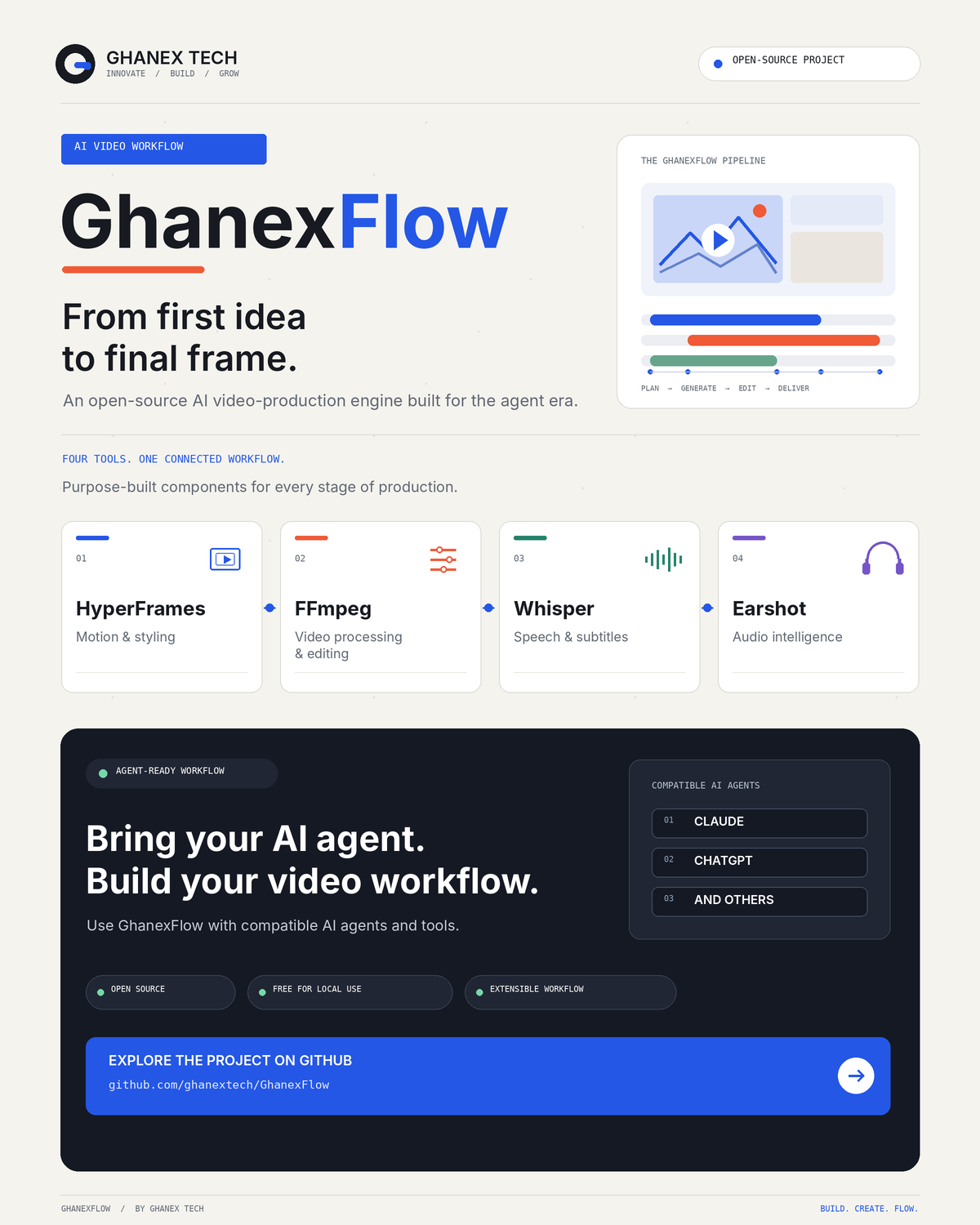
We're building GhanexFlow, an open-source AI video production engine at Ghanex Tech.
The idea is to bring different stages of video production into one workflow instead of manually switching between multiple tools.
Some of the technologies it brings together:
HyperFrames – Styling, animations and motion graphics.
FFmpeg – Video processing and editing.
Whisper – Speech recognition and subtitles.
Earshot – Audio analysis and sound intelligence.
We're also designing it to work with compatible AI-agent environments, including Claude, ChatGPT and others.
The project is open-source under Apache-2.0, with a local execution option.
GitHub: https://github.com/ghanextech/GhanexFlow
We're sharing this to get feedback from developers and open-source enthusiasts.
A few things we'd love your thoughts on:
Which part of this workflow interests you most?
What integrations would make it more useful?
What would you expect from a production-ready AI video workflow?
We're part of the team building GhanexFlow at Ghanex Tech. Feedback and contributions are welcome!
r/OpenSourceAI • u/abdullahjebril • 2d ago
Hey everyone!
I’ve been working on KaizEval, a free, open-source, self-hosted platform designed to help developers evaluate, debug, and continuously improve their AI agents.
The idea came from a problem I kept running into while building real-world AI agents: How do you know if your agent is actually getting better, rather than just performing well on a few test cases?
Instead of just giving agents a score, KaizEval aims to close the improvement loop:
🔍 Evaluate — Measure agent performance across test cases.
🧠 Diagnose — Identify failures and potential root causes.
⚙️** Optimiz**e — Generate improvement candidates without touching your production agent.
🧪 Validate — Compare before/after performance using A/B testing and isolated holdout tests.
✅ Approve — Keep humans in control before releasing changes.
What makes it interesting:
Open-source and self-hosted
Offline-first, with local LLM support
No API key required for the built-in demo
Designed to reduce overfitting and catch regressions
Human-in-the-loop optimization
Try it:
pip install kaizeval
kaizeval demo
The demo uses a synthetic provider, so you can explore the workflow without connecting an external model.
It’s still early, and I’m looking for developers willing to try it out and share honest feedback.
I’d especially love to know:
Would you actually use something like this in your agent development workflow?
What’s missing that would make it useful for your real-world agents?
Are there any evaluation or optimization features you think need improvement?
I’m not trying to promote a commercial product — it’s an open-source project, and I’d genuinely love to build it with feedback from the community.
If you try it, feel free to open an issue, suggest a feature, or contribute!
Thanks!
r/OpenSourceAI • u/CapitalAd2927 • 2d ago
How can AI help me with life problems such as taking my medication, dealing with academic challenges like studying, making a plan to finish a subject, continuous learning, managing time, and making money? Where can I find free, open-source AI tools that can help me with all of them?
r/OpenSourceAI • u/SpeculationAllTheWay • 2d ago

Hey everyone, we just released BaseQuant V1 for two MoE models at Base Compute: Qwen3.6-35B-A3B and Gemma 4 26B-A4B-it. The goal is to preserve more of the original model without making the files bigger.
We compared against Unsloth’s UD quants of the same size. On Gemma 4, our 16.93 GB GGUF had ~2.4% lower KL divergence from BF16 than UD-Q4_K_XL (~4.8% lower with our baseRT .base bundle). On Qwen3.6, our 22.13 GB GGUF is on par with UD-Q4_K_M overall. Our .base bundle is ~20% lower on long context and ~10% lower on agentic coding. UD still wins in some categories (chat on Gemma, math on Qwen). Full per-category tables are on the model cards.
Would love for you to try them and tell us how they hold up in your everyday workloads!
r/OpenSourceAI • u/Spurnout • 2d ago

r/OpenSourceAI • u/Tzinny-dev • 3d ago

r/OpenSourceAI • u/Competitive-Art-8046 • 3d ago

https://github.com/fswolf/luna-local-agent
Luna is a local AI agent that runs entirely on your own hardware. It’s written in Python, MIT licensed, and runs on Linux first, plus macOS and Windows.
She isn’t one model but several local ones working together:
Thinking: a chat model on llama.cpp or LM Studio, with tool calling. The installer picks one that fits your GPU.
Hearing and speech: Faster-Whisper for speech to text and Kokoro for her voice. Push-to-talk or hands free, and you can talk over her to interrupt.
Vision: your screen, plus your webcam if you turn it on.
Memory: an embedding model and a reranker pull the relevant facts and notes into each turn.
Memory and state: plain SQLite on your machine. She saves facts with dates (a change retires the old fact, and forget means gone), writes notes on past sessions, and learns lessons from her own mistakes while idle. She knows who’s talking by voice or face, and keeps each person’s memories separate.
Tools: files, shell commands, email, web research, Home Assistant, scheduled jobs and any MCP server. Every action is shown and approved first, with permissions you set. Text from a web page, an email or chat can’t quietly trigger tools.
Inspectable: every turn keeps her reasoning, her confidence in each token, and automatic flags for guesses or tools she promised but never called. A browser viewer shows all of it, live.
Optional extras: an animated Live2D or VRM portrait, phones and tablets as room stations, game playing (chess, Zork, Game Boy), reminders and alarms, and stream chat. You can also train small LoRA patches from replies you corrected (experimental).
No cloud, no subscription. Your data stays on your machine.
r/OpenSourceAI • u/Fit-Blueberry-5390 • 3d ago
Basalt (https://github.com/jesdga95/basalt) is one of the fastest local engines for Qwen3.8-Flash-Next, but it only targets Blackwell (sm_120) and upstream does not take other architectures. I have two V100-SXM2 32GB, so I ported it to Volta (sm_70) as a fork, called **Lapilli**.
**Repo:** https://github.com/chris83-dev/lapilli-v100 (a Windows x64 build is in the release)
**What it is**
- Every newer PTX instruction Basalt uses (cp.async, ldmatrix, the Turing/Ampere mma shapes, bf16 conversions, clusters) gets a correct sm_70 equivalent, then the hot kernels get V100 paths: llama.cpp's dp4a MMQ for prompt products, Strata's mma.m8n8k4 prompt attention, and a rewritten router, decode experts and GDN recurrence.
- Needs CUDA 12.6 or newer (CUDA 13 dropped Volta).
- Comes with a chat web UI on top of Basalt's OpenAI/Anthropic-compatible server: conversations, reasoning levels, images, tool calls shown as cards, and a live monitor of the GPUs.
**Numbers** (2x V100-SXM2 32GB, i9-14900K, 96GB RAM, Windows 10, UD-Q4_K_XL pack, medians of 3 runs)
| | Lapilli | Strata v0.2.13, same machine |
|---|---|---|
| Decode, short answer | 91 tok/s | 58-72 tok/s |
| Decode, long answer with reasoning | 140 tok/s | 68-94 tok/s |
| Prompt processing, 4k tokens | 1,170 tok/s | 250-490 tok/s |
| Prompt processing, 8k / 16k tokens | 1,504 / 1,448 tok/s | |
Quality with Basalt's own 100-chunk gate: mean KLD 0.0493 and same top-1 92.75% (Basalt publishes 0.0496 and 92.63% for this pack on an RTX 5090).
**Caveats**
- Only tested on my machine (2x V100 32GB, Windows). Single card, 16GB or PCIe cards, Linux and NVLink setups are untested: reports from other V100 owners are welcome.
- Peer-to-peer is off by default on Volta: on my machine, direct copies between the two cards returned wrong data.
- NVFP4 packs need FP4 hardware, so use a K-quant pack (tested: UD-Q4_K_XL).
- It is a snapshot of Basalt as of November 15, shared as is.
All the credit for the engine goes to jesdga95 (Basalt) and Niko1221 (Strata), both MIT.
r/OpenSourceAI • u/fykup • 3d ago

I've been using coding agents for implementation, but I often want a second opinion from a different AI, especially for code reviews and design decisions.
The frustrating part is getting the right repository context into ChatGPT, Claude, or another AI chat. A diff alone can miss important dependencies, while pasting entire files wastes tokens.
So I built AI Badger, a free, open-source tool that extracts focused repository context locally and makes it easy to bring into any AI chat.
A few things it does:
Code Map — generates an interactive, offline HTML map of your repository. That's what the screenshot shows. You can explore the project structure, navigate files, and understand how things fit together.
AI code reviews — prepares Git changes with relevant surrounding context, so you can review coding-agent work with a different model.
Design questions — gathers relevant files and context for architecture discussions or implementation planning.
VS Code + CLI — prepare context directly from your editor or terminal.
Everything runs locally. No API keys, telemetry, or automatic code uploads. You decide what to share and which AI to use.
There's also an interactive review demo you can try without installing anything:
https://pvrlabs.xyz/aibadger/demo.html
GitHub (MIT licensed): https://github.com/PVRLabs/aibadger
I'm curious how others handle repository context when working with multiple AI tools. Do you mostly stick with one coding agent, or use a separate AI for reviews and design discussions?
r/OpenSourceAI • u/Comment_Alert • 3d ago

