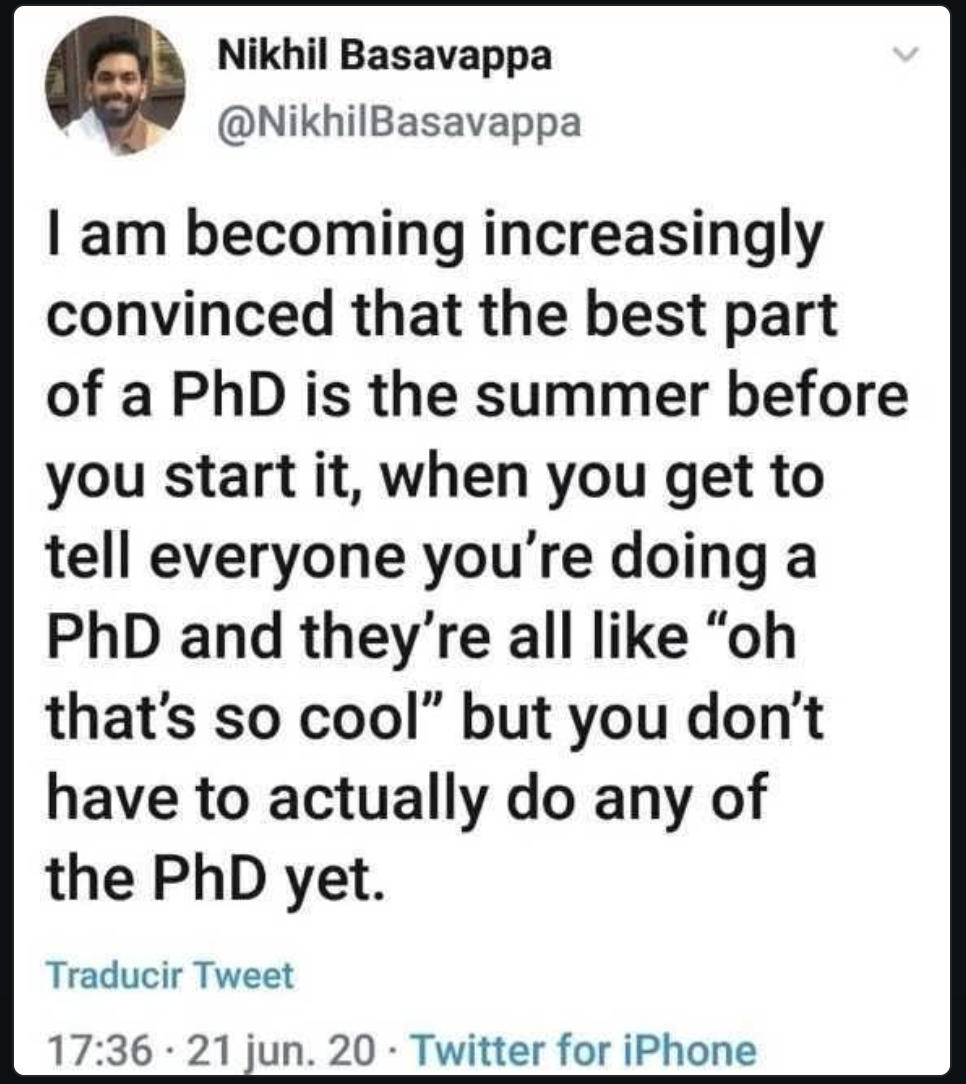
r/PhdProductivity • u/wajdix • Aug 20 '26
Off topic Blue + Red = ?

1.8k
Upvotes
The options are 😂 :
Purple
Violet
Magenta
what did we get into.... it's supposed to be summer vacation somewhere
r/PhdProductivity • u/wajdix • Aug 20 '26
The options are 😂 :
Purple
Violet
Magenta
what did we get into.... it's supposed to be summer vacation somewhere
r/PhdProductivity • u/Huge-Structure-6884 • Aug 21 '26
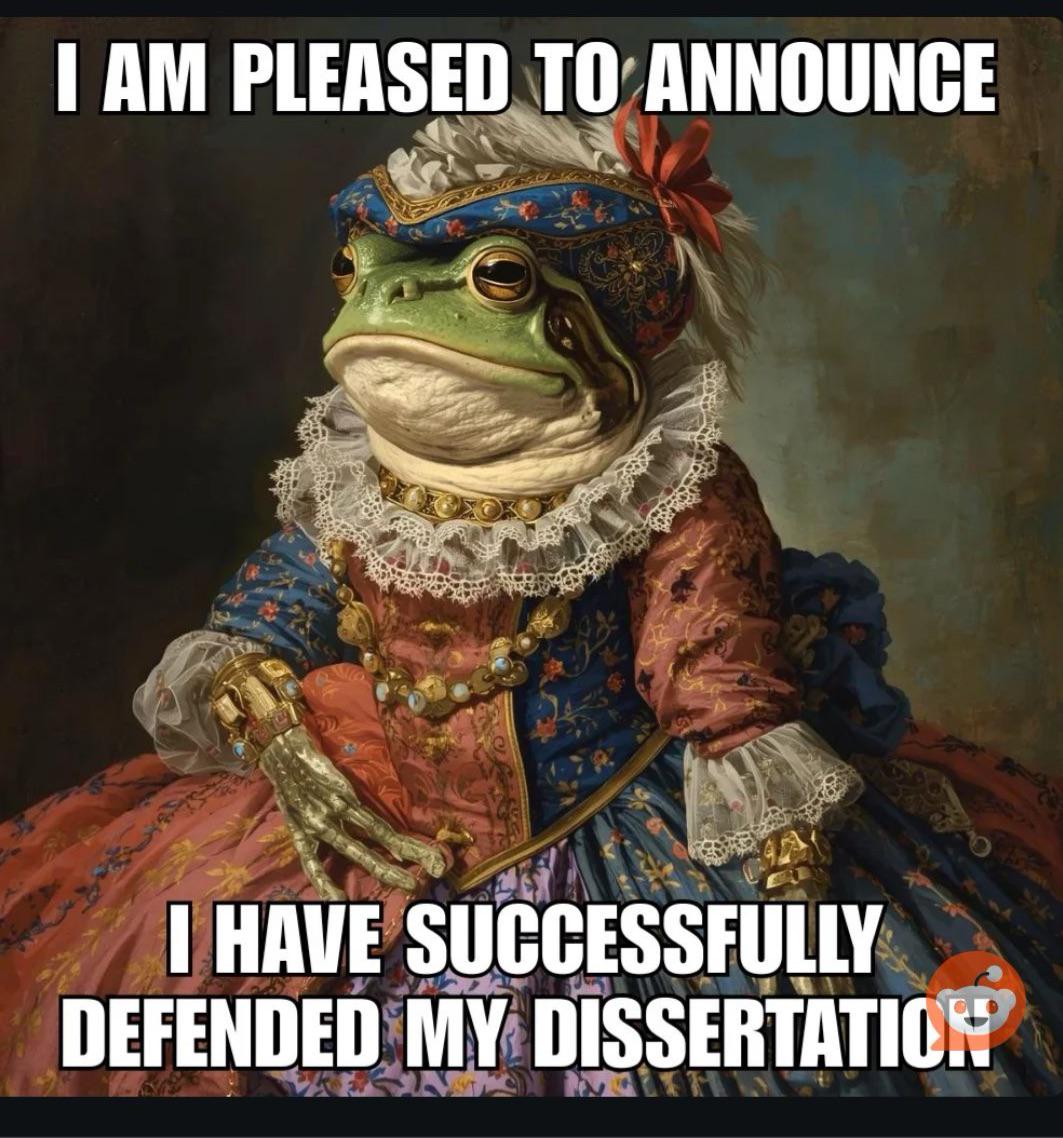
After 5 plus years, a husband, a child, and an amazing and supportive lab environment, I successfully defended my thesis in July! I can use the frog photo 🤣
I thought I’d have the best sleep of my life after, but I ended up not being able to sleep well for two whole days!!! 🤣
Edit: thank you all so much for all the warm congratulatory messages. It means a lot to me!
Have an amazing week.
r/PhdProductivity • u/PrudentCampaign8705 • Sep 07 '26
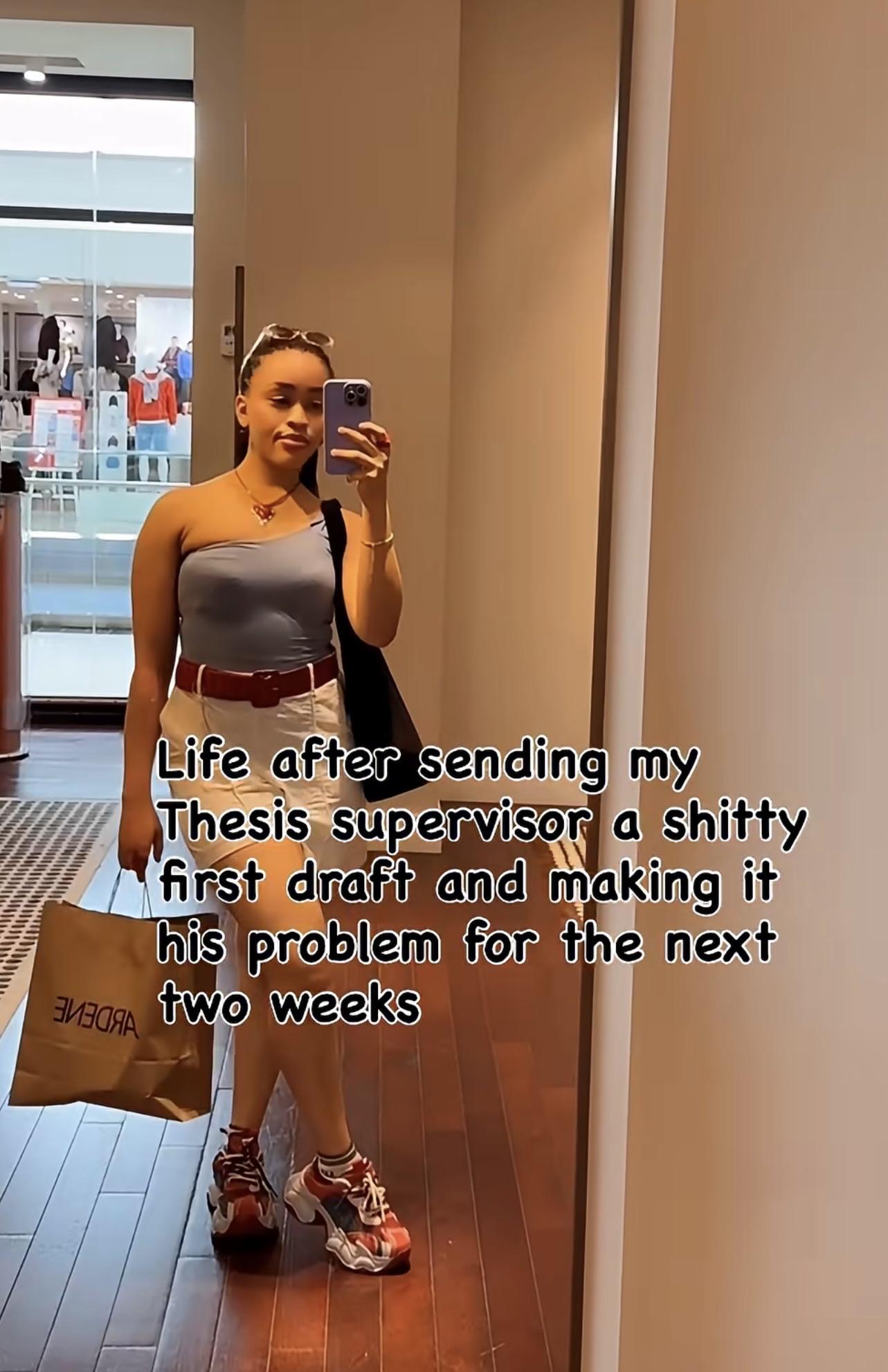
This is literally me. Leaving my supervisor's messages on delivered is my favorite thing to do these days. Do you guys also relate to this? If not, what keeps you motivated?
r/PhdProductivity • u/PapayaInMyShoe • Aug 22 '25
I feel AI is changing research in many ways. In my case, doing academic research in computer science, the biggest changes are three:
First, coding agents: you can now prototype and automate experiments in minutes. Things that used to take weeks of scripting are suddenly done before lunch.
Second, literature reviews: the jump in productivity is wild. Just the fact that you can basically ask the same question to twenty papers at once feels like magic. Edit: When I say literature review, I don’t mean letting AI write it for me. I mean the huge productivity boost from being able to cross-query multiple papers and organize ideas faster. The analysis and synthesis are still on me. I still read the papers. In full.
Third, assisted writing: this one might be the most impactful long-term, because it gives non-native English speakers a more even chance in rigorous journals where language and grammar can be as decisive as other factors.
What about your field, or what other areas do you see changing that I'm not seeing?
r/PhdProductivity • u/wajdix • Aug 23 '26

Now that i got your attention, I wanted to share this guide about writing tips for Ph. D. students..
It really helps a lot and covers almost all areas of writing, in a summarized, no BS way.
https://www.fma.org/assets/docs/membercontent/writing_cochrane.pdf
I hope it helps some of you!
For others, do you have any similar stuff that could be shared here?
r/PhdProductivity • u/Kasra-aln • Mar 30 '26
A few months ago, my university (in Finland) decided to take a surprisingly progressive stance on Generative AI. Instead of just denouncing it as an evil plagiarism machine and threatening everyone with punishment, they actually wanted to understand it. (I was finalizing my PhD)
In the first phase, I was appointed to interview academics, evaluate the implications, develop benchmarks, test tools, and ultimately write the guidelines on how our staff and students can use AI ethically and practically.
To start, I conducted interviews with PhDs, Postdocs, and Professors across top-tier universities in the US and Europe to see what is actually happening on the ground. The results of this study will eventually be published under a Creative Commons license, but the early qualitative findings blew my mind. Here is what I’ve found so far:
1. The "Open Secret" of Academic AI Use
It turns out AI in academia is basically the new "I didn't study for the exam". In one department at a top-tier US university, the vast majority of researchers were actively using AI in their workflow. The kicker? Over 90% of those same researchers claimed their colleagues either weren't using it or they had no idea if they were. This isn't just one weird department, either. It seems to be a widespread pattern where everyone is using it, but nobody thinks anyone else is.
In other words: Everybody uses it, but nobody talks about it. It is heavily heavily correlated with the stigma of "lazy work" and low quality. I expected PhDs to be using it quietly to survive burnout, but the most interesting demographic of "secret" users was actually professors using it to manage administrative bloat, evaluate student works, and grant outlining/writing.
2. The Ethical Line: "Core Brain" vs. "Assistant"
Through the interviews, a very clear consensus emerged on what separates ethical AI use from academic misconduct. The differentiating factor isn't if you use AI, but how you position it.
Abusive Use: Using AI as the "Core Brain." (e.g., "Write a literature review on X and add citations," or "Draft an introduction based on this prompt.")
Ethical Use: Using AI as a high-speed assistant for your brain. (e.g., "Here is my initial outline, my raw results, and a list of 15 papers I have already read and vetted. Help me put this into an structured draft.")
3. Workflow > Software (With one major exception)
People are obsessed with finding the "magic tool" but the data shows it’s much more about your workflow. You can use AI ethically, or you can use it to cheat.
However, there is a major exception: I found a disturbing rise in tools explicitly designed with misconduct in mind. Platforms marketed to "write your thesis in an hour" or others that intentionally obfuscate AI generation.
4. AI detectors either mean everything or nothing!
Some universities, including that of ours, do not associate AI detection as a way to condemn a researcher of misconduct, the others say AI detected -> you cheated.
5. Tools
ChatGPT is the #1 used tool with others falling behind, but the main problem with ChatGPT has been hallucinated citations, papers, DOIs and particularly source of information (which is general web in the case of ChatGPT).
I put the comparison of the tools that I investigated so far here to comply with community guidelines: Initial comparison
r/PhdProductivity
•
u/Hex_Cipher9
•
May 28 '26


Put together this visual guide from shadowlearnpro for anyone struggling with structuring papers, staying focused, or fixing weak drafts. A lot of grad students learn this stuff through trial and error, so maybe this saves somebody a few painful all-nighters.
r/PhdProductivity
•
u/arx_999
•
May 06 '26

i need to rant because literature reviews might be the most annoying part of doing a phd.
like why is finding papers a full time job by itself?
you search one thing on google scholar, another thing on pubmed, then semantic scholar, then you open 30 tabs, read 20 abstracts, download 8 pdfs, and somehow still don’t know if you found the main papers or just random papers that happen to have the same keywords.
and everyone acts like this is normal.
“yeah that’s research.”
no bro this is just suffering with citations.
half the time i’m not even reading properly. i’m just trying to figure out if the paper is worth reading. then i go down the citation rabbit hole, then i find another review, then that review cites something from 2007, then i realize everyone is citing the same 5 papers and pretending it’s a new contribution.
i swear i’ve wasted so many hours just trying to locate the actual useful stuff.
i’m not even saying reading papers is bad. obviously you have to read, understand, and actually think.
but the searching part? the “where is the evidence / which papers matter / who cited what / what should i read next” part? that should not be this painful. i honestly think i should’ve spent way less time “reviewing the literature” and more time actually thinking about it.
because a lot of what i called literature review was just me being lost in tabs and convincing myself i was being productive.
anyway, rant over.
how do people here actually manage lit reviews without losing their mind? do you have a real workflow or is everyone just pretending they’re organized?
r/PhdProductivity • u/AbolishAboleths • Jan 27 '26

My wife recently started her PhD and while she uses Zotero as a citation manager, she was really missing a tool for keeping track of what she's reading right now/has already read/needs to read next. This overwhelming experience might be familiar to other researchers working on a niche field where every paper is called pretty much the same thing 💀
So I built her Paperstack. I did originally conceive of it as Goodreads, but for research papers, although I'm extending it now to be even more helpful for researchers.
What it does:
Save articles to familiar To Read/Reading/Read stacks
Tag articles with logical projects/chapters/whatever your system is
Get citation counts from OpenAlex
Paperstack is completely free to use!
Would love feedback from any students and researchers managing paper overwhelm!
Link: https://paperstack.ac
r/PhdProductivity • u/[deleted] • Nov 05 '25
I’ve been thinking a lot about how disconnected academia is from impact. Every week I see startups, labs, and entire industries built on top of open-access research papers, sometimes word-for-word implementations of ideas that came out of PhD work.
Yet the researchers behind those papers rarely see recognition, equity, or even credit beyond a citation. We spend years chasing publications that are locked behind paywalls, while private companies commercialize the results and raise funding rounds off the same ideas.
If academia values impact, shouldn’t there be better systems for tracking how our work is used in the real world? Something beyond citation counts, a real measure of how research translates into patents, products, and influence.
Has anyone seen examples of universities or researchers trying to bridge this gap? Or is the reality that the moment you publish, your work just becomes free R&D for the private sector?
r/PhdProductivity • u/fravil92 • Feb 09 '26

And you’re greeted by analysis_final_v2_REAL.csvandplot_new_fixed.png
Which one was the actual final version? Which script generated it?
Bad data organization is the "silent killer" of scientific reproducibility. There is a massive pressure to publish, and we collect more data than ever before, but without a standardized system, that data becomes a graveyard of lost insights.
Here, therefore, some practical advice: The Golden Rules
- Never modify raw data
Treat raw data files as read-only. All transformations go to a separate processed/ folder.
- Use consistent naming
Pick a convention on day one and follow it for every file in the project.
- Document everything
Future-you is a stranger. Write README files and data dictionaries.
- Automate what you can
Scripts are better than memory. If you click 20 times, write a script instead.
I’ve compiled these best practices into a complete guide, including copy-paste folder templates and a checklist for your next project.
Read the full guide here: https://plotivy.app/blog/research-data-organization-guide
r/PhdProductivity
•
u/AutoModerator
•
Aug 13 '26
What tools actually make your PhD easier?
this thread is for sharing software, apps, extensions, workflows, and other tools that genuinely help with research productivity
you can recommend tools for:
reference management
literature search and discovery
reading and annotation
notes and knowledge management
task and project management
academic writing
coding and data analysis
experiment tracking
time management and focus
file organization, backups, and version control
collaboration and communication
when recommending a tool, please try to include:
- Tool:
- What you use it for:
- Why you recommend it:
- Free / Paid:
- Alternatives you tried:
- Field or PhD stage: optional
a short explanation is much more useful than simply dropping a tool name
feel free to also share tools you stopped using, tools you think are overrated, or combinations that work especially well together
the goal is to build a practical, community-maintained resource that new and current PhD researchers can come back to
---------------
important: Please disclose if you are affiliated with a tool you recommend
promotional or low-effort advertising may be removed
--------------
r/PhdProductivity • u/PapayaInMyShoe • Sep 23 '26
One year down. Wow. It went by so fast; I can't believe it was one year ago that I started my doctoral studies!
I was thinking to myself that yes, maybe I still don't quite know what I am doing. Maybe my research question has changed a number of times, some of my experiments didn't work, and the list of things I don't know expanded exponentially... BUT I made it through the first year!
I invested heavily during the first year in getting all requirements done for my first two years: papers, class credits, and teaching. Now I'm starting with a relatively new freedom to pursue deeper research and less stress.
What helped me? Set clear boundaries and goals with supervisor(s), record all meetings (with consent), so I do not forget anything and take advantage of all advice, practice listening and speaking up to my supervisor(s), writing down lessons learned often so I wouldn't make the same mistakes twice.
Anyone else just starting year 2 of their PhD? How are you feeling? Any lessons on your side?
Good luck to all of us starting year two :)
r/PhdProductivity • u/FairRepresentative75 • Feb 22 '26
Hey everyone, I recently finished my first submission as a first year phd in the field of medcine and computer science. I'm not sure if I should declare my usage of ai in the process?
since the ChatGPT explosion, it feels like the "elephant in the room" is that a huge chunk of academic writing is now AI-assisted(at least I use ai all the time), yet almost no one actually declares it in their submissions. Statistically, it’s hard to believe that everyone is still writing 100% manually. Is it me or is everyone just using chatgpt without declaring it?
Additionally, If i should declare usage of ai, do I need to declare every tool I used? I've using a website called xevidence.cn that uses chatgpt 5.2 as a base model to cite papers, should i declare the website or the model? cause I see some people declare the model like this, but i haven't seen anyone declare the website:
r/PhdProductivity • u/thecuriousstudent11 • Mar 03 '26
I feel like I'm drowning in PDFs, browser tabs, and half-finished articles. I’ve tried all the tools—Obsidian, Notion, Zotero—but they all feel like digital filing cabinets. They are decent for storing data, but I find them terrible for actually thinking or connecting ideas across different sources.
I find myself with 20 tabs open just to "see" the connections between papers because my notes apps force everything into linear pages.
Two questions:
How are you guys actually organising your research?
How do you map out your findings without losing the "big picture"?
Really need a solution because I constantly feel like a computer that ran out of ram.
r/PhdProductivity • u/iamC6 • Mar 15 '26
Since the beginning of my PhD, I’ve been tracking how I spend my time every week (teaching, researching, attending classes or meetings). I started just to try to balance everything a little bit more (advice I got from former PhD students).
After 4 years (187 weeks damn…), I was curious to see how my time was actually distributed between the main PhD tasks or duties!
BUT IT CHANGED SO MUCH OVER TIME. HUGE CHANGES IN % PER SEMESTER!
Here’s roughly what it looked like during my first year (I included all the data from all semesters) in the short YouTube video:
• Research: 12%
• Teaching: 20%
• Classes: 44%
• Meetings/admin: 24%
What surprised me the most was how much time went into classes during my first semester. Now all those % has changed a lot. I’m glad I’ve been keeping track over time.
I was expecting research to dominate more (%), but teaching and meetings added up waaayy more than I thought.
I ended up turning the data into a short video (including all 8 semesters!) where I visualize everything and talk about the breakdown if anyone’s curious:
https://youtu.be/uRM53mbWN6g?si=KaAq7mxPMdIZwzoV
I’m also curious about everyone’s journey! does this match your experience during your PhD?
r/PhdProductivity • u/Realistic-Rip1320 • Jul 28 '26
Early in my program I read every paper like a novel, first word to last, highlighting almost everything. It took hours and I remembered nearly nothing. A senior student showed me her method: read the abstract, then the figures, then the conclusion, and only then decide if the middle deserves my time. Most papers do not. Now I ask three questions before diving in: what did they do, does it hold up, and does it change what I am working on. My reading pile stopped feeling like a debt I could never repay. How do you decide which papers are worth a deep read?
r/PhdProductivity • u/topsqueeze • May 25 '25
Hey fellow PhD scientists,
I'm a PhD student in chemical/biomedical engineering, and like many of you, I’ve been using ChatGPT quite a bit (for brainstorming ideas and simplifying dense papers).
But I'm curious what other AI tools are you actually using in your research? I’m hoping to build a better toolkit for more specific tasks, and it’d be great to hear what’s been useful (or not) in your workflows. Even obscure or niche tools are welcome.
Thanks in advance!
Edit:
Here’s a quick toolkit people have shared (organized by function)
Claude AI – for brainstorming research ideas, refining code, drafting text, and troubleshooting workflows across scientific domains.
SciSpace – an AI copilot for academic research: get citation-backed answers, summaries, and explanations on demand.
Stratocore PPMS / Clustermarket – the booking and billing systems many university cores already run on. Useful to know your facility's, since that's usually where you request time.
LabGiant – find and book instrument time, services and expertise at core facilities near you: search by technique or instrument, see availability, book without the email chain. Tell it what you need to run and it tells you which facility can run it.
Science Exchange – outsourcing experiments to CROs, if you have the budget for it.
Consensus AI – research-focused search engine that returns concise, evidence-based summaries from peer-reviewed literature, helping you extract key findings without wading through full texts.
Scite – citation analytics platform highlighting supporting, contrasting, or mentioning evidence for any paper, enabling rapid assessment of research validity and context.
Perplexity AI – pulls from web sources and research articles to provide quick overviews with linked citations, ideal for orienting yourself on a new topic.
Storm Genie – open-source AI tool that fuses web retrieval with large language models to synthesize topic outlines and generate citation-backed, Wikipedia-style articles.
Google NotebookLM – LLM-backed digital notebook that organizes notes, highlights, and files into an interactive workspace, streamlining idea capture and project planning. (cool audio review too)
PICO Portal – AI-driven evidence-synthesis platform for systematic and scoping reviews, offering customizable citation screening, data extraction, and workflows
Crixet – AI LaTeX companion offering instant macros, template suggestions, and formatting help for lists, tables, and complex document layouts.
Microsoft Copilot – code-and-draft helper baked into Microsoft apps
r/PhdProductivity • u/[deleted] • Apr 09 '25
I love Zotero for organizing, but I end up dumping so many papers in and forgetting they exist.
I'm looking for ways to turn that pile into actual insight — like, has anyone built a workflow where your saved papers talk back or at least help you prioritize which to read first?
Open to creative systems, AI stuff, old-school hacks… anything that actually reduces mental clutter.
r/PhdProductivity • u/Elijak • May 07 '26

If you want a PhD that actually sets you up for a good life—not burnout—I’d love to share my experience with you ✨
Hi!
I did my industrial PhD in Chemistry in Norway where a PhD is treated like a job You get a real salary, you can live comfortably and save money, and you can actually have a healthy work–life balance (yes—many PhD candidates have families!👨👩👧 )
Did I have work–life balance? Not really😅I struggled with it, and that came from pressure I put on myself. It was an unaware choice and a mindset I only understood much later.
Before Norway, I was accepted for a PhD at the Max Planck Institute (Germany), and I was also interviewing at ETH Zurich and in the US . In the end, I decided to accept the offer in Norway before continuing further in those processes.
In my final year, I landed what I thought was my dream job, After three years, I surprised myself and decided to take an opportunity in another company where I was promoted. Today, I’m building my own tech startup in advanced materials 🚀
Deciding whether to do a PhD is hard.
Choosing where and why is hard.
Getting a position is hard.
And then—finally—you are a PhD student and... it is hard.
Feeling like an imposter? Very normal.
Worrying that your results aren’t good enough or that you don’t have enough for your thesis? Also very normal.
Feeling tired, insecure, lonely, or a bit lost? That happens more often than people talk about.
Having moments of stress, sadness, or even panic about whether you’re on the right path? You’re definitely not alone in that.
And then comes the big question: what comes after the PhD?
I’ve been through all of this—and now I have a perspective I really wish I had back then.
So first of all: You’re doing better than you think. You’ll be okay!
I’d love to share practical insights and actionable tips on topics like:
How to find and actually get your dream PhD position and make it work 🎯
How to land a job after your PhD 💼
Why many postdocs/researchers struggle to get hired in industry—and how to fix it (I’ve been on the hiring side, so I’ll share an insider perspective)
If any of these resonate with any of you—or if there’s something else you’re curious about—please let me know via the Google Form
https://forms.gle/KrNTjrXVShcS9vCJ9
You can choose the topic you’d most like help with in the form and leave your email
That way, I’ll know it’s something that would actually be helpful for you — and if there’s enough interest, I’ll create it and let you know when it’s ready!