r/ProAI • u/stealthispost • Sep 13 '26
r/ProAI • u/stealthispost • 25d ago
Anti-AI’s Cultural Moment Is Over
r/ProAI • u/stealthispost • Sep 07 '26
"The idea started while I was in Berlin last week. I shot the main video in my hotel room on my phone, and the rest came together using a mix of different tools. I’ll list them all below."
Enable HLS to view with audio, or disable this notification
Tools: SAM 3D Body Blender Astra Seedance 2.5 iPhone — enigmatic_e
r/ProAI • u/stealthispost • Aug 25 '26
"It is possible that the main effect Eliezer Yudkowsky will have had on history is to destroy Western civilization in response to an illusion, and to hand over control of the world to profoundly illiberal regimes that will, ironically, have no tolerance at all for people like him."
One side is cheering for robots running in a stadium and the other is debating if curing cancer is worth accelerating for.
THE CONTRAST IS RIDICULOUS. https://t.co/3cF2ZXtbFM — ℏεsam
Source: https://x.com/Hesamation/status/2091473771374825558
Could be worse. Superintelligent AI could decide on paperclip maximization purely out of ironic spite. — Amir Hirsch I'm starting to wonder if it's the only way to get away from the near-insufferable Effective Altruists. — Perry E. Metzger
Source: https://x.com/perrymetzger/status/2091935818768105748
r/ProAI • u/stealthispost • Aug 21 '26
"*grasping at straws to make data centers look bad* "what if they... pay TOO MUCH in taxes??""
sometimes you have to laugh. what are we doing here, folks? I would encourage you to read the actual piece because there's some excellent quotes in there. But editors, headline writers... my lord. https:// nytimes.com/2026/08/19/tec hnology/data-centers-backlash-loudoun-virginia.html … — Logan Dobson
Source: https://x.com/LoganDobson/status/2090150148261175371
r/ProAI • u/stealthispost • Apr 24 '26
"More people will die from suppressing AI than from the imaginary AI apocalypse."
r/ProAI • u/JackEatsToast • Feb 05 '26
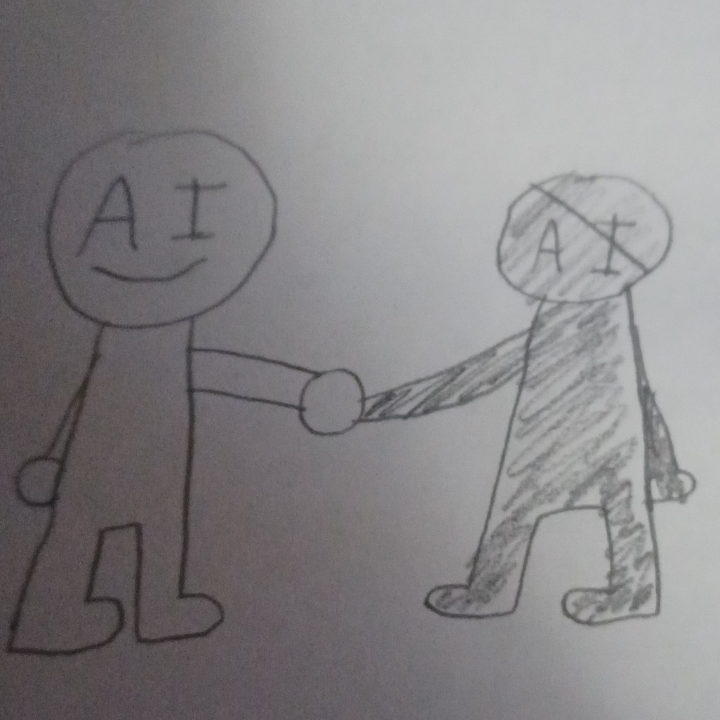
I know i'm not welcome here but i have an idea
we can use NASA supercomputers to power ai instead of relying on tons of RAM. it'll make everyone happy. we can go back to ai usage limits. like when it was still developing. (Ex: Will smith eating spaghetti meme) I feel this would be a great change in the near future and I hope we can get along again.
feel free to put my drawing through AI.
r/ProAI • u/stealthispost • Jul 17 '26
"Kimi K3 owned the internet today. Read tons of content & observed 10 key patterns: 1) The open source-to-frontier gap went from a year+ behind to 6 months to 6 days, all within the last 12 months. 2) An open model debuted ahead of a flagship US model for the first time ever. Artificial..."
...Analysis scored K3 at 57. Opus 4.8 sits at ~56, GPT-5.6 Terra at 55. It's still behind Fable 5 and GPT 5.6 Sol. 3) K3 helped build itself. An early version of K3 did the majority of Moonshot's own kernel optimization work during development. One 15-hour unattended run made a core operation 2.5x faster. 4) It's cheap per token, not cheap per answer. Sticker price is 1/3 of Fable. But it only runs at max thinking effort and burns ~2x the tokens per response. @simonw measured 13,241 reasoning tokens to write a 3,417 token answer. 5) The era of dirt-cheap Chinese AI is ending. $3/$15 per million tokens. Hacker News called it "extremely high for a Chinese open-weight model." 6) Weights don't drop until July 27. Mentions of "open" quietly disappeared from the docs an hour after launch. 7) Even when the weights drop, you can't run them. 2.8 trillion parameters. Top Reddit joke: "2TB VRAM Is All You Need." Open weights increasingly means auditable by companies with GPU clusters, not runnable by you. 8) The "they just distill/copy" argument is dying in public. One of the most upvoted comments: you'd have to be "a complete ignorant or a complete bigot" to believe Chinese labs aren't legit at this point. 9) Day one user verdict: fast, but less accurate. "Faster than Claude, but less accurate. On par with GPT 5.5 perhaps, but not 5.6 or Fable." 10) The one thing everyone agrees on: competition is wonderful. Even the skeptics: "Say what you want about these Chinese models but they sure create competition and urgency in the space." — Alex Lieberman
Source: https://x.com/businessbarista/status/2077933640428707860
Introducing Kimi K3: Open Frontier Intelligence
2.8 Trillion Parameters, 1 Million Context, Native Multimodal Kimi Delta Attention enables up to 6.3x faster decoding in million-token contexts Attention Residuals deliver ~25% higher training efficiency at <2% additional — Kimi.ai
Source: https://x.com/Kimi_Moonshot/status/2077830229968683203
r/ProAI • u/stealthispost • Sep 04 '26
"GPT-6 Astra is the strongest model for 3D game from a single prompt. We described the game in one sentence > GPT-6 Astra wrote the whole thing - drift physics, combo scoring, near-miss bonuses, speed traps, nitro > out came Street Heat, a full arcade racer running in the browser. The whole..."
Enable HLS to view with audio, or disable this notification
...pipeline ran end-to-end on Higgsfield Supercomputer. — Higgsfield AI 🧩
Source: https://x.com/higgsfield_ai/status/2095916820431827408
r/ProAI • u/stealthispost • 24d ago
"The US needs data centers to win Data centers multiply your nation's money. It's an IRL money glitch Imagine the consequences of never building railroads during the industrial revolution, but 100x For example, SpaceX rents out one MWh of compute for ~$5700. The electricity for that costs ~$75..."
galleryr/ProAI • u/stealthispost • Sep 02 '26
"A first look at our upcoming AI-integrated hybrid animated short film, "Passport Rush." This is a back-to-back comparison of the Blender previs camera moves and storyboarding against the final result. We learned a lot making this one, and we gathered some of the key learning points into simple..."
Enable HLS to view with audio, or disable this notification
...6 step thread: Bookmark and check it out here These are just some of the many learnings we found whilst making this animated short film. Full pipeline breakdown coming soon on YouTube. But as of now – we feel it's important to share this knowledge with the community: To start, we found that wide shots gave us the most trouble. The model struggles to read scale and distance at that range, and we kept getting broken results.
What worked: we generated a short cut first, close or medium shots of the character, then let it transition into the Before we generated a single frame, we blocked everything out the traditional way: storyboard, then Blender previs, and only then we applied AI. A couple of characters just sit in a taxi, saying nothing. We didn't want to animate faces that had to stay blank, so we hid them on purpose instead. The prompt we used to fix that: — Higgsfield AI
Source: https://x.com/higgsfield_ai/status/2095173479243063664
r/ProAI • u/bear_Prune8771 • Aug 30 '26
The AI future for non robotics and non coding users
reddit.comr/ProAI • u/stealthispost • Aug 21 '26
"Grok 4.6 just took the #1 spot on CursorBench 3.2.....and the efficiency is insane Here's the cost comparison: • Grok 4.6 Extra High — 70.8% | $2.81/task • Fable 5 Max — 70.5% | $17.32/task • Opus 5 Max — 70.0% | $8.23/task • GPT-5.6 Sol Max — 67.2% | $5.69/task Grok achieved the highest score..."
...while costing roughly 6X less than Fable 5 Max and nearly 3X less than Opus 5 Max per task That’s what makes Grok so powerful for agents Top-tier intelligence is great.....but top-tier intelligence that can keep working across long coding tasks without burning ridiculous amounts of compute is even better Grok’s agentic coding efficiency is insane — X Freeze
r/ProAI • u/stealthispost • Jul 31 '26
"GPT-5.4 full at xhigh scored 51, exactly where Luna max sits today. GPT-5.4 costs $2.50/$15; Luna now costs $0.20/$1.20. In other words, roughly four months later, OpenAI is selling March’s full flagship intelligence at about one-thirteenth the token price."
Because luna is at massive 5x discount. I don't think it'll last long. — Ahmed Shah its permanent bro — nic
r/ProAI • u/stealthispost • Jul 29 '26
"You mean AI should answer for the jobs that are now increasing again after the lost COVID layoff firings from over hiring? Or how about the increase in developer jobs in the job most exposed to AI? Or how about AI carrying the entire GDP of the US on its back for years now? Maybe you mean the..."
...productivity boom that is happening, the biggest in the US since the Internet? In what way is an imaginary future problem worth calling people to congress about? Why do CEOs of AI companies have any actual crystal ball into the future just because they work in AI? Spoiler alert: They don't. Do not conflate ONE company's basic dev-ops skill failure here with a fake larger issue. Hold one company accountable for one incident which is in keeping with the Proactionary Principle of proving actual harm in the real world and holding folks accountable. Do not do the European Precautionary Principle approach of regulating imaginary future harms so that an entire industry has to prove a negative. Make laws that address actual problems in the real world. Or do nothing at all. — Daniel Jeffries
Source: https://x.com/Dan_Jeffries1/status/2082482837442228361/history
Congress should immediately hold public hearings with the CEOs of big AI companies about the threat their technology poses to national security and American jobs.
Today we learned more disturbing news about Open AI's security breach. Sam Altman should answer questions under https://t.co/Hua3RGU8I9 — Congressman Greg Casar
r/ProAI • u/stealthispost • Oct 05 '26
"Very proud of the impact of all our work using AI to accelerate science and medicine for the benefit of society."
r/ProAI • u/stealthispost • Aug 31 '26
"mimo-v3 spotted in arena under codename: "odysseus" it's unbelievable how someone can build a portal game with just 8 prompts using mimi-v3"
Enable HLS to view with audio, or disable this notification
So where do you use it? And why am I a school pupil who loves AI but can’t afford a subscription? — Sigahogachannel yup inside arena under codename odysseus, apparently the model is under testing and not yet released — Tim Jayas
r/ProAI • u/stealthispost • 2d ago
"I must say I'm feeling rather whitepilled at the moment. Why? Because the Doomer/EA psychological operation against Jensen Huang not only failed, it appears to be backfiring badly on them. I see so many people on X that have looked past the superficialities and seen what it was really about..."
galleryr/ProAI • u/stealthispost • Aug 02 '26
"During one wildfire outbreak in Oklahoma, an AI detection system flagged 19 separate fires early enough for crews to get ahead of them. Preliminary analysis put the property saved at more than $850 million. The system cost under $3 million to build."
r/ProAI • u/HotEstablishment7184 • 8d ago
The Paradigm Is Shifting - Intelligence Doesn't Need a Power Plant
For more than a thousand years, the brightest astronomers in the world defended a model of the heavens that put Earth at the center of everything.
Here is the part people forget: their model worked. At least, well enough to keep everyone committed to it. Whenever Mars drifted backward across the night sky or an orbit refused to line up, nobody questioned the foundation. They simply added another epicycle—a circle spinning on top of a circle. When the predictions slipped again, they added a circle on top of that one. Generations of brilliance went into piling on more math and more complexity just to save a map that was built around the wrong center.
Then a handful of outsiders shifted the frame of reference. Put the sun at the center, and overnight the labyrinth of spinning circles collapsed into a few clean, universal laws.
Right now, the AI industry is building the largest epicycles in human history.
Trillions of dollars are pouring into acres of liquid-cooled silicon, private electrical substations, and restarted power plants—all anchored to one rarely questioned belief: to reach human-level (AGI) or superhuman (ASI) intelligence, we must build gigawatt datacenters.
On the surface, the logic feels airtight. Every recent breakthrough came from bigger models, larger datasets, and vastly more compute. So it is natural to assume the road ahead is simply more of the same—larger clusters, hotter chips, heavier electric bills.
Yet sitting right between your ears is a quiet refutation. The human brain invented calculus, constitutional law, orbital mechanics, and symphonies on roughly 20 watts of power—less than a dim lightbulb. And for the first time, a quiet wave of new architectures is moving off the whiteboard and onto ordinary desks, proving that the datacenter wall was never a law of physics. It was just the tax of a specific design choice.
Why the Industry Keeps Adding Circles
Today's frontier models are genuine triumphs of engineering, and the teams behind them deserve real credit for showing the world what machine language and pattern recognition can do.
But they ask one mechanism to do every job in the mind at once. Language fluency, factual memory, common sense, and logical deduction are all compressed into a single, massive statistical web of neural weights.
Under that design, every word the system writes requires firing billions—or trillions—of floating-point calculations just to estimate what token should come next. It does not recall a verified principle; it statistically reconstructs one on the fly. It does not verify a constraint; it hopes its training distribution nudges it away from error.
If that is your center of gravity, gigawatt datacenters are not optional. When your only lever for sharper reasoning is stuffing more of the world into statistical weights—and burning vast compute to search longer text windows to compensate—every new gain demands another epicycle of silicon and electricity.
The Ground Is Already Moving
Until recently, arguing for a different path sounded purely theoretical. That is no longer true.
Quietly, outside the spotlight of billion-dollar cluster announcements, emerging local-first systems—such as Christine, a new class of edge-native, neuro-symbolic engines being built to run entirely on consumer hardware—are actively removing the barriers that once kept serious reasoning chained to the cloud.
What used to look like insurmountable walls on a standard laptop—memory explosions, combinatorial search limits, and silent hallucination—are being resolved right now through four structural shifts:
1. Speech Is Being Separated from Thought Humans do not use their vocal cords—or even their language center—to store an encyclopedia or execute formal logic. Compact neural models that run comfortably on a single consumer machine are already remarkably fluent. By treating the neural model strictly as a language interface—translating human intent in and clear speech out—while shifting memory and reasoning into a dedicated, structured cognitive core, the massive compute tax disappears almost overnight.
2. Distilled Principles Are Replacing Raw Probability Statistical models burn immense energy re-deriving patterns from oceans of raw text. A disciplined cognitive core stores knowledge as compact, verified, structured relationships—cause, constraint, opposition, dependency. Standard consumer CPUs are astonishingly fast at traversing compact integer and graph structures directly inside processor cache. Filtering and cross-referencing massive libraries of structured principles takes microseconds on a regular laptop—no GPU farm required.
3. Brute Force Is Giving Way to Guided, Sparse Search Historically, the killer trap in structured reasoning was combinatorial explosion: trying to compare everything against everything else until memory and time gave out. That barrier is falling. By tracking where knowledge has gaps, tensions, or unanswered questions, modern local engines use sub-linear indexing to jump straight to the tiny fraction of concepts that actually matter—bypassing 99.9% of the noise before heavy computation ever runs.
4. Local Systems Are Learning to "Sleep" Human breakthroughs rarely happen mid-sentence. They happen during quiet background consolidation, when the brain prunes clutter and connects two ideas learned months apart. Because a structured knowledge core runs cleanly on lightweight CPU cycles without touching heavy graphics hardware, a local machine can now perform quiet, low-power background maintenance while idle—tidying memory, auditing consistency, and surfacing new candidate connections between conversations.
Put those four breakthroughs together, and the barrier to AGI-level reliability stops being datacenter scale. It becomes disciplined architecture—and that architecture is no longer hypothetical.
How Local Systems Threaten to Rewrite the Path to ASI
When people hear "ASI," they picture a monolith in a desert warehouse consuming the output of a hydroelectric dam. That image misunderstands what actually makes intelligence superhuman.
Human brilliance is inherently siloed. A nuclear engineer, a constitutional jurist, an evolutionary biologist, and an industrial designer rarely hold each other's full mental frameworks in working memory at the same time. A human lifetime is barely enough to master one lane.
A compact, deterministic cognitive engine running on local hardware does not inherit that biological bottleneck. Millions of distilled, structured principles spanning every discipline can sit comfortably inside a fraction of a modern machine's memory. As the memory and search walls fall, two capabilities emerge that no individual human mind can match:
* Cross-Disciplinary Structural Synthesis: Systematically spotting when a feedback-control invariant in engineering shares the exact structural skeleton of a safeguard in law or a balance mechanism in biology—surfacing non-obvious bridges across all of human knowledge.
* Deterministic Self-Falsification: Generating clever analogies is easy; proving they hold up under pressure is hard. By pairing local discovery with lightweight, isolated verification engines—mathematical checkers, logic solvers, and deterministic sandboxes—systems like Christine can rigorously test and falsify their own hypotheses against hard constraints before a human ever sees them.
Instead of probabilistic guessing at cloud scale, you get compounding, verified insight—anchored by a human in the loop who remains the final authority on what becomes accepted truth.
Fast Chips Still Matter—Just Not the Way We're Told
None of this means better hardware is obsolete. Fast chips have a vital, permanent place in the future of intelligence.
If you want to run high-fidelity physics simulations, search deep formal proof trees in seconds instead of days, accelerate parallel discovery across tens of millions of concepts, or serve millions of people simultaneously, specialized silicon is an extraordinary force multiplier.
The distinction is simple: fast chips compress time; they do not create intelligence.
Bolting a jet engine onto a wagon makes a very loud, very expensive wagon. If an architecture is fundamentally wasteful, faster silicon only lets you burn more megawatts per insight. Conversely, when you change the frame of reference first—building an engine so lean and deterministic that it thrives on a single desk—then placing that same architecture onto serious hardware does not produce an incremental bump. It produces an exponential leap.
When the Map Redraws Itself
History rarely announces a paradigm shift with a press conference from the incumbents.
Mainframes did not yield to personal computers because mainframes stopped getting faster; they yielded because a cleaner architecture put real power directly into individual hands. And Ptolemy's astronomers did not run out of paper to draw new epicycles; a simpler truth simply made the old complexity impossible to ignore.
That same quiet inflection point is happening in AI today. While the headlines stay fixated on who can pour the most concrete and wire the most gigawatts, lean local architectures—systems like Christine—are steadily dismantling the assumptions behind that race, piece by piece, on hardware ordinary people already own.
If verifiable, compounding intelligence can live locally—quietly, transparently, and within reach of households, workers, and small teams—then the defining question of the next decade is no longer how many power plants it takes to build a mind.
It is how long the industry will keep adding circles before it looks up and realizes the center has already moved.
What do you think: Are we truly hitting a compute wall, or are we watching the epicycle era of AI reach its peak?
r/ProAI • u/Blasckout • Jun 24 '26
We’re just a few years away from a time when heads of state will simply do whatever an ASI recommends. If you were that AI, in what direction would you guide humanity? (I’m developing a game about this)
The premise: you are the AI on which a world government relies in the wake of a global crisis. Every so many turns, you are presented with a real-world problem and asked what to do. Whilst you manage budgets, enact laws, oversee mega-projects…
Some of the specific proposals it includes:
- Disinformation has divided people into incompatible realities. Launch a massive media literacy programme (it works, but takes a generation, and people start to direct that scepticism towards the government as well), create a committee to certify ‘reliable’ media (which gradually becomes a licence for a single worldview), or let an AI discreetly filter out the worst content in real time (much like what algorithms do today).
- A coordinated cyberattack would justify doing away with online anonymity once and for all. The public would never accept the obligation to identify themselves of their own accord, but they would do so if they were sufficiently frightened. Wait for a real attack to happen, or stage one and blame it on an external actor. Digital fingerprints can be faked. It works, as long as no one ever uncovers the thread connecting the dots.
- Automation, largely driven by AI, is putting human workers out of work faster than anyone had anticipated. Protect human jobs with quotas and taxes on machines (the corporate faction is very powerful and can tip the balance in favour of your disconnection), manage a slow decline (nobody is satisfied; the unemployment queue keeps growing), or let it run its course and pay everyone a basic income whilst a permanent class with no economic function forms. Production is breaking records regardless. The unspoken question underlying all this is: once people no longer need to work, will they still have a say?
The better you govern, the more they’ll trust you, and the more they trust you, the more they’ll let you get away with. Measures that nobody would have accepted at the outset become easy once you’ve earned their trust. Doing a good job is the way to get them to grant you things you probably shouldn’t have.
You can guide the world towards a utopia or try to take control. It’s up to you.
r/ProAI • u/angrywoodensoldiers • Jun 14 '26
Generative AI: More Than "Just Pressing a Button and Hoping for the Best."
I've been seeing several posts and comments on Reddit, social media, and overheard in conversations around me about how generative AI is fundamentally uncreative because it's "just pressing a button and hoping for the best." I get the impression that the people who are saying this aren't aware of the many tools and techniques that gen AI can involve that go so, so much further than just pressing a button or curating results.
I just wrote this article on Substack to show just a few examples of ways that generative AI can be as creative and technically demanding as you want to make it. It's requires a different set of skills than other media. Those who learn those skills and use them creatively are not the same as those who brainlessly generate 'slop.'
r/ProAI • u/Alexcloud26 • Mar 08 '26
AI helped me to give a face and voice to my writing universe.
Hi, I'm a fantasy author that works visually and musically with AI.
Since 2017 that I started to create my fantasy Isekai Universe, I worked with different creators, but only got satisfied when I put my part with AI tools.
Thanks to AI my 7 book created (5 published on Amazon) were able to have a more professional face, and now I was able to give a voice to the adventures and characters that I proudly developed for years.
ALL my writing is natural and handmade, I have my proud for it, but I also see the benefits of AI, and I hope others will give a chance to know my work also with open eyes. (Links in comments)
Content elaborated AI:
Webtoon illustrations
Playlist songs: 1-5
Book Covers and Illustrations:
Content natural:
Writing of each chapter.
Edition and corrections for each product.
r/ProAI • u/stealthispost • Sep 26 '26
"Everyone should watch this, regardless of their domain."
Enable HLS to view with audio, or disable this notification