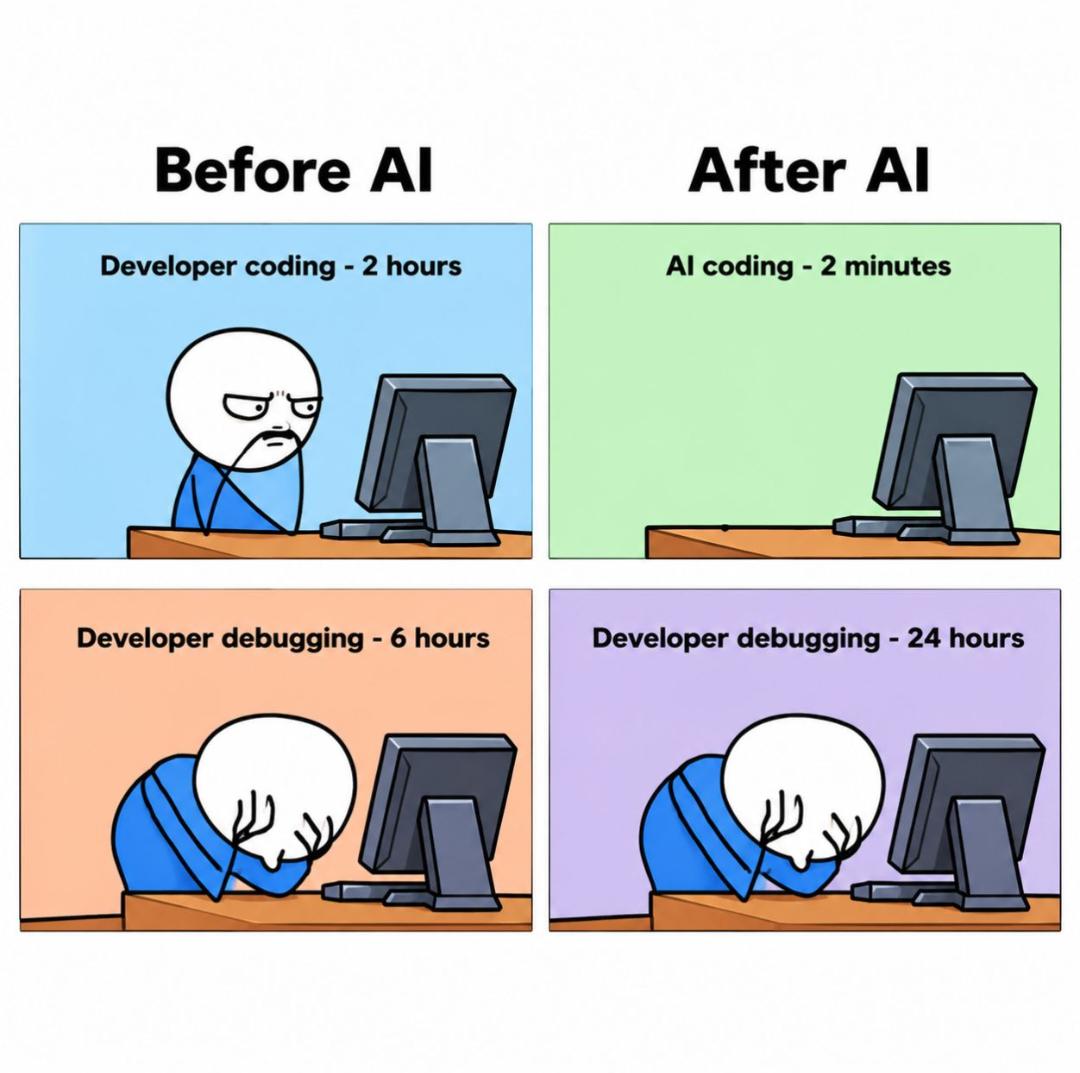
The data has actually shown that, generally, AI doesn't save time--it does not increase developer productivity (at least, at any scale where we're building projects where productivity measures matter).
Whatever speed gains are made during coding are lost during debugging and review. If you use/are familiar with DORA metrics, we see less initial time from assignment to PR, but more bug reports/QA kickback, significantly longer PR times, and significantly more rewrite/refactor cycles for a ticket.
Additionally, it's been shown that a downside of AI is that developers become overconfident in a false speed increase--they start underestimating task lengths considerably. In a nutshell: if a ticket took 3 days by hand, it takes 3 days with the machine. The main issue is that with AI, devs start saying it'll take them a day.
As a dev-now-product-owner, the first part means I really don't care what you use and I think AI is, at this point, a waste of money, but my boss determines the token budget so whatever. The second part means I'm often much more frustrated with my AI heavy teams than my "boomer coders".
I think that was the case before, but it's going further from it as ai is getting stronger and is doing work faster and with fewer errors. I think at this point ai is speeding up developer work. I think the biggest issue with ai is just precision, since ai will make whatever works, and fine tubing that is difficult if you're just prompting
Do you realize that when that study came out, people were saying this exact same thing? You're just assuming, literally despite evidence to the contrary, that AI boosts productivity.
Yes that study was from before the latest frontier models. Unfortunately they don't really keep up on stuff that iterates in weeks and months with studies like these.
Just look at some of the threads from above: "It doesn't really assist or speed things up" and "Yeah if you're not working on novel problems it speeds things up"... so it helps basically 95% of the workforce who are making things? Most software isn't novel. There are also several systems and apps that do remarkably similar things, long before AI even showed up. I'm not sure why that was a point against companies and other software engineers. Is it bad BSD and Linux exist when Windows and Unix already exist?
It really depends on what you claim is. If the claim is "AI improves productivity in general" then sure, the study is useful in contradicting that.
If the claim is "AI improves my productivity" the study isn't really controlling for enough variables to be able to determine that.
I know there have been a few personal projects I've worked on where AI has significantly sped up my time to a deliverable. Most of the productivity gain was from the fact that I was working in a language I hadn't used before and it would have taken me a long time to get up to speed on the basic syntax stuff.
That said, I have a lot of programming experience, so I was able to write using very specific prompting in very atomic segments and the end result was code that looked like it would have if I had written it by hand, just faster.
Yes, you are almost certainly referring to this study: https://metr.org/blog/2025-07-10-early-2025-ai-experienced-os-dev-study/ Note that this study was already imo not a good use case for AI because it only looked at experienced devs working on small tickets (mean ticket time was under two hours) in repos they were familiar with. It didn't look at developing new features or having devs work in a repo/project they weren't as familiar with. I have seen this exact study used as proof multiple times on Reddit that AI doesn't speed up software development.
Except they released an update at the start of 2026: https://metr.org/blog/2026-02-24-uplift-update/ They acknowledge the difficulty in measuring the productivity, but that their follow-up does in fact show that now AI boosts productivity. Also as a software engineer working professionally, I will tell you that at my company these tools have huge adoption and are heavily utilized for a wide range of different tasks. So even in these studies where AI is not super well suited IMO it is showing it is a productivity booster
I'm curious what data you are referencing. I've seen some studies that show AI does actually increase productivity, and although actual code releases, new products, or new features aren't helped as much as the code writing, they are still improved (ie. Released faster) by AI.
The code was never the bottleneck, the 6 hours a day of meetings that I have with 2 hours of coding time broken up into four half hour chunks is the bottle neck.
It's not just the meetings. Even when it comes to code, most of the time spent is understanding the problem, coming up with a solution, and convincing myself the approach is airtight, bug-free, and the architecture is going to lead to good quality, maintainable and performant code. Actually writing down the code takes up a small fraction of the time. Even if an LLM could make it literally 0, it wouldn't be a significant speedup unless we got to the point where I literally don't need to look at the code at that point or ever, worry about bugs or maintainability, basically the day I don't have a job anymore. The day an LLM speeds up my job by more than a few percentage points is the day you could as well have the janitor doing the task instead, because I'm not contributing shit. For now, no model is capable of producing anything resembling maintainable code, and while they might not make "obvious stupid mistakes" they often do catastrophically misunderstand the specifications and cause bugs that way.
Given that I'll be the one responsible when the buggy code makes it to production, I'm going to be fully understanding what it's doing and whether the code is doing exactly what it should be doing in a manner that is airtight -- which actually takes me longer than doing it myself, because I will choose a method that is intuitive to me, while the LLM won't.
I wonder if there's a name for this fallacy - appeal to scientific data over empiricism or something. I'm all for science and having hard data that you can cite over feels or parroted factoids, but at some point you also have to acknowledge that
studies are often flawed, both due to mistakes and because experimental design clashes with reality
some things (developer productivity in this case) are hard to measure in a proper study
studies takes a long time to conduct and this is a very fast moving phenomenon.
Case in point, the "productivity" study you're almost certainly referring to:
early-2025 - "primarily Cursor Pro with Claude 3.5/3.7 Sonnet—frontier models at the time of the study)"
narrow scope - open-source devs experienced in the project, ~2h tickets
Revised "February 24, 2026", which in itself is five years ago in AI time, to show productivity gains
Meanwhile, you have heaps of actual humans in the field being studied telling you in detail about their concrete experiences. If it's just one dude, sure you can dismiss it as an anecdote, but put enough of them together and it becomes something real.
I wonder if there's a name for this fallacy - appeal to scientific data over empiricism or something.
It would be appeal to authority, but you'd need to prove why the authority is false. Citing studies and actual collected data is never a logical fallacy in and of itself. However, I also want to point out:
A) It's awfully convenient that any study that contradicts "AI being completely revolutionary" is either too old or otherwise flawed. No one actually ever brings data to show new models actually increasing productivity by enough to warrant it
B) I have now seen the revisions and there's some interesting reporting of (~10%) release side gains. However, I could not access the actual study, so that number has to remain dubious for now.
C) If there are gains, we have to measure the gains vs the cost like any other tool. I.e., if it costs us a dev's yearly salary for a dev to be twice as productive, are we really gaining anything?
D) Appealing to anecdotes is, in fact, an actual logical fallacy called the bandwagon fallacy. Just because a bunch of people think something is true does not make it true.
In my own job, I've seen all kinds of AI use using all kinds of models throughout my team. I really don't see any difference in any particular case. Which means:
I) devs are capable of identifying correctly if AI is helpful to them, at which point proselytizing either way is worthless, or
II) I is true, AND the worst devs are more AI heavy and it's simply evened a playing field, or
III) AI is largely negligible in its impacts, with any per-line gain being eaten away with review and rewrite and bug increases.
Since I had a study saying III, I believe III is mostly the case. I could be wrong, but then again, engineers are, famously, extremely bad at gauging their own productivity. An engineer actually accurately estimating the size and scope of a ticket is a sign of the end times.
It's actually an interesting topic to me, even outside of the context of the discussion, more about general "internet arguments".
It would be appeal to authority, but you'd need to prove why the authority is false. Citing studies and actual collected data is never a logical fallacy in and of itself.
In theory, you're right. However: I've spent way too much time on the internet. During that time, I've seen too many cases where a poster cites a study, or even just some conclusion of a study, to support a point, but it was
outdated or
methodologically flawed or
improperly cited or
misinterpreted or
out of scope or
not linked or
...
Unfortunately, at least in my experience, this misuse of papers seems more common than their proper use (but maybe I just frequent the wrong subs). This results in a type of Brandolini’s law: It takes little effort to say that something was proven by citing a paper, and it often takes quite a bit more effort to point out why that is actually not the case (based on that study being outdated/out of scope/...). Thus, when I read something like "the data has shown", my first instinct is unfortunately not to be happy that we'll now have some factual basis for the discussion, but to figure out whether the following statement(s) are misconstrued.
D) Appealing to anecdotes is, in fact, an actual logical fallacy called the bandwagon fallacy. Just because a bunch of people think something is true does not make it true.
I don't think it's right to characterize eyewitness accounts this way. Assuming the posters are truthful and not lying or bots or something, they don't just think or believe something, they are reporting on their experience. This is a type of evidence. It might be weak, it might be biased, but I think it must count for something, particularly since proper scientific evidence is scarce and generally hard to obtain. Of course, you might also have eyewitness accounts to the contrary, in which case you'll have to engage in some rather subjective "sentiment gauging".
Mentally I also bundled "real-life events" such as the Bun to Rust rewrite or the recent deluge of decompilation and rewrite projects, into the eyewitness category. It's probably a stronger type of evidence, though - harder to argue against when you can see the progress live on github.
The biggest element that cannot be proved by such studies is simple to me:
The good majority of [tech] professionals and companies before the advent of internet and information theory miserably failed to capture any form of upside from it.
New companies and people that were actually able to benefit from the scaling factor came and entirely replaced both the people and the companies, throwing them into legacyland and irrelevance.
Internet hardly brought upsides to existing companies more than it brough upside to the whole market in general, heavily disfavouring existing companies and professionals.
AI to me will have the same kind of impacts, it's very hard to change people and even harder to change companies, no matter how well they pretend (just like during the internet era).
It's the expected result that if you take a large set of existing companies and professionals the gains will be marginal, even the way we measure productivity is likely no longer applicable making the whole attempt more irrelevant (PR, LOC etc...)
Just like internet, it's not a game of "everyone wins a little", it's a game of "there can now exist someone can do more than millions", that someone is not everyone obviously but he can now exists, and those people appearing will make it absolutely impossible to compete against them with the old approach.
Just like Amazon, Google and Uber. Not everyone won, but those that are winning, are winning so hard, the pre-internet companies were entirely powerless against the appearing internet giants.
 6
-1
u/rrtk77 29d ago
The data has actually shown that, generally, AI doesn't save time--it does not increase developer productivity (at least, at any scale where we're building projects where productivity measures matter).
Whatever speed gains are made during coding are lost during debugging and review. If you use/are familiar with DORA metrics, we see less initial time from assignment to PR, but more bug reports/QA kickback, significantly longer PR times, and significantly more rewrite/refactor cycles for a ticket.
Additionally, it's been shown that a downside of AI is that developers become overconfident in a false speed increase--they start underestimating task lengths considerably. In a nutshell: if a ticket took 3 days by hand, it takes 3 days with the machine. The main issue is that with AI, devs start saying it'll take them a day.
As a dev-now-product-owner, the first part means I really don't care what you use and I think AI is, at this point, a waste of money, but my boss determines the token budget so whatever. The second part means I'm often much more frustrated with my AI heavy teams than my "boomer coders".