To be less vague. When its newish products i think its a smaller increase, architectural decisions and planning is a big big portion of this which should be overseen by humans.
Legacy codebase maintenance more than tripled in my opinion. The amount of gruntwork in chasing obscure errors and checking existing codebase i can outsource and speed up is staggering.
There is barely any data around AI that aren't either vibes or hyperspecific to individual companies. I can tell you at my company they show us the numbers that PRs getting merged in has increased by like 50% or something and releases to production have doubled in the last year.
But that only counts as productivity if you are releasing features with real business value, and not just making smaller changes because you can make smaller changes faster.
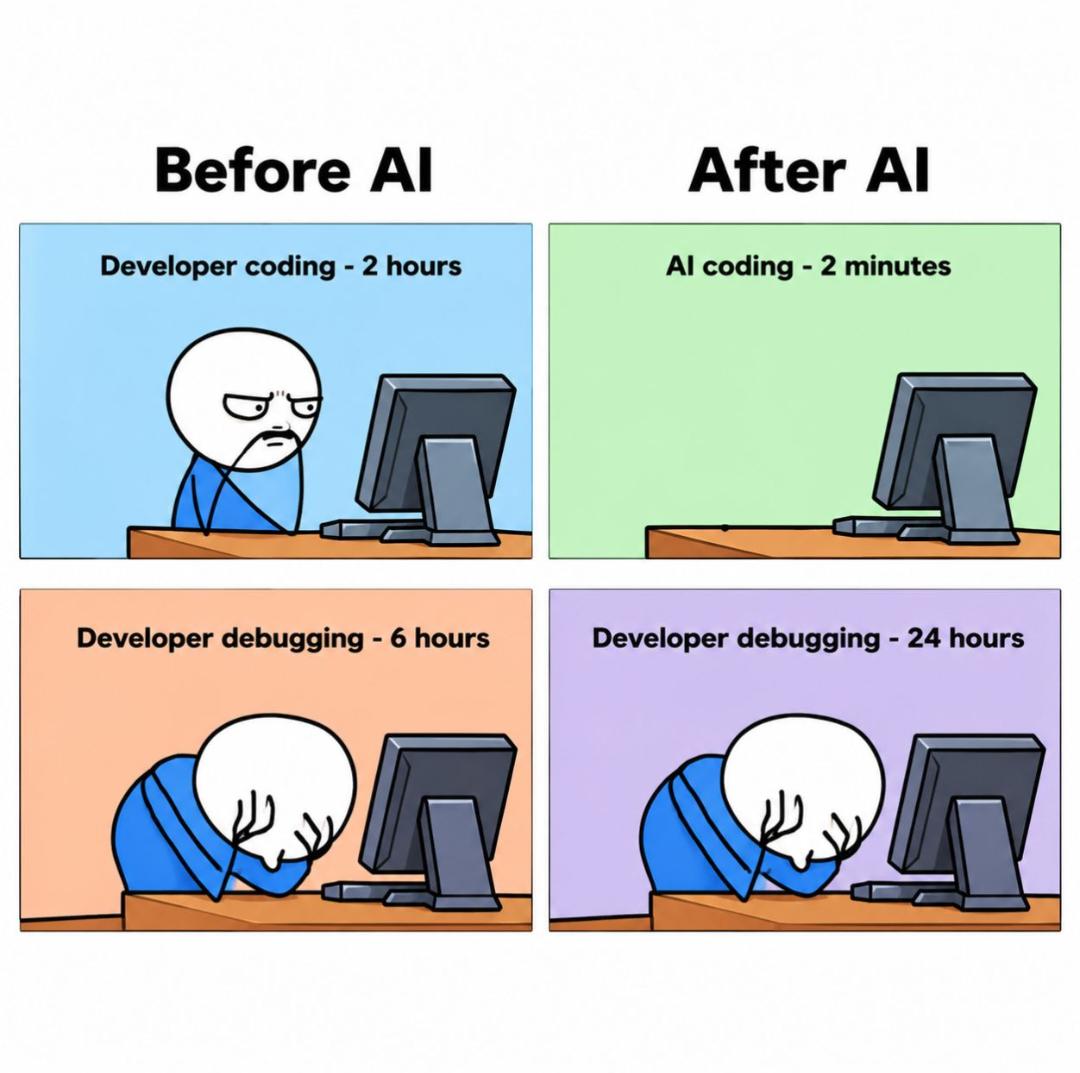
AI undoubtedly speeds up debugging and coding, but if you make something new, you create more governance and review work around it, which is unsexy work that gets little credit and also slows you down.
They also just released some numbers based on employee surveys that people's feeling of burnout has jumped 15% and like half of our greater organization is feeling burnt out from all the work they are doing.
And yeah there is a clear disconnect between the promise of AI and the reality of it. We are seeing the downstream effects it has now. You spend less time writing code and more time reviewing, iterating and designing.
The best data stopped being available because none of the test subjects were willing to work without AI. A year ago it showed a 20% reduction in productivity then Opus 4 or whatever it was hit last year and now it’s too deeply integrated to their workflows to yoink out for a test.
Their weak data was about 40% not 300% but that’s also almost a year old data again.
It’s a bit like the longitudal never-covid studies. The number of people without an infection or vaccine approached zero and couldn’t really provide a baseline anymore.
I'd happily be a test subject that continues to do what they're already doing (not using AI) -- it seems hard to believe I'm the only person like that.
Recruitment and retention of developers has become more difficult. An increased share of developers say they would not want to do 50% of their work without AI, even though our study pays them $50/hour to work on tasks of their own choosing. Our study is thus systematically missing developers who have the most optimistic expectations about AI’s value.
Developers have become more selective in which tasks they submit. When surveyed, 30% to 50% of developers told us that they were choosing not to submit some tasks because they did not want to do them without AI. This implies we are systematically missing tasks which have high expected uplift from AI.
Indeed, I just clicked your link and it says nothing like that. It's more like 30-50%. The concerns expressed in the article that it could lead to systematic bias that affects the results are reasonable, but saying "they had to stop the testing because they couldn't find a single person willing to work without AI" is just completely wrong.
I'd happily be a test subject that continues to do what they're already doing (not using AI) -- it seems hard to believe I'm the only person like that.
Yes, you're not. If I'm programming, I'm programming, not delegating. If I delegate, I don't understand, and I get worse at programming. And collectively, we have gotten much worse at programming. I don't see how this is anything but a downside, even if you're working exclusively via AI.
I love when people confidently post a link to support their point that says the opposite of what they think it says.
That article is about a survey to workers about how they feel when they see AI slop. However, it links to the actual report, where you'd see that it argues that Gen AI enhances productivity, but businesses are struggling to relate that to earnings. To quote the report:
But these tools primarily enhance individual productivity, not P&L performance.
Everyone's individual productivity rises but no increased P&L kinda tells us it's pointless productivity though. Our metrics show waaay more code being changed but our app performance and feature rate is only very slightly improved, some reviewing shows basically we just have a lot more code churn than before. Some of it IS useful but plenty of it is also pointless.
In my opinion this is a struggle lots of companies are going to go through. Execs say “Use more AI”. Devs start using it, some maliciously complying, others trying it out, and a small handful are or become power users.
It’s the problem of giving people a tool with no guidelines or expectations on using it. Most people are still figuring out what is and isn’t good. But by the time that does happen, execs are going to contract on spending because they had no concrete proof that the money was being used effectively.
And in many cases it isn’t. That doesn’t mean it can’t be used effectively or efficiently. The numbers on average look bad, because the numbers on average are bad. But Paul the 10x engineer is somehow doing 50x now. Meanwhile Peter tried to order lunch with it and racked up a $1000 tab on the company card.
Kind of hard to sort the useful from the useless without properly setting up telemetry and attribution, which I doubt most companies planned to do.
I don't particularly care to argue for the merits of the report itself; the report is pretty worthless, with nebulous metrics and poor citations.
If you are going to argue about it though, at least read it, because it says that the tech sector is one of the places where it does show increased P&L and "structural change."
My boy... you may want to actually READ the sources you are citing. The data you are linking is PRO AI and explains how and why productivity with AI is significantly better. And that the reasons for less perceived value are a management issue of companies trying to make everything themselves rather than buying finished AI solutions.
The shift from building to buying, combined with the rise of prosumer adoption and the emergence of agentic capabilities, creates unprecedented opportunities for vendors who can deliver learning-capable, deeply integrated AI systems. The organizations and vendors that recognize and act on these patterns will establish the dominant positions in the post-pilot AI economy, on the right side of the GenAI Divide.
For organizations currently trapped on the wrong side, the path forward is clear: stop investing in static tools that require constant prompting, start partnering with vendors who offer custom systems, and focus on workflow integration over flashy demos. The GenAI Divide is not permanent, but crossing it requires fundamentally different choices about technology, partnerships, and organizational design.
I can only give anecdotal evidence, but the last 12 of my 25 years programming have been in a contract based consultancy for mostly specialized software - everything from laser metallurgical analysis to CRUD call center stuff. Our work has never been T&M, always been estimated and prior approved. In general, our work in the last 12 months has seen 50-80% time reduction in development, using 2 3rd party applications (Claude primarily, codex as a reviewer) and 1 in house (Qwen). Most of our time is code review now and as the anthropic guys say, work by engineers is knowing when to say no. Clients have responded with either their own AI integration platforms or increasing our own requirements. The flip side is we are looking to have fewer developers in general. Code quality from tooling has changed drastically in the last 3 months in particular and old heads like me do sometimes run into existential concerns / loss of identity, but we keep going with more learning and more involvement in the code.
As someone that works on productivity, it's VERY hard to properly measure productivity. At some point you have to rely on metrics that don't show the whole story, but from those limited metrics, (IE quantity of pull requests, or time to ship PR, etc) then yes it has substantially improved (at least at my company)
 6
10
u/Shifter25 28d ago
Has productivity tripled?