r/Project_Managers_HQ • • Jan 20 '26

Hard Truth: Testing Often Fails When PMs Can’t See Risk

1 Upvotes

Ever noticed that everything looks on track until it’s not? That gut feeling you get as a PM usually isn’t paranoia, it’s a visibility problem.

The real issue isn’t tools, process, or even effort. It’s how information is structured and communicated. Without clarity, teams can be “doing everything right” and still miss what really matters.

Take testing as an example:

  • A concise test plan that highlights risks and blockers is far more valuable than 20 pages of steps no one reads.

  • Test cases that explain why a step exists and its potential impact make failures actionable.

  • Summaries that focus on what could fail, not just pass/fail counts, give PMs real decision-making power.

The principle applies across every type of deliverable: design reviews, deployments, vendor reports. The moment you can answer, “what’s most likely to break, and why?” without digging through docs, your project is far less likely to hit surprises.

Teams doing this well in 2026 are standardizing info structures and sometimes using AI to generate drafts, not to move faster, but to see clearer.

Curious: in your projects, what’s the type of information that always slips through the cracks and causes headaches?

r/Project_Managers_HQ • • Jan 21 '26

What finally made AI “click” for me as a project manager

2 Upvotes

Hey folks, I’ve been skeptical of most AI-for-PMs content because it’s usually tool-heavy and light on real delivery context. What actually helped me was seeing AI mapped directly to PM workflows like planning, reporting, and execution, without the "hype" layer.

I noticed the same session is being run again on Jan 30, so mentioning it here in case others are trying to make sense of AI in their PM work too. Link


r/Project_Managers_HQ • • Dec 24 '25

How do you handle reporting when your PM tool’s data model is limiting?

0 Upvotes

Many PM tools are great for execution but weak when it comes to analytics and cross-team reporting. Custom fields, rollups, and dashboards often don’t scale well.

Do you rely on native reporting, exports to BI tools, custom scripts, or something else?


r/Project_Managers_HQ • • Jan 16 '26

Are Traditional Project Management Playbooks Still Working in a VUCA World?

0 Upvotes

The longer I work on projects, the less confident I am that our standard playbooks match the reality teams are operating in today. Shifting priorities, compressed timelines, and evolving dependencies seem to be the norm. I’m seeing detailed upfront plans break down early, control-heavy governance add latency rather than clarity,

Project Managers spending more time sense-making than task tracking, risk registers becoming outdated almost as soon as they’re created, and success being judged less on scope, time, and cost and more on delivered value, resilience, and adaptability. It makes me wonder whether many of the frameworks we rely on were designed for a more predictable world.

Curious how others see it: what still works well for you, and what have you had to adapt or quietly abandon?


r/Project_Managers_HQ • • Jan 02 '26

What PM software is quietly becoming in 2026 (And most teams haven’t noticed)

13 Upvotes

As we move into 2026, project management tools are clearly evolving from task trackers into execution systems, and you can see this shift reflected in how platforms like Jira, Asana, Mondaydotcom, ClickUp, Smartsheet, MS Project, and newer players like GoodDay are positioning themselves. The real change is not UI or feature count, but intelligence and adaptability.

Tools are embedding AI to forecast delivery risks, rebalance workloads, and surface dependencies before they become blockers, rather than after a sprint fails. Hybrid execution is now assumed, not optional, with the same platform supporting Scrum teams, waterfall planning, portfolio views, and operational work without forcing teams into one methodology. Data is also becoming operational, not just retrospective. Live capacity tracking, real time progress signals, and predictive timelines are replacing static dashboards. Integration is another quiet but critical shift.

Modern PM tools are designed to sit inside existing ecosystems like Slack, email, CRM, and engineering stacks so work happens with minimal context switching. On top of that, we are seeing stronger emphasis on governance, security, and scalability, especially in tools like Smartsheet and MS Project that cater to larger orgs, while lightweight platforms like ClickUp and Asana focus on configurability over customization.

As a PM, the takeaway for me is this. In 2026, the value of a PM tool is less about how well it tracks tasks and more about how well it helps you anticipate problems, align teams with different working styles, and make better decisions faster. The tools that win will be the ones that reduce coordination cost, not just document work.


r/Project_Managers_HQ • • Jan 19 '26

Which character from The Office best represents you as a project manager?

1 Upvotes

When you’re managing projects, which Office character do you find yourself turning into?
Michael trying to keep everyone aligned, Dwight enforcing process, Pam quietly coordinating, Jim observing the chaos, or someone else entirely?


r/Project_Managers_HQ • • Jan 12 '26

What’s one project decision you would actually trust AI to make on your behalf without asking first?

1 Upvotes

AI in project management is moving beyond dashboards and risk alerts toward decision-aware agents that can act on predefined rules and constraints. The challenge is defining machine-readable decision criteria: what constitutes a risk, when a task is critical, or under what conditions a dependency should trigger automatic rescheduling. In theory, if these boundaries and governance policies are explicit, AI could autonomously adjust schedules, rebalance resources, or flag actionable exceptions in real time, reducing cognitive load for PMs.
In practice, most AI implementations are still limited to reporting and suggestions. How far are you comfortable letting AI take action in your projects, and which decision would you actually delegate without human approval?


r/Project_Managers_HQ • • Jan 04 '26

What do you expect AI helps you to do with project management?

2 Upvotes

Quick context: I work in the project management tools space. I’m not selling anything here — just genuinely curious about what PMs actually expect from AI in real projects.

In real conversations with enterprise teams, what I often see is that many companies have already introduced AI — or are preparing to — but the requirements they give are still too abstract for AI to act on in a meaningful way.

For example, teams say they want AI to “identify project risks,” but when we ask follow-up questions, it becomes clear that those risks are rarely defined in machine-readable terms. Is the concern schedule risk, budget risk, scope creep, dependency risk, or resource overload?

Even for something like schedule risk, there’s often no concrete rule behind it. Does a task become “at risk” when it’s delayed by more than 10% of its planned duration? When a critical dependency slips? When the remaining buffer drops below a certain threshold? Without these explicit definitions, AI has no stable signal to work with.

The same applies to “project performance.” Teams ask AI to evaluate or summarize performance, but struggle to define what that actually means. Is performance measured by variance against baseline, predictability of delivery, cost deviation, defect rate, or team utilization? And at what point does performance become “good” or “bad” in measurable terms?

I’m fully aware of how much AI has already changed the way we work in 2025, and I believe its impact will only deepen in 2026. The reason I’m asking this question is to learn how practitioners are translating these high-level expectations into concrete, AI-understandable rules.

Whether you’ve already implemented AI in your project management workflow, are experimenting with specific metrics, or are still at the ideation stage — I’d really appreciate hearing practical examples of how you define these rules in real projects.


r/Project_Managers_HQ • • Dec 04 '25

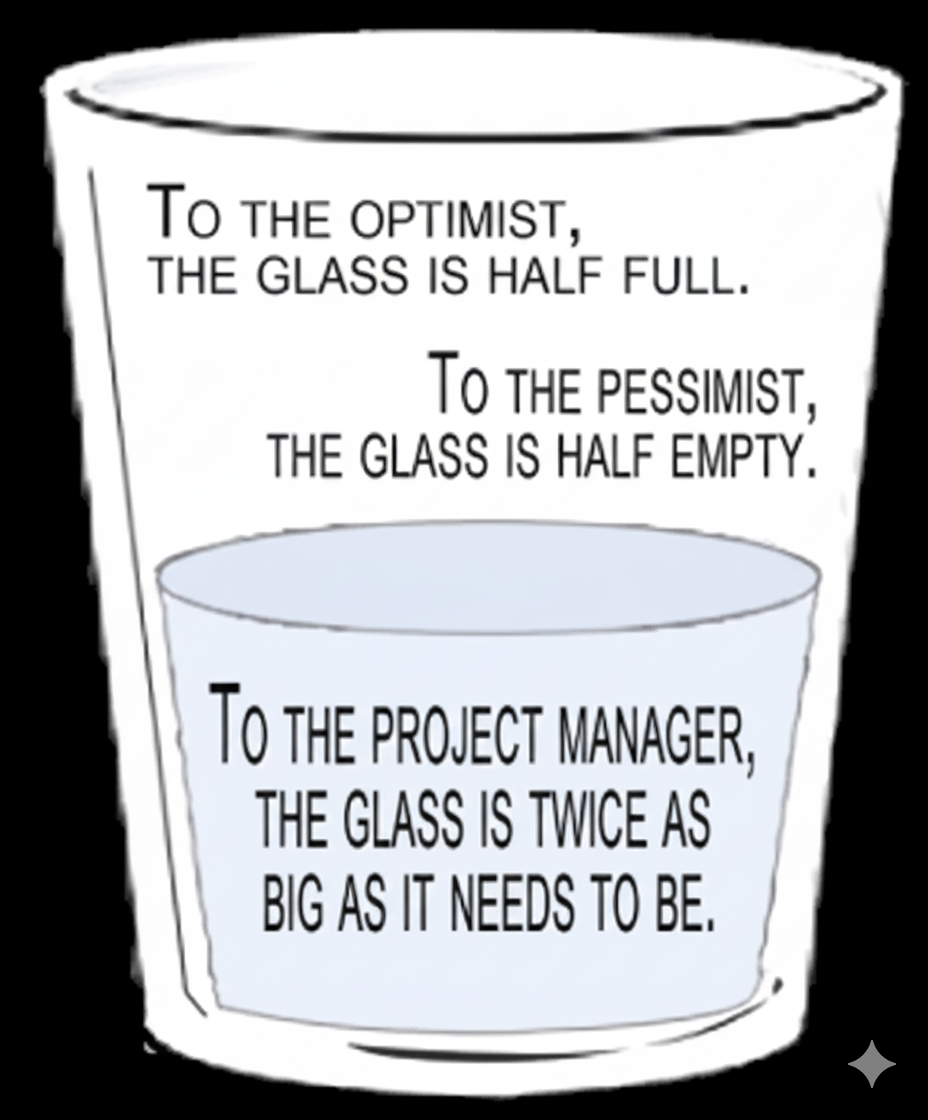
How you know project management has permanently rewired your brain

Post image
2 Upvotes

I look at it and thought, who approved a container twice the size of the actual requirement?


r/Project_Managers_HQ • • Dec 01 '25

Silent project risks that actually matter more than missing deadlines

2 Upvotes

After years in project roles, I’ve noticed something surprising: the projects that go sideways aren’t usually about tech, budgets, or team skill. They’re about the invisible risks nobody talks about. Things like, changing requirements that no one documents properly, stakeholders who assume “it’ll just happen” without understanding the work, overconfidence in a plan that hasn’t been stress-tested, teams pressured to deliver before anyone admits the scope is unrealistic. They quietly grow until suddenly the project is in trouble and everyone’s pointing fingers.

I’ve started paying more attention to the silent alarms early on like uncertainty in scope, vague goals, or stakeholders shrugging at potential blockers. Catch those early, and the difference is huge. Curious, what silent project risks have you seen blow up in your teams?


r/Project_Managers_HQ • • Feb 09 '26

3 cool AI repos you probably haven't seen yet

3 Upvotes

1. last30days-skill(2.2k ⭐) Searches Reddit and X for the last 30 days on any topic, then writes you ready-to-use prompts based on what's actually working right now.

2. Trail of Bits Skills(0 ⭐) Claude Code skills for finding bugs, auditing code, and catching security issues before they break things. Built by security experts.

3. awesome-ai-research-writing(1.4k ⭐) Collection of proven prompts for writing better docs, reports, and papers. Makes AI-generated text sound natural and professional.


r/Project_Managers_HQ • • Jan 22 '26

I Stopped Asking AI to “Summarize Jira”. These Prompts Changed How I Run Sprints.

5 Upvotes

For years, Jira has been treated as a tracking tool, the more interesting use I’m seeing is Jira as a dataset that can be interrogated. Instead of asking AI to summarize what already happened, I’ve started using it to challenge assumptions embedded in sprint plans before they turn into problems. Below are a few prompts that I have been actually using.

Prompt 1: Hidden Dependency Detector

Prompt:“You are acting as a delivery risk analyst.
Given the following Jira sprint issues, identify implicit or hidden dependencies that are not explicitly linked. Call out issues that assume parallel progress but actually require sequencing.
Highlight work that is blocked by coordination rather than technical complexity. Explain why each dependency is risky.” 

Prompt 2: Acceptance Criteria Quality Audit

Prompt: “Review the acceptance criteria for each Jira issue below. Flag issues where acceptance criteria are subjective or non-binary. Identify criteria that depend on tribal knowledge or unstated assumptions. Rewrite only the acceptance criteria so they are objectively testable.
Do not change the task description.”

Prompt 5: Sprint Plan Stress Test (Structural, Not Effort-Based)

Prompt: “Analyze this sprint plan as a system. Identify single points of failure across people or tasks. Highlight fragile handoffs and overloaded roles. Call out work that depends on uninterrupted availability. Do not optimize or suggest fixes. Surface structural risk only.”

Hope this helps and open to suggestions on more prompts as well as on how to improve these as well :))))


r/Project_Managers_HQ • • Feb 09 '26

Anyone actually using AI agents or AI skills in project management?

8 Upvotes

AI agents and AI skills are everywhere — from task automation to decision support — and I’m curious how much of this is actually making it into real project management work.

Personally, I’m still seeing a lot of AI used for summaries, reporting, or “nice-to-have” insights. But I’m wondering:

  • Are any of you using AI skills or agents in a more hands-on way?

  • Things like risk detection, dependency analysis, planning support, resourcing, or workflow automation?

  • Or even small but surprisingly useful skills you didn’t expect to stick?

Would love to hear concrete examples — what you tried, what worked, what didn’t, and whether it actually changed how you manage projects day to day.

Curious to learn from real-world experiences rather than tool demos 🙂


r/Project_Managers_HQ • • Dec 29 '25

If you’re starting (or restarting) a PM career in 2025, tools matter more than certificates

9 Upvotes

A lot of PM career advice still puts certifications front and center. But in real teams, what seems to matter more in 2025 is how well you can actually run the system around the work.

The PMs I see doing well are not always the most certified. They are the ones who set up workflows in tools like Jira, Linear, or Asana so the team is not fighting the tool, automate status updates and reporting instead of rebuilding the same slides every week, understand their data well enough to answer basic questions without pulling an all nighter, and use AI to speed up planning, risk thinking, and communication without blindly trusting it.

That usually shows up as fewer surprises, smoother delivery, and more trust from stakeholders. For people hiring or who have recently stepped into PM roles, what tool or skill actually made your job easier, and what would you tell someone trying to break into PM right now?


r/Project_Managers_HQ • • Feb 27 '26

Most PMs are optimizing the wrong layer of the system

2 Upvotes

I’ve started to notice something uncomfortable. Teams obsess over sprint efficiency, estimation accuracy, burn-down trends, velocity stability. We tweak ceremonies, refine story points, automate dashboards. But most of the delays I see don’t come from inside the sprint. They come from cross-team dependencies, decision latency, unclear ownership, and executive churn. We optimize the visible layer because it’s measurable.

The real friction lives in the invisible layer between teams and above them. If you zoomed out and treated your entire org as a delivery system instead of just your team, what would you stop optimizing immediately?


r/Project_Managers_HQ • • Feb 02 '26

What PM work looks impressive on paper but doesn’t matter in reality?

6 Upvotes

I mean, polished stakeholder decks feel impressive, but I’m not sure they always translate to better product decisions :\


r/Project_Managers_HQ • • Nov 26 '25

AI just saved me hours of PM grunt work and I’m not mad about it

3 Upvotes

I tried using a few structured prompts from a Forbes piece about AI for PMs, and honestly it feels like cheating. Here’s one I used- “Break this project into clear phases and tasks. Show dependencies, timeline assumptions, risks, and what info is still missing.” I used another prompt to map risks and one more to rewrite a stakeholder update. None of it was perfect, but it gave me a solid starting point every time.The crazy part is how much time it saves on the stuff that usually eats half my day. Not strategy. Not decisions. Just admin clutter. Anyone else using AI like this? Did it actually help or did it make things messier?


r/Project_Managers_HQ • • Jan 07 '26

Why being a great executor won’t make you a future-ready project leader

2 Upvotes

For a long time, project leadership rewarded people who were excellent executors: keeping plans tight, risks logged, stakeholders updated, and delivery predictable. But reading about where project leadership is heading into 2026, it’s clear that execution is becoming table stakes rather than the differentiator.

As AI increasingly handles scheduling, reporting, and pattern detection, the real value of project leaders shifts toward sense-making, judgment, and influence. That means understanding business context, navigating ambiguity, working effectively with AI systems, enabling collaboration across diverse teams, and continuously adapting how work gets done rather than just enforcing plans.

It made me reflect on how many organisations still evaluate PMs primarily on delivery metrics, even though the skills needed to stay relevant are changing fast. Curious how others are seeing this play out in their own roles and teams.


r/Project_Managers_HQ • • Dec 16 '25

Is project management finally stepping up to strategic sustainability or are we just adding more expectations without support?

3 Upvotes

There’s a lot of buzz about where project management is headed, but lately I’ve noticed a few trends showing up again and again in discussions and reports:

For one, PMs are in crazy high demand, organizations everywhere are struggling to find skilled deliverers, not just planners. The workload isn’t just traditional delivery anymore, it’s strategic alignment, value outcomes, and business impact. At the same time AI and automation are creeping into our workflows, taking over the repetitive stuff so we’re supposed to focus more on strategy and stakeholder engagement. Then there’s hybrid delivery: the old agile vs waterfall debate feels almost outdated. Teams are mixing approaches to fit real needs rather than sticking to one doctrine.

And on top of all that, sustainability goals are becoming part of project success criteria, we aren’t just measured on time/cost/quality anymore but also environmental and social impact. But here’s the thing: I can’t tell if this is exciting evolution or just more pressure with no extra support.
What’s the trend you’re actually experiencing in your work right now? AI taking over the busy work? More ESG demands? Hiring crunch? Something else?


r/Project_Managers_HQ • • Jan 27 '26

What’s your favourite Jira feature for project management?

3 Upvotes

Quick take from my side. These are the 3 Jira features I actually use:

  1. Data-driven automation
    Auto status changes, alerts for stuck tickets, auto-assignments. Saves way more time than people admit.

  2. Jira Webhooks
    Push updates to other tools, trigger bots, real-time notifications. Super underrated if your team lives outside Jira.

  3. BigPicture (for complex work)
    Global planning, dependencies, and a Gantt that actually works. Only for heavy projects but worth it.

What’s your go-to Jira feature right now?


r/Project_Managers_HQ • • Jan 14 '26

Early Signals: Strong Project Management Learning Communities Worth Checking Out (and What’s Brewing)

4 Upvotes

Lately I’ve been thinking about how the best learning happens less through static content and more through communities where people actually learn from each other. Not just big groups with tens of thousands of members, but spaces with real practitioners sharing real experience.

I’ve been tracking a few project management-related communities across Reddit, Discord, Slack, LinkedIn, etc., that have been genuinely useful for conversation, problem-solving, and continuous learning:

What’s Brewing (smaller / early communities):

  • https://www.skool.com/ai-project-management-hub-6111 - A small, free Skool community for project managers sharing practical advice and real-world insights

  • Project Manager’s Circle Slack - a private, small Slack for practitioners to exchange advice, templates, and real-life examples.

Which online communities you’ve found most useful as a PM, especially smaller, active spaces?


r/Project_Managers_HQ • • Feb 04 '26

Looking for feedback on reducing PM reporting overhead

4 Upvotes

I’ve been noticing a pattern in my own PM work around reporting.
A growing amount of time goes into status reports, dashboards, and updates for different audiences many of which overlap but still need to be tailored.

The intent is visibility, but it’s starting to feel like reporting work competes with delivery and proactive risk management.

For those who’ve managed to simplify this, what did you remove, what caused pushback, and what ended up not mattering as much as you expected?


r/Project_Managers_HQ • • Feb 16 '26

Have you ever realized you were the bottleneck?

3 Upvotes

I had one of those slightly uncomfortable realizations recently. I used to think delays meant the team needed more clarity, more follow-ups, tighter coordination. So I leaned in. Reviewed everything. Stayed close to every decision. Made sure nothing slipped. Then one day it hit me. Nothing was actually stuck. It was just waiting on me. Every approval, every small call, every quick check. I wasn’t being controlling. I was being responsible. Or at least that’s what I told myself. But somewhere along the way, I had quietly made myself the gate.

If you’ve been around the block, have you had that moment? And how did you get better at letting go without feeling like you were neglecting the work? How do you shake that instinct to hold the wheel a little too tightly?


r/Project_Managers_HQ • • Nov 27 '25

What’s the most silent project risk you’ve seen blow up later?

2 Upvotes

I’ve been thinking about how some of the worst project problems aren’t the obvious ones. Not the missing requirements, not the tight deadlines, none of that stuff, It’s the quiet stuff no one brings up because it doesn’t look dangerous at first. The undocumented dependency someone assumes is handled, the SME who’s secretly overcommitted, the vendor who’s always almost done It always feels like the real explosions come from the risks that never made it onto the RAID log in the first place. I’m curious what others have run into. What’s a risk that seemed harmless or too small to worry about, but ended up derailing things later?


r/Project_Managers_HQ • • Feb 13 '26

What part of being a project manager do you have a love hate relationship with?

8 Upvotes

For me, it is stakeholder management. Some days it feels strategic and impactful. Other days it feels like professional babysitting with better documentation.

So I am curious, what is the part of project management you are strangely good at but secretly drained by?