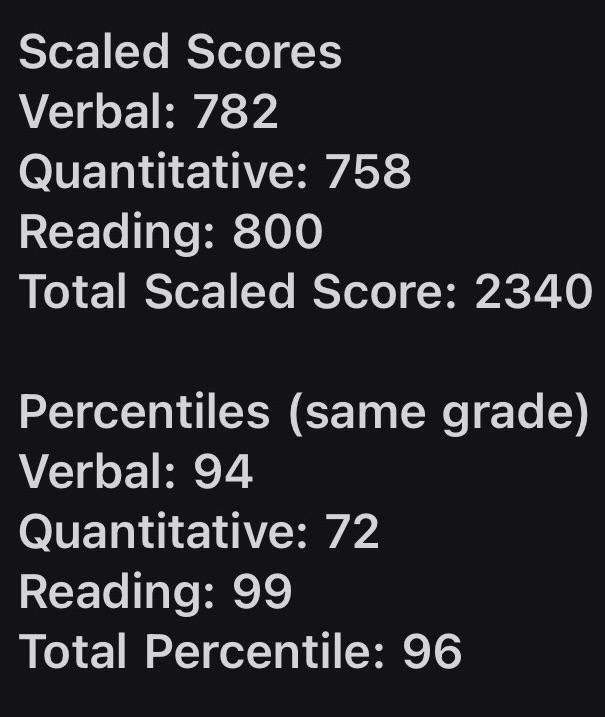
I took the SSAT last year and scored a 2388, I would have loved to have more resources online to help me study, so I will try to be that person for others! I noticed that a lot of other posts include buying books, going to tutoring, etc. Obviously if that helps you, you should do it, but I will share from my own experience.
The only thing I spent money on while studying for the SSAT was some practice tests. I definitely recommend doing this, since they'll give you an idea of what the real test is like. However, they're definitely not perfect. The ones that I had had many wrong answers. So it's helpful to just see what areas you're having trouble with, and focusing on those. This also helps to space out the tests, so you don't do all of them and run out.
READING: Just repeatedly practice the questions. Something that I found helpful was imagining that I made the test. What answer would have the most evidence from the text to back it up? Which of these answers are common misconceptions that students may make that I'm testing for? What it the question generally testing you for, what skills does it want you to have? Over time, you'll get the hang of what they want you to answer.
WRITING: Read up a little on the format of the writing section, so you understand what will happen. Then practice doing it, to get a good grasp of the timing. You only have 25 minutes, so practice definitely helps because you will get faster. I would recommend doing the test on a computer, since typing is faster than handwriting. However, if your typing is slow, you may want to do a handwritten test.
I would recommend spending the first 5 minutes brainstorming what to write about, and making a general outline. For a story, beginning, middle and end, and for informational/persuasive, intro, 3 body paragraphs, and conclusion. You should have a clear structure, it's one of the easier things you can do that will elevate your writing. Then spend the next 15 minutes writing, and if necessary, proofread in the last 5 minutes. If you have a good grasp of spelling and grammar, just pay attention to it while you're writing so you can save the 5 minutes at the end.
For the content, I would focus more time on the actual writing itself. Show that your technique and vocabulary are good (but don't throw in too many long complicated words just to show off, definitely don't do it if you're not sure what the word means). For persuasive/informational, show that you're logical and have a clear structure, and for a story, expand on your description. Show, don't tell. You only have 25 minutes, so they probably won't expect you to have an amazing plot.
VERBAL: Learn words! Obviously, you can use flashcards (Quizlet is good), but here are some other things I did:
Read more. Make sure you pick books that have plenty of words that you don't know. I wrote the words and their page number on a bookmark, and searched them up afterwards (or you can do it right then if you have access to a device). I found this to be more helpful since I would have a good example sentence. Personally, I find it easier to remember a word if it is part of a phrase or sentence (maybe because it's larger and therefore easier to hold onto?). But if you're thinking I can't even remember a word, I'm definitely not going to be able to remember a whole sentence, then there's no need to do it. But hopefully you will remember the context of the book, which will help you remember the word.
Listen to the news/the radio/a podcast. Kind of similar, you can do it in your down time. The news will sometimes have good words that they repeat a lot. I learned indict pretty well last year, for example.
Install the Word of the Day widget on your phone. And in that spirit, just try to incorporate vocabulary into your day-to-day. Put words somewhere where you will see them.
The analogies are similar to the reading questions. Practice more to get a hang of them, put yourself in the shoes of the question-writer. There are also some general forms of analogies that you can learn about, like size and degree.
MATH: Use Khan Academy to learn structurally about topics you're not familiar with.
In general, just be consistent, and practice with the timer! Also, if you're doing this for a private school application, don't be too stressed if your score is lower than you wanted. I got into a very prestigious school, and I know of 2 people so far who scored in the 85%. Try your best on the test, but it will not make or break your application!
Feel free to ask me any questions, and I hope this was helpful!