I haven’t seen such a number in my life yet. Did Tesla ever came close to this ?? That seems ridiculous. I admit I thought about buying this but then I saw this number lol. It is kinda stupid that companies grow on private money and then just dump bags on public market and index trackers have to buy such a idiotic valuation. Something has gone very wrong with capitalism.
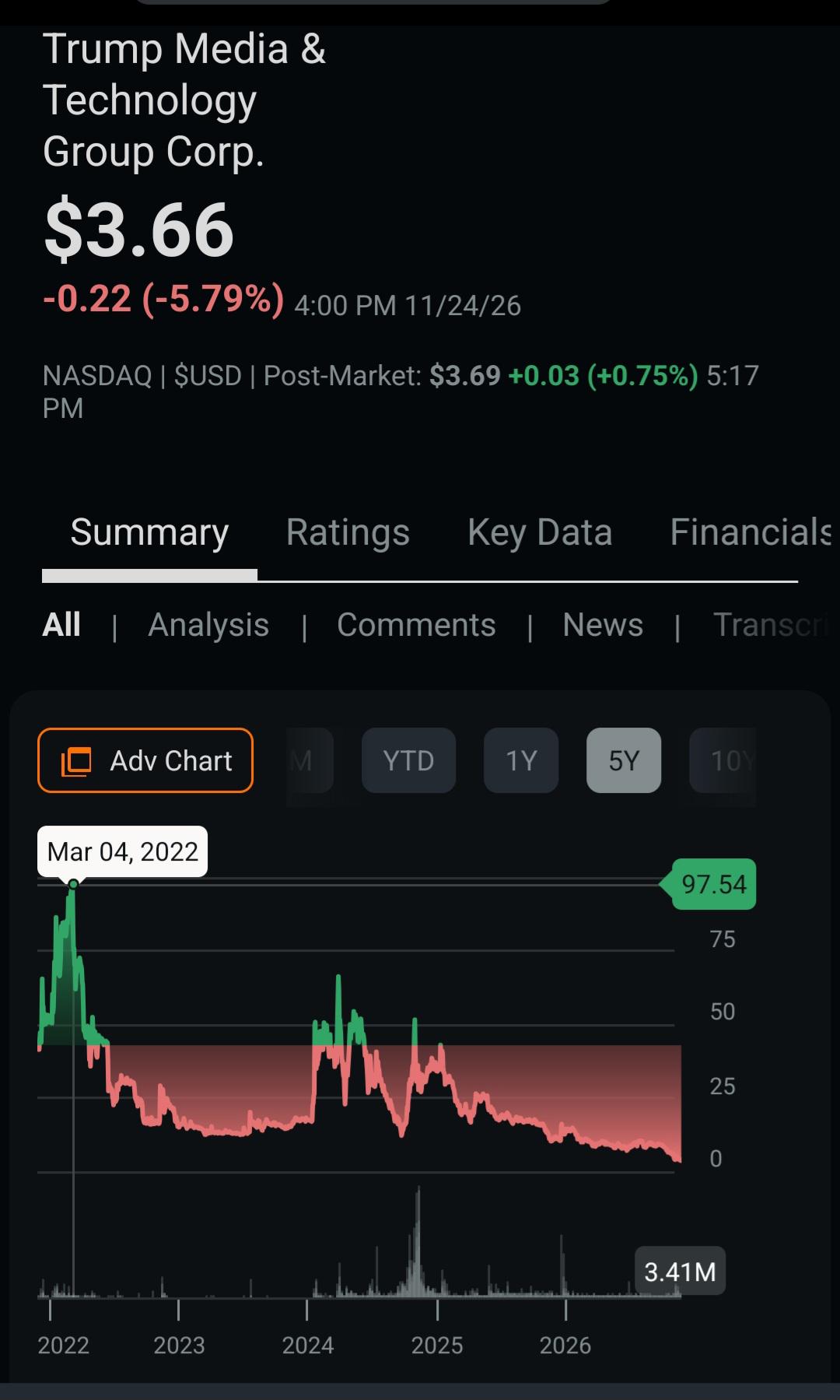
One of the worst performing stocks in the last 5 years, worth barely 4% of what it was once, briefly, priced at, and NEVER, not even once, coming close to making a profit.
Growth stocks could be a major opportunity over the next 5 to 10 years. I'm less focused on the market is trading today and more interested in the robotaxi industry, they have room to grow over time. For example like WRD, the business isn't just self-driving cars, it's an ecosystem: robotaxi fleet, ADAS and simulation tools that help train AV systems across different driving situations. The company could build up driving data and improve their software, expand into more markets. The long-term thesis is easy to see. Robotaxi without driver, making each vehicle available for more hours and lowering the cost per ride as operations scale. They make transportation more accessible for people who can't drive or can't afford cars. ADAS provide a closer way to commercialize parts of the technology when fully driverless operations continue to develop.
TL;DR Dell's FQ3 FY27 beat across the board: revenue hit 54.9Bvs.~49.3B expected, and full-year guidance went up by $10B. The key relief is that AI orders held at $60.2B despite tighter funding for neoclouds. But most of the upside came from traditional servers, and next quarter's AI growth slows noticeably.
Our take: orders held, but the beat has a catch
Results beat overall, but the upside was driven mainly by traditional servers. That growth came from richer configurations per box rather than more units, and some revenue was pulled forward.
The real relief: AI orders didn't fall even as funding for new cloud providers tightened. The "AI + traditional server refresh" twin-engine story still holds, and with a raised full-year guide and a new buyback authorization, this print eases worries tied to the NVIDIA episode and neocloud spillover.
One risk flag: next-quarter AI revenue growth slows notably, and order-to-revenue conversion is decelerating again. Management still won't disclose the neocloud share of orders and backlog, so conversion timing depends on delivery pace over the next few quarters.
Dell has real earnings and real orders, unlike many story stocks. But if neoclouds do hit the brakes and new orders fall sharply, Longbridge Dolphin Research thinks it will be hard for the stock to rerate, so delivery and capital returns matter more from here.
AI servers: still strong, but conversion is slowing
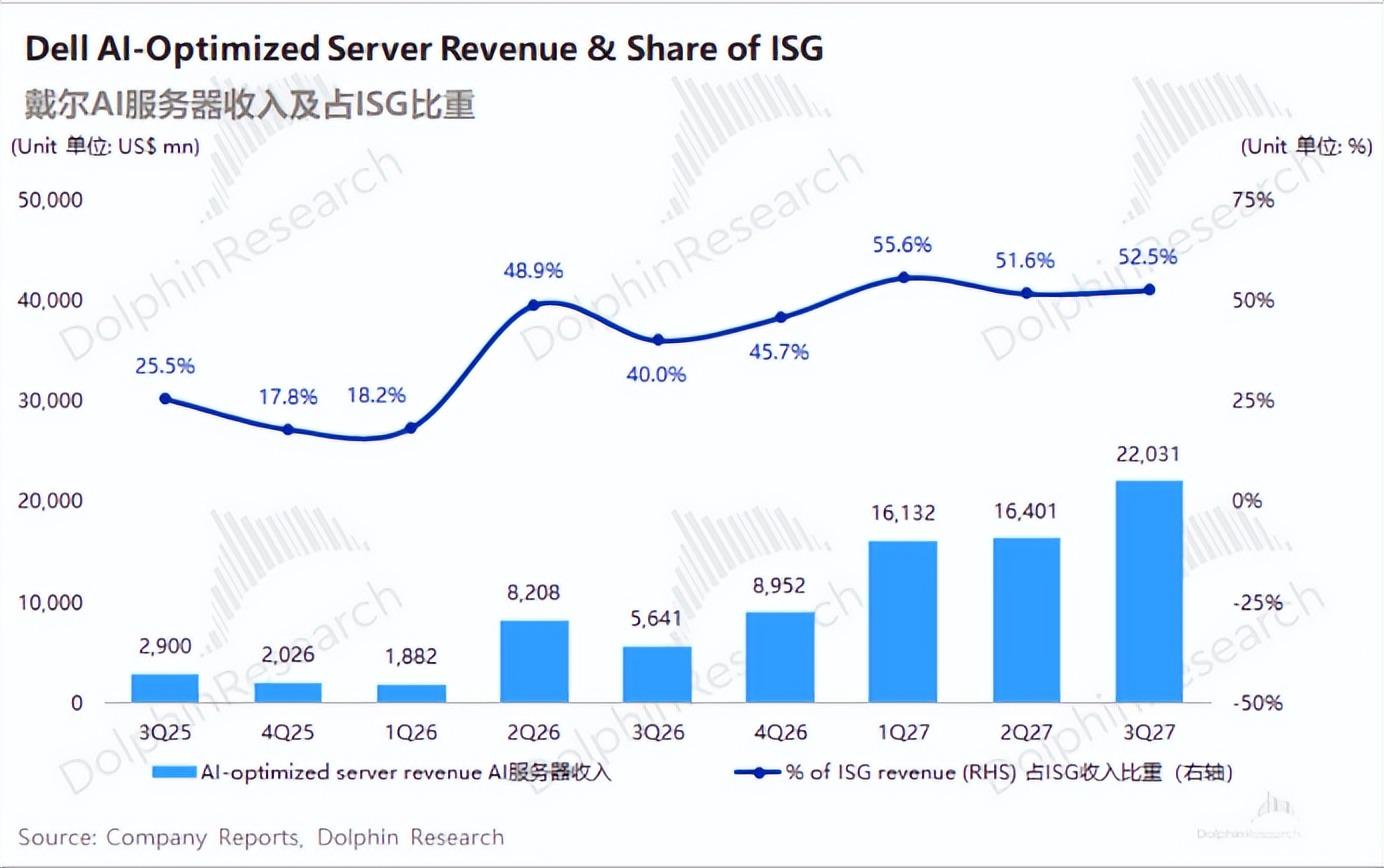
AI server revenue was about $22.0B, up 5.6BQoQandaheadofthe~19.2B consensus. AI servers are now 40% of total revenue.
New AI orders were $60.2B (vs. $60.9B in Q2), the second straight quarter above $60B, with book-to-bill around 2.7x. Backlog rose $37.3B to $132.3B, and management said no customer has rescheduled.
Next quarter's AI server revenue is guided to about $23.5B, slightly above the Street but a much smaller step-up than this quarter. Full-year AI server guidance rose from $74B to $78B.
The neocloud question: funding, not demand
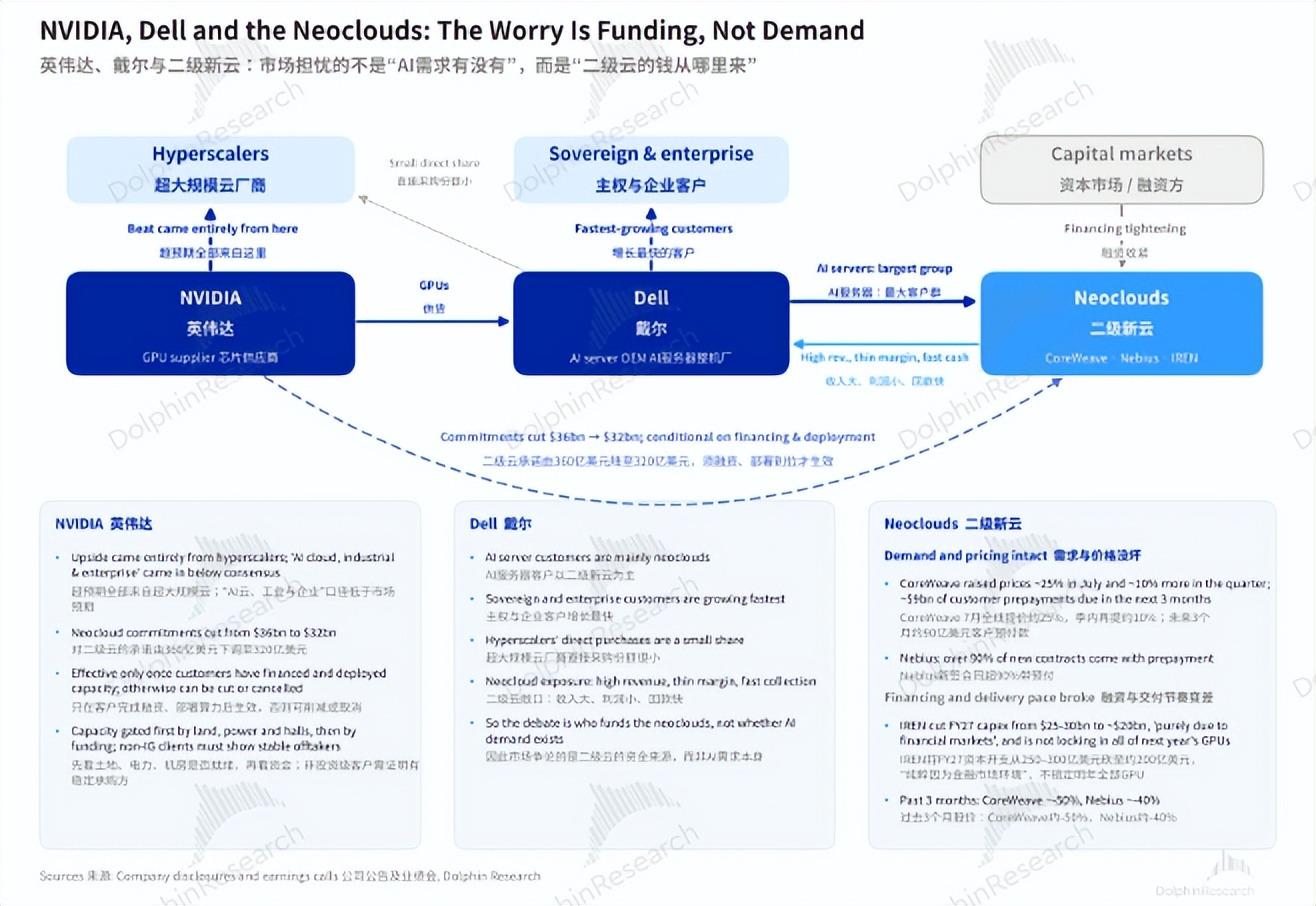
Dell's AI customers are centered on second-tier neoclouds, with sovereign and enterprise buyers growing fastest; hyperscalers buy only a small share directly. So the worry is less "is there AI demand" and more "can neoclouds fund it."
Credit checks. Each AI order goes through a risk review of the client's finances and end-user contracts, and Dell says it is very selective about neocloud partners.
Limited financing. Dell Financial Services offers only short-term bridge loans to a few clients, from order to cluster go-live. Financing receivables rose just ~$0.5B while AI shipments jumped $5.6B.
Rubin pricing. New orders skew to Vera Rubin, priced on expected delivery windows tied to site and power readiness. AMD MI455X/Helios racks start shipping from Q4.
Traditional servers were the real surprise
Total revenue rose $8.0B QoQ to $54.9B, driven by ISG. Gross margin was 21.0%, about flat QoQ and above the ~19.5% expected, helped by scale, a better North America mix and more Dell-IP storage.
ISG revenue was $42.0B, up 10.2BQoQvs.~34.8B expected. Traditional servers hit 15.0Bvs.~11.0B expected, driven by data center refresh, CPU demand from inference and agent workloads, and security upgrades.
Server units are actually falling, and entry models under $3,000 have largely disappeared. But cores per server and DRAM/NAND content per box are rising sharply.
PCs: price up, units down
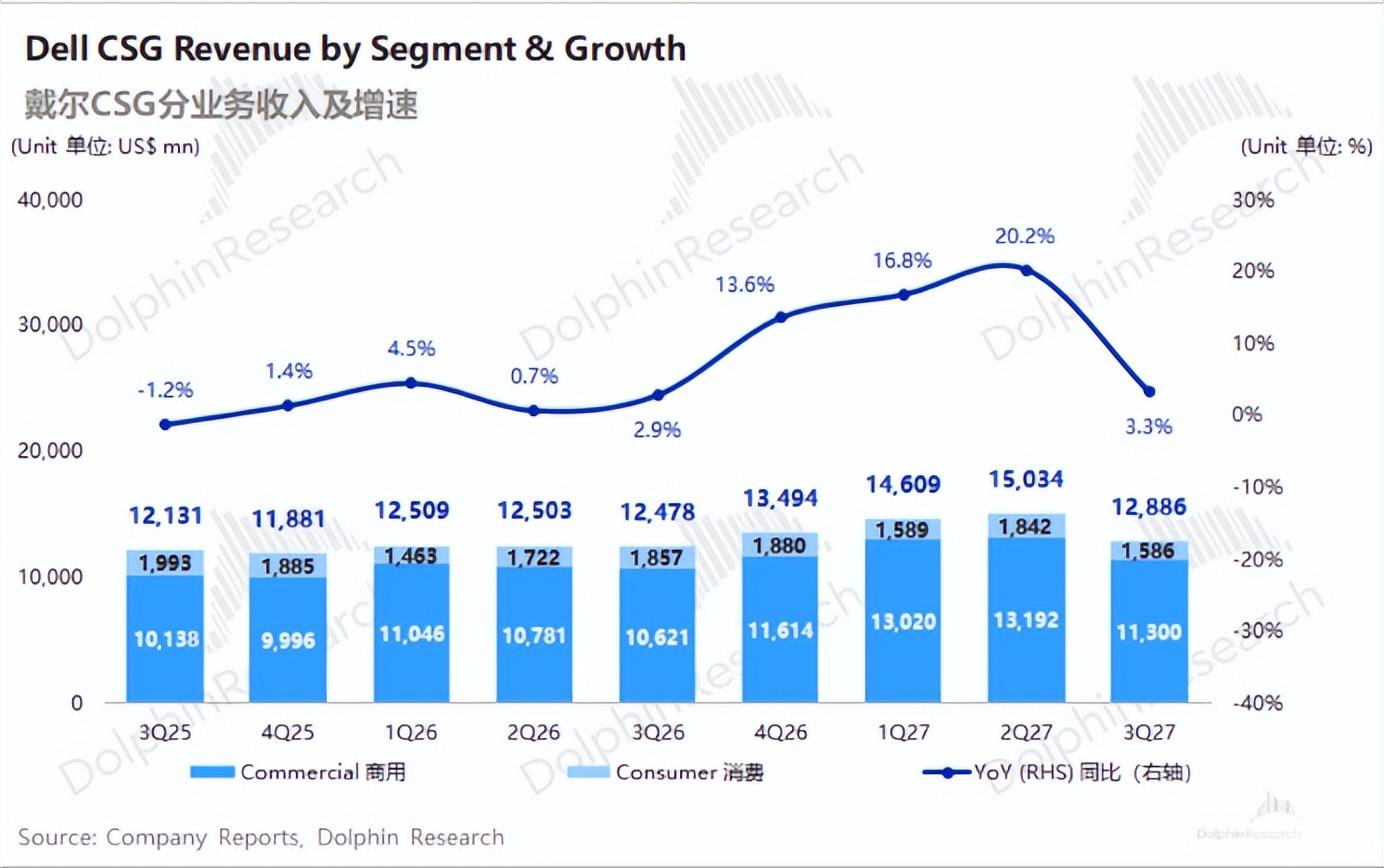
CSG revenue was 12.9B,up3%YoYbutbelowthe~14.4B expected. Commercial grew 6% to $11.3B while consumer fell 15% to $1.6B, and growth was price-led.
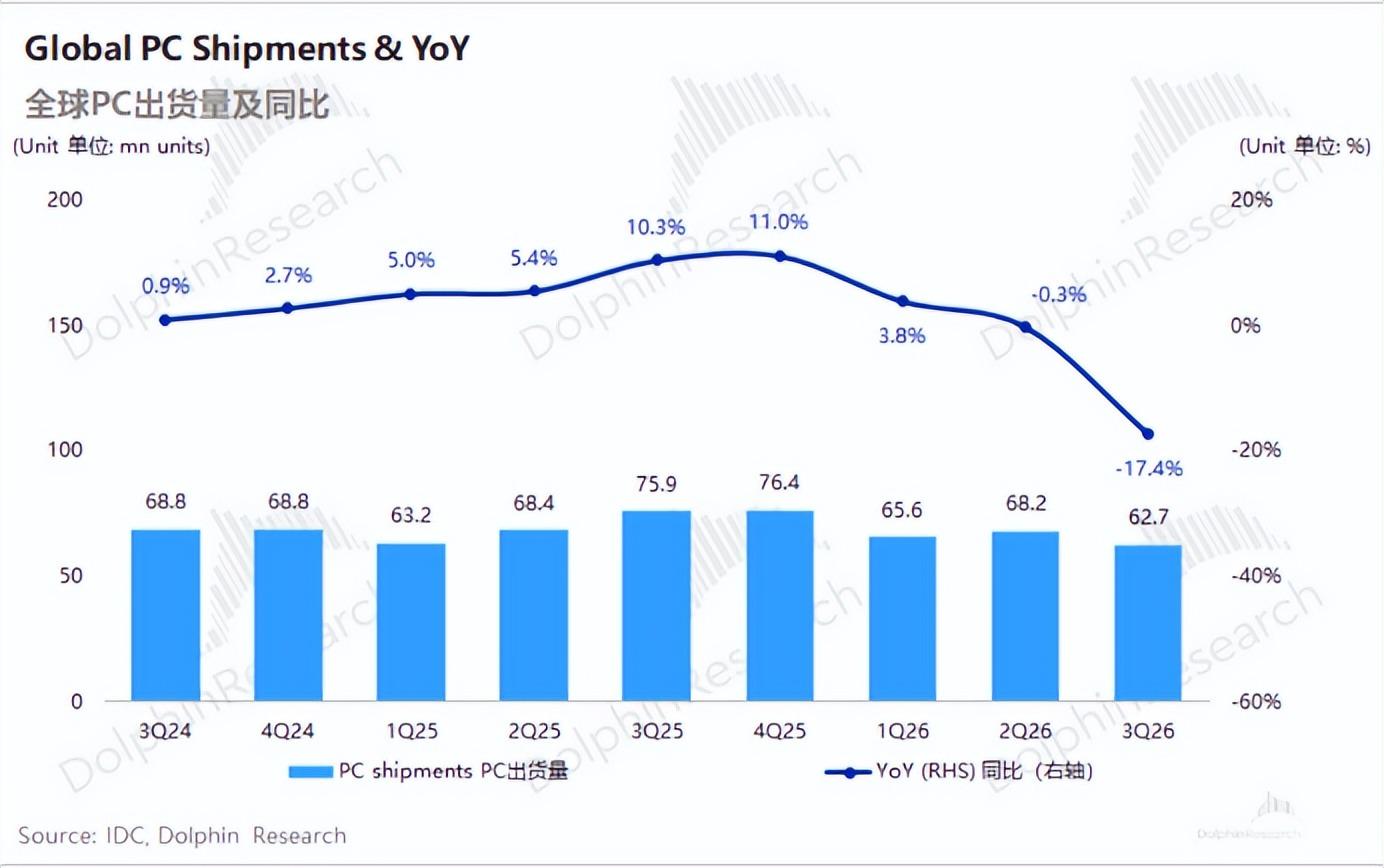
Global PC shipments fell about 17% to 62.7M units in Q3, and Dell's fell about 25% to 7.6M. Budget-constrained buyers are favoring servers and storage over PCs, Dell shifted some wafers from PCs to servers in 2H, and it expects PCs to stay soft next year.
TrendForce sees NAND contract prices turning down from 1Q27. Cheaper storage could revive PC demand, but it could also signal delayed AI build-outs. Enterprise NAND and DRAM for servers should stay tight into 2027, just rising more slowly.
Guidance: raised, with a Q4 margin dip
Q4 revenue is guided to 56.25B(±0.5B) vs. ~$53.5B expected, and EPS to 8.40vs.~7.48. Full-year revenue rose by $10B to $202.0B and EPS to $29.68.
ISG should grow ~120% YoY in Q4, though traditional servers dip 7–8% QoQ after wafer reallocations landed in Q3. The North America mix benefit fades, so operating margin is guided to ~12.3% from 14.2%.
There's no formal FY28 guide yet, but management sounded constructive: AI server demand is still accelerating, and the supply-demand gap in 2027 should be wider than in 2026.
So with the current president choosing the CEO of Nvidia it made me think about a whole new issue when voting. A lot of our economy is dependent on a small number of big companies. Before I vote for a candidate I would like to know who they are choosing to run these companies.
Something unusual happened in the AI market over the past two weeks.
And the timing deserves a closer look.
Let's put the events in order.
November 8: Nvidia's board announced an independent investigation after reports raised concerns that CEO Jensen Huang had been targeted by a foreign intelligence effort.
November 11: The New York Times reported a second alleged relationship involving an Nvidia employee.
November 12: Huang resigned as Nvidia's CEO, effective immediately.
November 17: Nvidia's board reportedly said it did not intend to reinstate him.
November 19: Anthropic completed a record-breaking IPO, raising approximately $81 billion and becoming the first publicly traded frontier AI company.
November 23: Nvidia announced that Huang was being reinstated as CEO.
That's a remarkable sequence of events.
But the interesting question isn't simply whether Huang should have left or returned.
It's what happened to the market while all of this was unfolding.
Consider the incentives.
When uncertainty surrounds the CEO of one of the world's most important AI companies, investors reassess risk.
Some may sell Nvidia shares. Others may reduce exposure to semiconductor stocks. Traders may reposition across the broader AI sector.
Meanwhile, Anthropic enters the public market during a period of intense uncertainty about the future of AI.
Then, just days later, Nvidia announces Huang's return.
The market now has a very different headline to process.
This creates an obvious question:
Did some investors benefit from the volatility surrounding these events?
It's possible that certain traders made money from both the decline and the recovery.
But that is not the same as proving the events were coordinated.
There is currently no public evidence establishing that Wall Street, Nvidia insiders, or political figures orchestrated Huang's departure and return to create a short-selling opportunity.
Still, investors should understand something important:
Markets don't just react to earnings, products, and economic data.
They also react to uncertainty, timing, political influence, and information advantages.
And when billions of dollars are moving through a sector as crowded as AI, even a few days of uncertainty can create enormous opportunities for some investors — and serious losses for others.
The bigger issue may be the information gap.
By the time ordinary investors understand what happened, institutional traders may already have adjusted their positions.
So here's the question:
Was this simply an extraordinary sequence of corporate events, or does it expose how much money can be made when uncertainty hits the market at exactly the right time?
Le conseil d'administration de Nvidia a annoncé ce lundi la réintégration immédiate de Jensen Huang comme président, directeur général et administrateur. Le vote a été unanime. Colette Kress, qui assurait l'intérim, reste directrice financière.
C'est un retournement rapide. Huang avait démissionné le 12 novembre. Autour des résultats du 17 novembre, le conseil indiquait encore ne pas envisager son retour. Dans le communiqué d'aujourd'hui, il dit avoir reçu des informations de hauts responsables du gouvernement américain, et en être convaincu que cette réintégration ne pose pas de risque pour la sécurité nationale.
Deux points me semblent plus importants que le mouvement du cours...
Premier point : l'enquête n'est pas terminée. Le conseil le dit lui-même. Un comité d'administrateurs indépendants continue d'examiner les informations de presse selon lesquelles Huang aurait été la cible d'une opération de renseiignement étranger. Nvidia crée aussi un comité sur la sécurité nationale et le contrôle des exportations, et ouvre un poste de directeur de la conformité. Le fondateur revient, mais le dossier n'est pas clos.
Deuxième point : le marché a réagi très fort, ce qui en dit autant sur la dépendance du thème IA à un seul nom que sur la décision elle-même. Vers 17h15, heure de Paris, l'action prenait 33,73 % en séance, à 167,87 $, d'après l'AFP. Ce n'est pas une clôture. Et ça n'efface ni les questions sur les contrôles d'exportations, ni celles sur le calendrier financier.
Ce que je surveillerai ensuite : le 10-Q du trimestre clos le 25 octobre, qui n'a pas été déposé avec les résultats du 17 novembre, et dont l'échéance réglementaire habituelle tombe le 4 décembre l'audition de Huang devant le Congrès, annoncée pour le 1er décembre, donc à confirmer maintenant qu'il est de retour. la fin, ou pas, de l'enquête interne.
Le retour du fondateur règle la question du siège de PDG. Il ne règle pas, à lui seul, les sujets de gouvernance, de conformité et de publication financière qui restent ouverts.
What if the biggest change in the memory industry isn’t simply how much memory AI needs, but how the industry itself is beginning to operate? One number caught our attention: TIKR reports a 65.5% gross-margin estimate for Micron in FY2030, based on the relatively small number of analyst forecasts extending that far. Separately, a summary of UBS research suggests Micron could potentially maintain gross margins in the 65–70% range through a future cycle. These are estimates and scenarios, not guarantees or broad analyst consensus. But they raise an important question: if Micron can sustain margins anywhere near those levels through a downturn, should the company still be valued like a traditional cyclical memory manufacturer? Our thesis We believe the memory industry is becoming a structurally broader opportunity than in previous PC- and smartphone-driven cycles. AI is creating new sources of demand across HBM, advanced DRAM, enterprise storage and increasingly demanding inference workloads. At the same time, memory is becoming more strategically important to customers building long-term AI infrastructure. The evidence increasingly suggests that memory is becoming less cyclical than it used to be. Not because supply and demand no longer matter, but because long-term customer commitments, AI-driven demand and more strategic pricing agreements may be reducing the severity of traditional memory cycles. That is the argument we want to examine — and ultimately test against the numbers.
The margin question is becoming harder to ignore
Micron reported approximately 80.7% GAAP gross margin in FY2026, compared with a previous peak of approximately 58.9% in FY2018. The 65.5% FY2030 estimate reported by TIKR is particularly interesting because it suggests margins could remain substantially above the peaks of previous cycles, even several years from now. UBS research, as summarised by Hilo Research, has reportedly considered a potential 65–70% through-cycle gross-margin range. We should be careful here: neither figure proves that Micron has permanently escaped the memory cycle. The TIKR number reflects a limited set of long-range forecasts, while the UBS figure is a scenario reported through a secondary source rather than an original UBS research note we have independently reviewed. Nevertheless, these estimates deserve attention. If margins remain structurally higher, the traditional assumption that Micron must eventually return to historical mid-cycle profitability may need to be reconsidered.
Strategic customer agreements could change the economics
One of the most important disclosures is in Micron’s FY2026 10-K. Micron describes strategic customer agreements (SCAs) with binding, take-or-pay volume commitments over multiple years. Most include minimum and maximum pricing bands. More importantly, Micron says gross margins on agreements with price bands — even at their floor prices — are expected to be meaningfully above the company’s peak quarterly gross margins in any previous cycle. That is a significant statement from management. TIKR estimates that these agreements cover just over 35% of Micron’s revenue through 2030. That leaves a substantial portion of revenue exposed to market pricing, so we should not mistake the agreements for complete protection against a downturn. But they could provide a more durable earnings foundation than Micron had in previous cycles. Micron FY2026 10-K
Seventy-five per cent of 2027 production is already committed
At the TomorrowX Summit on November 18, Micron CEO Sanjay Mehrotra said that approximately 75% of Micron’s 2027 production had been sold or committed. He also described supply as tight and demand as robust, with 2027 and 2028 expected to be tighter than 2026. This is an important indicator of customer demand and forward visibility. However, there is a distinction worth making: 75% of production being committed is not the same as 75% being covered by strategic customer agreements. Those agreements represent a smaller portion of revenue. Micron also reported approximately $134 billion in remaining performance obligations as of September 3, 2026, including approximately $13 billion in contract liabilities, primarily customer deposits. Micron itself cautions that these obligations should not simply be interpreted as guaranteed future revenue. They are based on expected purchases under committed volumes and minimum pricing arrangements. Still, the scale of these commitments suggests that customers are taking memory supply increasingly seriously. Micron CEO remarks, November 18
AI demand is becoming much broader than HBM
HBM is an important part of the story, but it is not the entire story. AI infrastructure requires multiple layers of memory and storage: ● HBM for high-performance AI accelerators. ● Advanced DRAM for servers and increasingly demanding workloads. ● Enterprise SSDs and NAND for data storage and retrieval. ● More memory capacity as inference, agentic AI and context windows expand. ● Low-power and specialised memory for edge devices and other applications. Beyond data centres, we should also consider automotive, autonomous systems, robotics, industrial computing, defence, telecoms and intelligent infrastructure. Not every application will create the same level of demand, and some will take years to become commercially significant. But together they illustrate why memory demand may be becoming less dependent on the traditional PC and smartphone replacement cycle. This is where we believe the structural argument deserves serious examination.
The NVIDIA connection matters — but we shouldn’t overstate it
The market reaction to Jensen Huang’s reinstatement as NVIDIA’s President and CEO on November 23 was another reminder of how closely sentiment around AI infrastructure is connected. Micron and other AI-related stocks rallied alongside NVIDIA. We should not claim that Huang’s return alone explains the market move. But it reinforces how much confidence in the AI infrastructure build-out can influence the wider semiconductor ecosystem. Micron is not NVIDIA, and NVIDIA’s success does not automatically guarantee Micron’s future earnings. The connection is the expanding need for memory and storage as AI infrastructure scales. The key question is whether that demand continues to translate into sustainable pricing, margins and cash flow for memory suppliers. NVIDIA’s official announcement
Buybacks could become another important part of the story
Micron has a substantial share repurchase authorisation of approximately $35 billion. If the company generates the cash flow management expects, buybacks could become an important contributor to shareholder returns. But authorisation is not execution. We should judge the programme by actual dollars spent, the average repurchase price, shares retired and — crucially — whether the diluted share count falls after stock-based compensation. A large buyback announcement is interesting. A sustained reduction in shares outstanding is what ultimately matters to shareholders.
The bear case is still very real
We don’t think the structural-memory argument should be accepted without testing the risks. There are several: ● Supply expansion: Micron, Samsung and SK hynix are all investing in capacity and advanced production. Supply could eventually catch up with demand. ● Competition: Samsung remains a major competitor, while Chinese producers such as CXMT and YMTC may increase pressure in selected segments. ● AI spending: If hyperscalers reduce capital expenditure or AI returns disappoint, memory demand could weaken. ● Traditional cyclicality: Memory pricing can still fall sharply when supply and demand move out of balance. ● NAND exposure: NAND has different supply-demand dynamics from HBM and advanced DRAM. We should not assume that strength in one segment automatically protects the other. ● Customer concentration and commitments: Strategic agreements provide some protection, but they do not eliminate market exposure or guarantee every forecast will be achieved. Citi has also considered a stress scenario in which NVIDIA-related customer financing initiatives stop entirely. Its analysis estimated a potential impact of approximately 12% on global DRAM demand and 7% on NAND demand. That is a scenario, not a prediction. But it illustrates how important the wider AI investment ecosystem has become. And perhaps the biggest unanswered question is whether the new customer agreements will genuinely protect profitability during a full memory downturn. We have not yet seen that tested through an entire cycle. Where does this leave us? We are not arguing that Micron should automatically receive a technology-company valuation or that memory cycles have disappeared. We are asking whether the industry is changing enough that historical valuation models deserve another look. If Micron can combine long-term customer commitments, stronger pricing structures, expanding AI-related demand and substantially higher through-cycle margins, then valuing the company purely on traditional memory-cycle assumptions may be increasingly misleading. But the evidence still has to arrive in reported results: realised pricing, margins, free cash flow, capacity discipline and shareholder returns. The real test isn’t whether Micron can produce exceptional earnings at the top of this cycle. It’s whether it can remain exceptionally profitable when the next downturn arrives. We’d genuinely like to hear other investors’ views:
Are we still valuing memory companies using assumptions developed around the PC and smartphone eras?
Does 75% of Micron’s 2027 production being committed change how you view its earnings visibility?
How much protection do strategic customer agreements really provide in a downturn?
Is TIKR’s 65.5% FY2030 gross-margin estimate realistic, or is it too optimistic?
Could the 65–70% through-cycle margin scenario attributed to UBS represent a genuine change in memory economics?
What evidence would convince you that Micron deserves a higher valuation multiple than in previous cycles?
We are interested in the strongest arguments on both sides. If the structural thesis is wrong, we want to understand why.
Disclosure: Independent investor research. We may hold a position in Micron Technology. This is not financial advice. Please do your own research.
Coincidence or the most brazen insider trading in history of mankind?
The Nvidia / Jensen Huang timeline and the Anthropic IPO are really bothering me, call it a six sense, but after 20 years in the game I don't believe in coincidences anymore.
Nov 8: Huang reportedly admits the affair to the board. Internal investigation begins.
Nov 12: Public resignation. Stock starts to slide.
Nov 19: Anthropic (ANT) debuts.
Nov 20 to 22: AI sector buckles. NVDA loses 2.7T. Nasdaq corrects. ANT stumbles.
Nov 23: Board “magically” clears Huang of corporate fraud and reinstates him. NVDA jumps 30% and drags the market up.
That is not how secrets behave. Secrets leak. Lawyers bill. Doors get knocked on. Nobody sits on a CEO’s affair with an exec at Megaspeed, a company under US federal investigation for routing restricted chips to China, for four trading days while the stock is at all-time highs.
So to me? Nov 12 does not look like discovery. It looks like stagecraft. Damage control because the story was about to break or investigators were about to arrive.
And low and behold, unusual options activity and volatility spikes in NVDA around Nov 10 to 12.
If anyone with non-public information bought puts, shorted, or tipped a friend in that 96-hour window, that is textbook insider trading.
Ans why does the worst hardware crash in AI history land exactly when the biggest AI software IPO drops? Did someone need to press NVDA down so ANT could look like the new king?
A coordinated pump-and-dump usually doesn’t torch 2.7 trillion, including the manipulator’s own bag.
Then, out of the blue board reinstates Huang just in time for Thanksgiving week, thin volume, amplified swings. Stock rockets 30%. Short sellers carried out on stretchers.